


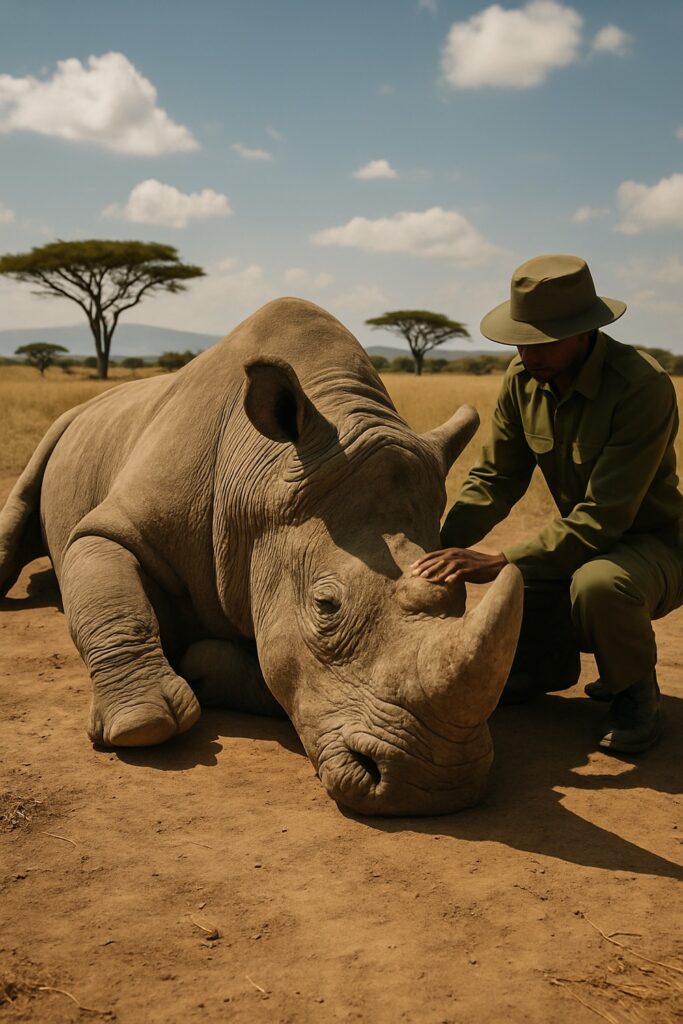
Two animals. Same species. Both female. That’s the entire population of northern white rhinos left on Earth, and the only reason it isn’t zero is that a team of scientists, rangers, and one very specific freezer in a laboratory are working around the clock to make sure it stays at two — for now.
On March 19, 2018, a 45-year-old rhino named Sudan lay down in the grass at Ol Pejeta Conservancy in Kenya and didn’t get back up. He was the last male northern white rhino on Earth. What he left behind wasn’t just grief — it was a biological situation that has no real precedent, and that scientists are now racing to reverse before the window closes entirely.
Northern White Rhino Extinction: How Two Survived
Najin and her daughter Fatu are it. The whole species. They live inside a fenced sanctuary at Ol Pejeta Conservancy, surrounded by armed rangers every hour of every day — not as a spectacle, but because that’s the only reason they’re still breathing. Researchers like Dr. Thomas Hildebrandt of the Leibniz Institute for Zoo and Wildlife Research have spent years studying their biology, trying to find some way to pull a species back from an edge it’s already half-fallen off. The question isn’t just whether it’s scientifically possible. It’s whether it’ll happen fast enough to matter.
Two animals. One lineage. Millions of years of evolutionary memory — concentrated, right now, in two individuals grazing inside a fence in Kenya.
Poaching Did What Ice Ages Could Not
This is the part that keeps stopping me cold. Northern white rhinos survived the last ice age. They outlasted sabertooth cats and woolly mammoths and walked through tens of thousands of years of drought, flood, volcanic eruption, and continental upheaval. They made it through all of that. Then, in the span of a single human lifetime, their numbers collapsed from thousands to single digits.
Poaching for horn — combined with agricultural expansion and political instability across central Africa — reduced the species to just three individuals by 2015. Three. On the entire planet.
The horn trade drove most of it. Rhino horn sells for more per kilogram than gold on illegal markets, used in traditional medicine despite having zero proven medical value. It’s keratin. Chemically identical to your fingernails. And a species that survived the Pleistocene paid for that myth with its existence.
That last fact kept me reading for another hour.
The Rangers Who Guard the Last Two
At Ol Pejeta, protecting the last two members of a species looks like armed rangers running rotating shifts, 24 hours a day, every single day of the year. Najin and Fatu don’t wander freely — their range is managed, monitored, and locked down in a way that most heads of state would envy. You can read more about the people doing this work at this-amazing-world.com, where stories like this one sit alongside others that are honestly just as urgent.
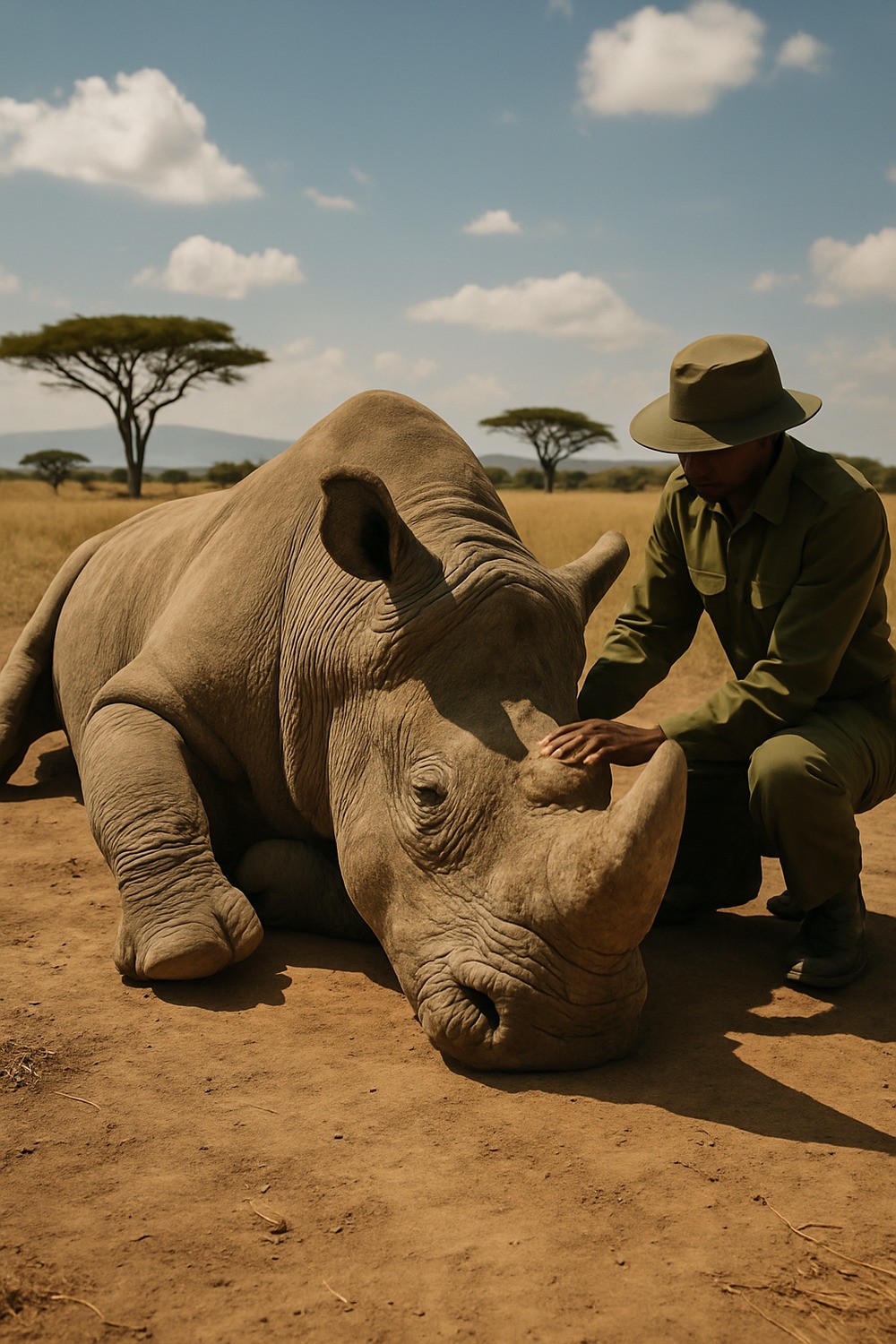
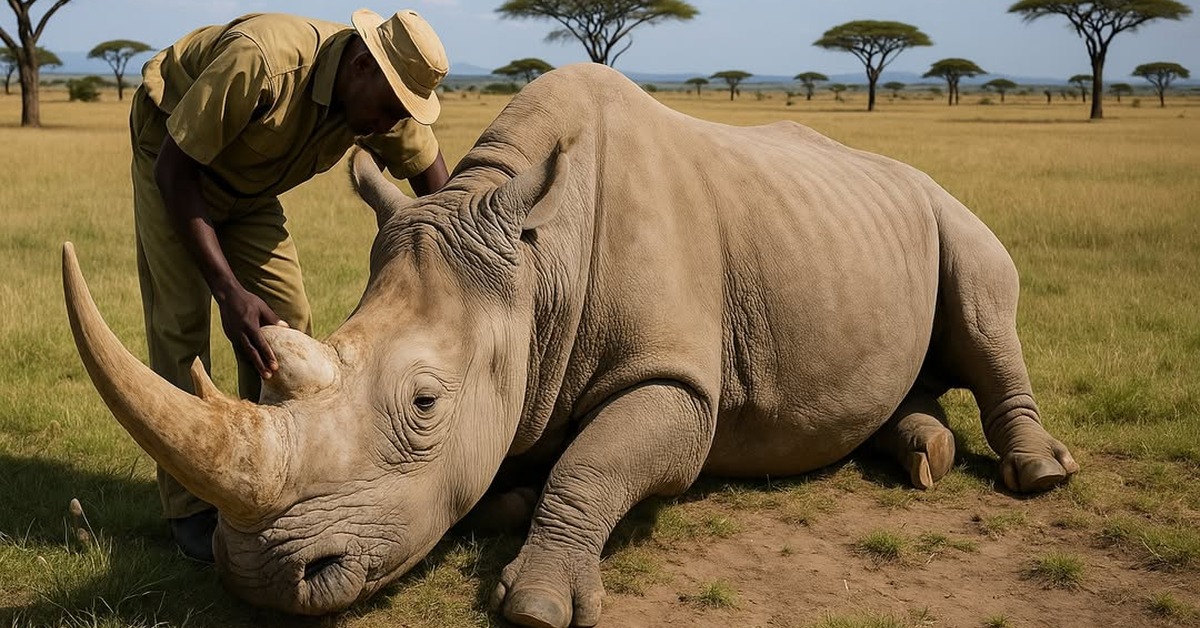
The rangers know these animals by name. By sound. By the specific way each one moves through the grass in the morning. There’s something quietly devastating about watching a person carrying a rifle stand guard so that two animals can simply graze. Simply exist. It’s protection stripped to its absolute bones.
A Laboratory Is Their Only Path Forward Now
Neither Najin nor Fatu can carry a pregnancy. Najin has leg problems that make gestation dangerous. Fatu has uterine abnormalities that rule it out entirely. So even if scientists successfully fertilize their eggs — using Sudan’s cryopreserved sperm, collected before his death — the embryos would need to be implanted into southern white rhino surrogates. It’s never been done before. Not in rhinos. Not at this level of genetic complexity.
The northern white rhino extinction timeline is being fought inside a petri dish.
The first viable northern white rhino embryos were created in 2019, which was genuinely a breakthrough. But creating an embryo and successfully bringing a calf to term through a surrogate are two completely different problems. That second part? Nobody’s cracked it yet.

The Science Is Extraordinary — And Completely Unproven
The technology being used here didn’t exist ten years ago. Techniques like induced pluripotent stem cells — essentially reprogramming skin cells to behave like reproductive cells — are being explored as a way to generate more genetic diversity, since only a handful of individuals’ DNA is available to work with. Turns out the science of de-extinction-adjacent conservation has moved faster than almost anyone expected, driven almost entirely by cases exactly like this one.
But urgency and success aren’t the same thing.
Every step in this process — egg retrieval from a living rhino, fertilization, embryo cryopreservation, surrogate implantation, full gestation — has to work. All of it, in sequence, with an animal that’s never carried another subspecies’ calf before. The margin for error is essentially zero. And the clock is running in one direction only.
By the Numbers
- Approximately 2,000 northern white rhinos lived in the wild in the 1960s. By 2008, according to the WWF, that number had fallen to just 8 individuals — a collapse that happened almost entirely within a single human lifetime.
- Rhino horn: up to $60,000 per kilogram on black markets.
- Sudan was 45 when he died — elderly for a rhino, whose average lifespan in protected environments runs somewhere between 40 and 50 years.
- Southern white rhinos, the closest living relatives and the most likely surrogate candidates, rebounded from fewer than 50 individuals in the late 1800s to over 20,000 today. That recovery is one of conservation’s genuinely rare success stories — and it’s also the reason scientists think assisted reproduction might work here, if enough pieces fall into place in time.

Field Notes
- Najin was born at the Dvůr Králové Zoo in the Czech Republic in 1989. She has never lived wild.
- Scientists have successfully retrieved eggs from both Najin and Fatu using a procedure adapted from horse reproductive medicine — each retrieval is genuinely risky for the animals, and nothing about it is routine.
- The northern white rhino’s closest living relative — the southern white rhino — was itself nearly extinct in the late 19th century. Their recovery is part of why anyone believes this next attempt might work at all.
What We Lose When a Species Goes Silent
The northern white rhino extinction isn’t only a conservation tragedy — it’s an information loss. Permanent, irreversible information loss. Every species carries biological data refined across millions of years of evolution: disease resistances, ecological relationships, behavioral adaptations that shaped entire ecosystems around them. When a species disappears, that data is gone. We don’t always know what we’ve lost until we need it. With rhinos specifically, researchers are still only beginning to understand the role they played in shaping the grasslands they grazed for millennia.
Najin and Fatu aren’t symbols. They’re individuals. Najin is in her mid-thirties. Fatu is in her twenties. They have preferences, routines, and daily behaviors that the rangers around them know by heart. The weight of what they represent sits entirely outside their awareness.
They’re just living.
That’s the part that’s genuinely hardest to sit with.
For millions of years, the northern white rhino held on through everything the planet threw at it. We gave it less than a century to disappear — and now a small group of scientists and rangers are trying to buy back what was spent so carelessly. Whether they succeed or not, the story of Najin and Fatu deserves to be known. If this kind of story keeps you up at night, there’s more waiting at this-amazing-world.com — and some of it is even stranger than this.


