


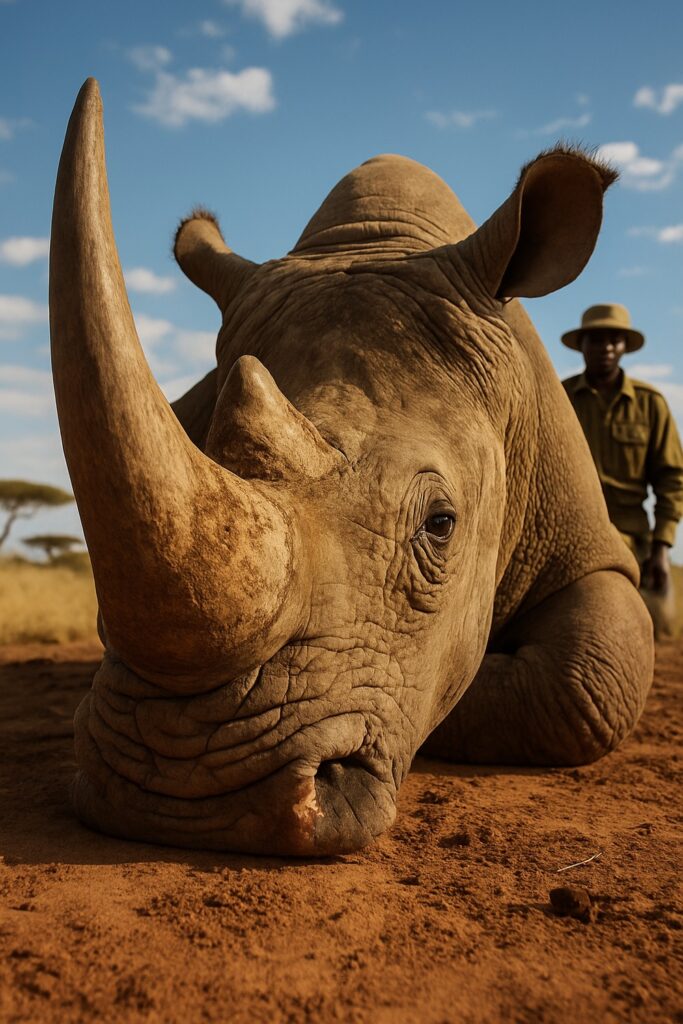
Here’s the thing about northern white rhino extinction — it doesn’t announce itself. It just keeps happening, one animal at a time, until the count reaches two. Both female. Both alive only because armed rangers rotate through eight-hour shifts on the Kenyan savanna, rifles ready, watching grass that once held thousands of the same animal.
Sudan died on March 19, 2018, at Ol Pejeta Conservancy in Kenya. He was 45 years old, arthritic, and the last male northern white rhino on the planet. When the veterinary team made the decision to euthanize him, a genetic lineage that had survived ice ages, continental shifts, and tens of thousands of years of ecological upheaval simply ended. What remained were his daughter Najin, her daughter Fatu, and a question that no one in conservation had ever faced quite this directly: can science do what nature no longer can?

How a Species Walked to the Edge of Extinction
Ceratotherium simum cottoni — the northern white rhino — once ranged across a vast corridor of central Africa, from Chad and the Central African Republic down through Uganda, the Democratic Republic of Congo, and into Sudan. Not a pocket of habitat. A continent’s worth of grassland and woodland, supporting a population that, as recently as the 1960s, numbered around 2,000 individuals. According to records compiled on the northern white rhinoceros, relentless poaching for horn — driven by demand across Asia and parts of the Middle East — combined with decades of civil conflict across central Africa, made coordinated protection nearly impossible. By the 1980s, rangers were outgunned. By the 1990s, the animals were disappearing faster than censuses could track them.
Agricultural expansion compounded the crisis. As human populations grew across Uganda and the DRC, habitat fragmentation cut populations off from one another. Small groups couldn’t recover. Females that might have bred with males from neighboring territories found those territories gone — replaced by farms, roads, and settlements. The math became brutal. A species that reproduces slowly, with a gestation period of 16 months and typically one calf at a time, cannot outrun a poaching rate that removes adults faster than calves mature.
By 2008, the northern white rhino was declared extinct in the wild. Four animals survived in captivity at that point. Then three. Then, after Sudan’s death, two. The speed of the collapse — from 2,000 animals to functionally zero in roughly 60 years — is the kind of statistic that stops conversations. It should stop them more often than it does.
The Last Two and the Guards Who Keep Them Alive
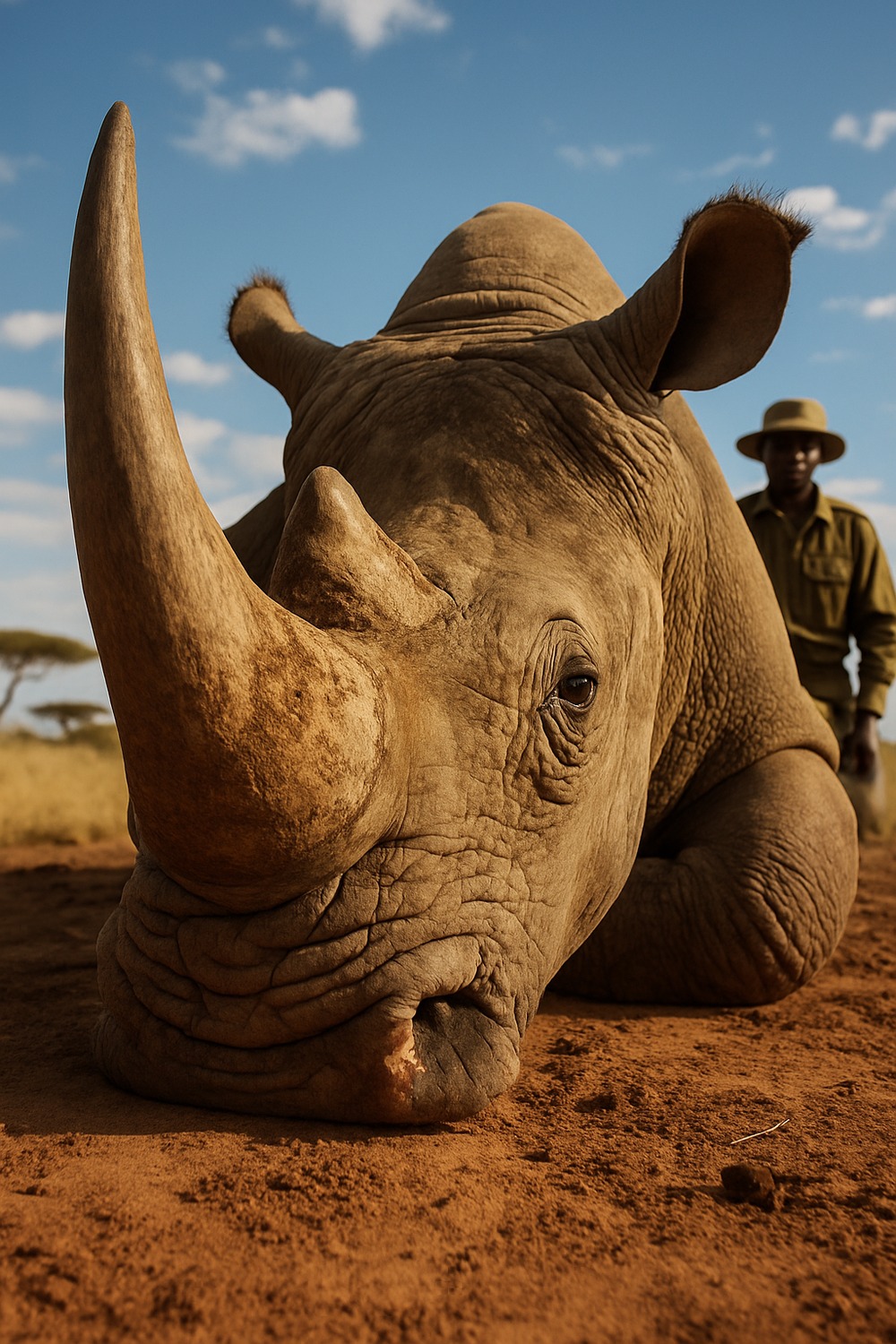
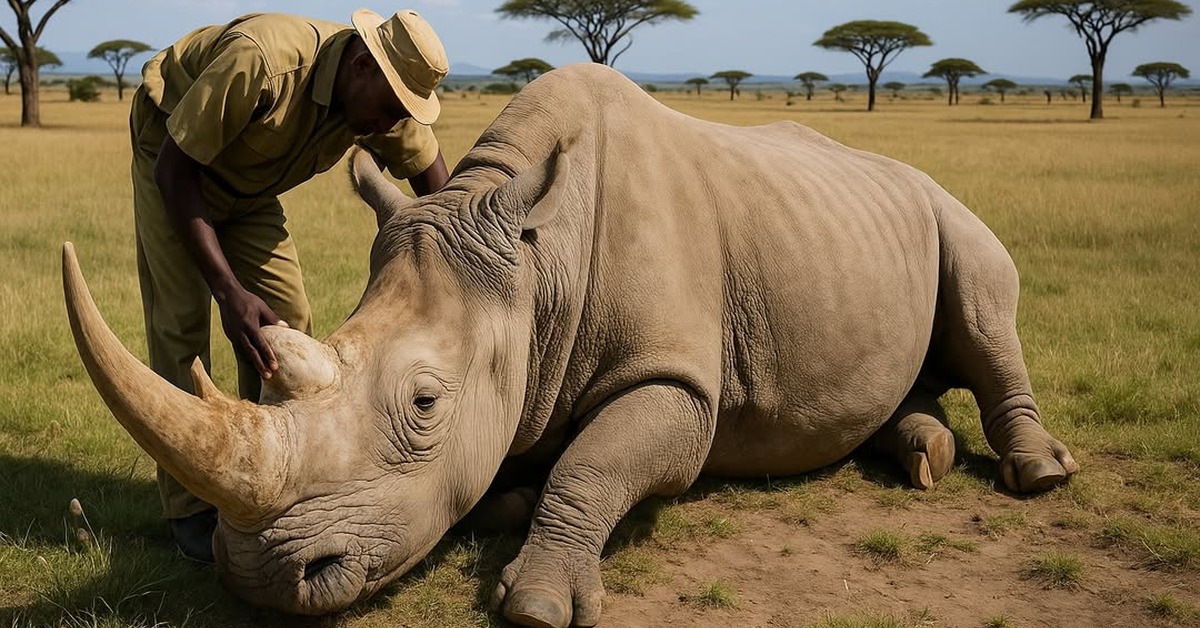
Najin is in her mid-thirties. Fatu, her daughter, is in her mid-twenties. Both live within a protected enclosure at Ol Pejeta Conservancy in Kenya’s Laikipia County — open savanna where they graze, mud-wallow, and move through their days under a vigil that the rangers assigned to them treat as something closer to a calling than a job. The story of what happens when an entire species is reduced to two individuals is also, unavoidably, a story about the people who refuse to let those two slip away quietly. If you want to understand what that vigil looks like up close, the full account of Sudan’s final days is told in the story of the last male northern white rhino at Ol Pejeta — worth reading before you go further here.
The armed protection isn’t ceremonial. Rhino horn remains one of the most valuable commodities on the black market, fetching prices that rival gold by weight. In 2022, the Wildlife Justice Commission estimated the street value of rhino horn at between $60,000 and $100,000 per kilogram in some Asian markets. Even a functionally extinct subspecies isn’t safe from that kind of economic pressure. Poachers don’t distinguish between a species with thousands of individuals and one with two.
Najin and Fatu recognize their rangers. That’s not anthropomorphism — it’s behavior documented by the Ol Pejeta team over years of daily contact. In a situation this fragile, that trust is one of the few things that feels, against all logic, like hope.
The Lab That Might Reverse the Irreversible
Why does this moment in the science matter? Because in 2019, a team led by researchers at the Leibniz Institute for Zoo and Wildlife Research in Berlin — working with the Italian reproductive medicine company Avantea and Ol Pejeta Conservancy — announced something that rewrote what anyone thought was possible: they had successfully created northern white rhino embryos in a laboratory. Using eggs harvested from Fatu and Najin, fertilized with frozen sperm collected from Sudan and another male named Suni before their deaths, the team produced viable embryos that were cryopreserved for future transfer. As published in Nature Communications, the procedure required adapting protocols developed for southern white rhinos — the northern subspecies had never been subjected to this kind of assisted reproduction before. The team succeeded on their third harvesting attempt. That detail matters. It means the first two failed.
The northern white rhino extinction timeline makes this science uniquely urgent. Embryos from ongoing procedures are now being prepared for implantation into southern white rhino surrogates — the closest living relatives, with reproductive biology similar enough to make surrogacy theoretically viable. No northern white rhino embryo has yet been carried to term by a surrogate. The science is real. The embryos exist. But the bridge between a cryopreserved cell cluster and a living calf standing on Kenyan grass is still unbuilt.
Underneath the science, a harder question waits. Even if a calf is born, it’s genetically limited — the diversity contained in Sudan’s sperm and two living females doesn’t represent the full breadth of what the subspecies once was. Researchers at the Leibniz Institute are also working to develop stem-cell-derived gametes (researchers actually call this induced pluripotent stem cell reprogramming) — essentially creating eggs and sperm from skin cells donated by twelve northern white rhinos before they died. That project could, in theory, restore enough genetic diversity to sustain a future population. Whether “in theory” becomes “in practice” is what the next decade will determine.
What Northern White Rhino Extinction Means for Conservation Science
Northern white rhinos have become a reference point — uncomfortable but clarifying — for the entire field of conservation biology. The Zoological Society of London, which tracks species vulnerability through its EDGE of Existence programme, uses northern white rhinos as a benchmark for what happens when intervention comes too late for conventional methods but perhaps not too late for biotechnology. That distinction matters enormously. It forces conservationists, policymakers, and funders to ask whether de-extinction science should be treated as a legitimate conservation tool rather than a last resort that arrives too late. In 2021, BioRescue — the international consortium leading the assisted reproduction effort — received renewed EU funding specifically because the northern white rhino project had demonstrated that IVF procedures in large wild-type mammals were more viable than previously assumed.
What’s counterintuitive here is that northern white rhino extinction, in a strange and painful way, has accelerated the science that might prevent the next one. The techniques developed for Najin and Fatu — oocyte aspiration in large terrestrial mammals, embryo cryopreservation, cross-subspecies surrogate preparation — are now being studied for application to the Javan rhino, the Sumatran rhino, species still counted in dozens rather than twos. The laboratory built around failure is being handed to animals that still have time.
Watching a species contract from 2,000 individuals to two in a single human lifetime, you stop calling it a tragedy of circumstance — it was a series of choices, most of them about money and politics, that science is now being asked to undo.
That doesn’t soften what was lost. Sudan represented a genetic library that no sequencing project can fully reconstruct. Behaviors, adaptations, decades of learned territory knowledge — those don’t transfer through embryos. What’s coming, if it comes, will be a biological approximation of something that existed in full.
The Poaching Economy That Built This Crisis
Following the money is the only way to understand how two animals came to represent an entire subspecies. Rhino horn is composed of keratin — the same protein that makes up human fingernails. It has no verified medicinal properties. And yet, demand across Vietnamese and Chinese markets, where it’s been marketed as a cure for everything from hangovers to cancer, created a black-market economy estimated by TRAFFIC, the wildlife trade monitoring network, to have driven rhino poaching across Africa to record levels between 2007 and 2015. South Africa alone reported 1,215 rhino poachings in 2014. Northern white rhinos, already critically small in number and living across some of the least-policed terrain on Earth, had no buffer against that pressure.
The crisis wasn’t uniform — it was specifically concentrated in regions with weak governance infrastructure, exactly where the last wild northern white rhinos happened to live. Garamba National Park in the DRC was the final stronghold for wild individuals. By 2005, aerial surveys found fewer than ten animals there. Armed militias, some linked to the Lord’s Resistance Army, operated in the same territory as the last wild population, and conservation rangers faced gunfire, not just poachers. By 2008, African Parks declared the wild population functionally gone, and the decision to relocate the remaining captive animals to Ol Pejeta in 2009 came down to a single calculation: Kenya offered what Garamba couldn’t — a stable political environment and armed protection with actual institutional backing.
And today, anti-poaching technology at Ol Pejeta includes thermal imaging drones, GPS collar monitoring, and a ranger network operating on rotating eight-hour shifts. The cost of protecting two animals at this level runs into hundreds of thousands of dollars annually. That figure is simultaneously staggering and completely beside the point. There’s no version of this story where the money isn’t spent.

How It Unfolded
- 1960s — An estimated 2,000 northern white rhinos ranged across central Africa, representing the subspecies at its last known population peak.
- 1984 — Poaching-driven collapse reduced the wild population to fewer than 15 individuals across their entire historical range.
- 2009 — The last four surviving northern white rhinos were transferred from Dvůr Králové Zoo in the Czech Republic to Ol Pejeta Conservancy in Kenya, marking the end of any meaningful wild presence.
- 2019 — BioRescue announced the first successfully created northern white rhino embryos using IVF, offering the first scientifically credible path toward a future calf.
By the Numbers
- 2 — Living northern white rhinos remaining as of 2024, both female, both at Ol Pejeta Conservancy, Kenya (BioRescue / Ol Pejeta).
- 2,000 — Estimated population of northern white rhinos in the 1960s, before the poaching crisis accelerated through the 1970s and 1980s.
- $60,000–$100,000 per kilogram — Estimated black-market street value of rhino horn in some Asian markets (Wildlife Justice Commission, 2022).
- 16 months — Gestation period of a white rhino, meaning even a successful surrogate pregnancy requires more than a year before a calf is born.
- 12 — Northern white rhinos that donated tissue samples before death, providing the genetic material for stem-cell-derived gamete research at the Leibniz Institute for Zoo and Wildlife Research.
Field Notes
- Fatu is considered the stronger candidate for egg harvesting because Najin has hind-leg weakness that makes the sedation required for oocyte aspiration riskier for her — a detail the BioRescue team disclosed in 2020 that reframed how many viable eggs the program could realistically collect.
- Sudan’s sperm was collected and cryopreserved years before his death, while he was still healthy enough to provide high-quality samples — a decision made in the late 2000s that now represents the entire paternal genetic contribution to any future northern white rhino population.
- Southern white rhinos, the proposed surrogate species, share approximately 99.7% of their genome with northern white rhinos — close enough for surrogate pregnancy to be plausible, different enough that researchers can’t assume the physiology is identical in every reproductive detail.
- Researchers still don’t know whether a northern white rhino calf raised by a southern white rhino surrogate will develop species-typical social and foraging behaviors — or whether the absence of a northern white rhino mother creates behavioral gaps that can’t be filled. It’s a question that won’t have an answer until a calf actually exists.
Frequently Asked Questions
Q: Is northern white rhino extinction truly irreversible, or can science bring them back?
Northern white rhino extinction as a wild, self-sustaining population is functionally complete — no wild individuals remain. Viable embryos were created by the BioRescue consortium using IVF in 2019, and researchers are working toward implanting them in southern white rhino surrogates. A biological population may eventually be restored, but genetic diversity will be severely limited. Whether that constitutes genuine recovery or a scientific approximation is a question the conservation community is actively debating.
Q: Why can’t Najin or Fatu carry a pregnancy themselves?
Both females have reproductive conditions that make natural or assisted pregnancy in their own bodies medically inadvisable. Najin has hind-leg weakness that makes prolonged sedation — required for procedures like embryo transfer — dangerous for her. Fatu has uterine abnormalities that would prevent a normal pregnancy from developing. Their eggs remain viable for harvesting, but the embryos created from those eggs must be carried by southern white rhino surrogates. This is why the surrogate program is the only reproductive pathway currently available.
Q: What’s the most common misconception about why northern white rhinos disappeared?
Many people assume habitat loss was the primary driver, but the dominant cause was targeted poaching, specifically for horn. Northern white rhinos actually lived across habitat that, in parts of their range, remained ecologically intact well into the 2000s. What collapsed wasn’t the landscape — it was security. The last wild population in Garamba National Park, DRC, was destroyed by armed poachers operating in a conflict zone where conservation enforcement was structurally impossible. Habitat mattered, but the gun ended it.
Editor’s Take — Alex Morgan
What I keep returning to in this story isn’t the science — it’s the arithmetic of neglect. We watched a population of 2,000 animals fall to 2 across roughly six decades, and the response at each threshold was almost always too slow, too underfunded, or too late. The IVF work now underway is genuinely remarkable. But it exists because every conventional intervention failed first. If a calf is ever born from those cryopreserved embryos, it won’t be a victory. It’ll be an expensive lesson we’re still in the middle of paying for.
Two animals stand in a field in Kenya, breathing. Armed men stand nearby, watching. In a laboratory in Berlin, cells sit frozen at minus 196 degrees Celsius, waiting for science to catch up to what was lost. Northern white rhino extinction isn’t a closed chapter — but it’s the kind of story that should make us look at every other species still counted in the hundreds and ask, with genuine urgency, what we’re prepared to do before the number reaches two. What else are we watching, right now, without fully understanding what disappears when it’s gone?


