


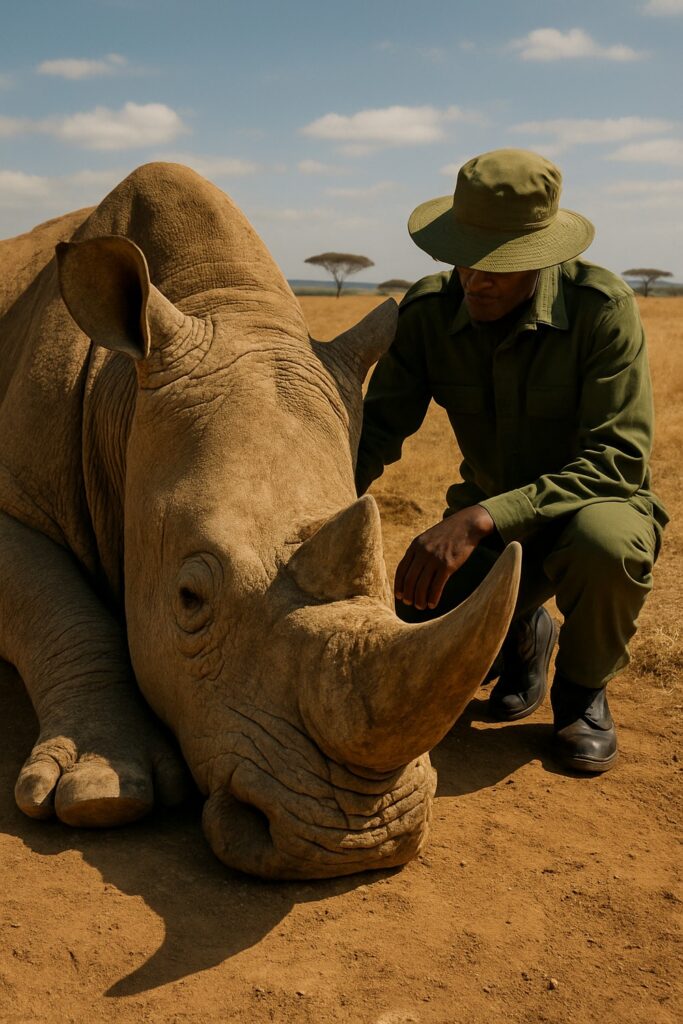
Two animals. That’s what’s left. Not two breeding pairs, not two small herds tucked away in some corner of central Africa that researchers haven’t catalogued yet — two individual rhinos, a mother and her daughter, living inside a fenced conservancy in Kenya while armed guards rotate shifts around them day and night.
At Ol Pejeta Conservancy, Najin and Fatu wake up every morning as the rarest large mammals on Earth. No males exist. No wild population is out there somewhere waiting to be rediscovered. What remains of an entire subspecies is breathing, grazing, and moving within a single sanctuary — and a small group of humans with rifles is the only thing standing between them and permanent silence.
Northern White Rhino Extinction: How It Happened So Fast
The northern white rhino once ranged across Uganda, Chad, Sudan, the Central African Republic, and the Democratic Republic of Congo. Around 2,000 existed in the 1960s. By 2015, there were three. Dr. Thomas Hildebrandt of the Leibniz Institute for Zoo and Wildlife Research has described the collapse as “one of the fastest documented declines of a megafauna species in recorded history.”
Poaching drove most of it — horn worth more per gram than gold on certain black markets. But poaching alone might not have finished them.
Agricultural expansion was fragmenting their habitat at exactly the same time. A species can sometimes survive one catastrophic pressure. It rarely survives two running simultaneously, for decades, with almost no enforcement slowing either one down. That combination — that specific, terrible overlap — is what made the northern white rhino extinction irreversible before most people even knew it was happening.
Sudan Was the Last Male. Then He Was Gone.
Sudan spent his final years at Ol Pejeta, where he became one of the most photographed animals on the planet — listed on a dating app at one point to raise conservation awareness. When he lay down on March 19, 2018, and couldn’t rise, veterinarians made the call to euthanize him. He was 45.
His death wasn’t a surprise. Everyone watching knew it was coming.
But knowing something is coming doesn’t make the silence after it any easier. The last male. The end of a genetic line that had persisted on this planet for millions of years. And then, just like that, gone. Learn more about animals standing at the edge of existence and what’s being done — and not done — to pull them back.
Two Animals Left: What Their Daily Life Actually Looks Like
Najin is in her early thirties. Fatu is in her twenties. Neither can carry a pregnancy to term — Najin has leg problems that make gestation dangerous, and Fatu has uterine abnormalities that rule it out entirely. So even if you could somehow reverse the northern white rhino extinction crisis through natural reproduction, these two specific animals couldn’t do it. The biology doesn’t cooperate. Which means the science has to attempt something it’s genuinely never done before, while the clock keeps running.
Their guards work in shifts. Armed. Watchful. There are people whose entire job is making sure these two animals don’t die from human hands before the researchers get a chance to work.
That’s the world we’ve built.
The Science Racing Against Permanent Silence
The northern white rhino extinction story isn’t finished — not quite. A consortium of scientists working under the BioRescue project, involving Kenya Wildlife Service, Ol Pejeta Conservancy, Dvůr Králové Zoo, and the Leibniz Institute, has successfully created northern white rhino embryos in a laboratory. They’ve harvested eggs from both Najin and Fatu, fertilized them with Sudan’s preserved sperm, and grown viable embryos. According to Wikipedia’s documentation of the subspecies, multiple embryos have been successfully produced and are now held in cryostorage.
That last detail kept me reading for another hour. Frozen embryos of a functionally extinct subspecies, sitting in a lab, waiting on a procedure — implanting them into southern white rhino surrogates — that has never been accomplished in rhinos of any species. Not even close relatives. Never done.
Razor-thin margins. But the alternative is a world where northern white rhinos exist only in photographs and frozen archives. So the scientists keep going.

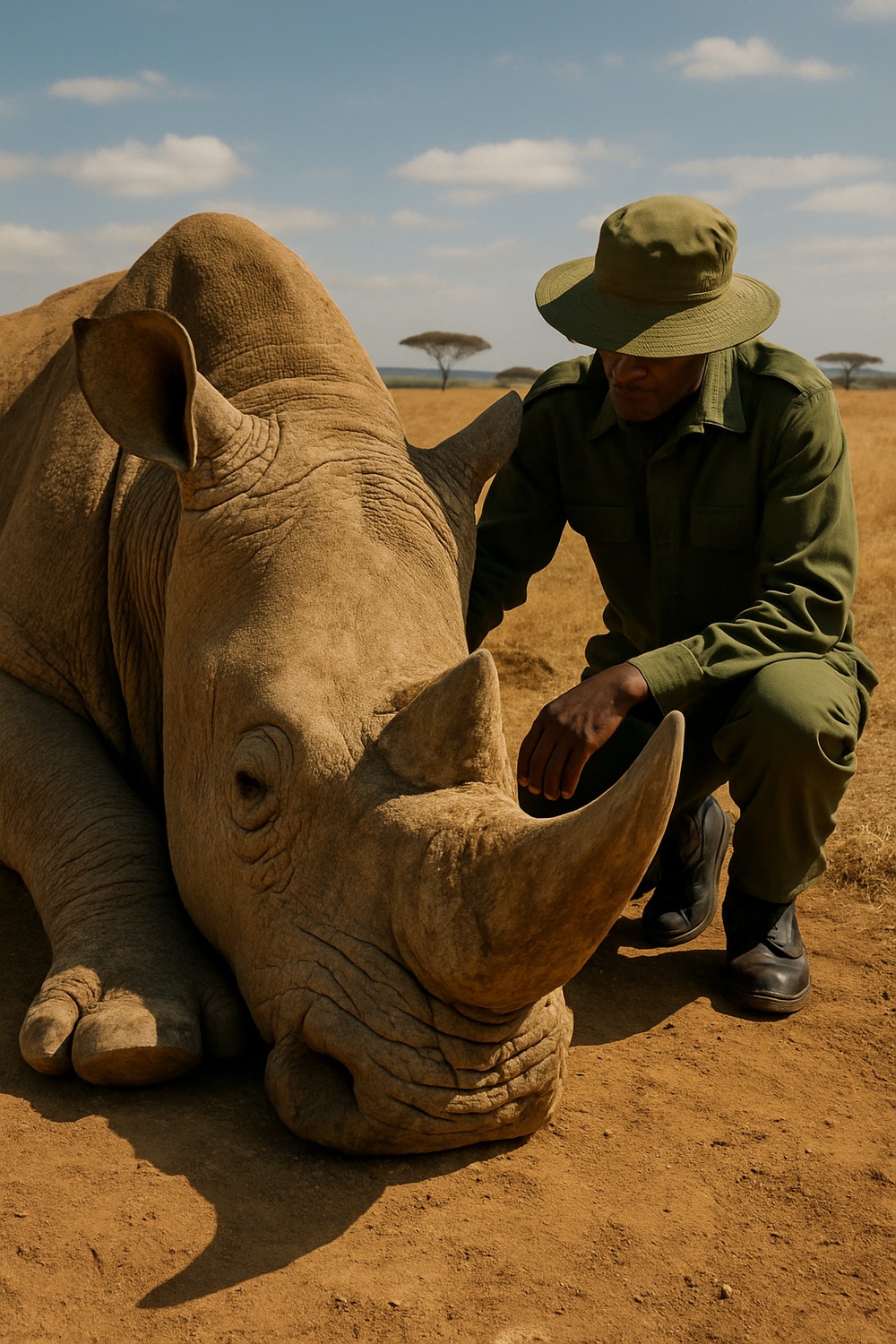
They Outlasted Ice Ages. We Gave Them One Century.
Northern white rhinos are ancient. Their lineage traces back millions of years. They walked through ice ages that reshaped entire continents, survived climate shifts that erased species we now only know from fossils. Sabertooth cats — gone. Woolly mammoths — gone. Giant ground sloths — gone. The northern white rhino outlasted all of them without showing any particular signs of struggle.
What finished them off was a horn made of compressed keratin. The same protein as your fingernails.
Organized, sustained, commercial poaching — and the human appetite for something that has no proven medicinal value whatsoever — did what millions of years of planetary upheaval couldn’t. That’s the part that sits heavy. Not that extinction happens; it’s been happening since life began. But this one was chosen. Economically incentivized. Allowed to accelerate through decades of insufficient response. The northern white rhino didn’t lose a fight with nature. It lost a fight with demand.
By the Numbers
- Around 2,000 northern white rhinos lived across central Africa in 1960. By 2018, that number had fallen to 2 (WWF, 2023).
- Rhino horn fetches up to $65,000 per kilogram on illegal markets — one of the most valuable wildlife commodities on Earth (TRAFFIC, 2022).
- 2019: BioRescue produced the world’s first northern white rhino embryo via IVF. First time for any rhino species.
- Southern white rhinos, their closest relatives, number around 15,940 — meaning the gap between near-extinction and relative stability represents roughly 15,938 animals. That number is worth sitting with for a moment.

Field Notes
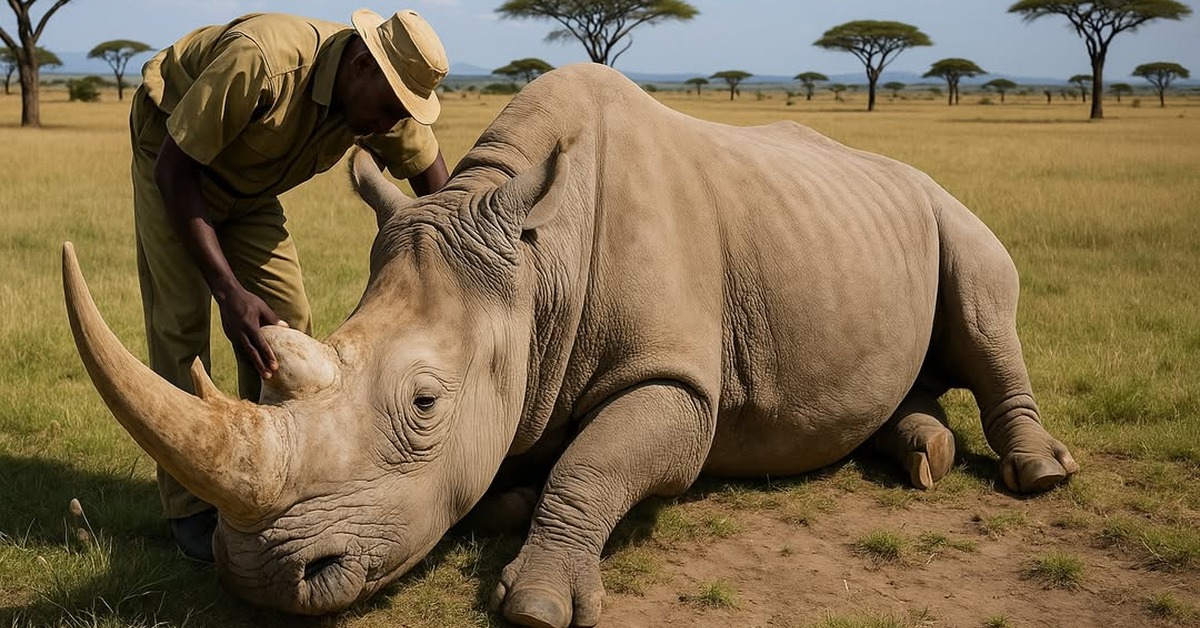
- Fatu and Najin can identify individual human caretakers by scent alone — rangers who’ve worked with them for years report that both rhinos respond differently to familiar versus unfamiliar people even before making visual contact.
- Sudan had a Tinder profile in 2017.
- Seriously — the Ol Pejeta Conservancy listed him with the bio “I’m one of a kind,” and the campaign raised over $500,000 for conservation in a matter of weeks.
- The embryos in cryostorage represent more than one subspecies’ survival: the assisted reproduction techniques being developed here may eventually apply to other critically endangered species, making this whole project a potential template for future conservation science.
What We Lose When We Lose Them Forever
The northern white rhino extinction isn’t only about one subspecies. It’s about what happens when we underestimate the permanence of “gone.” Rhinos are ecosystem engineers. They graze in patterns that shape vegetation, which shapes what other animals can survive in a landscape. They’ve been doing this for millions of years — quietly, consistently, without anyone needing to manage it or even notice it was happening. When a species like this disappears, you don’t just lose the animal. You lose everything it was doing that you didn’t realize mattered until it stopped.
Turns out, a lot of things work that way.
Najin and Fatu are alive today because hundreds of people decided their lives were worth protecting at significant cost and effort. That decision matters. So does asking whether we’ll make that same decision earlier next time — before it comes down to two individuals, a freezer full of embryos, and a procedure nobody’s ever successfully pulled off.
Two rhinos. Armed guards. Frozen embryos. And a team of scientists attempting something that’s never been done anywhere, in any species, because the only other option is watching a lineage that survived millions of years disappear on our watch. The northern white rhino story isn’t finished. But how it ends depends on choices being made right now — in labs, in policy rooms, and in the market for illegal wildlife products. If this kind of story keeps you reading at odd hours, there’s more waiting at this-amazing-world.com.


