



London, Ontario shouldn’t work the way it does — and that paradox is worth sitting with. A mid-sized Canadian city of roughly 500,000, it carries more living canopy, more research infrastructure, and more cultural density than cities twice its size ever seem to manage. London, Ontario earns the name Forest City not through branding but through something rarer: accumulated intention. The Thames River — same name as London’s English twin, a coincidence that charms some visitors and confuses others — threads through the whole place, stitching parks and trails and neighborhoods together with a quiet insistence. It looks inevitable. It wasn’t.


A Canopy Like No Other: The Green Soul of the Forest City
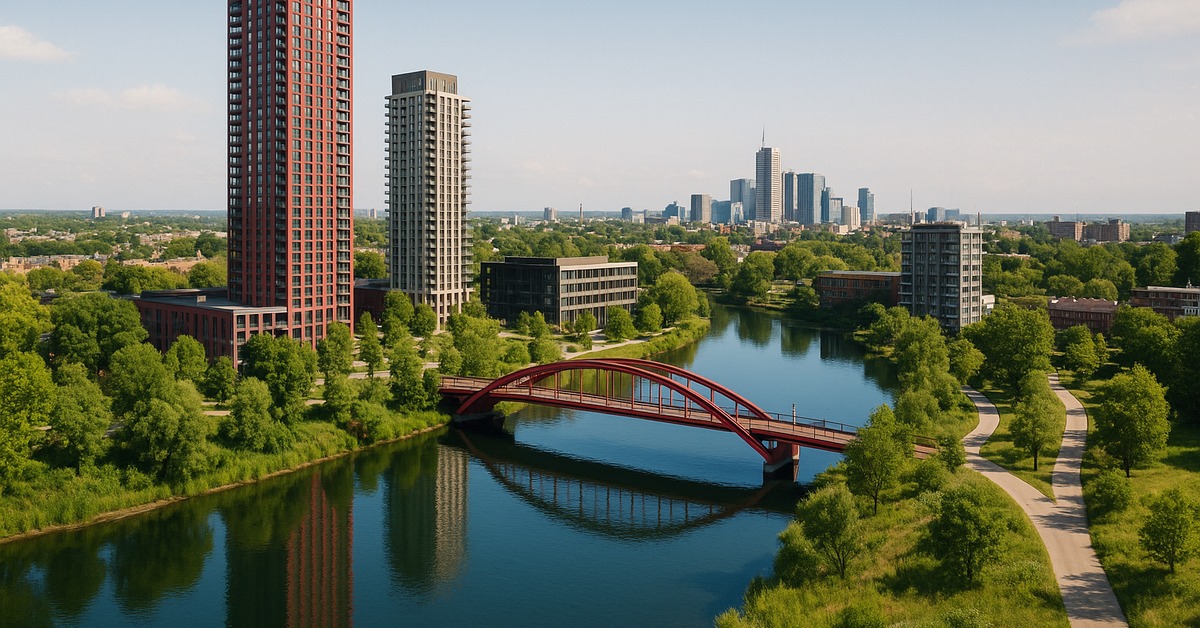
Roughly 28 percent of London’s surface sits under living canopy — an extraordinary number for a North American city of this size, and one that city foresters will tell you didn’t come easy. What produced it was decades of deliberate civic commitment layered on top of a landscape that glaciers essentially pre-designed: rolling, water-threaded terrain that made greenery almost inevitable, provided anyone bothered to protect it. More than 200 kilometers of trail connect communities through parks and green corridors. Springbank Park stretches along the Thames for miles, offering the kind of pastoral breathing room that makes you wonder why anyone lives anywhere with less of it.
But what makes London’s relationship with its green infrastructure genuinely interesting isn’t the acreage. It’s the integration. Cyclists commute along river trails flanked by wildflowers in July. Families picnic under century-old beeches on weekday afternoons like it’s nothing unusual. Researchers from Western University study urban ecology in greenbelts that are, turns out, a ten-minute walk from their laboratories. Nobody’s driving to the park here — they’re already in it, constantly, because the city was built that way. (Environmental planners call this “ecological embeddedness,” which is a clunky phrase for something that actually works.)
There’s real science behind what this does to people: lower stress markers, stronger community ties, a civic pride that newcomers keep describing as almost disorienting in its warmth. London’s trees aren’t scenery. They’re load-bearing.
Knowledge, Healing, and the Institutions That Drive a City Forward
Founded in 1878, Western University’s Gothic-revival limestone buildings sit on rolling lawns that look like someone commissioned a painting of what a university should feel like. It draws students and scholars from over 100 countries. Fanshawe College runs alongside it — applied programs, direct pipeline into the regional economy, a genuinely diverse and entrepreneurial student body that tends to stay in the city after graduating, which is exactly what a mid-sized city needs. What you get from that combination is a constant churn of young talent and research that doesn’t stay on campus.
It moves outward into neighborhoods that used to be manufacturing corridors and are now lined with startups and innovation offices. That migration of energy from campus to city isn’t accidental — it’s what happens when institutions and place grow into each other over generations.
And then there’s the healthcare infrastructure, which is where London becomes genuinely hard to explain to people who haven’t looked closely. London Health Sciences Centre and St. Joseph’s Health Care London form one of Canada’s largest hospital networks. The Lawson Health Research Institute — affiliated with both — has produced clinical discoveries that changed treatment protocols in other countries.
Why does this matter? Because for a city of roughly 500,000 people, this concentration of medical expertise functions less like a public service and more like a second economy. Top physicians arrive for the research access. That draws funding. The funding enables more research. (Epidemiologists have a name for this kind of self-reinforcing system, but the short version is: it’s rare, and London has it.) Tens of thousands of jobs are anchored to it, with a stability that purely industrial cities almost never manage to hold onto.
Cities that bet on knowledge infrastructure rather than commodity cycles tend to age better. London made that bet early enough that the compounding has become visible.
Culture, Creativity, and an Unexpected Pop Superstar
London’s cultural scene operates on a principle of consistent surprise. Museum London holds a serious collection of Canadian fine art that would draw crowds in a much larger city. The Grand Theatre stages productions that compete — genuinely compete — with what you’d find in Toronto or Vancouver. Victoria Park fills up during festival season with jazz, film screenings, ribfest, multicultural celebrations — the particular electricity of a city that has decided, collectively, to be loud about what it loves.
Independent music venues. A culinary scene built on regional farm supply. Galleries that aren’t performing art so much as making it. Nobody talks about this much, but the Justin Bieber connection — he’s from neighboring Stratford, raised in this regional orbit — says something real about the landscape. This part of Ontario has a habit of producing outsized things from quiet ground.

How It Unfolded
- 1826 — London, Ontario is founded as a planned settlement in Upper Canada, its location chosen deliberately along the Thames River for water access and agricultural potential.
- 1878 — Western University is established, beginning the institutional layering that would eventually define the city’s economic identity.
- 1960s–1980s — Sustained investment in parkland and river corridor protection cements London’s canopy advantage over peer cities that chose development instead.
- 2010s–present — Housing pressure from Toronto overflow and international immigration tests the balance between growth and the green infrastructure that made the city worth moving to.
Balancing Growth With the Green Promise
The pressure is real now and it’s accelerating. Housing demand — driven partly by people priced out of Toronto, partly by international newcomers arriving faster than infrastructure can absorb them — is pushing development outward into green corridors that took two or three generations to establish. City planners are in a genuine reckoning with zoning laws, infill strategies, and canopy protection bylaws that need enforcement with actual consequences rather than aspirational language.
But the deeper question isn’t procedural. How do you grow without dismantling the specific qualities that made growth worth pursuing in the first place? London has no clean answer yet — only the ongoing negotiation between what the city became and what it keeps being asked to sacrifice.
By the Numbers
- 28% — Share of London’s surface covered by living urban canopy
- 200+ km — Trail network connecting parks, river corridors, and neighborhoods
- 100+ — Countries represented in Western University’s student and faculty population
- ~500,000 — London’s current population, placing it among Canada’s largest mid-sized cities
- 2 — Major hospital networks (London Health Sciences Centre and St. Joseph’s Health Care London) anchoring the region’s medical economy
Field Notes
- Springbank Park follows the Thames River for several kilometers west of downtown — the trail is navigable by foot or bicycle and offers the clearest sense of how the river shapes the city’s spatial logic.
- Museum London’s Canadian art collection is undersold even locally; the permanent galleries reward a longer visit than most first-timers expect to give it.
- Victoria Park sits at the geographic and social center of the city — what happens there during summer festival season is a reasonable measure of London’s civic temperature at any given moment.
- The Fanshawe College campus sits northeast of the university district; walking between the two along the river trails takes about 40 minutes and tells you more about the city’s scale than any map would.
Where to See This
- Springbank Park, London, Ontario — best experienced in late spring through early autumn when the Thames River trails are fully accessible and the canopy is at full density; the park stretches far enough west to feel genuinely removed from the city.
- Lawson Health Research Institute (London, Ontario) — affiliated with Western University and London Health Sciences Centre, it represents the practical convergence of academic and clinical research that defines the city’s medical economy.
- For a grounded introduction to London’s urban ecology history, the City of London’s Urban Forestry unit publishes canopy assessments and long-range management plans that are more readable than they sound — and make the 28% figure feel earned rather than inherited.
Frequently Asked Questions
Why is London, Ontario called the Forest City?
The nickname reflects the city’s unusually high urban canopy coverage — roughly 28 percent of its surface area — alongside a network of parks and river trails that make green space a structural feature of daily life rather than an amenity bolted on afterward.
Is London, Ontario worth visiting?
For a mid-sized Canadian city, it punches well above its weight on institutions, cultural programming, and livability. Museum London, the Grand Theatre, and the Thames River trail system are all legitimate draws. It’s not Toronto — and that’s part of what makes it interesting.
What is London, Ontario known for?
Its urban canopy, Western University, a disproportionately large hospital and research network, and a cultural scene that surprises people who arrive with low expectations. The Wikipedia entry on London, Ontario covers the formal history; what it can’t quite capture is the texture of the place.
How far is London, Ontario from Toronto?
Roughly 190 kilometers — about two hours by car on the 401, or two and a half hours by train. Close enough to feel the pressure of Toronto’s housing market. Far enough to have developed its own character entirely.
What universities are in London, Ontario?
Western University (founded 1878) and Fanshawe College are the two primary institutions. Together they generate the research output, talent retention, and economic churn that keeps the city’s knowledge sector functioning. See our broader coverage of Canadian cities for context on how London compares regionally.
Editor’s Take — Sarah Blake
What stays with me about London, Ontario isn’t the canopy percentage or the hospital rankings — it’s the implied argument the city makes just by existing the way it does. Places that invested in shade and research and walkable river trails two generations ago are now being treated as models. London wasn’t ahead of its time; it was simply consistent when other cities were distracted. The question of whether it can hold that consistency under the current development pressure is, genuinely, one of the more interesting urban stories in Canada right now.
What London, Ontario argues — quietly, through its institutions and its tree coverage and its hospital research outputs — is that the future of livable cities doesn’t belong only to megacities. It belongs to places that tended their roots carefully enough that real growth became possible. The Forest City isn’t preserved in amber. It’s moving, reaching upward the way the elms on its oldest streets have always reached, pulling light from every available direction. Whether it can keep doing that while absorbing the pressure that’s coming is the only question that matters now. I’d bet on the trees.


