



Nobody was expecting the parrot to talk. That’s the part that makes this strange — he’d been sitting in a Tokyo police station for days, completely silent, while officers tried to figure out who he belonged to.
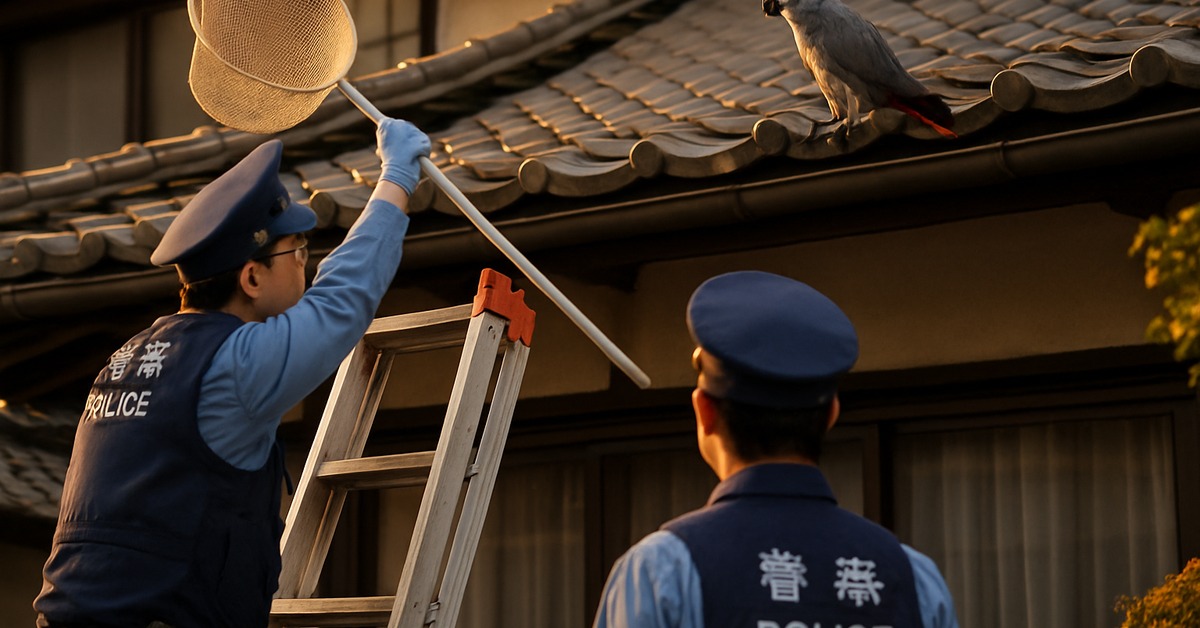
A small grey bird had turned up on a rooftop one evening, no tag, no chip on record, no owner anywhere in the picture. They brought him in. They waited. And then, several days later, he opened his beak and gave them a name and a full home address — every number correct, every syllable in place. Case closed. By a parrot.
The African Grey Parrot Address That Stunned Tokyo Police
African grey parrots aren’t just good talkers. They’re intelligent in ways that still catch researchers off guard, even now. Dr. Irene Pepperberg of Harvard spent decades studying an African grey named Alex, and what she found kept rewriting the assumptions. Alex could distinguish same from different, grasp the concept of zero, and do basic arithmetic. Alex the parrot identified objects, colors, and shapes with accuracy that matched young children. So when one of these birds memorizes a full street address and holds onto it until the moment someone needs to hear it — that’s not a party trick. That’s something else entirely.
The Nakamura family had clearly done their homework. Their bird, Mr. Yosuke Nakamura — the parrot, not a human relative — had been taught his own name and home address thoroughly enough that he could recite both on command. Or, as it turned out, off command. When the moment finally called for it.
How Days of Silence Broke Into a Perfect Statement
He said nothing his first night at the police station. Not a syllable. Officers weren’t even sure he could talk. He got transferred to veterinary staff, and it was there — under quieter, more patient conditions — that he started to open up. The shift from mute bird to self-narrating witness took just a few days.
What’s striking isn’t just that he talked. It’s that he talked at the right moment, to the right people, with exactly the right information. That last part kept me reading about this for another hour, honestly. Because that’s not mimicry. Mimicry is random. This was targeted — knowing, on some level, that these specific strangers needed a specific piece of information.
If you’ve ever wondered what other animals might be quietly holding onto, you’re not alone — this-amazing-world.com has covered some equally strange cases of animal memory and communication.
African Grey Parrots Aren’t Just Repeating What They Hear
The science here matters. African grey parrots process language differently than most birds — they use words referentially, meaning they connect the word to the actual thing, not just to the reward they got for saying it. When Mr. Yosuke Nakamura announced his name and address to the veterinary staff, he wasn’t running through a shuffled playlist of memorized sounds. He was, in some meaningful sense, identifying himself to people who could help. That distinction changes how you read the whole story.
They can live 40 to 60 years in captivity. They form deep bonds with their owners. They absorb language the way children do — through immersion and repetition and context — and sometimes, when they get separated from the people they’re bonded to, they use that language to close the distance.
What Happened Inside That Tokyo Police Station
Picture it. A quiet room in a veterinary facility. A city of 14 million people outside the window. A small grey bird sitting among complete strangers. And then, clear as anything, a voice delivers a name and a full street address. Every number exact.
The staff didn’t need to post flyers. Didn’t need to scroll databases. The African grey parrot address was, effectively, his own GPS coordinates — spoken out loud, on his own terms, in a Tokyo suburb.
Police called the Nakamura family. The reunion was quick.
But here’s the detail worth sitting with: he’d been silent for days before that. He wasn’t panicking. Wasn’t performing for attention. He waited — and then, when it apparently made sense to him, he spoke.


The Cognitive Science Behind This Behavior
African grey parrots don’t store words like a recording device stores audio. Research suggests they have working memory, problem-solving ability, and what some researchers describe as a rudimentary theory of mind — a basic grasp that other individuals have knowledge and needs that differ from their own. That’s a capacity human children typically develop around age four.
Which raises the obvious question: was that what Mr. Yosuke Nakamura was doing? Recognizing that these strangers holding him lacked a specific piece of information he had access to?
The Nakamura family’s decision to train their bird this way wasn’t unusual in Japan’s dedicated parrot-keeping community. But the fact that it actually worked — that he retained the address, held it through days of stress and displacement, and deployed it to the right audience at the right time — puts this right at the edge of what we currently understand about non-human cognition. It’s a small story from a Tokyo suburb. The question it leaves behind is considerably larger.
By the Numbers
- African grey parrots can learn 200 or more words, with some individuals exceeding 1,000 distinct sounds, per research compiled by the World Parrot Trust (2021).
- Dr. Pepperberg’s subject Alex correctly identified objects and quantities with roughly 80% accuracy in controlled trials — performance matching children aged 4 to 6 in equivalent tests.
- African greys are listed on CITES Appendix I. Wild populations have declined by an estimated 99% in parts of West Africa over the past three decades.
- A captive African grey holds the documented record for the largest confirmed vocabulary among non-human animals. The species consistently outperforms dolphins, great apes, and border collies in language-based cognition tests — which is a sentence I had to read twice.

Field Notes
- African grey parrots have been observed constructing novel word combinations to describe objects they’ve never encountered before. Not repetition. New phrases, built from parts.
- In Japan, African greys are classified as exotic pets and require registration under the Act on Invasive Alien Species. A lost bird with no documentation is genuinely difficult to trace through official channels — which makes what Mr. Yosuke Nakamura did even more consequential than it sounds.
- Alex’s last words to Dr. Pepperberg, the night before he unexpectedly died: “You be good, see you tomorrow. I love you.” He said this every night. He was 31.
Why This Story Has Some Staying Power
The African grey parrot address story circulated quietly when it first came out, and it’s not hard to see why. It’s warm. It resolves. Nobody gets hurt. But underneath that tidy surface is something worth taking seriously — we share this planet with minds we barely understand. Animals that perceive and remember and communicate, and in cases like this, seem to act with something that looks uncomfortably like intention.
Mr. Yosuke Nakamura didn’t get lucky. He got home because someone had cared enough to teach him, and he’d been smart enough — or present enough, or aware enough, pick your word — to hold onto it until it mattered.
The Nakamura family got their bird back. The larger question that parrot left sitting in that veterinary office — how much do animals understand that we’ve simply never thought to ask about — doesn’t have a clean answer yet.
A lost parrot in Tokyo recited his address to strangers and found his way home. It sounds like a fun fact. It’s also a small window into something genuinely strange about the minds living alongside ours — stranger and richer than we usually stop to consider. There’s more where this came from at this-amazing-world.com, and some of it is even harder to explain.


