She Was 19, Pregnant, and Alone at the Helm of Cape Horn
It is 1856. A nineteen-year-old woman stands at the helm of a 216-foot clipper ship rounding Cape Horn, four months pregnant, while her husband lies unconscious below deck with typhoid fever and the first mate sits confined in his quarters after she put him there.
Nobody appointed her captain. Nobody trained her for this. She’d just read the navigation manuals on the previous voyage because she was curious, the way you might read about something that interests you on a long trip, half-convinced you’d never actually need it. Then the ocean called her bluff.
Mary Ann Patten, Captain: How It Actually Happened
The Neptune’s Car wasn’t just any ship. It was one of the fastest commercial clipper vessels of the 1850s — built specifically to race cargo from New York, down around the southern tip of South America, and up to San Francisco. Maritime historian David Cordingly, who spent years documenting women at sea in his naval history research, noted that the ship had already set competitive crossing times before this particular voyage. Speed was the whole point. These ships were the freight trains of their era, and their reputations lived and died by the clock.
Mary Ann had sailed aboard the Neptune’s Car once before, as the captain’s wife. During that crossing, she borrowed navigation manuals and worked through them on her own. No instructor. No exam. No reason anyone could imagine she’d ever use what she learned.
Then Joshua Patten collapsed with typhoid fever, and suddenly she had every reason.
She didn’t have formal training. She had the books she’d read, a lantern, and roughly fifty days of open ocean between her and San Francisco. The part that stays with me, honestly, is that she’d treated celestial navigation like a hobby — and that hobby is the only reason the ship made it home.
The First Mate Tried to Take Command
Here’s where it gets complicated. The Neptune’s Car’s first mate — a man named Keeler — had already been a problem before Joshua got sick. Insubordinate, possibly drunk on duty, with formal complaints already logged against him by the captain. When Joshua collapsed, Keeler saw his opening and pushed hard to take the wheel.
Mary Ann, four months pregnant and running on almost no sleep, said no. Then she had him locked below deck.
A teenager. Confined a grown man who technically outranked her. And kept sailing.
The second mate was willing but inexperienced. The crew — seasoned men, most of them older than her by decades — followed her lead regardless. Maybe they had no other choice. Or maybe they could see, standing on that deck in those seas, exactly who was in charge and why. Either way, she held the helm, and nobody took it from her.
What Cape Horn Actually Does to Ships
Cape Horn is where the Atlantic and Pacific collide at the bottom of South America. The nicknames for the wind systems there — the Roaring Forties, the Furious Fifties — aren’t poetry. They’re warnings. Waves regularly hit 60 feet. Storms can run for weeks without letting up. Before the Panama Canal opened in 1914, there was no other maritime route between the coasts, and Cape Horn killed ships and sailors with something close to indifference.
She wasn’t navigating difficult water. She was navigating the most feared stretch of ocean in the world. In winter. While pregnant. While splitting her hours between navigation charts and the sickbed of a man who was getting worse, not better.
Fog. Dwindling rations. A crew watching her for signs of doubt.
That detail alone deserves a full stop.
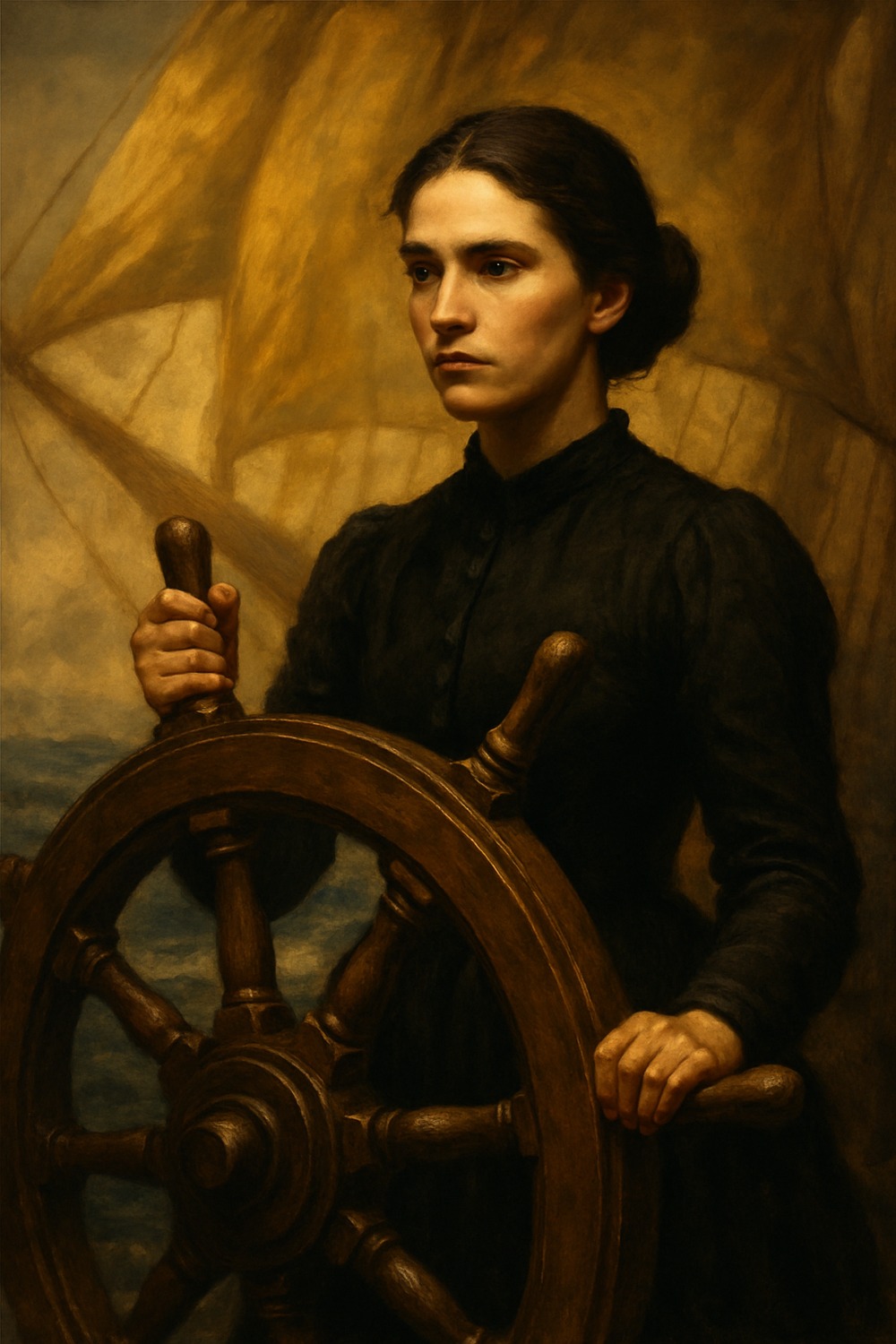
She Brought the Ship In. Intact. On Time.
Fifty days after Joshua collapsed, the Neptune’s Car sailed into San Francisco Bay. Cargo intact. Crew alive. The shipping underwriters — the men whose entire business was calculating risk — awarded her $1,000 on the spot. That’s roughly $35,000 today. Not a salary. Not a contract. More like a payment made in a state of visible disbelief that a nineteen-year-old pregnant woman had just successfully commanded one of their vessels around Cape Horn when experienced male captains sometimes didn’t manage it at all.
She reportedly said she’d only done what a wife must do.
That sentence has followed her story ever since. Sometimes quoted admiringly. Sometimes as evidence of how thoroughly she’d absorbed the framing that was available to her. She didn’t claim the word “captain.” She called herself a wife doing her duty, and the men around her were entirely comfortable letting that stand as the official version.
By the Numbers
- 216 feet: the length of the Neptune’s Car — built for speed on the Cape Horn route, one of the premier commercial vessels of the 1850s
- 50 days of command, from Joshua’s collapse to arrival in San Francisco Bay in 1856
- 60+ feet: typical wave heights off Cape Horn in Southern Hemisphere winter, the conditions she navigated while four months pregnant and running on almost no sleep
- $1,000 awarded by underwriters in 1856 — roughly $35,000 now, handed over in what the historical record can only be read as stunned acknowledgment. There was no official category for what she’d done. They just gave her money and moved on.
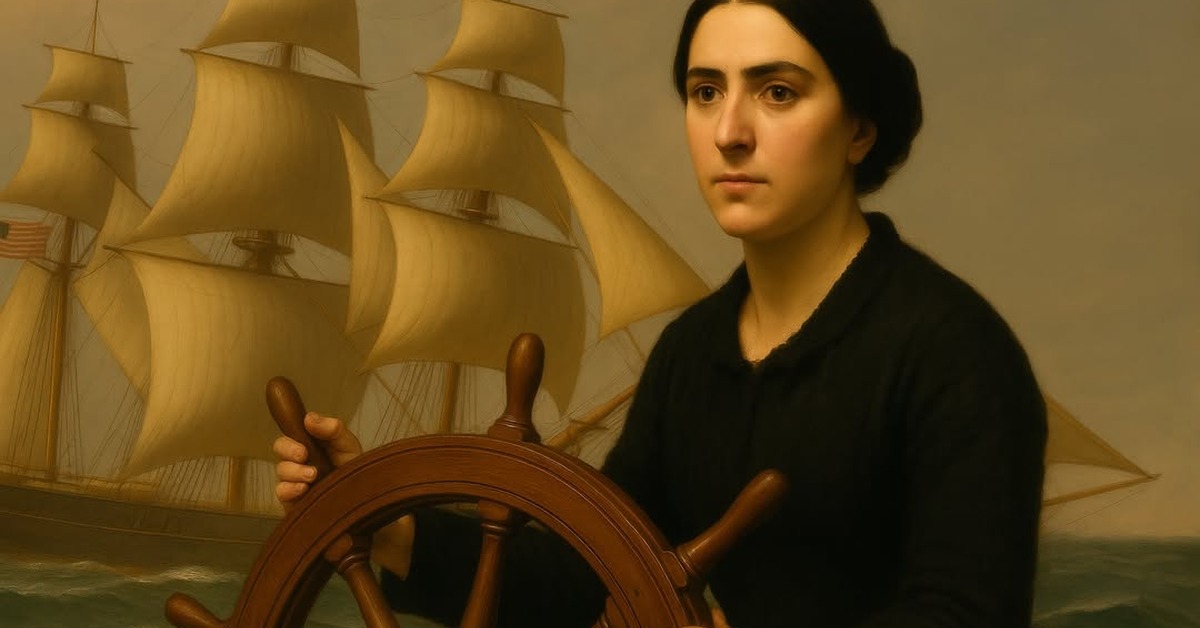
Field Notes
- She taught herself celestial navigation on a previous voyage, purely out of curiosity — no instructor, no certification
- Joshua Patten never fully recovered from the typhoid he contracted on that voyage. Mary Ann spent the remaining years of her life caring for him. She died in 1861 at 24 years old — five years after the crossing that made her briefly famous and then promptly forgotten.
- First mate Keeler later claimed she’d acted improperly by assuming command. Maritime law had no framework to settle the argument either way, because it had genuinely never occurred to anyone that a framework might be needed.
Why Mary Ann Patten’s Story Still Matters Now
Mary Ann Patten is a case study in how history decides who gets recorded — and under what label. She performed a measurable, documented act: navigated a commercial vessel through Cape Horn, kept her crew alive, delivered the cargo on schedule. That’s not interpretation. That’s a logbook entry. And the historical record filed her under “captain’s wife,” because that was the only available slot.
How many others are in those footnotes?
Researchers studying gender and maritime history have found recurring patterns — women performing skilled labor at sea that was logged under their husbands’ names, or not logged at all, because the people keeping records couldn’t quite process what they were looking at. Mary Ann’s story survived because it was extreme enough to make newspapers. Most weren’t extreme enough. They just disappeared into the margins.
There’s something worth sitting with in the phrase “only what a wife must do.” Not because she was wrong to use it — she wasn’t, and the framing was entirely rational for 1856. But because the men who heard it were so relieved by it. It let them take the strange, inconvenient fact of her competence and file it somewhere comfortable. She commanded a ship through Cape Horn. She did it without catastrophic loss. Those two things belong in the same sentence as her name, without a single qualifier attached.
Turns out that last fact is the one that kept me reading for another hour — not the seamanship, impressive as it was, but the way she handed everyone around her a more manageable version of the story, and how quickly they took it.
Mary Ann Patten sailed into San Francisco Bay and then quietly back into the footnotes. She was 19. She was pregnant. She was the most competent person on that ship — and history’s response was to note her devotion as a wife rather than her skill as a navigator. She deserved a different sentence. She deserved several. There’s more at this-amazing-world.com, and the next story is, somehow, even stranger.