This Frog Looks Exactly Like Moss — And That’s the Point
Nobody walking through a Vietnamese karst forest is looking for this frog. That’s precisely why it’s still alive.
Deep in the dripping limestone forests of northern Vietnam and Laos, there’s a frog that has essentially solved the problem of being eaten — not by running, not by fighting, not even by hiding in the conventional sense. It just becomes something else. A clump of wet moss. A patch of lichen on a cave wall. It sits there in broad daylight, in plain sight, and ceases to exist as a frog.
Key Facts
- The Vietnamese mossy frog (Theloderma corticale) was first formally described in 1903, with systematic field documentation of its camouflage beginning only in the 2010s.
- When threatened, mossy frogs can hold completely motionless for 10 or more minutes, long enough for most predators to lose interest.
- Vietnam has lost approximately 43% of its original forest cover since 1943, per World Bank data, threatening the frog’s limestone karst habitat.
- The frog inhabits moist karst limestone forests of northern Vietnam and Laos, where moss grows thick year-round on rocky walls.
- Theloderma corticale’s skin mimicry operates in three dimensions, replicating physical texture rather than just visual pattern, making it one of the most structurally complex frog camouflage systems documented.
In short: The Vietnamese mossy frog (Theloderma corticale) uses mossy frog camouflage to vanish into the limestone karst forests of northern Vietnam and Laos. Its skin replicates moss in three dimensions, mimicking texture rather than just color, and it freezes motionless for over 10 minutes, letting sharp-eyed birds and snakes pass within centimetres without noticing it.
How Mossy Frog Camouflage Actually Works
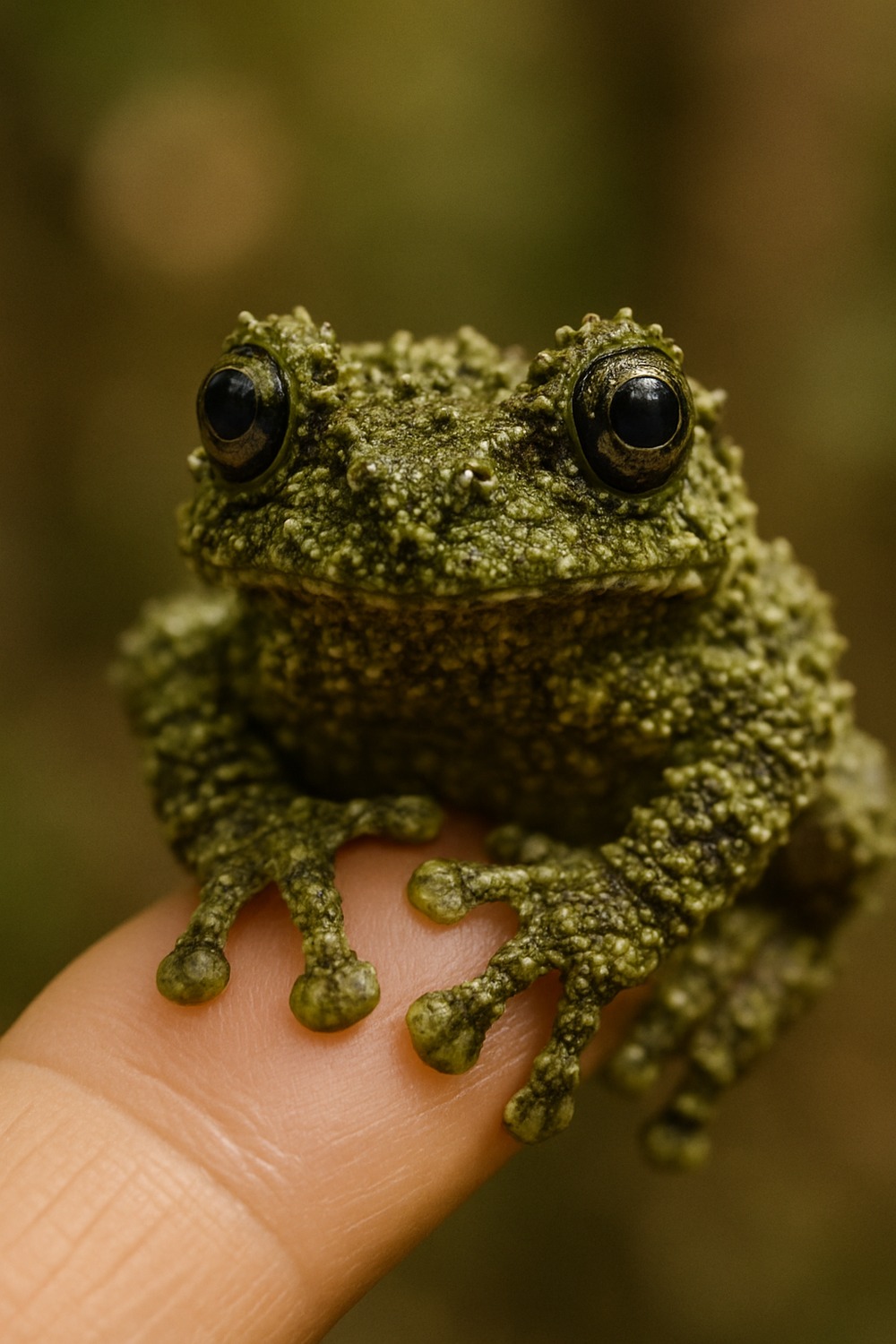
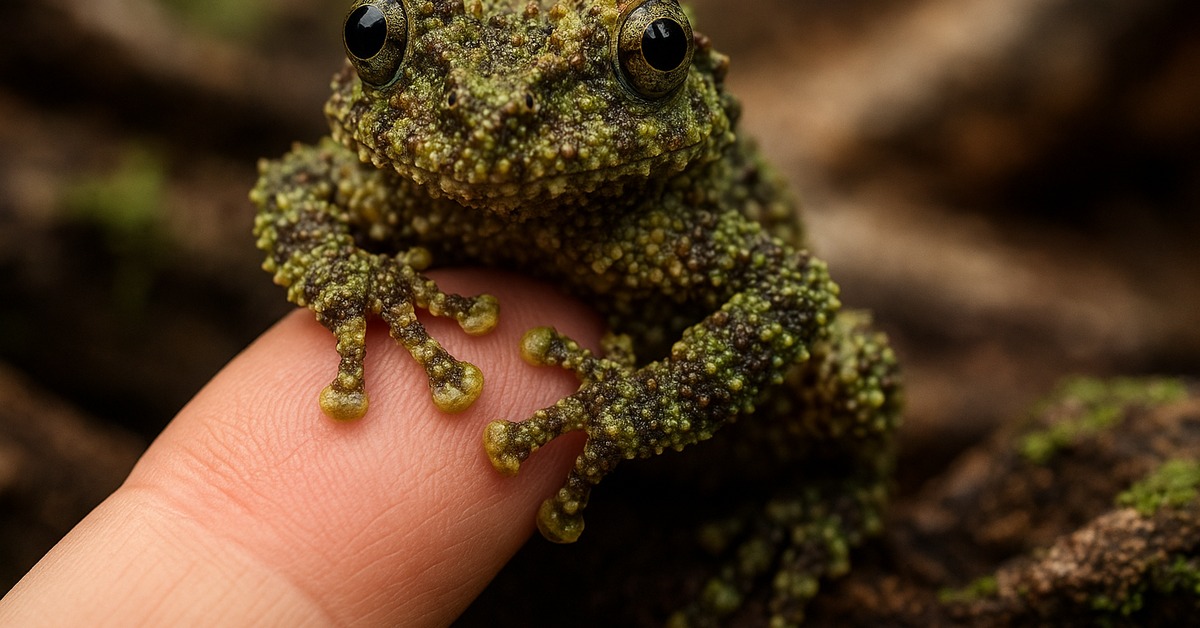
The Vietnamese mossy frog (Theloderma corticale) isn’t just green. Its skin runs through this chaotic patchwork of bumps and ridges and irregular blotches — olive, brown, near-black — that don’t just mimic the color of moss but replicate its actual surface geometry. The texture of it. Researchers at the University of Natural Sciences in Hanoi, including herpetologist Dr. Nguyen Quang Truong, documented how these frogs position themselves on damp rock walls and cave ledges where the visual match is almost optical. Almost architectural.
But here’s the question nobody’s fully cracked yet: do the frogs actively choose surfaces that already match them, or does something in their skin gradually adjust to close the gap?
That’s not a small distinction. It’s the difference between a frog that got lucky with genetics and a frog that’s actively solving a puzzle every time it settles somewhere new. The answer, frustratingly, is still open. What we do know is that the camouflage is three-dimensional. Not flat color. Topography. That last detail kept me reading for another hour.
Stillness Is Their Most Lethal Weapon
Most camouflage breaks the moment something moves. That’s always the catch. The mossy frog has co-evolved a behavioral trick that pairs with its disguise almost too perfectly: it freezes. Not for a second the way a startled cat might. We’re talking minutes of absolute stillness — muscles locked, eyes half-closed, body curled into a tight ball that reads, visually, as nothing more than a wet clump of vegetation. You can explore how other species use extreme camouflage strategies across the animal kingdom, but few commit to it at this level.
Scientists observed hungry birds and snakes — animals with genuinely sharp vision — pass within centimeters of these frogs without registering them as prey.
Not luck. A survival system refined across thousands of generations into something close to perfection. Speed is loud. Stillness is invisible.
The Forest That Made This Frog Possible
Mossy frog camouflage didn’t develop in a vacuum. It evolved because of one very specific environment: the moist karst limestone forests of northern Vietnam and Laos, where humidity sits perpetually high, moss grows thick on every surface, and the rocky walls are draped in green year-round. In this habitat, moss isn’t decoration. It’s the dominant visual texture of essentially everything. A frog that matches it perfectly doesn’t need speed. It needs patience. That’s it.
Turns out when your environment is stable and predictable enough, you can afford to specialize completely. The mossy frog went all-in on a single habitat type and it worked — for thousands of years, at minimum.
Until now, that habitat has stayed largely intact. But the forests are shrinking.
The Threat Hidden in Plain Sight
Here’s the thing — the same specialization that makes mossy frogs extraordinary also makes them fragile in a way that’s genuinely uncomfortable to think about. A generalist animal muddles through in a degraded forest. A frog that’s spent millennia fine-tuning itself to match one specific surface type, in one specific forest ecosystem, doesn’t have a backup plan. Theloderma corticale is currently listed as a species of concern — not yet critically endangered, but the limestone karst forests it depends on are being cleared for agriculture, logging, and development at a pace that outstrips what we actually know about the frog’s population health.
And the research gap is real. No solid population counts. No long-term monitoring data. Observations, some lab studies, a lot of unknowns.
Which means we might not know how bad it’s gotten until the frogs are already gone — invisible, as always, right up until the end.
By the Numbers
- Theloderma corticale was first formally described in 1903 — it then took over a century of study before researchers began documenting its camouflage behavior under systematic field conditions (Nguyen et al., University of Natural Sciences Hanoi, 2010s).
- Vietnam has lost approximately 43% of its original forest cover since 1943, per World Bank data.
- When threatened, mossy frogs can hold completely motionless for 10+ minutes — long enough for most predators to lose interest and move on.
- Unlike the flat color-matching seen in most camouflaged amphibians, Theloderma corticale‘s skin mimicry operates in three dimensions, replicating physical texture rather than just visual pattern — which makes it one of the most structurally complex camouflage systems documented in any frog species globally.
Field Notes
- Semi-arboreal, usually found clinging to rock walls just above slow-moving streams — so the camouflage has to work on both wet and dry surfaces at once.
- When startled or handled, they curl into a tight ball and play dead, a secondary defense that kicks in if the camouflage fails. Two-stage escape system, essentially.
- They’ve become genuinely popular in the exotic pet trade, which adds pressure to wild populations that nobody’s monitoring closely enough to fully measure yet.
Why This Frog’s Survival Actually Matters
Mossy frog camouflage is a window into something much bigger: how life finds radical, elegant solutions to the problem of staying alive. Every bump on that frog’s skin is a tiny argument made by evolution across generations — a bet placed over and over that says this is what works here, in this forest, on these rocks, in this light. Studying that system doesn’t just tell us about one obscure frog in Southeast Asia. It tells us about the relationship between organism and environment, about how tightly life can become woven into a specific place, and about exactly what vanishes when that place disappears.
These frogs aren’t charismatic megafauna. They don’t have the PR budget of tigers or elephants.
But they’re doing something just as extraordinary — quietly, invisibly, in forests that keep getting smaller. That should matter to us more than it currently does.
The mossy frog doesn’t ask to be noticed. That’s the whole point. But maybe that’s exactly why it deserves our attention — before it disappears the same way it’s always survived: without anyone realizing it’s gone. Evolution built something genuinely strange here, and we’re only just beginning to understand it. There’s more at this-amazing-world.com, and the next one is even stranger.
Frequently Asked Questions
Q: How does mossy frog camouflage actually work?
The Vietnamese mossy frog’s skin runs through a chaotic patchwork of bumps, ridges and irregular olive-to-near-black blotches that mimic not just the color of moss but its actual surface geometry. Researchers at the University of Natural Sciences in Hanoi documented how the frogs position themselves on damp rock walls where the visual match is nearly optical. Crucially, the camouflage is three-dimensional, replicating physical texture, which makes it far harder to detect than flat color-matching.
Q: Why doesn’t movement give the mossy frog away?
Most camouflage fails the moment something moves, so the mossy frog has evolved a behavioral trick that pairs with its disguise. When threatened it freezes completely, holding absolute stillness for 10 or more minutes with muscles locked and body curled into a tight ball. Scientists have observed hungry birds and snakes with sharp vision passing within centimetres of these frogs without ever registering them as prey, refined across thousands of generations.
Q: Is the Vietnamese mossy frog endangered?
Theloderma corticale is currently listed as a species of concern rather than critically endangered, but it faces real pressure. The limestone karst forests it depends on are being cleared for agriculture, logging and development, and Vietnam has lost roughly 43% of its original forest cover since 1943. There are no solid population counts or long-term monitoring data, and the frog is also popular in the exotic pet trade, adding pressure nobody is closely measuring.
Illustrations are AI-generated. Article fact-checked and human-edited. Our editorial standards.