



Father-son coalitions in wild lions are so statistically improbable that the Notch lion Maasai Mara coalition shouldn’t have made it past the first field report. When researchers watching Kenya’s Maasai Mara first logged what Notch was doing — staying with his sons, forming a functional unit with them, holding territory alongside them — the working assumption was a kinship misread. It wasn’t. What followed across eight years on that grassland was something the scientific literature genuinely didn’t have a category for.
Notch ruled the Marsh Pride in Kenya’s Maasai Mara ecosystem through the mid-2000s — one of Africa’s most observed and photographed wildlife territories. He wasn’t the biggest lion. He wasn’t the most fearsome on sight. But what he built across those eight years rewrote what researchers and field guides thought they understood about lion paternal behavior.
The Year Notch’s World Collapsed Around Him
In 2005, a rival male killed Notch’s primary mate, and the ripple effects were immediate and savage. Without a breeding female to anchor his position, Notch’s grip on the Marsh Pride began to dissolve. Lion social structure is brutally transactional — a male’s dominance is tied to his coalition strength and his access to females. Researchers studying the Maasai Mara ecosystem, including field biologists affiliated with the Mara Conservancy, had long documented how lion social hierarchies collapse when a dominant male loses his breeding partner. New males move in fast. And when new males take over a pride, they don’t just displace the resident male — they kill his cubs, eliminating any genetic competition before establishing their own lineage.
Notch had five young sons. Every challenger that tested his position was, in effect, testing whether those cubs would survive the week.
For two full years, from 2005 into 2007, Notch fought off rival males with a consistency that field guides in the Mara still talk about. Short, violent confrontations at dawn. Territorial scent-marking that had to be constantly renewed. A presence that never fully retreated. He was buying time — one skirmish at a time.
By the time his sons reached adolescence, they were large enough to matter in a fight. That window — the gap between helpless cub and functional coalition partner — is exactly what most lion fathers never survive long enough to protect. Notch survived it. Barely, and visibly scarred, but he survived it.
How Six Males Became the Mara’s Dominant Force
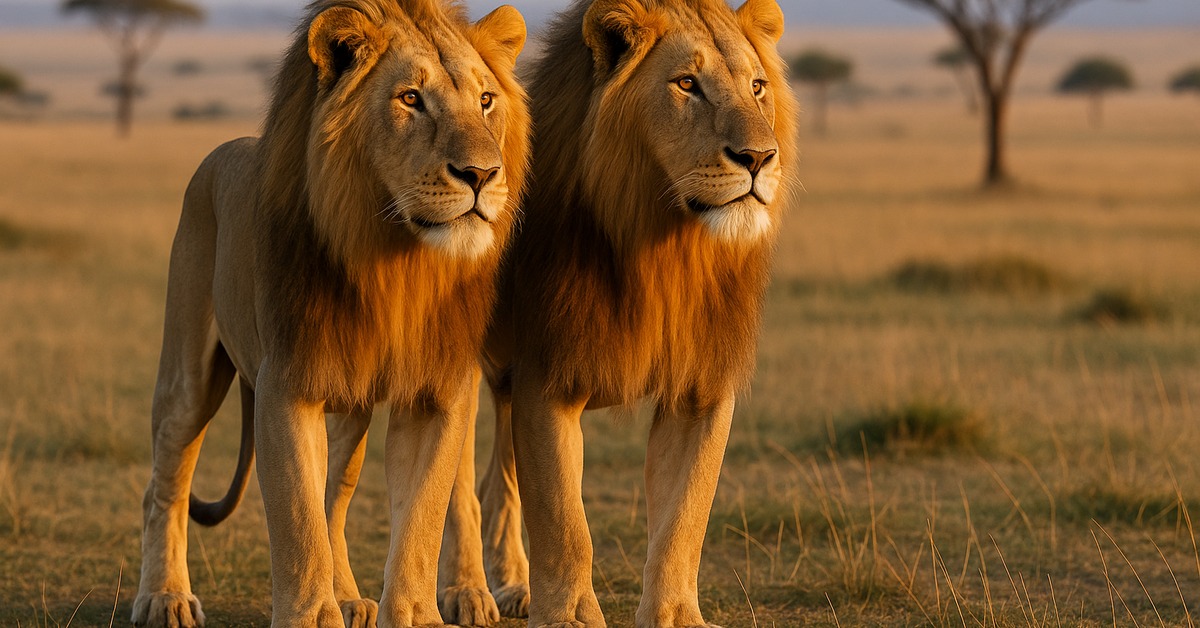
When Notch finally lost the Marsh Pride in 2007, the expected script wrote itself: aging male wanders off, adolescent sons scatter to the periphery, everyone disperses into the brutal lottery of finding new territory. That’s not what happened. Notch stayed with his sons — all five of them. The coalition that formed numbered six lions, an unusually large grouping. By 2008, this family unit had asserted dominance over roughly ten prides across the central Maasai Mara, controlling one of the largest territorial ranges recorded for a lion coalition in the ecosystem.
Six adult males moving as a coordinated unit is a different proposition entirely from a single aging male and a scattered group of confused adolescents. The numbers changed the outcome. What makes the Notch lion Maasai Mara coalition so remarkable in the wider record of animal dynasties is the same quality that makes certain human stories impossible to forget — loyalty that defies the math of survival.
Field guides who worked the Mara during those years describe the coalition as something you felt before you saw it. Six adult males cresting a ridge at dusk — the sheer mass of them, the unhurried pace — communicated a kind of authority that smaller groups simply can’t manufacture. Notch, older and more scarred than his sons, moved at the center. Always the center.
What Science Says About Father-Son Lion Bonds
Why does this matter beyond one lion’s story? Because it forces a reckoning with what we thought we understood about paternal investment in large felids altogether.
Father-son coalitions in lions are genuinely rare in the scientific literature, and the Notch case sits at the edge of what researchers can confidently explain. Most lion coalitions form between brothers or unrelated males of similar age who grow up together on the periphery of a pride. Research flagged the Notch coalition as an outlier case that challenges baseline assumptions about paternal investment in large felids — the mechanics of male lion dispersal, where young males are pushed out and must build coalitions from scratch, make it statistically unlikely for a father to remain bonded to sons long enough to form a functional unit at all.
And yet the counterintuitive element here isn’t just the emotional narrative — it’s the evolutionary logic. A father remaining with adult sons doesn’t obviously serve his reproductive interests in the short term. His sons aren’t his genetic future in the way his cubs are; they’re competitors for the same resources. (Researchers actually call this the coalition cost problem — the tension between individual reproductive payoff and group territorial benefit.) The Notch lion Maasai Mara coalition demonstrated that combined territorial dominance created conditions under which all members, including the aging patriarch, had access to food, safety, and eventually breeding opportunities with the prides they controlled.
Here’s the thing: it may not be sentiment at all. It may be sophisticated, if instinctual, game theory — played out across a grassland at dawn by animals with no concept of what they were proving. Researchers who’ve tried to fit the Notch case into existing dispersal models have consistently found it doesn’t quite fit anywhere.
The data here doesn’t flatter simpler explanations, and any framework that tries to reduce what Notch did to accident alone deserves scrutiny it rarely gets.


The Notch Lion Maasai Mara Coalition at Peak Power
From 2008 into 2009, the coalition was at the height of its territorial reach. A study of pride dynamics in the central Mara during this period documented the coalition’s control across an area spanning multiple river systems and overlapping the ranges of at least ten distinct prides. For context, a typical dominant male or pair of males in the Mara might reliably control one to three prides at any given time — six males working in coordinated unison multiplied that reach by an order of magnitude that hadn’t been systematically recorded in the ecosystem before.
That’s not a pride. That’s a dynasty.
Territorial control at that scale produces cascading effects. Other males learned the coalition’s scent markers and avoided conflict. Younger challenger groups — pairs and trios of incoming males — tested the perimeter and retreated. Rangers and guides began recognizing individual coalition members by their scars and mane patterns. Notch himself — identifiable by a distinctive notch in his ear, the feature that gave him his name — was documented regularly moving across the territory, still present, still central to the group’s movements even as his sons grew larger and more physically dominant than their father. The coalition didn’t need to fight constantly; their reputation functioned as a deterrent, and from 2008 to roughly 2011, that grip held in a way most wildlife managers in the area hadn’t seen replicated before or since.
How It Unfolded
- 2005 — Notch loses his primary mate to a rival male; his hold on the Marsh Pride begins to erode and his five young sons face immediate threat from incoming challengers
- 2007 — Notch is displaced from the Marsh Pride but, defying standard dispersal behavior, remains with all five of his sons rather than wandering off alone
- 2008 — The six-male coalition reaches peak territorial dominance, controlling the ranges of approximately ten prides across the central Maasai Mara — a scale rarely recorded for any single coalition in the ecosystem
- 2013 — Notch disappears from field notes and camera trap records, estimated at fourteen to seventeen years of age; his sons continue holding territory under the names Four Musketeers and Three Musketeers
When Dynasties End and What They Leave Behind
Every territorial dynasty in the animal world has a ceiling. For the Notch coalition, it arrived around 2011 — not as a sudden collapse but as a gradual erosion. The sheer geographic scale of territory they’d claimed became impossible to police effectively. Challenger groups found gaps. Younger males from outside the region began testing boundaries that a six-lion coalition, now aging at its core, couldn’t simultaneously defend.
Historical parallels aren’t hard to find: the Mapogo coalition in South Africa’s Sabi Sand Game Reserve, six males who controlled vast territory through extreme aggression in roughly the same era, faced a structurally identical problem. Expansion creates vulnerability. The wider you spread, the thinner your actual presence becomes on any given border.
But what came next wasn’t the story most people expect. One pride slipped out of their control, then another. Territorial boundaries contracted back toward a core range that could realistically be defended by a smaller, older group. By 2012, the coalition had fractured into smaller sub-units. What had been a family bloc became several smaller alliances, each anchored by one or two of Notch’s sons. The dynasty didn’t collapse — it subdivided.
In 2013, Notch was last sighted in the Maasai Mara. He was old by any lion’s standard — likely between fourteen and seventeen years of age, well beyond the typical eight-to-ten-year lifespan of a wild male. No carcass was ever confirmed. He simply stopped appearing in field notes and camera trap records, the way the oldest animals often do. Quietly, at the edge of the known range, somewhere the monitors don’t reach.

By the Numbers
- Approximately 20,000 lions remain in the wild across Africa as of 2023, down from an estimated 200,000 in the mid-20th century (IUCN Red List)
- At its 2008 peak, the Notch coalition held territory overlapping roughly 10 prides across the central Maasai Mara ecosystem
- Wild male lions average 8–10 years in the wild; Notch was estimated at 14–17 years at the time of his 2013 disappearance — nearly double the expected ceiling
- Father-son coalitions represent fewer than 5% of documented male lion coalitions in long-term African field studies, making the Notch case roughly 20× rarer than standard brother coalitions
- Kenya’s Maasai Mara ecosystem covers approximately 1,510 square kilometers; the broader Mara-Serengeti ecosystem spans over 25,000 square kilometers — the territory the Notch coalition ranged across represented a significant fraction of the Mara’s monitored core
Field Notes
- Notch got his name from a distinctive notch in his left ear — likely a fight wound — which allowed field researchers and guides to identify him reliably across years of documentation without tags or collars. A reminder that individual recognition in wildlife monitoring still depends, more than people assume, on old-fashioned observation.
- Most visitors to the Mara assume lion prides are female-led in terms of structure, which holds true for hunting and cub-rearing units — but territorial control, breeding access, and coalition politics are almost entirely driven by male dynamics that play out separately from, and often invisibly to, the female-centered social core.
- Notch’s coalition’s rise coincided with a period of unusually high prey density in the central Mara, which may have made sustaining six adult males metabolically feasible in ways that leaner years would have prevented. Circumstance mattered, even if it wasn’t the whole story.
- Researchers still can’t determine whether Notch’s behavior reflected anything like a learned or inherited tendency, or whether it was simply an anomalous outcome of specific circumstances — which means replicating the conditions to study it systematically remains effectively impossible.
Frequently Asked Questions
Q: What made the Notch lion Maasai Mara coalition historically significant?
Significant because it formed between a father and his five sons — an arrangement exceptionally rare in documented lion behavior. At its 2008 peak, the coalition controlled territory across approximately ten prides in the central Maasai Mara, a scale of dominance rarely recorded for a single coalition. Most male lion groupings of comparable size form between unrelated peers, not across generations.
Q: Why do new dominant lions kill cubs when they take over a pride?
When incoming males displace resident males in a pride, the females are still nursing cubs sired by the previous males. A nursing female won’t return to estrus — the reproductive cycle that makes her available to mate — until her cubs are weaned or die. Killing existing cubs accelerates the female’s return to reproductive availability, allowing new males to sire their own offspring faster. Cold in its logic, but consistent across lion populations globally.
Q: Did Notch’s sons go on to lead their own coalitions after the group split?
Several of Notch’s sons established their own territorial presences in the Maasai Mara after the coalition fractured around 2011 and 2012. The most documented were a sub-group known as the Four Musketeers and another referred to as the Three Musketeers, both believed to include Notch’s sons. A common misconception is that the Notch dynasty ended with Notch’s disappearance in 2013 — in reality, his genetic legacy continued actively shaping the Mara’s lion population for years afterward through his sons’ own territorial reigns.
Editor’s Take — Alex Morgan
Eight years is a long time to hold anything together on the Maasai Mara. What stays with me about Notch isn’t the scale of territory his coalition controlled at its peak — it’s the two years before any of that, when it was just one scarring male between five cubs and every challenger on the grassland. The science still can’t fully explain why he stayed. I’m not sure it needs to. Some outcomes are their own explanation, written in the animals that outlived their father.
What Notch’s story forces us to sit with isn’t really about lions. It’s about what loyalty costs, and what it occasionally, improbably, builds. An aging male on a grassland, choosing proximity over self-interest, not once but across eight years of escalating odds. Whether that choice was instinct or something stranger doesn’t change what it produced: a dynasty, a legacy, and a question that wildlife researchers are still genuinely unable to answer. What would African lion populations look like if more fathers stayed?


