Why Octopuses Have Three Hearts and Blue Blood
Three hearts, and one of them stops the moment the animal swims. That’s the paradox at the center of the octopus three hearts blue blood system — not a defect evolution forgot to fix, but a copper-laced solution to a problem red-blooded animals never had to solve. The ocean built something stranger than we expected, and it’s been working for 300 million years.
Beneath rocky overhangs off the Greek coast, in water barely 12°C, a common octopus (*Octopus vulgaris*) hunts in near-darkness with a cardiovascular system that would baffle any cardiologist. Blue blood pumps where red can’t cope. A main heart goes silent mid-sprint. How did evolution land on something so counterintuitive — and why does it work so well?
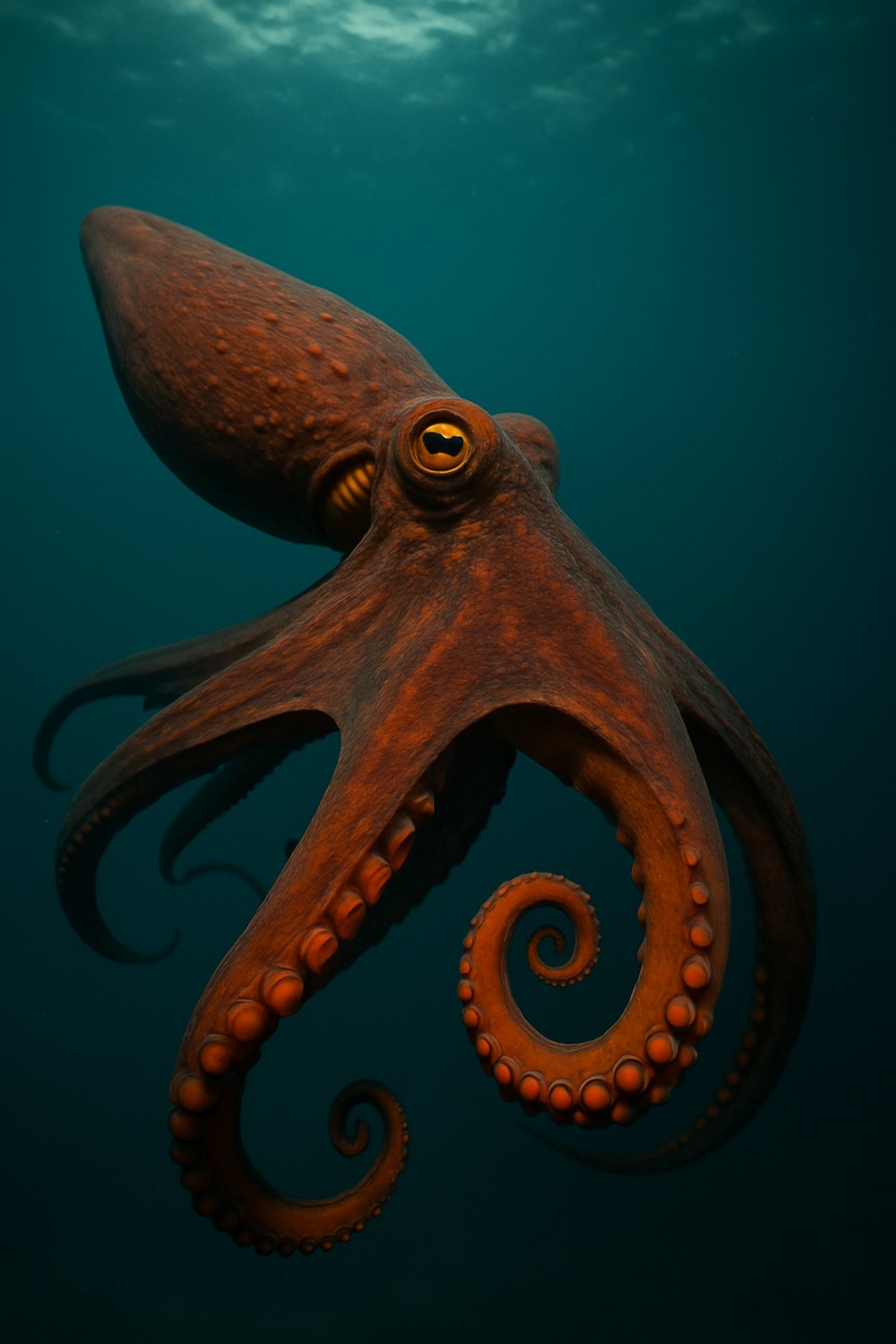

Why the Octopus Three Hearts Blue Blood System Exists
Start with oxygen — or rather, the lack of it. Researchers at the Stazione Zoologica Anton Dohrn in Naples, one of the world’s oldest marine biology institutes, have studied *Octopus vulgaris* in its natural Mediterranean habitat since the 1870s. What their work, and a landmark 2010 study published in *Marine Biology*, confirmed is that the three-heart arrangement isn’t redundancy for its own sake — it’s a precision response to the physics of cold, deep water. Two branchial hearts flank the gills and push deoxygenated blood through them, forcing it into contact with whatever oxygen the water holds. A third, the systemic heart, collects freshly oxygenated blood and drives it out through the aorta to the brain, arms, and organs.
Without this division of labor, the pressure needed to push blood through those long, muscular arms simply couldn’t be maintained at the gill stage too. The two jobs require different pressures, different timing, and — critically — different hearts.
Here’s the thing: when an octopus swims — really swims, jetting through open water — the systemic heart stops beating. Not slows. Stops. Hemocyanin, the copper-based protein that colors octopus blood blue, remains in circulation, but the systemic push pauses entirely for the duration of the swim. The branchial hearts keep working. But the main pump goes silent. It’s one reason octopuses actively dislike swimming and will almost always choose to crawl — the energy cost is too high, and the design penalizes open-water movement by starving the body of fully circulated oxygen at the exact moment it needs it most.
Think of it as a car that loses power steering the moment you accelerate past 60. It works. It gets you there. But you learn, very quickly, not to push it. Octopuses learned that lesson about 300 million years ago.
Blue Blood in a Cold and Oxygen-Thin World
Human blood is red because hemoglobin — the protein that ferries oxygen through our bodies — is built around iron. When iron binds oxygen, it turns bright red. Octopus blood is blue because it uses hemocyanin instead, built around copper. When copper binds oxygen, it turns a distinctive blue-green. That distinction isn’t cosmetic. It’s the whole adaptation. Hemocyanin performs poorly at warm temperatures and high pH, which is precisely why you won’t find it in warm-blooded mammals. But in cold, low-oxygen, slightly acidic deep water — the kind found 200 meters down in the eastern Mediterranean or off the Canary Islands — hemocyanin outperforms hemoglobin significantly. It binds oxygen more efficiently at low partial pressures, meaning it can extract a useful amount of oxygen from water where red-blooded animals would begin to struggle. This biological trade-off appears in other cold-water specialists too — much like the deep-sea creatures off the coasts of places like Australia’s ancient underwater shelves, whose chemistry is tuned to specific pressure and temperature windows.
Why does temperature matter so much? Because hemocyanin’s advantage isn’t fixed — it scales with cold.
In 2016, researchers at the Alfred Wegener Institute in Bremerhaven published findings on how Antarctic octopuses — specifically *Pareledone* species — use hemocyanin with an even higher oxygen affinity than their Mediterranean relatives, adapted to water temperatures hovering around 0°C. Their blood is a deeper, more saturated blue. At 0°C, hemocyanin can carry roughly three times the oxygen load it manages at 25°C. Evolution, in this case, didn’t just tinker — it committed entirely to a different chemistry. And an octopus moved suddenly into warmer water doesn’t just feel uncomfortable. Its blood becomes functionally less efficient almost immediately, oxygen-carrying capacity drops, and the animal tires faster, hunts less effectively, and becomes vulnerable. Temperature isn’t just weather for these animals — it’s a dial that controls the efficiency of every heartbeat.
The Heart That Stops During Swimming
It sounds catastrophic. But marine biologists at the Monterey Bay Aquarium Research Institute (MBARI) in California, who have conducted extensive video observation of deep-sea cephalopods since the early 2000s, have documented how this pause is built into the octopus’s behavioral repertoire as a feature rather than a flaw. The systemic heart stops because the muscular effort of jetting through water — contracting the mantle hard and repeatedly — physically compresses the pericardial sac surrounding it. That compression interrupts normal cardiac function. The octopus can’t stop this happening any more than a human can choose not to have their heart rate rise while sprinting. Compensation comes from the branchial hearts, which continue pushing oxygenated blood through the gills and maintain some level of circulation throughout. It’s a workaround, not a solution — and it explains why octopuses, despite being capable of remarkable bursts of jet-propelled speed, consistently prefer slow, arm-walking locomotion across the seafloor in almost every observed foraging situation.
The energy math is stark. Swimming costs an octopus significantly more oxygen than crawling, at the exact moment its oxygen delivery system is least effective. Laboratory measurements taken at the University of British Columbia in 2019 showed that jet-swimming raised metabolic oxygen demand in *Octopus rubescens* by more than 200% compared to resting, while simultaneously reducing systemic heart output. The gap between demand and supply widens the longer the swim continues. Octopuses resolve this by keeping sprints short — typically three to five seconds — before returning to the seafloor.
Not timidity. Arithmetic.
Watch one hunt on video and the pattern is obvious: slow approach, sudden jet, immediate return to substrate. Three seconds of flying, then the arms take over again. The octopus three hearts blue blood system and the behavior it shapes aren’t limitations — they’re the reason the animal can function at all in an environment where those three seconds of speed are usually enough.
What Octopus Three Hearts Blue Blood Reveals About Evolution
Turns out, the octopus cardiovascular system is an unusually clear example of what evolutionary biologists call convergent pressure — where a single environmental challenge shapes multiple biological systems simultaneously toward the same solution. The three-heart layout, the hemocyanin-based blood, the chromatic skin camouflage, the distributed nervous system with two-thirds of all neurons located in the arms rather than the brain — all of it points toward an animal engineered from every angle for a specific ecological niche. A 2021 study from the Max Planck Institute for Brain Research in Frankfurt, examining the neural architecture of *Octopus vulgaris*, noted that the arm-based nervous system allows independent limb movement even when the systemic heart is paused, meaning the arms can continue searching for prey during a swim-recovery pause.
An architecture that anticipates failure, because failure in deep cold water is always one bad decision away — that’s not an accident of evolution. That’s the whole point, and the committee of selection pressures that built this system left no room for a simpler answer.
And distributed redundancy like this is rare in vertebrates, where a single central heart failure is typically catastrophic. Octopuses have offloaded enough function to peripheral systems that no single failure point takes down the whole animal immediately. Three smaller systems, each with a distinct role, are more resilient in a harsh environment than one large one. If a branchial heart is compressed or stressed, the systemic heart continues. If the systemic heart pauses during swimming, the branchials hold the line.
Researchers at the Woods Hole Oceanographic Institution in Massachusetts are currently mapping hemocyanin variants across different octopus species to understand how rapidly this protein adapts to local temperatures. Early results suggest population-level adaptation can occur in as few as 20 to 30 generations — geologically speaking, an eye blink.

Where to See This
- Eastern Mediterranean waters — particularly the coasts of Greece, Croatia, and southern Italy — offer the best chance of watching *Octopus vulgaris* in shallow rocky habitat between April and October, when they move into waters of 15–20 meters during warmer months.
- Monterey Bay Aquarium in California (montereybayaquarium.org) maintains giant Pacific octopus (*Enteroctopus dofleini*) in captivity year-round and offers detailed interpretive material on cephalopod cardiovascular biology for visiting researchers and the public.
- For deeper reading, the 2016 paper “Hemocyanin Function and Evolution in Cephalopods” in *Frontiers in Physiology* remains the most accessible technical overview of why blue blood behaves differently at low temperatures — freely available through open-access journals.
By the Numbers
- 2/3 — the proportion of an octopus’s total neurons located in its arms rather than its central brain, allowing independent movement even during cardiac pauses (Max Planck Institute for Brain Research, 2021)
- 200 meters — the typical maximum foraging depth of *Octopus vulgaris* in the eastern Mediterranean, where temperatures average 12°C
- 3× — hemocyanin’s oxygen-carrying advantage over hemoglobin at 0°C compared to 25°C (Alfred Wegener Institute, 2016)
- 3–5 seconds — the typical duration of a full jet-swimming burst before an octopus returns to the seafloor to recover systemic cardiac function
- ~300 million years — the estimated evolutionary age of the cephalopod body plan, predating dinosaurs by roughly 65 million years
Field Notes
- In 2018, divers working with the Hellenic Centre for Marine Research off Crete documented an *Octopus vulgaris* that appeared to “freeze” for 40 seconds after a jet-swimming escape — now interpreted as a recovery pause while the systemic heart re-established normal rhythm following sustained compression.
- Octopus blue blood turns colorless when fully deoxygenated (researchers actually call this the “cleared” state), meaning a dead or severely oxygen-deprived octopus loses its blue tint entirely — a fact that confused early anatomists, who sometimes recorded octopus blood as “clear.”
- All cephalopods — squid, cuttlefish, and nautiluses — run variations on the same branchial-plus-systemic layout, suggesting the three-heart system evolved once in the common ancestor and has been conserved for hundreds of millions of years.
- Researchers still can’t fully explain why the systemic heart doesn’t simply beat harder to compensate for the compression during swimming, rather than stopping — the mechanical models predict partial, not complete, cessation, and the gap between prediction and observation remains unresolved.
Frequently Asked Questions
Q: Why does an octopus have three hearts and blue blood — isn’t one heart enough?
One heart isn’t enough when you need to maintain different blood pressures at the gills and across the body simultaneously. The octopus three hearts blue blood system divides the cardiovascular workload: two branchial hearts manage gill oxygenation, while the systemic heart handles whole-body distribution. This split is essential given the low oxygen availability in cold deep water, where a single heart couldn’t maintain both pressures efficiently. It’s not excess — it’s specialization.
Q: Does the blue blood actually work better than human red blood?
In cold, low-oxygen conditions, yes — significantly. Hemocyanin, the copper-based protein that makes octopus blood blue, binds oxygen more efficiently at low partial pressures and cold temperatures than hemoglobin does. At 0°C, the advantage is roughly threefold. At human body temperature (37°C), hemocyanin performs poorly, which is why warm-blooded animals never evolved it. The two systems are optimized for completely different thermal environments — neither is universally better, but hemocyanin wins decisively in the cold deep ocean.
Q: Is it true the octopus’s heart actually stops when it swims?
Yes — the systemic heart stops, but not from cardiac arrest in any dangerous sense. Muscular contractions of jet-swimming compress the pericardial sac surrounding the heart, physically interrupting its rhythm. The two branchial hearts continue working throughout. Because this happens every time an octopus swims, the animal has evolved behavior to minimize swimming duration and prefer crawling. It’s a common misconception that the octopus is in danger when this happens — the pause is a normal, built-in feature of the system, not a malfunction.
Editor’s Take — Alex Morgan
What strikes me most about the octopus three hearts blue blood story isn’t the biology — it’s what it implies about our assumptions. We tend to treat the vertebrate cardiovascular plan as the template, the sensible one, and everything else as a workaround. But an octopus running on copper-blue blood and a heart that voluntarily stops during exertion has been hunting successfully for 300 million years. That’s not a workaround. That’s a system so well-matched to its environment that it never needed updating. We’re the recent experiment. The octopus is the proof of concept.
Cold water doesn’t ask for explanations. It selects what works and discards what doesn’t, over timescales that dwarf everything humans have ever built or written. An octopus gliding across a Mediterranean seafloor at midnight, three hearts in motion, blood running blue through eight arms with minds of their own — it’s a reminder that life found workable solutions to hard problems long before we arrived to study them. What else is down there, running on chemistry we haven’t thought to look for yet?