


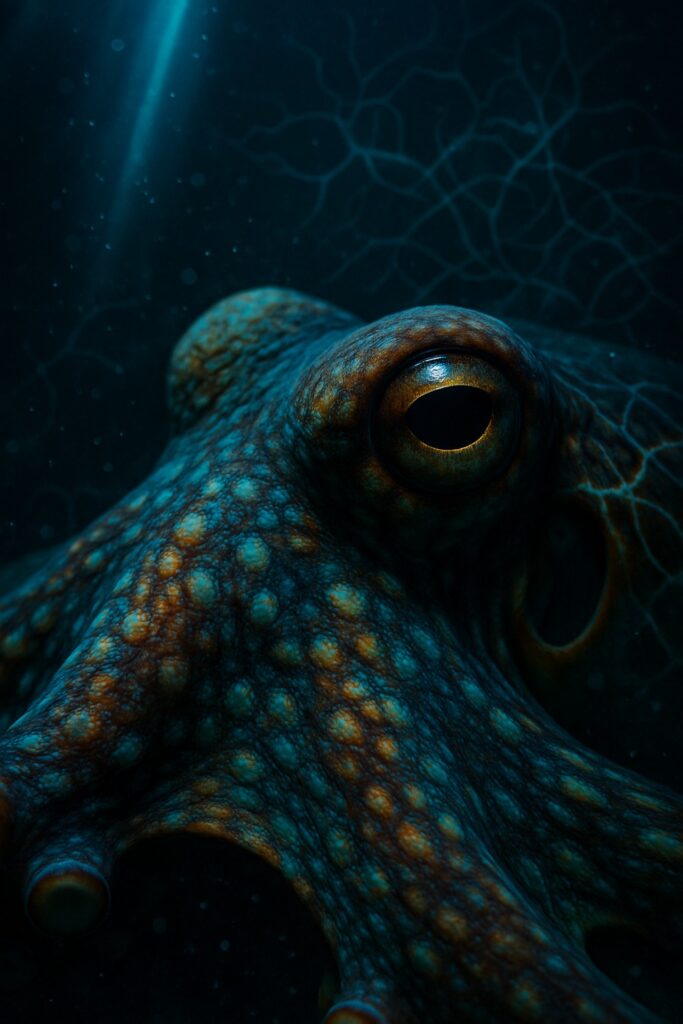
Octopus RNA editing shouldn’t work the way it does — and for a long time, nobody thought to check. Researchers were running routine neuron studies when the readouts came back wrong: the RNA leaving those cells didn’t match the DNA that produced it. Not in a handful of spots. In tens of thousands. Sixty percent of octopus protein-coding genes get chemically rewritten at the RNA level, in real time, inside living brain cells — while the animal is actively using them.
Researchers at the Scripps Institution of Oceanography, including Eli Eisenberg who co-led much of the key work, have spent years trying to map out exactly what that means — and the more they find, the stranger it gets. The common octopus, Octopus vulgaris, isn’t just living with the DNA it was born with. It’s annotating it. On the fly. While thinking.
How Octopus RNA Editing Actually Works in Practice
Every cell reads DNA to produce RNA, and RNA tells the cell which proteins to build. Here’s the basic setup most biology textbooks offer: for most animals, whatever RNA the DNA produces is what you get. The instructions come down from the master copy, unchanged, every time. That’s it.
Octopuses do something different. They chemically alter individual RNA letters before the protein ever gets made — swapping adenosine for inosine at specific sites, which changes what the protein ultimately looks like and how it behaves. According to RNA editing research, this kind of large-scale recoding is extraordinarily rare. Most animals show it in fewer than 1% of their genes. Octopuses do it across tens of thousands of sites.
Think of DNA as a recipe book locked behind glass. RNA editing is the chef penciling substitutions on a notepad right before cooking — the original recipe never changes, but what comes out of the kitchen can be completely different. And the octopus is doing this constantly, in real time, across its entire nervous system.
The Brain Connection Changes Everything Here
The editing isn’t spread evenly across the body. It clusters in neurons.
That’s not random. The proteins being most heavily edited are disproportionately involved in neural function — ion channels, proteins that govern how electrical signals travel through nerve tissue. Which makes sense when you think about what an octopus actually does with its brain: it’s solving puzzles, escaping tanks, recognizing individual human faces. That level of behavioral flexibility has to be coming from somewhere, and this might be a significant piece of it.
An octopus has around 500 million neurons — roughly comparable to a dog. But two-thirds of those neurons aren’t in the head at all. They’re in the arms: eight semi-autonomous limbs, each running complex sensory and motor processing independently. RNA editing may be how the octopus keeps all of that distributed machinery synchronized and flexible without needing to overhaul its genome every generation.
Why This Makes Octopuses Uniquely Adaptable Animals
Evolution through DNA mutation is slow. Generationally slow. A useful mutation might take thousands of cycles to propagate through a population, assuming it survives selection at all.
What changed? Everything, starting with the RNA editing system that sidesteps that constraint entirely. When water temperature drops, or a new predator appears, or the chemistry of a tide pool shifts overnight — the octopus doesn’t wait for its genome to catch up. The RNA editing system can adjust protein behavior in the moment, tuning the nervous system to new conditions the way you’d adjust a thermostat. Most animals genuinely don’t have this.
That’s not a small advantage. It’s worth saying plainly: a mechanism that compresses evolutionary timescales into the span of a single organism’s life is, by any reasonable measure, one of the most significant biological capabilities we’ve ever documented.
Octopuses already thrive in conditions that would stump most marine animals — shallow tropical reefs, deep cold-water floors, rocky intertidal zones that transform twice a day. Biologists have always found that range puzzling. RNA editing might finally be the explanation. Though one question nobody’s answered yet: does the octopus consciously trigger these edits, or are they automatic responses to physiological stress signals the animal has no awareness of?

The Cold Water Clue Scientists Didn’t Expect
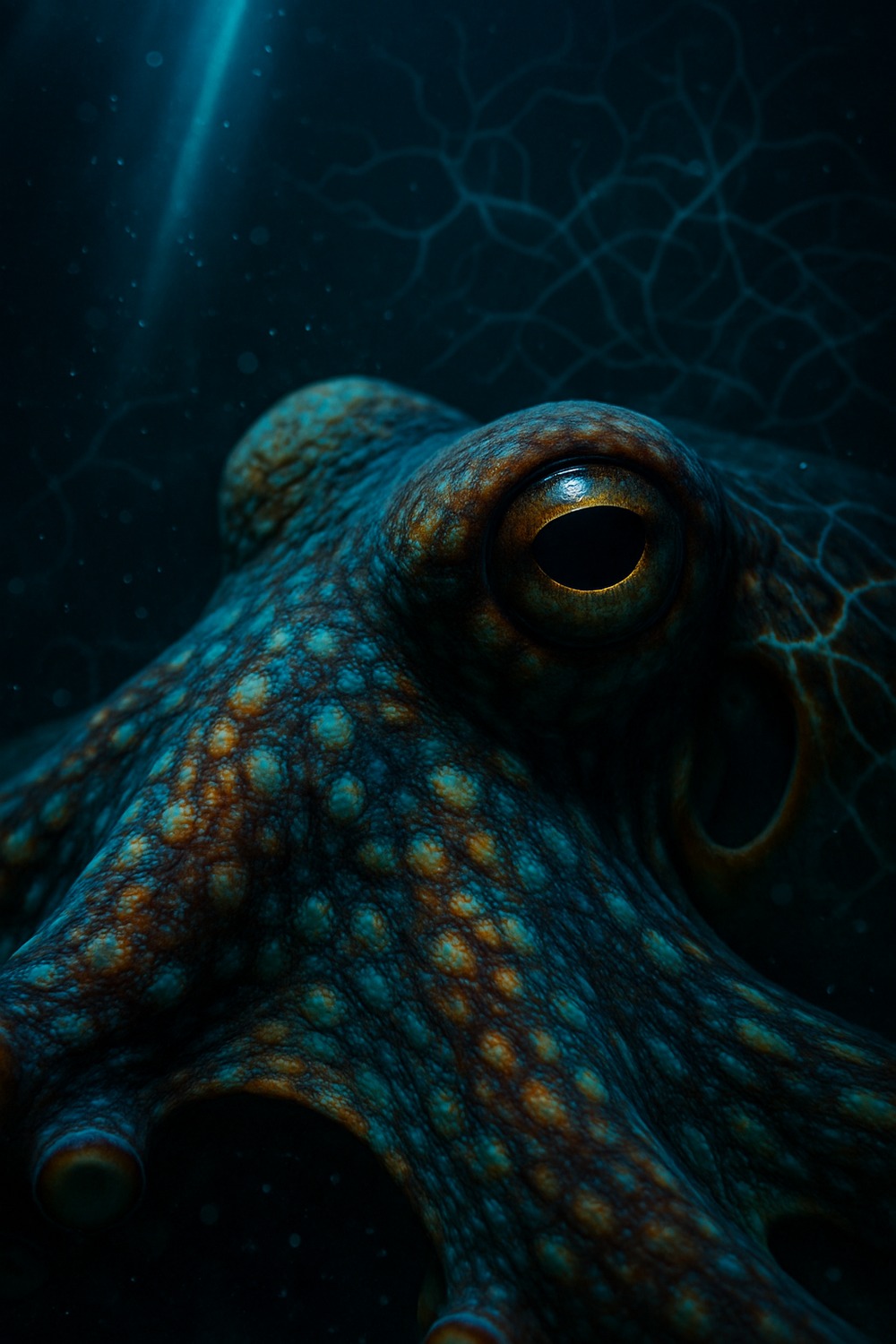
Antarctic octopuses were the first hard data point. Compared to their warm-water relatives, they showed dramatically ramped-up RNA editing in the specific neural proteins that govern how nerves fire at low temperatures. Membranes stiffen in the cold. Electrical signals slow down. The RNA editing appears to compensate directly for this — keeping the nervous system operating normally in conditions that should, by most biological logic, impair it significantly.
Turns out, that last finding is the one that kept pulling researchers deeper. Because what’s implied isn’t just “octopuses are interesting.” What’s implied is that the timescale of adaptation here is completely different from anything we normally associate with evolution. DNA mutations that achieve the same compensation would require countless generations of selection pressure. RNA editing can, in theory, happen within a single animal’s lifetime.
Maybe within days. Scientists are only beginning to map out where that boundary actually sits.
How It Unfolded
- 2015 — Rosenthal and Eisenberg’s teams publish in Cell, identifying ~60% of octopus protein-coding genes undergoing RNA editing, far exceeding any previously studied animal.
- 2017 — Follow-up research identifies 33,000 discrete RNA editing sites in the octopus nervous system, compared to roughly 3,000 in the entire human transcriptome.
- 2019 — Studies of Antarctic Pareledone octopuses reveal environmentally-triggered editing responses to cold water, linking the mechanism directly to real-time physiological adaptation.
- 2024–2026 — Researchers begin probing whether individual octopuses vary in their editing patterns — a question with profound implications for what “individual” means at the molecular level.
By the Numbers
- ~60% of octopus protein-coding genes undergo RNA editing — compared to less than 1% in most mammals, per research published in Cell (2015) by Rosenthal and Eisenberg’s teams.
- 33,000 RNA editing sites identified in the octopus nervous system, versus roughly 3,000 in the entire human transcriptome.
- Antarctic Pareledone octopuses showed up to 55% increases in specific RNA edits when exposed to cold — the largest environmentally-triggered RNA editing response recorded in any cephalopod.
- Cephalopods are the only animal group known to use this mechanism at this scale, which is genuinely strange given that their closest relatives — slugs, snails — barely do it at all. Something shifted, evolutionarily, in the cephalopod lineage specifically.


Field Notes
- Squid and cuttlefish also show elevated RNA editing rates — suggesting this trait evolved early in cephalopod history, possibly tied to the group’s move away from protective shells toward intelligence as their primary survival tool.
- Almost all octopus RNA editing involves the same single chemical swap: adenosine to inosine (researchers actually call this A-to-I recoding). But that one swap can change how a protein folds, which changes how it interacts with other proteins, which cascades into behavioral differences that look, from the outside, like a completely different animal.
- Still unknown: whether individual octopuses vary in their editing patterns from one another. If they do, that’s a form of individual molecular plasticity nobody has a framework for yet. If they don’t, the system looks more like a hardwired reflex — sophisticated, but not quite what “flexible” usually implies.
What This Could Mean for Understanding Intelligence
Standard models of intelligence involve big brains, long developmental periods, complex social structures. Octopuses contradict all three. They live roughly two years. They’re almost entirely solitary. Their centralized brain is tiny by mammalian standards. And yet they do things — behavioral things, problem-solving things — that we normally only expect from animals with much more impressive hardware.
If RNA editing is part of the reason, it suggests something neuroscience doesn’t have a comfortable category for: that molecular adaptability might function as an alternative route to behavioral complexity. You don’t necessarily need a bigger brain. You might just need a more flexible transcriptome.
And that matters beyond biology. It’s relevant to how we model neural function, how we think about the relationship between genetics and cognition — and, uncomfortably, what we even mean when we say an animal is intelligent.
How many other animals are doing versions of this that we haven’t measured? We’ve only seriously looked at cephalopods. The tools to detect widespread RNA editing at this scale are relatively new. What if this mechanism turns out to be more common than we thought — and we missed it because we weren’t asking the right question, or weren’t looking at the right species, or just assumed the answer was already no?
Editor’s Take — Alex Morgan
I’ve read enough biology to get numb to the word “remarkable” — but this one didn’t let me do that. What stops me isn’t the scale of the editing, though 60% is staggering. It’s the implication that an animal with a two-year lifespan might be solving, at the molecular level, problems that DNA-based evolution would need millennia to address. That reframes what intelligence actually requires. Not time, not size — just the right kind of flexibility built into the right layer of the system. The octopus figured that out 300 million years ago.
Octopuses have been on Earth for around 300 million years. They’ve outlasted mass extinctions, ocean chemistry collapses, the rise of vertebrates, the whole lot. Octopus RNA editing might be a significant part of why — a molecular toolkit that doesn’t wait around for evolution to solve problems, but adjusts in the moment, in the cell, in the actively-firing neuron. That’s not a metaphor. That’s what’s happening right now in every cold tide pool and reef. There’s more at this-amazing-world.com, and genuinely — the next one gets stranger.


