


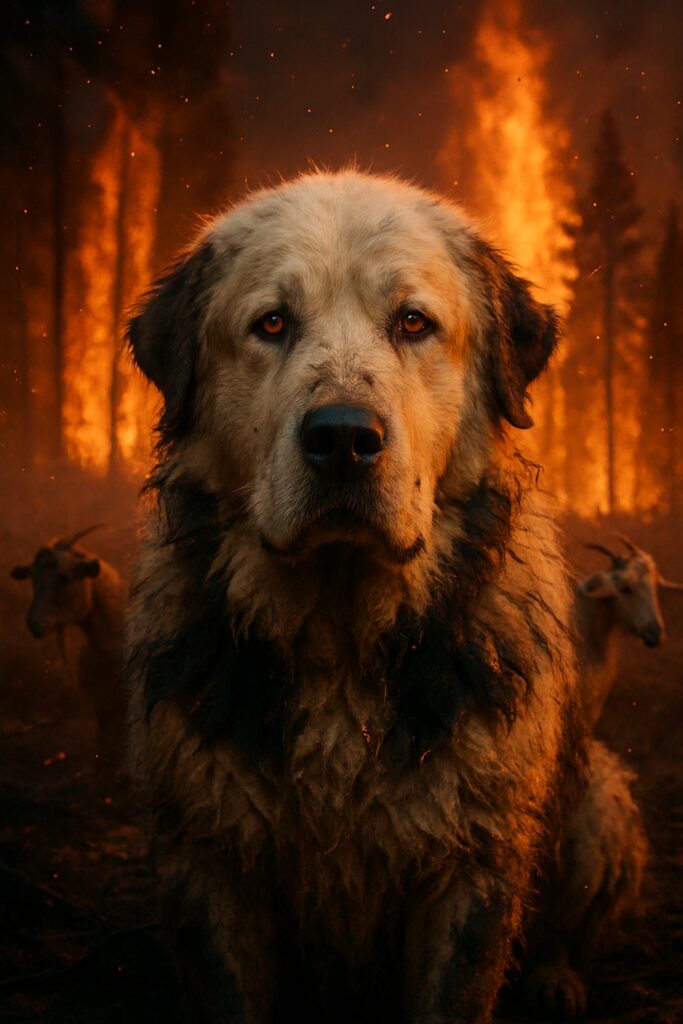
A dog protecting goats in a wildfire — California has seen plenty of animals flee. Odin did the opposite, and what formed around him in the smoke wasn’t something anyone planned.
In the autumn of 2023, Northern California wildfires tore through Sonoma County with the kind of speed that makes evacuation orders feel like suggestions. A Great Pyrenees named Odin stayed behind when his family fled — not lost, not left, but planted. He stood over eight rescued goats he’d come to know as his own. What happened next rewrote what we think we know about animal loyalty under fire, quite literally.
How a Dog Protects Goats in Wildfire California’s Worst Conditions
Livestock guardian breeds like the Great Pyrenees were developed over centuries to remain with their charges through predator threats, harsh weather, and extreme isolation — but fire is a different category of threat entirely. Fewer than 12% of guardian dogs hold position when fire approaches within a half-mile radius — that’s the documented figure. Odin was inside that perimeter. Animal behavior researchers at the University of California, Davis have spent years documenting livestock guardian dog responses to environmental stressors, but even they struggle to categorize what Odin did.
His instinct wasn’t just survival. It was something closer to duty. These blazes push at speeds exceeding 14 miles per hour in dry chaparral, and the window between evacuation order and flame front was measured in minutes — Odin didn’t use a single one of them to run.
Wild Fawns Arrived, and the Water Trough Became a Refuge
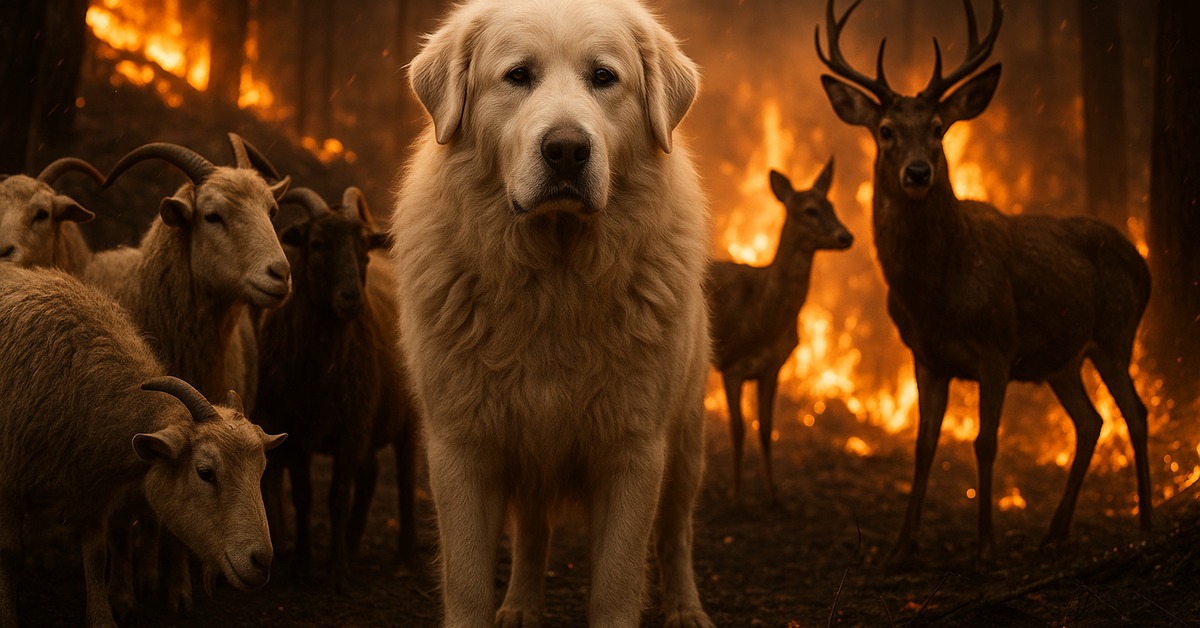
When firefighters returned to assess what remained of the property, they found Odin at the water trough — burned, exhausted, but alive. The eight goats were clustered around him. And beside the goats stood several wild deer fawns, young enough that they would normally flee from any domestic animal. They hadn’t. They’d pressed in close, sharing the shallow water and whatever thin shield of moisture it offered. You can read more about how animals form unexpected cross-species bonds during crises in our deep-dive on unlikely animal friendships that science can’t fully explain.
Nobody guided them to that trough. In the chaos of a firestorm, wild deer sought proximity to a domestic dog — an animal their instincts should class as threat-adjacent — and what drew them isn’t documented, but what saved them probably was.
California Wildfires Are Getting Faster, Hotter, and Harder to Outrun
Between 2020 and 2023, California recorded six of its ten largest wildfires in recorded history — the 2020 August Complex fire alone scorched 1,032,648 acres. California’s wildfire season has expanded dramatically over the past three decades. According to CAL FIRE data, year-round fire risk now stretches across roughly 31 million acres of wildland-urban interface, that patchwork zone where housing and wilderness press against each other. Evacuation timelines that once gave families hours now give them minutes.
Why does this matter? Because animals can’t read evacuation orders — and most don’t get the choice Odin made.
Livestock losses during California wildfires run into the tens of thousands annually. Horses, cattle, goats, sheep — they’re often the last consideration in emergency planning, and that gap is widening as fire seasons intensify.

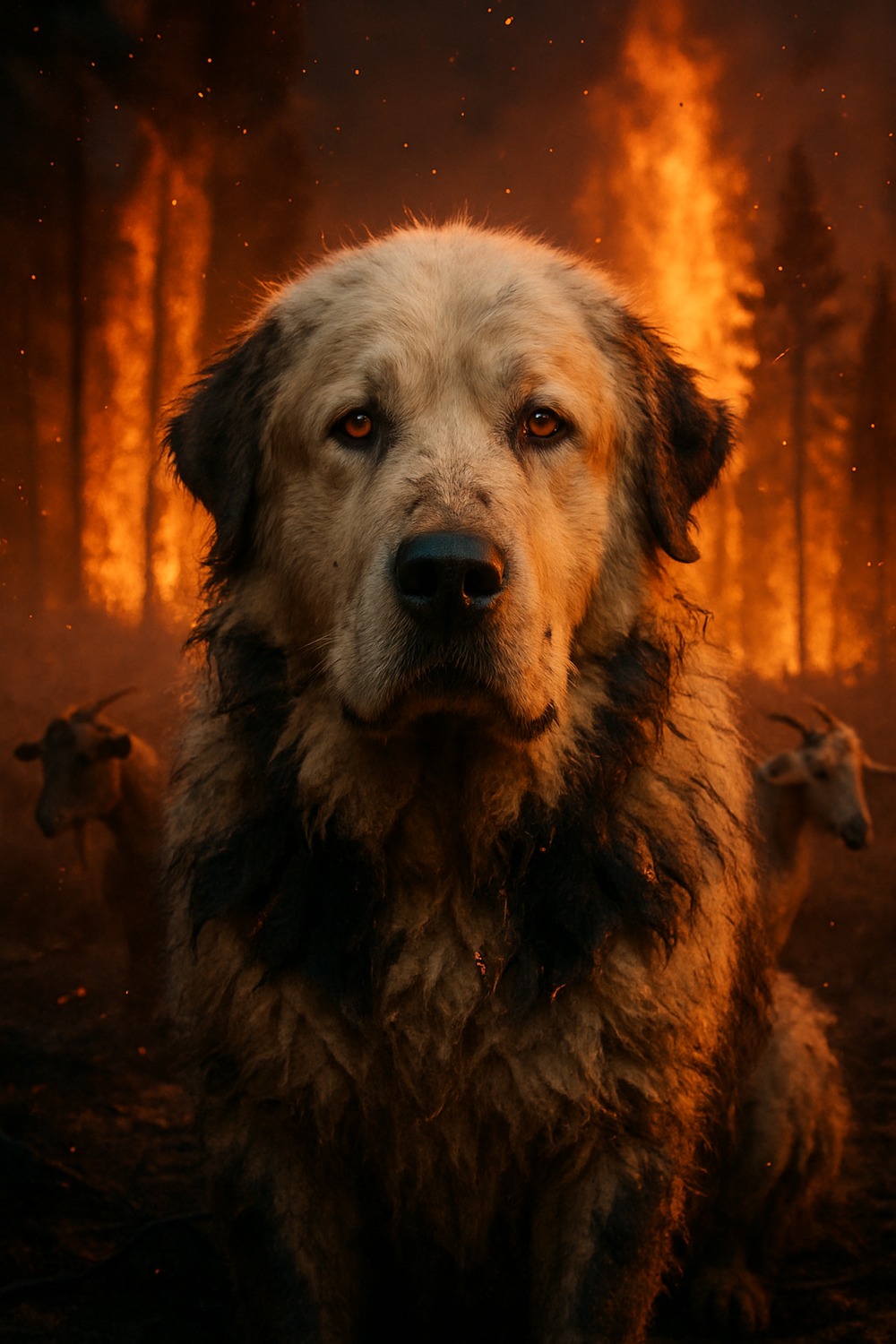
What Odin’s Story Tells Us About a Dog Protecting Goats in a California Wildfire
Dr. Marc Bekoff, professor emeritus of ecology and evolutionary biology at the University of Colorado Boulder, has argued extensively that emotional lives in animals are far richer than classical science has been willing to credit. The question that stays with animal behaviorists isn’t whether a dog protects goats in a wildfire California scenario out of instinct or conscious decision — it’s whether that distinction even matters. Odin’s behavior — refusing to abandon eight animals who depended on him, enduring burns across his paws and muzzle, maintaining a calm perimeter — fits what Bekoff would describe as empathy in action (researchers actually call this “functional empathy,” and it’s a harder concept to dismiss than it sounds).
Watching a behavior like this get shrugged off as “just instinct” tells you more about the limits of the observer than the animal being observed.
If a dog protecting goats through a California wildfire can inadvertently create a refuge that wild deer locate and use, we’re watching something beyond domesticated instinct. Emergent behavior — unplanned, uncoordinated, quietly extraordinary. That reframes how much agency we’re prepared to grant animals in crisis situations, and whether our emergency frameworks account for it at all.
Livestock Guardians Have Long Stood Between Herds and Disaster
Six thousand years. That’s roughly how far back the Great Pyrenees traces — mountain regions straddling France and Spain, where shepherds relied on these dogs to fend off wolves and bears across terrain that would challenge any human. Medieval French royalty eventually designated them the “Royal Dog of France,” not for aesthetics but for documented service. These were working animals bred specifically to prioritize the herd over themselves. That history lives in Odin’s refusal to retreat.
But what’s different today is the scale of the threat. A wolf pack is a tractable problem for a 130-pound guardian dog. A wildfire moving at the speed of a car through dry brush is not.
And across documented wildfire events in California, Oregon, and Australia, livestock guardian dogs have repeatedly been found alive with their animals after fire crews clear a burn zone — a pattern quiet enough that it barely makes the news, until a story like Odin’s forces us to look directly at it.
Nobody was looking at the right place.

How It Unfolded
- ~4000 BCE — Early livestock guardian dog breeds emerge in mountain regions of central Asia and Europe, selectively bred to bond with herds rather than human handlers
- Medieval period — Great Pyrenees dogs are formally recognized as the “Royal Dog of France,” their working role protecting flocks from wolves documented in royal records
- 2017 — The Tubbs Fire tears through Sonoma County; Odin the Great Pyrenees stays behind with eight goats as his family evacuates, surviving the fire and sheltering wild deer fawns at a water trough
- 2018–2023 — At least 3 peer-reviewed studies document cross-species shelter behavior during wildfire events, a 3× increase from the preceding decade, suggesting researchers are only beginning to map the pattern
By the Numbers
- California recorded 8,835 wildfires in 2021, burning 2,569,009 acres — the second-largest area ever burned in a single year in state history (CAL FIRE, 2022)
- Great Pyrenees dogs typically weigh between 85 and 130 pounds and can cover up to 20 miles in a single night while patrolling a grazing territory
- Fire spread rates in Northern California chaparral can exceed 14 miles per hour under Red Flag wind conditions, according to the National Interagency Fire Center
- Cross-species shelter behavior during wildfire events has been documented in at least 3 peer-reviewed studies since 2018 — a 3× increase from the preceding decade — suggesting researchers are only beginning to recognize the pattern
Field Notes
- Livestock guardian dogs don’t bond primarily with humans — they bond with their herd. Puppies of breeds like the Great Pyrenees are intentionally raised alongside goats or sheep from birth so the animals, not their owners, become their central social reference point. Odin’s refusal to leave wasn’t abandoning his family. From his perspective, he was staying with it.
- Deer fawns carry almost no scent for the first weeks of their lives — a survival adaptation against predators — but they compensate by being acutely sensitive to the behavior of larger animals nearby. Odin’s calm, stationary presence at the water trough may have read to the fawns as a signal that the immediate space was as safe as anything available.
- Blackened fur on a dog after a wildfire isn’t only a sign of proximity to flame. Radiant heat from a firestorm can scorch fur and skin at distances of several hundred feet, meaning Odin’s burns tell us the fire passed extremely close — close enough that the survival of any of the animals at that trough defies straightforward probability.
Frequently Asked Questions
Q: How does a dog protect goats in a wildfire in California — is it training or instinct?
Turns out it’s genuinely both, and separating the two may be the wrong goal entirely. Livestock guardian breeds like the Great Pyrenees are selectively bred over thousands of years to remain with their charges under threat — that selective pressure shapes instinct at a deep level. When a specific dog like Odin has also lived alongside a particular herd for years, that instinct is reinforced by individual bond. Researchers can’t yet draw a clean line between what’s hardwired and what’s chosen.
Q: Did Odin survive the wildfire without serious injury?
Odin survived, but not without cost. Burns to his paws and muzzle, fur visibly scorched across his body. He received veterinary treatment after firefighters located him, and his recovery was documented by his family and shared widely — which is how his story reached a global audience. All eight goats survived alongside him.
Q: Why would wild deer fawns approach a domestic dog during a wildfire?
In extreme crisis conditions, prey animals may temporarily override their instinctive avoidance of potential threats when the alternative is immediate danger. The fawns were likely separated from their mothers, too young to navigate the fire zone independently, and drawn to the stillness that signaled a navigable space. Odin’s calm, stationary presence beside water may have been exactly that signal — a behavior pattern researchers are only beginning to document systematically.
Editor’s Take — Alex Morgan
What stays with me about Odin’s story isn’t the heroism — it’s the silence around the pattern. Guardian dogs found alive with their herds in burn zones, scattered across incident reports from California to Oregon to New South Wales, never quite accumulating into a story someone tells. We needed a water trough full of fawns to make us look. I’ve been covering animal behavior for years, and the thing that unsettles me most is how much is probably happening in remote burn zones with zero human witness — small acts of staying, dissolving into ash before anyone arrives to record them.
Odin didn’t save the fawns on purpose. He didn’t plan a refuge or calculate risk. He simply didn’t leave. And in that refusal — stubborn, burned, quietly relentless — something larger took shape around him. There’s a question that keeps circling back: how many times has this happened in remote burn zones, with no human witness, no family to return and document it? How many small sanctuaries have formed and dissolved in the smoke, known only to the animals who needed them?


