


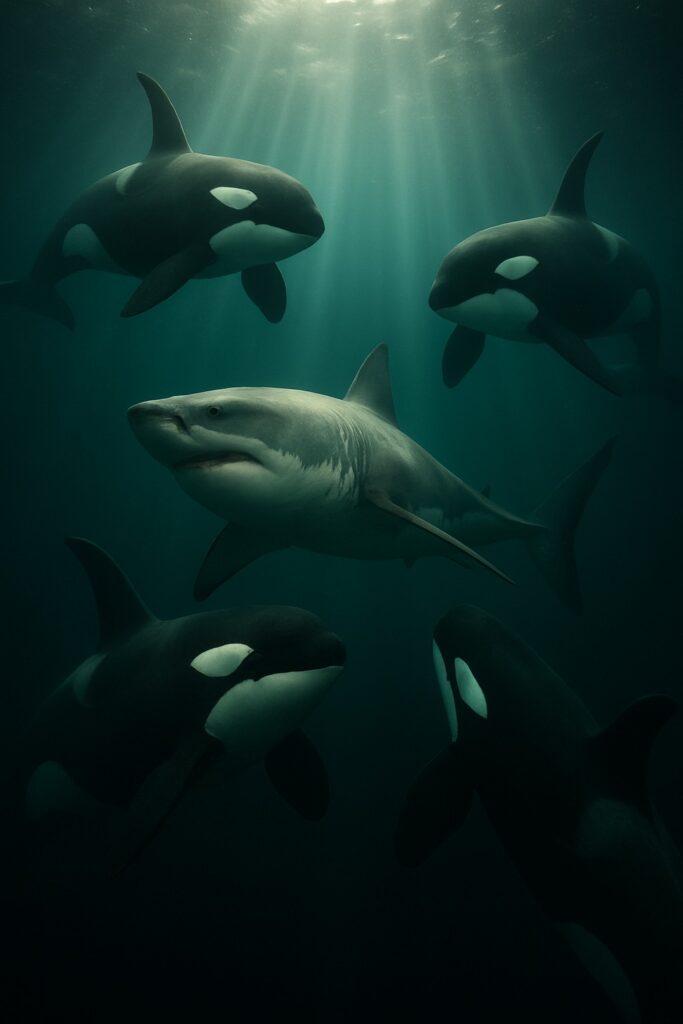
Nobody planned to study an empty ocean. That’s how this whole thing started — cage diving operators in South Africa showing up to water their entire business depended on, and finding nothing there.
Gansbaai used to be called the Great White Capital of the World. Not as marketing. As a genuine description — the sharks were so consistently present, so reliably thick in those waters, that researchers could practically set their schedules by them. Then around 2015, two orcas showed up. And somewhere between 2017 and now, the great whites just… left. Hundreds of miles of open ocean between them and a coastline their species had dominated for millennia. Turns out apex predators aren’t immune to knowing when they’re outmatched.
How Orcas Hunting Great White Sharks Actually Works
Port and Starboard — named for their collapsed dorsal fins, one bent left, one bent right — don’t hunt the way you’d expect. There’s no dramatic chase. What they do is stranger and more deliberate than that.
Working as a pair, they maneuver a great white into tonic immobility: a natural paralysis that kicks in when a shark gets inverted. The shark goes still. Limp. Alive. And then Port and Starboard open it up and remove the liver. Just the liver. Tonic immobility in sharks has been documented for decades — researchers have used it themselves to handle sharks in the field. But no one anticipated that another animal would figure out how to trigger it deliberately, consistently, as part of a feeding strategy. Dr. Alison Towner of Rhodes University, who has probably spent more time documenting this behavior than anyone, has described the extractions as almost surgical in their precision.
Which raises the obvious question: how did two orcas figure that out?
The liver isn’t an arbitrary choice. In a large great white it can weigh over 200 pounds — up to a third of the animal’s entire body weight — and it’s packed with squalene, an oily, energy-dense compound that gives the shark its buoyancy and fuels migrations across entire ocean basins. For an orca trying to maximize calories with minimum resistance, it’s basically the whole meal. Everything else gets left behind.
The Great White Capital Is Now Eerily Empty
The cage diving operators noticed first. Not just a slow week — empty days, then empty weeks, then operators running tours and coming back without a single sighting on water that used to make that outcome almost impossible. Something was wrong before anyone had the data to explain what.
Researchers started tagging sharks and tracking their movements. What came back was hard to sit with: the great whites were relocating, not just to the next cove, but hundreds of miles from Gansbaai. Away from territory their species had occupied and dominated for millions of years. That last fact kept me reading for another hour. Prey animals relocate. Apex predators — animals that don’t have anything above them in a local food chain — don’t do this. They don’t have a reason to. Except these ones did.
Port and Starboard are a very specific kind of reason.

What Happens When the Apex Predator Leaves?
Nature doesn’t sit still and wait.
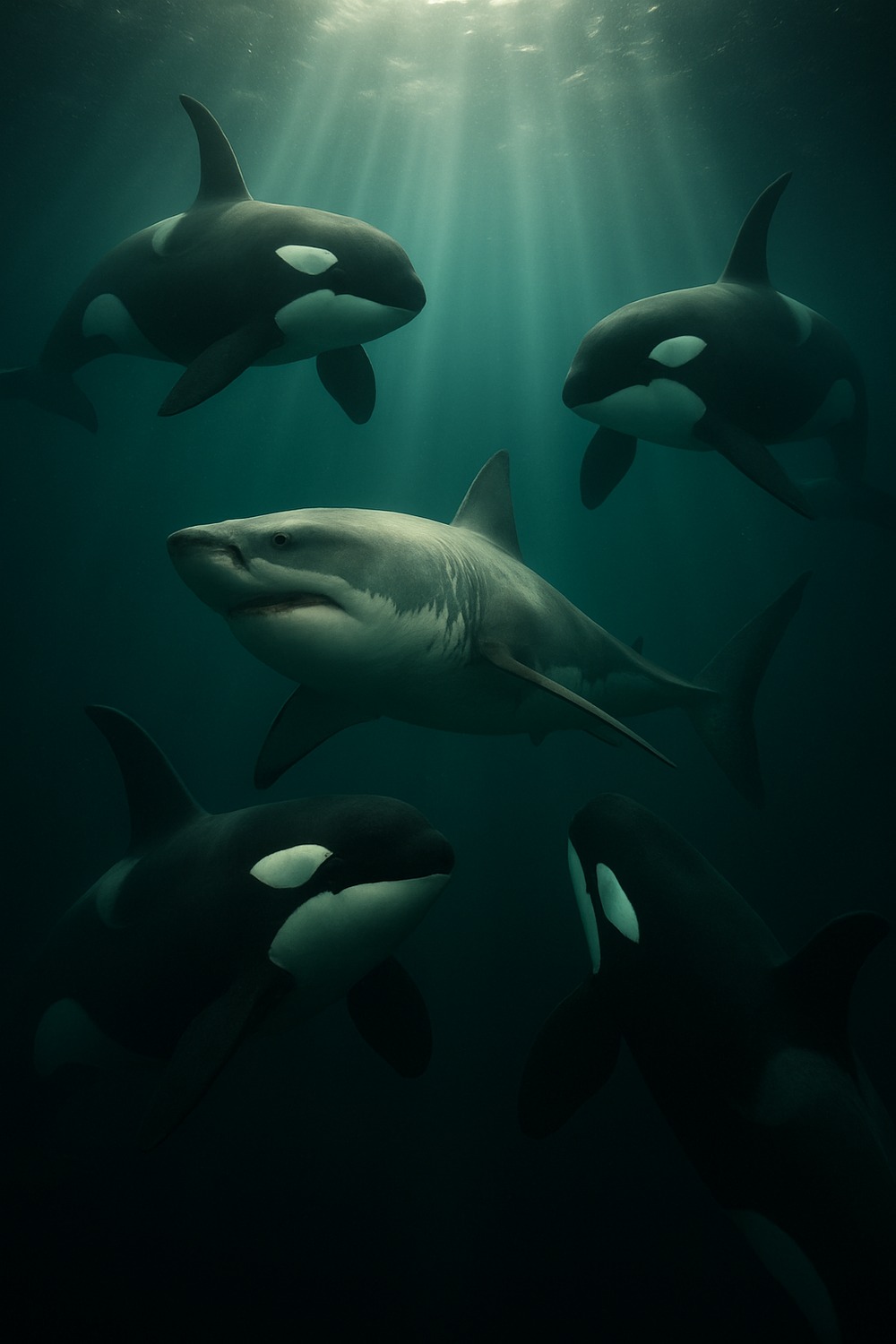
With orcas hunting great white sharks pushing the predators out of Gansbaai’s waters, everything the great whites had been keeping in check started moving. Broadnose sevengill sharks — stocky, powerful animals that had previously been outcompeted in the shallows — began showing up in numbers researchers hadn’t documented there in years. The shift happened fast. Within two years of the great white displacement, the sevengills were visibly, measurably filling the space.
This is a trophic cascade. Pull one animal out of the chain and everything above and below it reorganizes. Sometimes gradually. Sometimes in ways that take a decade to fully map out. What’s filling the silence in Gansbaai’s shallows isn’t necessarily more dangerous — but it isn’t the same ocean it was, either. And it changed in a handful of years, not geological time.
Here’s the part that keeps marine ecologists up: Port and Starboard aren’t managing anything. They’re not making decisions about ecosystems. They found something they’re good at eating, and they keep eating it. The world is rearranging itself around two killer whales and a preference for one specific organ.
This Behavior Has Never Been Recorded Before
We always knew orcas were intelligent. Coordinated hunters, complex social structures, regional dialects — none of that was new. What nobody anticipated was that individual orcas could develop techniques this precise, this consistent, and apparently this transmissible.
Port and Starboard don’t just opportunistically take sharks when they happen to encounter them. They seek them out. They’ve refined the method. They work it together. Some researchers think this looks like cultural transmission — behavior learned and shared within a social unit — which puts it in the same conversation as tool use when we talk about markers of animal cognition. The implications aren’t small. If orcas can develop targeted hunting strategies that exploit specific biological vulnerabilities — tonic immobility, organ-specific nutrition, the particular architecture of a shark’s anatomy — then what we understand about how apex predators actually think is probably missing some things.
Port and Starboard might not be anomalies. They might be the first documented version of something killer whales are capable of doing more broadly.
By the Numbers
- Great white sightings at Gansbaai dropped to near zero on many tour days since 2017 — a coastline that previously offered some of the world’s most reliable viewing (Marine Dynamics, 2022).
- Up to 24% of a great white’s total body weight is liver. In a 1,500-pound shark, that’s roughly 300+ pounds of squalene-dense tissue — which is what Port and Starboard are actually after.
- Tagged great whites relocated over 300 miles from Gansbaai following orca encounters.
- Broadnose sevengill populations in the shallows increased noticeably within two years of the displacement — one of the faster trophic cascade responses documented in recent South African marine research.
Field Notes
- Port and Starboard have also targeted bronze whalers and shortfin makos in South African waters — great whites appear preferred, almost certainly because of liver size.
- Tonic immobility in sharks typically holds for 15 minutes or longer once triggered. The shark is paralyzed and alive for the entire extraction. The orcas have more time than they need.
- Squalene — the compound that makes the great white’s liver worth targeting — is also commercially harvested for cosmetics and vaccine production. Shark liver oil has been a human commodity for centuries, which makes it quietly strange that two orcas independently arrived at the same conclusion about its value.

Why This Rewrites Everything We Thought We Knew
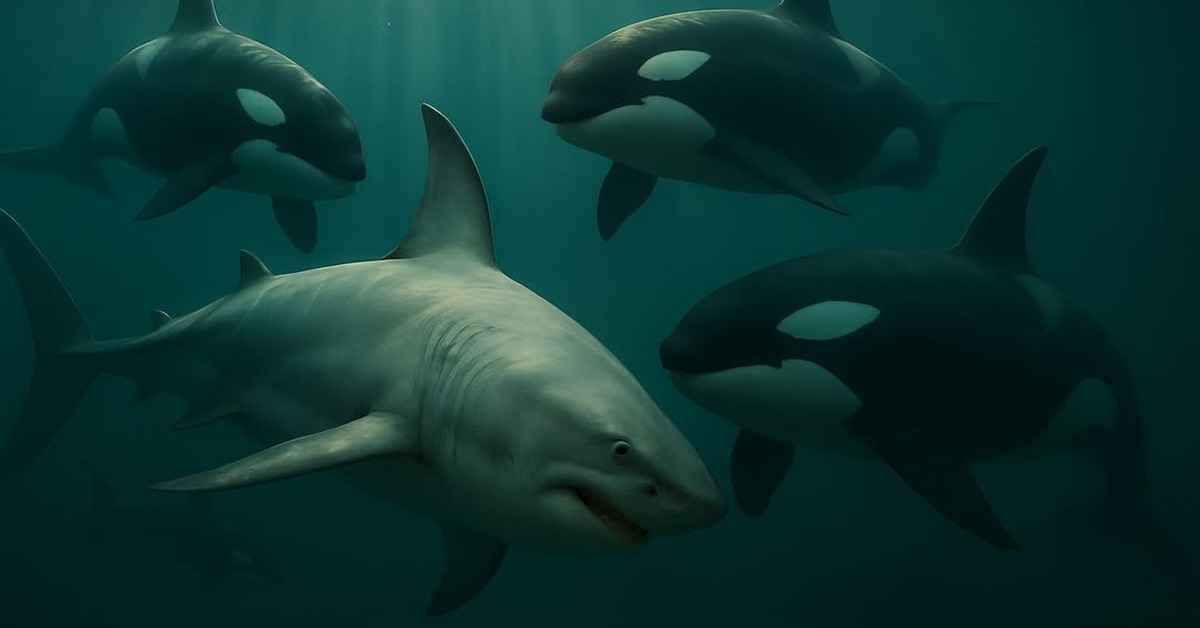
The story of orcas hunting great white sharks in Gansbaai isn’t really a story about two unusual animals. It’s a demonstration of how precarious apex predator dominance actually is.
Great whites have existed largely unchanged for millions of years. They have almost no natural predators. Their position at the top of the local food chain wasn’t something anyone was watching closely, because nothing had ever threatened it. And then two orcas — not a pod, not a population, two individuals — destabilized an entire regional population in a few years. Not through attrition. Through method. Through finding a technique that worked and repeating it until the sharks ran.
For Gansbaai’s tourism economy, the consequences are concrete and ongoing. A business model built around reliable great white sightings doesn’t function when the sharks won’t come back. For marine ecologists, it’s a real-time case study in ecosystem disruption running faster than most models predicted was possible. And for everyone else — it’s worth sitting with the fact that “apex predator” isn’t a permanent biological rank. It’s a position. Positions can be taken.
Two orcas with bent dorsal fins changed the ocean along an entire coastline. No mass die-off, no human intervention, no territory war — just a precise method, practiced over years, applied to one very specific vulnerability. The great whites are still out there, somewhere, hundreds of miles from water they used to own. And back in Gansbaai, something else is settling into the shallows where they used to be. There’s more at this-amazing-world.com — and some of it is stranger than this.


