


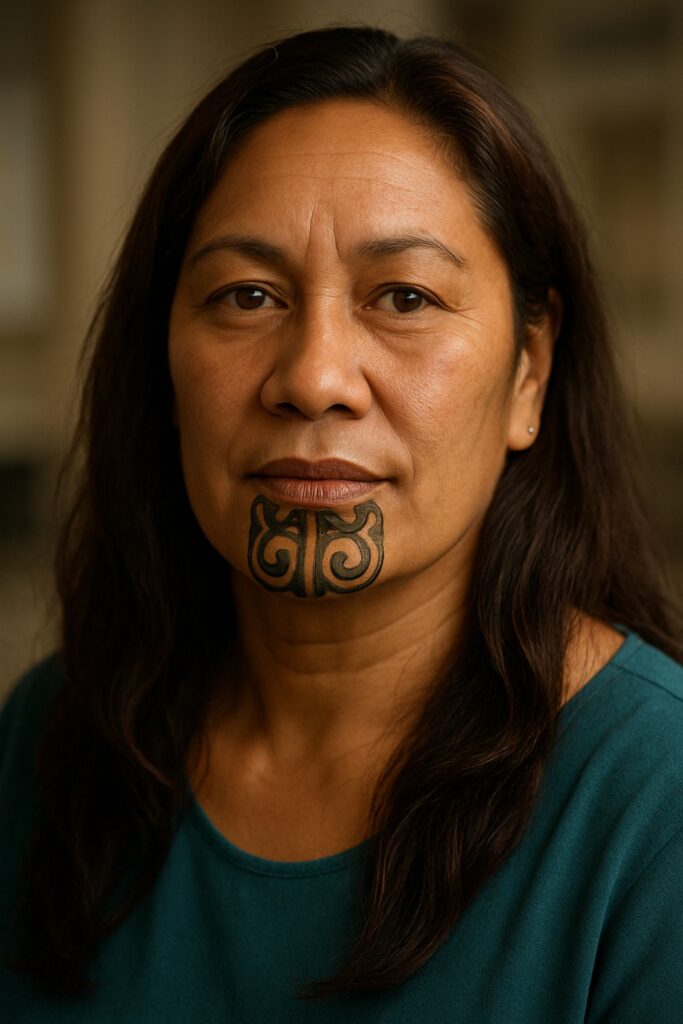
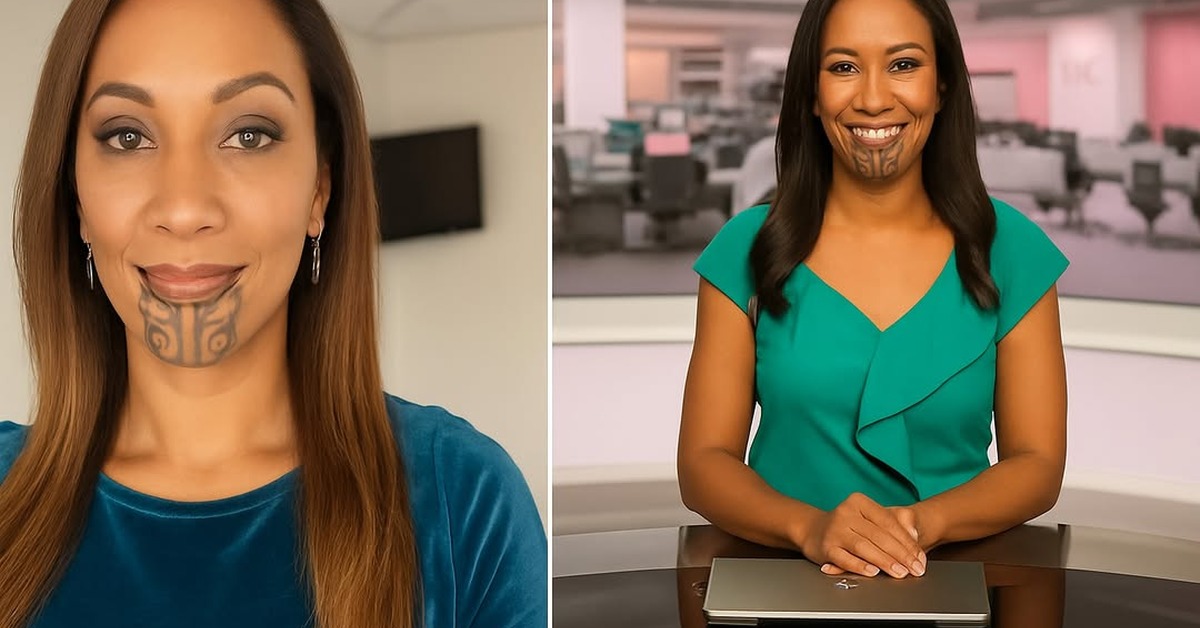
It’s Christmas night, 6 p.m., and a woman in an Auckland studio is about to read the news. On her chin: lines that trace back centuries, pressed into skin, belonging to three tribes at once.
Her name is Oriini Kaipara. She’d been working in broadcast journalism since 2003. And on December 25, 2021, she became the first person to present primetime national news in New Zealand wearing a Māori moko kauae — a traditional facial tattoo worn on the chin and lips of women, a marking that carries the weight of ancestry in every curve.
What the Māori Moko Kauae Actually Means
It’s not decorative. That’s the first thing.
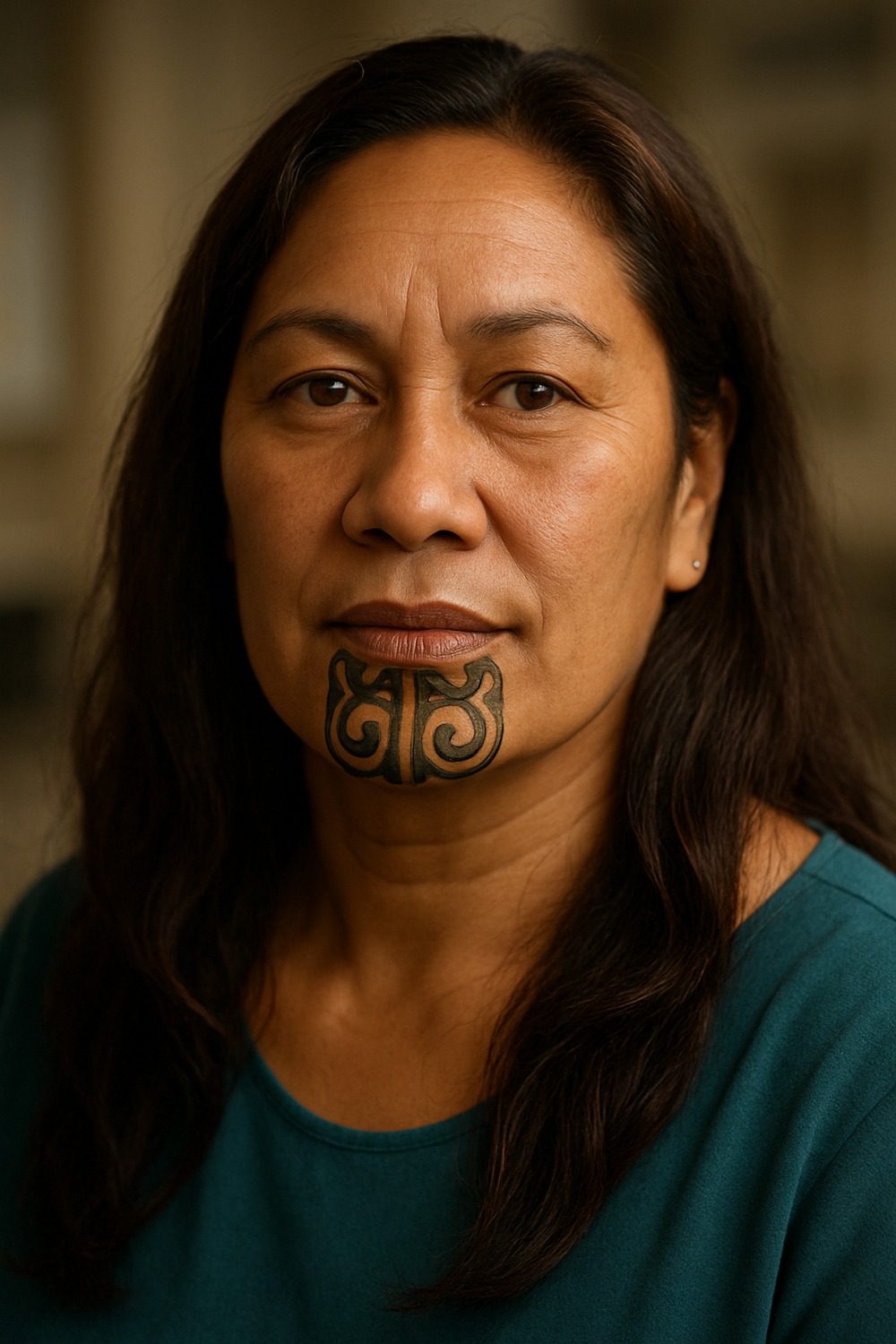
The moko kauae is genealogical — a visual record of whakapapa, the Māori concept of lineage and ancestry. Researcher Ngahuia Te Awekotuku, who spent decades documenting tā moko traditions, describes it as “a map of identity.” Each line, each curve, is specific to the wearer’s tribal heritage. It doesn’t just represent a person. It represents everyone who came before that person. Which means the face isn’t entirely your own — it belongs, in some sense, to a chain of people stretching back further than any living memory can reach.
Fewer than 2% of Māori women bear this marking today.
That number tells a quiet, ugly story. Colonization didn’t only take land — it took skin. The practice was suppressed, stigmatized, and nearly erased across more than a century of deliberate cultural disruption. For a long time, wearing a moko kauae in public spaces meant risking something. Judgment. Professional consequences. The particular cruelty of being made to feel that your own history was inappropriate.
How Oriini Earned Her Markings Over Time
She didn’t wake up one morning and decide to make history. She spent nearly two decades building a journalism career first — reporting, presenting, earning her place inside an industry that has never been especially generous to indigenous identity.
Then, in 2019, she received her moko kauae from master tohunga tā moko Te Rangitu Netana. Before that could happen, she spent years carefully tracing her lineage through three distinct tribes: Tūhoe, Ngāti Awa, and Ngāti Tūwharetoa. The process wasn’t a weekend decision. It was deliberate, deeply researched, and spiritually significant in ways that don’t compress neatly into a paragraph.
She didn’t rush it.
In a media industry that rewards speed and visibility above almost everything else, she waited until the markings were earned — until the knowledge behind them was solid enough to carry in public. That last detail kept me reading about this for another hour. You can read more about how indigenous identity shapes modern storytelling over at this-amazing-world.com.
The Broadcast That Changed Something Quietly
Christmas night has a particular texture on television. Fewer viewers. Softer news. A collective exhale after the day’s chaos settles. The response to Oriini’s bulletin, though — not quiet at all.
Messages came in almost immediately. Māori elders who wept watching it. Mothers who grabbed their children to point at the screen. Young Māori people who’d grown up watching television that almost never reflected them back, suddenly seeing a face that did. The Māori moko kauae, on a primetime national news anchor, on Christmas night. Nobody had seen that combination before. Not once, in the entire history of New Zealand broadcasting.
It just appeared. And stayed.

Representation Is About What People Carry With Them
Here’s the thing about representation in media that gets flattened in most conversations about it: it’s not just about who shows up. It’s about what they’re allowed to bring through the door with them.
For decades, indigenous and minority journalists around the world have described an invisible tax — the pressure to leave cultural identity at the threshold, to code-switch, to sand down the edges of yourself until you’re palatable enough for a mainstream audience. Oriini didn’t do that. She walked into that studio carrying 18 years of broadcast journalism and three tribes on her face. Both things, fully present, at the same time.
When someone in a position of mainstream visibility refuses to minimize themselves, it does something specific to the people watching. It gives permission. Not just to be seen — but to be whole.
By the Numbers
- Fewer than 2% of Māori women bear a moko kauae today — a dramatic collapse from pre-colonial times when the markings were widespread across Aotearoa New Zealand, according to cultural researchers documenting the practice’s revival.
- 18 years in broadcast journalism before her landmark Christmas 2021 bulletin.
- New Zealand’s Māori population makes up approximately 17% of the country’s total population (Stats NZ, 2023), yet indigenous representation in primetime anchor roles had historically been near zero before this moment.
- Master artist Te Rangitu Netana, who performed Oriini’s moko kauae, is among a small number of practitioners keeping traditional hand-tap tā moko techniques alive — techniques that were nearly extinct by the mid-20th century and weren’t exactly being taught in schools.

Field Notes
- Traditional tā moko was historically applied using chisels made from albatross bone — not needles. The tool carved grooves into skin rather than puncturing it, leaving the surface ridged, almost sculpted. Closer to woodworking than modern tattooing, which is a strange thing to sit with.
- Living connection to tupuna (ancestors), not just a personal marking.
- The moko kauae is treated with the same reverence as a family heirloom — wearing one in public is understood as an act of carrying, not displaying.
- The revival of tā moko accelerated in the 1990s alongside broader Māori cultural renaissance movements. But it’s been the public visibility of wearers in professional settings — law, medicine, journalism — that’s shifted cultural perception most sharply in the years since.
Why One Christmas Broadcast Still Echoes
There’s a version of this story that frames Oriini Kaipara as a symbol. A landmark. A headline.
And she is, in some ways — a Māori moko kauae on a national news anchor is genuinely historic, and no amount of careful framing changes that. But the more interesting version is simpler: she’s a journalist doing her job, fully as herself, and the country caught up to what that actually looks like. That’s what made the Christmas broadcast strange and moving in equal measure. It wasn’t performed. Nothing about it was staged for impact. It was just true — and the truth of it landed differently than anyone expected.
What does it mean for a culture to see itself at the center of its own national story? It means something shifts in the chest of a kid watching television on Christmas night. Something that doesn’t need explaining. That only needs witnessing.
History rarely announces itself with any kind of fanfare. It shows up in a studio at 6 p.m. on a quiet Christmas night. It lifts its chin. It looks directly at a camera. Oriini Kaipara didn’t issue a statement — she simply refused to disappear, and that refusal turned out to be everything. If this kind of story is the sort that keeps you up past midnight, there’s more waiting at this-amazing-world.com.


