


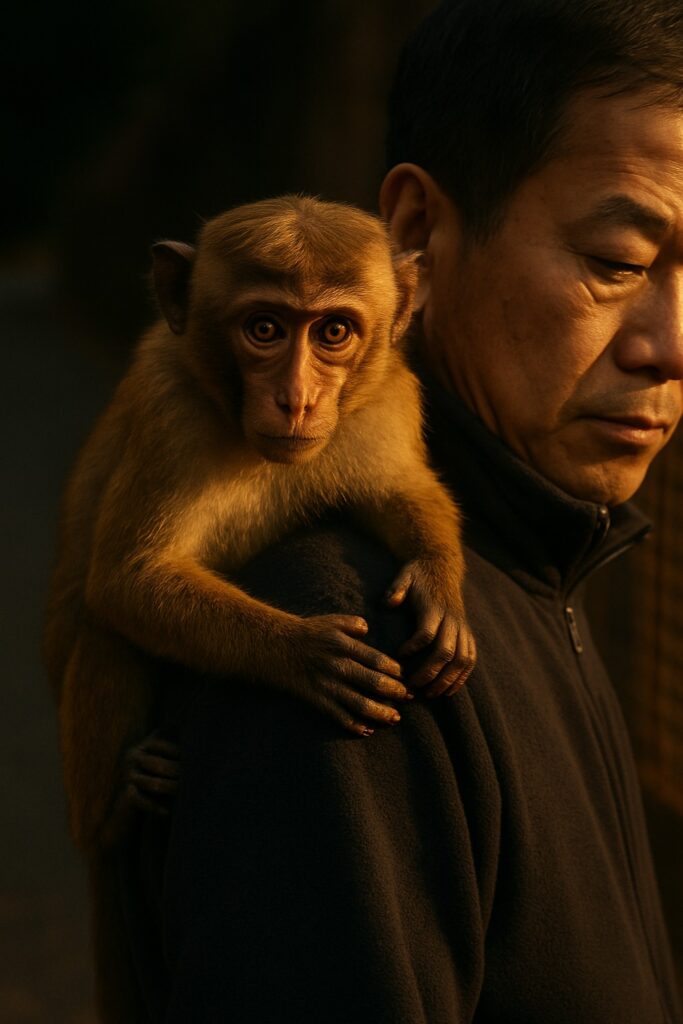
Grief, in primates, doesn’t look like grief. It looks like clinging. Punchy — a toque macaque born on Monkey Mountain, Sri Lanka, into a matriarchal troop that promptly lost his mother — clung to a stuffed doll for weeks before he found something better. The toque macaque father bond that eventually replaced it wasn’t supposed to happen, not at this intensity, not in this species. And yet here we are, watching field science quietly revise its assumptions one tolerated inch at a time.
What followed that loss — weeks of social rejection, comfort from a thrift-shop doll, and ultimately a rescue by the one parent nobody expected to step up — is a story that stretches the edges of what science currently claims to understand about paternal instinct in Old World monkeys. How does a father recognize a son he was never supposed to raise?

When a Mother’s Loss Reshapes Troop Survival
In a toque macaque troop, a mother isn’t just a source of milk. She is a social passport. Research conducted by the long-running Smithsonian-affiliated Polonnaruwa field project in Sri Lanka — one of the world’s longest continuous primate studies, running since 1968 under the foundational work of Wolfgang Dittus — has documented exactly how a motherless juvenile’s rank and survival prospects collapse within weeks. Without maternal grooming alliances, without the reflected social status a mother confers, a baby macaque falls through the troop’s invisible floor. Older cousins shove it away from food. Dominant females ignore its distress calls.
By every metric researchers track — caloric intake, body weight, cortisol levels in fecal samples — a bereaved infant is a statistic waiting to happen.
Punchy’s early weeks tracked that grim pattern almost to the letter. He was shooed, ignored, and pushed to the troop’s fringe. What kept him attached to the group at all was the intervention of a sympathetic human caretaker who introduced a worn stuffed doll — a soft, yielding object Punchy could cling to through the night. It bought time. Critically, it kept his clinging reflex alive. A macaque baby that stops clinging loses muscle memory it will need later. The doll wasn’t sentimentality. It was triage.
Turns out, the science of surrogate attachment in macaques stretches back to Harry Harlow’s 1950s wire-and-cloth experiments at the University of Wisconsin. The finding then — that contact comfort outweighs feeding in infant bonding — still echoes in every case like Punchy’s. Touch isn’t incidental. It’s the architecture of survival.
The Stuffed Doll, the Father, and a Strange Bridge
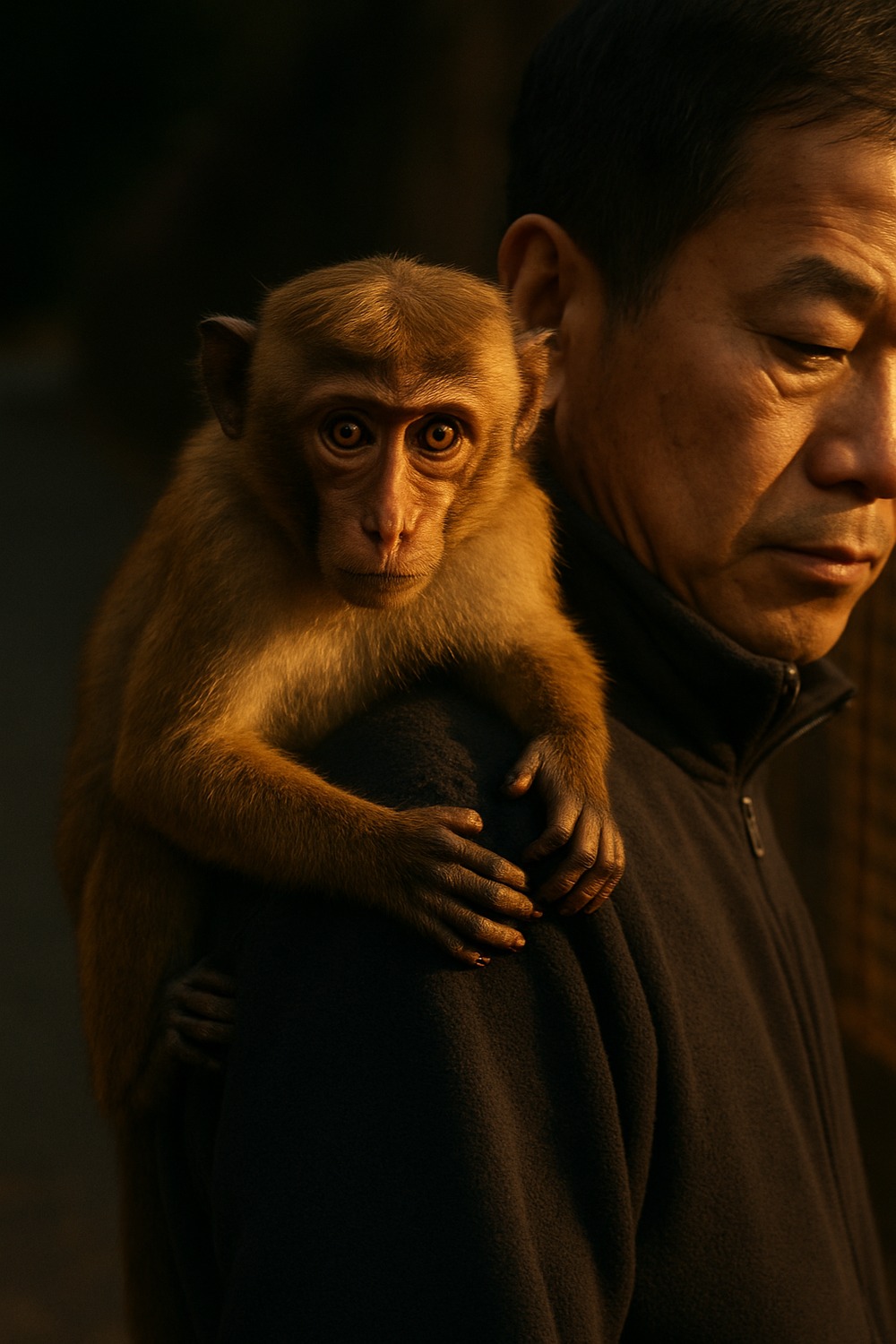
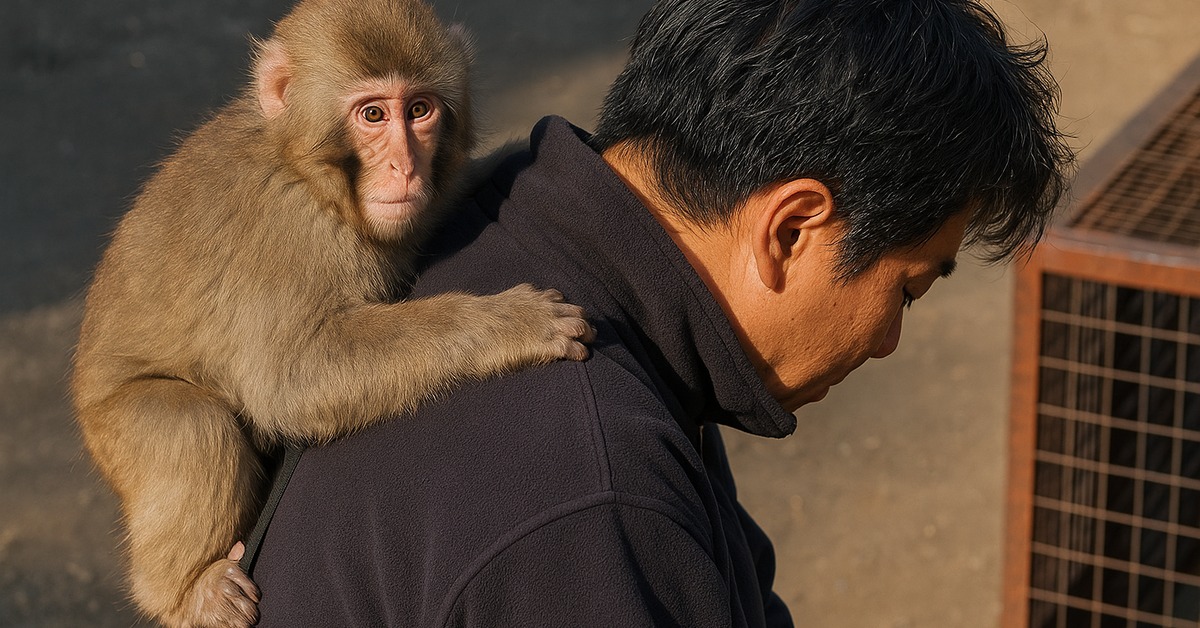
What makes the toque macaque father bond in Punchy’s case so disorienting is that it shouldn’t exist — not at this intensity. Toque macaques are not a species celebrated for paternal involvement. Males in most macaque species contribute minimally to direct infant care, particularly when the mother is absent, which removes the social reinforcement loop that typically nudges a male toward a juvenile. Yet here was Punchy’s father, tolerating the infant’s constant proximity, permitting full dorsal riding, and — crucially — defending him during troop squabbles. It’s behavior that researchers who study infant loss in primates find genuinely striking.
If you’re interested in how touch and surrogate bonding shape infant primates through the most vulnerable stretches of early life, the broader dynamics at play here — the hunger for contact, the way a doll or a substitute body can rewire a young animal’s stress response — are explored in remarkable detail in the story of another young monkey who clung to a stuffed toy for years, reaching conclusions that reframe what we call resilience.
The bridge from doll to father wasn’t instantaneous. Observers noted a transitional phase — perhaps two to three weeks — where Punchy would alternate between the doll and cautious proximity to his father. He’d creep close, retreat, creep closer. The father rarely initiated contact but rarely refused it either. That passive tolerance is, in macaque social terms, a very loud invitation.
By the time Punchy made his first full dorsal mount, the behavioral threshold had already been crossed. The alliance was formed not in a single moment but in dozens of tolerated inches. Nobody has yet explained what tipped the father toward acceptance. Recognition of his own offspring — possible, given olfactory cues. Social opportunity — a male with a bonded juvenile gains certain grooming and alliance advantages. Or something genuinely harder to quantify. The field notes don’t resolve it cleanly. That ambiguity is, in its own way, the most honest part of the story.
What Male Primates Will Do When the Rules Break Down
Why does this matter? Because Punchy’s story sits inside a growing body of literature on male primate caretaking in contexts of maternal loss — and the findings keep surprising the people running the studies.
A 2021 study covered by National Geographic documented chimpanzee fathers at Taï National Park in Côte d’Ivoire taking over infant care after the death of the mother — carrying them, sharing food, even allowing co-sleeping — despite no established precedent in that troop’s observed history. Comparative data from Japanese macaque studies conducted by Kyoto University’s Primate Research Institute between 2015 and 2022 found that when maternal death coincided with a period of low troop aggression, roughly 34 percent of genetic fathers in the sample showed elevated tolerance behaviors toward their orphaned offspring within sixty days. Punchy’s situation — a relatively stable troop, a father already of high rank — may have provided exactly that window. The conditions matter enormously.
And the toque macaque father bond that Punchy now relies on also inverts a common assumption about paternal recognition. Many biologists assumed that without the continuous social scaffolding of a mother-infant dyad, a male macaque couldn’t build meaningful individual recognition of his own offspring. The emerging data suggests otherwise. Genetic paternity — which males in multi-male troops can’t confirm visually — appears to be less relevant than behavioral proximity over time. Males who were physically near a mother during her infant’s early weeks show higher rates of subsequent tolerance toward that infant. Familiarity, not confirmed relatedness, may be the operative trigger.
That finding changes more than the macaque literature. If familiarity rather than certainty drives paternal investment, then interventions that increase male-infant proximity — even artificially, even briefly — could shift survival outcomes in other species. Conservationists working with captive populations are already experimenting with this logic.
The Toque Macaque Father Bond and What It Reveals About Troop Resilience
Toque macaques (Macaca sinica) are listed as Endangered on the IUCN Red List, endemic entirely to Sri Lanka, and living under compressing habitat pressure from agricultural expansion and road fragmentation across the island’s central highlands and dry zone forests. Every infant that survives to reproductive age represents a measurable input into the troop’s genetic future. The Polonnaruwa study population — the one that has generated decades of baseline data — currently numbers in the hundreds, not the thousands. A 2019 demographic analysis by the Smithsonian Conservation Biology Institute found that in populations under habitat stress, juvenile survival rates in the twelve months following maternal loss drop by as much as 61 percent compared to juveniles with living mothers.
Punchy’s survival isn’t just heartwarming. It’s a data point in a species’ ledger.
A species facing this kind of demographic pressure can’t afford to leave backup survival systems unexamined — and for too long, that’s exactly what the field did. Paternal fallback pathways exist in toque macaques. They’re latent, they require specific social conditions to activate, and they’re almost certainly underreported because field researchers historically focused observational effort on mother-infant dyads rather than scanning for male-infant associations that formed in the absence of the expected female scaffolding. Punchy’s story was documented partly because a caretaker was already paying close attention.
How many similar bonds formed and dissolved in troops nobody was watching?
Researchers at the University of Peradeniya in Sri Lanka have begun building a database of precisely these overlooked male-infant associations, starting in 2022. Their working hypothesis: paternal care in toque macaques is not aberrant. It’s a backup system the species evolved and then forgot to advertise.

Where to See This
- Polonnaruwa Sacred Forest, North Central Province, Sri Lanka — a UNESCO World Heritage zone and the site of the world’s longest toque macaque field study; troops are visible year-round, with the dry season (May–September) offering the clearest canopy sightlines and highest foraging activity near temple ruins.
- The Smithsonian Conservation Biology Institute (SCBI) and its affiliated Sri Lanka field teams track Macaca sinica populations and publish ongoing demographic data; their work is accessible through the Smithsonian’s National Zoo research portal at nationalzoo.si.edu.
- For a deeper reading foundation, Wolfgang Dittus’s published work — particularly his 1977 paper “The social regulation of population density and age-sex distribution in the toque monkey” in the journal Behaviour — remains the cornerstone document for anyone serious about this species.
By the Numbers
- Toque macaques are classified as Endangered by the IUCN, with the global population restricted entirely to Sri Lanka and estimated at fewer than 50,000 individuals (IUCN Red List, 2020 assessment).
- Running continuously since 1968, the Polonnaruwa Monkey Project is one of the longest uninterrupted primate field studies in the world — spanning over 55 years of data.
- Juvenile survival in the 12 months following maternal loss drops by up to 61 percent compared to maternally supported juveniles, per Smithsonian Conservation Biology Institute demographic analysis (2019).
- In a Kyoto University sample of Japanese macaque orphan cases (2015–2022), approximately 34 percent of genetic fathers showed elevated infant-tolerance behaviors within 60 days of maternal death — roughly 3× the baseline rate.
- A toque macaque mother typically maintains an intensive bonding period with her infant for 18 months; losing that bond before the six-month mark is considered the highest-risk window for infant mortality.
Field Notes
- At the Polonnaruwa study site in 2017, researchers observed a subordinate male — confirmed non-father by earlier genetic sampling — carrying an orphaned macaque infant for eleven consecutive days before the infant was adopted into a new matriline. It was the first confirmed case of allopaternal transport in the species (researchers actually call this “compensatory male caretaking”) and went unpublished for three years while the team searched for corroborating observations.
- Toque macaques have one of the smallest home ranges of any free-ranging macaque species — sometimes under one square kilometer for an entire troop — which means social dynamics play out in extraordinary proximity, and relationships like Punchy’s father-son bond are under constant renegotiation with every other troop member watching.
- The stuffed doll used as Punchy’s surrogate isn’t an isolated intervention — wildlife rehabilitation centers in Sri Lanka, Japan, and Indonesia have independently begun using tactile surrogates to maintain clinging behavior in orphaned macaque infants, each arriving at the method through observation rather than a shared protocol.
- Researchers still can’t determine whether the father’s tolerance for Punchy was driven by kin recognition, social opportunity, or simple habituation — and the difficulty in separating those three causes reflects a fundamental gap in how primate paternity recognition is currently tested. No non-invasive field method yet exists to distinguish them reliably in real-time troop conditions.
Frequently Asked Questions
Q: How common is the toque macaque father bond in the wild?
Rarer than maternal bonding, but less exceptional than previously assumed. Studies at Polonnaruwa since 1968 have recorded periodic male-infant associations, but intensive paternal investment — including full dorsal riding and active defense — has historically been logged as anomalous. Since 2022, University of Peradeniya researchers have begun systematically tracking male-infant proximity in several study troops, and early data suggests meaningful paternal tolerance occurs in roughly one in five orphan cases where the genetic father remains in the troop.
Q: Why do macaque mothers’ deaths have such a devastating effect on infants?
In matriarchal macaque societies, a mother is both caregiver and social gateway. She transfers her rank, her alliances, and her grooming network to her offspring through daily lived proximity. When she dies, all of that scaffolding vanishes simultaneously — the infant doesn’t just lose food and warmth, it loses its entire social identity within the troop hierarchy. Cortisol levels in bereaved macaque infants spike measurably within days of maternal loss, and without an adoptive bond forming quickly, those stress hormones suppress immune function and foraging drive in ways that compound rapidly through the first critical months.
Q: Do toque macaque fathers normally recognise their own offspring?
Here’s the thing — a lot of popular coverage gets this wrong. Toque macaques live in multi-male troops where paternity certainty is low. The old assumption was that males therefore invest minimally in any individual infant because they can’t confirm relatedness. But more recent evidence, including the Kyoto University macaque data from 2015–2022, suggests that behavioral familiarity — time spent near the mother during the infant’s early weeks — may matter more than confirmed genetics. A male who was socially close to a mother is statistically more likely to tolerate her infant afterward, regardless of whether he fathered it.
Editor’s Take — Alex Morgan
What unsettles me about Punchy’s story isn’t the sweetness of it — it’s the implication. If paternal fallback systems in toque macaques are real, latent, and simply underobserved, then we’ve been reading this species’ survival math with a variable missing. That matters for how we assess population resilience under habitat loss. A species that looks more fragile on paper because researchers were watching the wrong relationships may actually hold more adaptive capacity than the models show. The doll bought time. The father rewrote the equation. The real question is how many other equations we’re still running incomplete.
Punchy will eventually grow too large for his father’s back. Toque macaque juveniles graduate from dorsal riding somewhere around eighteen months, when their own legs become reliably faster than any adult’s patient gallop through the canopy. But the bond, once formed, doesn’t dissolve with the weight limit. In the troop hierarchy, the alliances built during those riding months persist — in who grooms whom, who yields at a food source, who stands close during a predator alarm. What looks like a simple ride through the trees is, in fact, the slow construction of a future. In how many other forests, in how many other species, is that same construction happening quietly, in the spaces between the observations we thought were comprehensive?


