


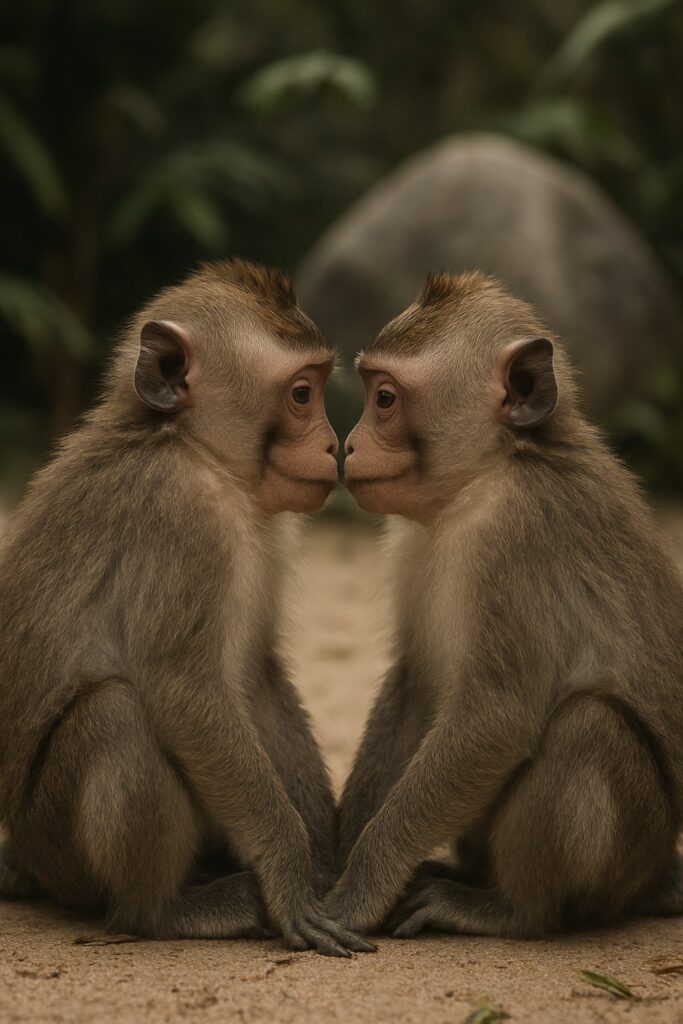
He came in clutching a plush toy so tightly the keepers couldn’t tell at first if he was holding it — or if it was holding him. That detail is the whole story, really.
Punchy arrived at Monkey Mountain sanctuary in central Thailand as a trembling handful — hypothermic, abandoned, maybe eight weeks old. A crab-eating macaque. A species so wired for social contact that isolation doesn’t just make them lonely; it starts rewriting their neurology within days. The plush toy he wouldn’t let go of wasn’t cute. It was the only reason he was still functional. And the story of how he went from that — from a shaking infant gripping synthetic fur — to nuzzling a companion in a sun-dappled clearing over a year later is not the story I expected when I started looking into it.
Why Orphan Macaque Rescue Is So Emotionally Complex
Crab-eating macaques — Macaca fascicularis — are among Southeast Asia’s most socially sophisticated primates. Primatologist Dr. Agustín Fuentes has documented how deeply their psychological health depends on early social bonding. Without a mother’s touch in those first weeks, the neurological blueprint for trust doesn’t just get delayed. It gets distorted. Sometimes permanently.
So when Punchy arrived alone and freezing, the odds weren’t just bad. They were bad in a very specific, very irreversible-feeling way.
The doll wasn’t a quirk. It was survival instinct. Young macaques denied maternal contact will fixate on anything that offers sensory comfort — warmth, texture, the vague illusion of presence. Punchy groomed his doll. Slept curled around it. Carried it into every corner of his enclosure. The sanctuary team let him, because sometimes the most sophisticated intervention is knowing what not to take away.
The Sanctuary Team’s Unusual Approach Changed Everything
Most primate rehabilitation programs try to wean animals off human contact fast. Get them back to wild behavior, wild instincts, wild company. Monkey Mountain took a slower road — introducing Punchy to other young macaques gradually, always on his terms, never forced. It mirrors what researchers have found in studies of animal trauma recovery and resilience: rushed reintegration tends to collapse entirely, while patient, incremental exposure builds something that actually holds.
The doll stayed in his enclosure for weeks after the other juveniles started appearing.
One keeper described watching Punchy sit at the edge of a play group for three straight days without moving toward it. Just sitting. Watching the other animals. Calculating, in whatever way an eight-week macaque calculates, whether the world was safe enough to enter again. That’s not timidity. That’s a damaged nervous system doing its job as carefully as it can.
Then There Was Grandma Sotomaru
Here’s where the story tips from heartbreaking into something genuinely strange and good. Grandma Sotomaru — a veteran female macaque who’d lived at the sanctuary for over a decade — has a documented history of adopting traumatized youngsters. The keepers call what she does “social scaffolding.” She doesn’t push, doesn’t initiate, doesn’t perform anything. She just exists nearby. Calm. Unhurried. Providing what researchers describe as ambient safety — the sense that the space around you is not a threat.
For an orphan macaque rescue to work at this depth, you need an animal like Sotomaru. Not every sanctuary has one.
Punchy found her in his fourth week. And something in him — some stress-cortisol-soaked corner of his tiny brain — apparently decided that was enough. He started leaving the doll behind. First for an hour. Then a morning. Then a whole day. Nobody made a note of it happening. Nobody announced it. One Tuesday, the toy was just sitting in the corner of the enclosure, abandoned, and Punchy was somewhere else entirely.
That Tuesday was the real turning point.

What the Doll Was Actually Doing to His Brain
Turns out, object attachment in infant primates isn’t just emotional crutch behavior — it’s neurologically functional. Studies in developmental primatology suggest that tactile self-soothing through objects helps regulate cortisol in isolated juveniles, keeping stress hormones from spiking into ranges that cause permanent behavioral damage. In plain terms: the doll was doing biological work. It was buying Punchy time.
That last part kept me reading for another hour. The idea that a plush toy could be a medical intervention — not metaphorically, but literally — changes how you look at the whole thing.
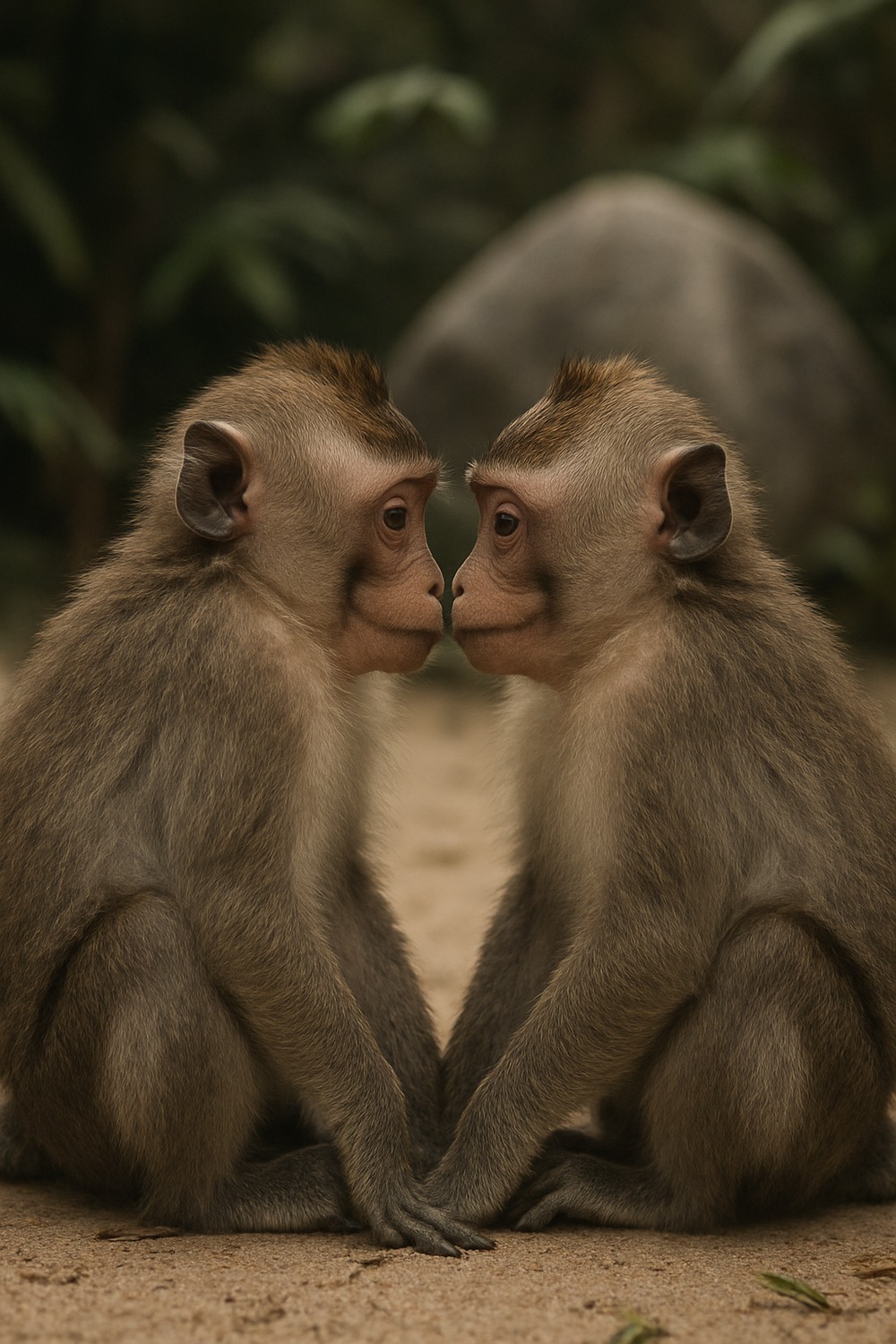
When he finally stopped needing it, that was evidence. Measurable, behavioral evidence that his nervous system had found better regulation elsewhere. In Sotomaru. In the juveniles at the edge of the play group. Eventually in one young macaque in particular who started showing up beside him in the leafy afternoon clearing, where the cicadas go absolutely relentless around dusk and the light goes long and gold through the canopy.
By the Numbers
- Roughly 70% of orphaned primates in captive rehabilitation show signs of attachment disorder — Punchy’s doll-fixation wasn’t exceptional, it was textbook (Primate Conservation Inc., 2021).
- Crab-eating macaques live in social groups averaging 20–30 individuals. A juvenile isolated for more than 6 weeks faces a statistically significant decline in long-term social integration success — and the window doesn’t stay open forever.
- Monkey Mountain, Phuetchabun province: 400+ primates rehabilitated since 2009.
- Their keeper-estimated reintegration success rate sits around 60%, compared to a regional average of 38%.
- A macaque’s critical social bonding window closes significantly by 6 months of age. Punchy arrived at approximately 8 weeks — inside that window, but barely.

Field Notes
- Crab-eating macaques are one of the only non-human primates documented using stone tools regularly in the wild — coastal populations have been cracking shellfish this way for at least 65 years, making them one of the longest-studied tool-using animal cultures outside of great apes.
- Macaque social hierarchies are matrilineal. Which means Grandma Sotomaru’s standing in the group gave Punchy a kind of inherited protection — social cover he hadn’t earned and didn’t know he had.
- Reintegrated after trauma: measurably more complex play behavior than peers who were never isolated.
- Which raises the obvious question — why would going through something terrible produce more social flexibility than not going through it? Researchers think the recovery process itself might be doing the building. That surviving the relearning builds something that straightforward development skips entirely.
Why Punchy’s Story Matters Beyond One Small Monkey
The broader reality of orphan macaque rescue is that it rarely ends this way. Across Southeast Asia, deforestation, the illegal pet trade, and human-wildlife conflict displace thousands of macaques annually. Most don’t find a Sotomaru. Most don’t get three slow weeks at the edge of a play group. Most don’t have a doll buying them just enough time for the right intervention to arrive.
Punchy’s case isn’t a feel-good moment, exactly — or it’s not only that. It’s a case study in what becomes possible when a rescue operation treats trauma as biology rather than misbehavior to be corrected. When the question stops being “how do we fix him” and becomes “what does he actually need, and can we wait long enough to find out.”
For the humans running these sanctuaries, the implications are enormous. It means resources. Patience. The willingness to let an animal set the pace of its own recovery, even when that’s expensive and slow and yields nothing you can put in a quarterly report. Most sanctuaries don’t have those luxuries. The ones that do are building proof of concept — evidence, in the form of one small macaque who made it, that the slower road goes somewhere worth going.
Watching Punchy reach toward another macaque with the kind of easy confidence that looks like it was never lost — it’s hard not to feel the weight of what almost wasn’t. He made it. But he made it because of specific people making specific choices in specific moments, and because one old female macaque happened to be exactly where he needed her to be. That’s the part that stays. There’s more at this-amazing-world.com — and the next one is stranger than this one, which I did not think was possible.


