



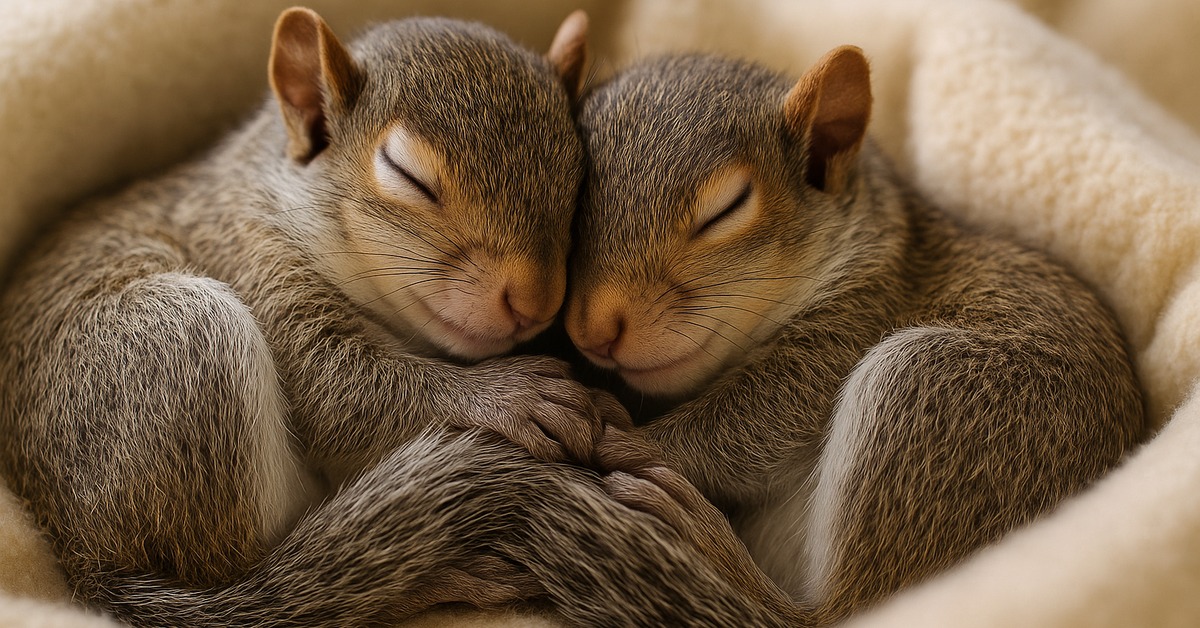
Here’s the thing about orphaned baby squirrels: they don’t wait to be rescued. They come to you. Two siblings — gray, soft-faced, barely six weeks old — appeared at a stranger’s window having already exhausted every other option. What brought them there wasn’t luck. It was biology running out its last available move.
Every spring, across the eastern United States, orphaned baby squirrels turn up alone, disoriented, and desperately vulnerable. Most people don’t know what to do. Call a vet? Leave them alone? Take them inside? The difference between the right answer and the wrong one can be measured in hours. This is the story of two siblings who found a family willing to pay attention — and what that attention cost, and what it saved.


What Orphaned Baby Squirrels Actually Need to Survive
Eastern gray squirrels (Sciurus carolinensis) are born blind, deaf, and almost entirely hairless — the definition of altricial, meaning they arrive in the world wholly dependent on maternal care. At six weeks old, a kit’s eyes have only recently opened, and its thermoregulatory system — the internal machinery that regulates body temperature — is still underdeveloped. Without a mother’s warmth, a young squirrel can slip into hypothermia within hours, even on a mild spring afternoon. According to the Wildlife Center of Virginia, which has treated orphaned wildlife since 1982, eastern gray squirrels must be kept at approximately 99°F (37°C) during early rehabilitation — a temperature window that mimics the nest microclimate their mother’s body provides. Miss that window, and even a well-fed kit can deteriorate without warning.
Spring litters in the eastern U.S. typically arrive between March and May, with a second litter following in late summer. When the nest goes silent and no adult returns, kits don’t simply wait — they descend. It’s not stupidity. It’s biology: an instinct to seek warmth and food even when no logical source exists. The two siblings in this story were already past the point of safe self-sufficiency when they appeared. Their mother had almost certainly died — likely struck by a vehicle, caught by a predator, or separated by a felled tree.
The smaller of the two kits showed skin tenting — a field sign of dehydration where pinched skin doesn’t spring back. He was also carrying fleas, a common burden for nestlings. Neither is immediately fatal. Both are urgent. This is the window that matters.
The Hidden Instinct That Drives Orphaned Kits to Human Homes
There’s something striking about the way orphaned baby squirrels approach human spaces. It isn’t random wandering. Wildlife rehabilitators and field biologists have noted for decades that distressed juvenile mammals frequently orient toward warmth, sound, and movement — all of which human homes emit in abundance. Research on infant primate bonding published by the University of Wisconsin in the 1950s and 60s demonstrated that warmth and contact are more immediately compelling to infant mammals than food alone. That same pull — toward something body-warm and stable — appears to drive juvenile squirrels toward lit windows, sliding doors, and human voices. Much like documented behavior in studies of how a baby monkey clings to a surrogate for comfort, the drive toward warmth and tactile contact in early mammalian development can override almost every other signal.
What does this mean practically? A kit pressing against your glass isn’t lost by accident — it has exhausted its other options. By the time orphaned baby squirrels reach a human threshold, they’ve often already spent hours — sometimes more than 24 — calling for a mother who isn’t coming back. Juvenile eastern gray squirrels produce an ultrasonic distress call, mostly inaudible to humans, that can persist for extended periods. Researchers at the University of Florida documented this vocalization pattern in 2007, noting that orphaned kits call most intensely in the late afternoon, when natural foraging and reunion behavior would normally peak.
That restraint was the right call. The family in this story waited a full night and part of a second morning before intervening — exactly as local wildlife guidance recommended. A mother squirrel will return for her young if the nest is disturbed, but she won’t return if she is dead. Knowing which situation you’re in is the entire game.
Wildlife Rehabilitation: Who Fills the Gap When Mothers Don’t Return
Why does this matter? Because the system holding these animals together is thinner than most people realize.
Over 10,000 licensed wildlife rehabilitators operate across the United States, according to the National Wildlife Rehabilitators Association — a network built almost entirely on volunteer labor, personal passion, and very little federal funding. When a call comes in about orphaned baby squirrels, these rehabilitators assess the animal’s age, weight, hydration status, and parasite load before beginning a feeding protocol that can stretch across eight to twelve weeks. Squirrel milk replacer — a commercially available formula calibrated to match the fat and protein ratios in wild rodent milk — is delivered via syringe in tiny, precisely timed doses. Too much at once causes potentially fatal aspiration. Too little, and the kit wastes.
What surprises most people is how counterintuitive good rehabilitation looks. Rehabilitators deliberately minimize handling. They cover enclosures to reduce visual stimulation. Human scent is kept to a minimum, voices avoided entirely around the animals. The entire goal is to raise an animal that remains behaviorally wild — one that has learned squirrel skills, not human associations. Orphaned baby squirrels that become too accustomed to people are called “imprinted” (researchers actually call this process anthropogenic bonding), and imprinted squirrels face long odds in the wild. They approach people, ignore predators, and lose the wariness that keeps them alive.
The two siblings from this story were transported to a licensed rehabilitator within 48 hours of their first appearance. That timeline — fast, but not panicked — gave them the best possible start. It also gave the family something unexpectedly difficult: the right kind of goodbye.
Orphaned Baby Squirrels and the Science of Second Chances
Rehabilitation success rates for orphaned baby squirrels are higher than most people expect, but lower than the optimistic numbers sometimes cited on social media. A 2019 analysis conducted by the National Wildlife Rehabilitators Association found that small mammals — a category that includes squirrels, rabbits, and opossums — had an overall release rate of approximately 60 to 70 percent when admitted before significant deterioration. That figure drops sharply when kits arrive dehydrated, hypothermic, or injured. It rises significantly when they arrive in pairs or small sibling groups, because social housing dramatically reduces the stress hormones that suppress immune function and slow weight gain. These two siblings, admitted together, had a biologically meaningful advantage simply by having each other.
At six weeks, an eastern gray squirrel’s developmental calendar is precise. Eyes open between four and five weeks. Incisor teeth emerge around three weeks and continue developing. By twelve weeks, wild squirrels begin making exploratory forays from the nest — and by fourteen to sixteen weeks, they are functionally independent. Rehabilitation doesn’t rush that calendar; it mirrors it, replacing absent maternal cues with scheduled feedings, temperature gradients, and eventually pre-release acclimation in outdoor enclosures. The first solid food — typically soft fruits, seeds, and high-protein insects — is introduced in rehabilitation between six and eight weeks.
Wildlife rehabilitators track every gram. Daily weight logs, feeding diaries, behavioral checklists — the paperwork behind a baby squirrel’s survival looks more like a neonatal ICU chart than anything most people associate with a backyard animal. The science is careful. The stakes feel small until you’re the one holding the syringe at 2 a.m.
Why Urban Sprawl Is Making This Story More Common, Not Less
Two orphaned kits at a window isn’t an anomaly. It’s a trend line, and it’s accelerating. As urban and suburban development continues fragmenting forested habitat across North America, the proximity between human homes and wild animal nurseries shrinks every year. Eastern gray squirrels are among the most adaptable urban wildlife species on the continent, successfully colonizing parks, tree-lined streets, and residential gardens from Toronto to Miami. But adaptability has a cost. Urban squirrel populations face higher rates of vehicle strikes, nest displacement from tree trimming, predation by domestic cats, and secondary poisoning from rodenticides — and each of these outcomes produces the same downstream result: orphaned young left without care.
The data on what urban environments do to these animals is uncomfortable to sit with, and the wildlife management community hasn’t done nearly enough to act on it. Urban wildlife researchers at the University of Toronto published findings in 2021 documenting elevated cortisol levels in city-dwelling gray squirrels up to 2.4× higher than rural counterparts — suggesting chronic stress as a baseline condition in dense urban environments. The International Union for Conservation of Nature classifies the eastern gray squirrel as a species of Least Concern globally, but that classification masks significant local pressure in highly developed corridors. Chronically stressed mothers produce less milk, invest less time in nest maintenance, and are more likely to abandon nests when disturbed. The more built-up an area becomes, the more orphaned baby squirrels its wildlife rehabilitators handle each spring.
Stand in any mid-sized American city in May. Watch the canopy. There are nests up there — leaf platforms wedged into forking branches, lined with grass and bark and fur. Inside some of them, right now, are animals three weeks from needing everything their mother can give. The margin between survival and that window glass is thinner than it looks.

Where to See This
- Eastern gray squirrel nesting activity is most visible between March and June across the eastern United States and Canada — urban parks in cities like Washington D.C., Philadelphia, and Toronto offer reliable sightings of juveniles making first forays from the nest by mid-May.
- The Wildlife Center of Virginia (wildlifecenter.org) and the Humane Society of the United States maintain searchable directories of licensed wildlife rehabilitators by state — the fastest way to locate a qualified contact for any orphaned animal emergency.
- For hands-on understanding of rehabilitation protocols, the National Wildlife Rehabilitators Association (nwrawildlife.org) publishes species-specific care guides accessible to the public, including detailed squirrel intake and feeding standards used by licensed rehabilitators nationwide.
By the Numbers
- Over 10,000 licensed wildlife rehabilitators operate across the United States, handling an estimated 4 million animals annually (National Wildlife Rehabilitators Association, 2022).
- Eastern gray squirrel kits weigh between 13 and 18 grams at birth — roughly equivalent to three U.S. quarters stacked together.
- 60–70% release rate for small orphaned mammals admitted in good condition; that figure drops to under 40% for animals admitted hypothermic and severely dehydrated (NWRA, 2019).
- Urban squirrel populations show cortisol levels up to 2.4× higher than rural counterparts, according to University of Toronto research published in 2021.
- A fully independent juvenile eastern gray squirrel is typically released between 14 and 16 weeks of age — meaning a kit admitted at six weeks requires roughly ten weeks of intensive care before release.
Field Notes
- In 2018, a wildlife rehabilitator in North Carolina documented an eastern gray squirrel mother successfully reclaiming three of four orphaned kits after a nest was destroyed by a tree crew — the fourth kit had already been transported to a rehabilitation center. Caught on a neighbor’s home security camera and shared widely, the recovery became an important case study in the “wait 24 hours” guidance now standard in many wildlife response protocols.
- Orphaned baby squirrels housed with sibling groups during rehabilitation gain weight measurably faster than solo kits — not because of shared body heat alone, but because social stimulation triggers feeding behavior more reliably than any human-administered cue.
- Eastern gray squirrels have a vestigial thumb — an elongated wrist bone functioning like a partial digit — which gives juvenile kits a surprisingly strong gripping reflex even before their eyes open. Rehabilitators use this reflex as a health indicator: a weak grip in a young kit often signals neurological stress or systemic illness before any other symptom appears.
- Researchers still can’t fully explain why some urban squirrel populations show dramatically lower rates of orphan production than neighboring areas with similar tree cover and vehicle traffic density — the variable appears to involve nest site selection patterns that haven’t yet been adequately mapped or modeled.
Frequently Asked Questions
Q: How do I know if orphaned baby squirrels actually need human help?
The clearest signs are: the animal is visibly injured, it’s been alone in the same spot for more than a full day, it’s cold to the touch, or it’s approaching humans and domestic animals without hesitation. Healthy juvenile squirrels learning to forage may appear alone but are typically quick-moving and alert. If a kit is lethargic, vocalizing continuously, or has visible parasites, it needs help. The standard guidance from the Humane Society is to wait 24 hours before intervening if the kit appears uninjured and no mother is seen.
Q: What should I do immediately if I find orphaned baby squirrels?
First, don’t feed them — the wrong food, delivered the wrong way, can kill a kit faster than hunger. Place the animal in a small cardboard box lined with a soft cloth, and add a gentle heat source underneath half the box — a heating pad on the lowest setting, or a sealed plastic bottle filled with warm water — so the kit can move toward or away from warmth. Then contact a licensed wildlife rehabilitator immediately using state wildlife agency directories or the NWRA finder tool. Transport within hours, not days. Time is the variable that matters most in early intervention for juvenile squirrels.
Q: Can orphaned baby squirrels be raised successfully as pets?
This is the most common misconception surrounding orphaned wild squirrels. In most U.S. states, keeping a wild squirrel without a rehabilitation license is illegal, regardless of how it was obtained. Beyond legality, squirrels raised as pets almost always develop behavioral problems — aggression, self-harm from confinement, and loss of the survival instincts that keep them safe in the wild. A squirrel that’s been humanized can’t be safely released and can’t comfortably live in captivity. The most genuinely kind outcome for an orphaned kit is a clean handoff to rehabilitation and, ultimately, release. Loving an animal sometimes means letting a professional take over.
Editor’s Take — Alex Morgan
What strikes me about this story isn’t the rescue — it’s the waiting. A family sat at a window through an entire night, doing nothing, because doing nothing was exactly right. That kind of restraint is harder than it sounds when something small and warm is pressing its face against your glass. Wildlife rehabilitation works best not when humans rush in, but when they read the situation carefully and act at precisely the right moment. That’s not a nature story. That’s a lesson in judgment that most of us spend years trying to learn.
Every spring, this scene repeats itself in tens of thousands of backyards across North America — a small creature at a threshold, and a human deciding what to do next. Whether it ends well depends almost entirely on whether the person on the other side of the glass knows what they’re looking at. Two siblings are sleeping now in a nest they didn’t build, fed by hands they’ll never recognize as kind. If they make it — and the odds say they might — they’ll spend their lives in trees, indifferent to every window they pass. That indifference is the goal. What does it mean to help something, if the measure of success is that it forgets you entirely?


