


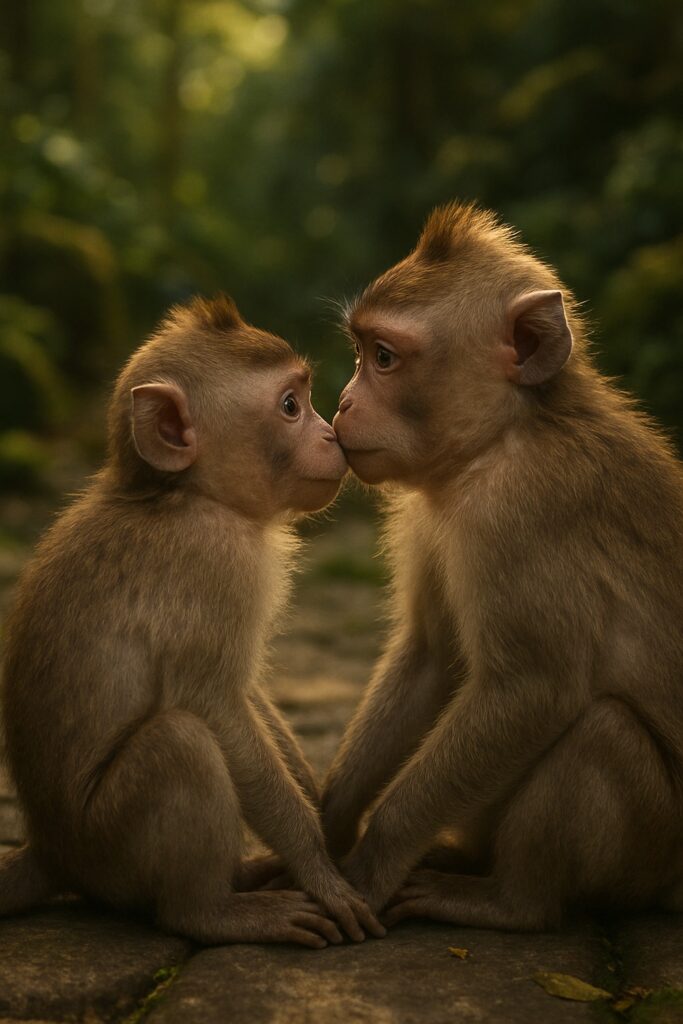
Nobody handed Punchy a treatment plan. They handed him a stuffed toy and hoped for the best.
When rescuers pulled him out — hypothermic, trembling, completely shut down — that plush animal was the only thing he’d hold. His hands locked around it and stayed there. The keepers at Monkey Mountain sanctuary in central Thailand named it Mama Doll. For weeks, maybe longer, it was the closest thing to a mother he had.
What Orphaned Macaque Healing Actually Looks Like
Crab-eating macaques — Macaca fascicularis — are scattered across ten countries in Southeast Asia, which makes them easy to underestimate. Common species, people assume, must mean resilient species. That’s not how trauma works. According to primatologist Frans de Waal’s foundational research on primate social bonding, early maternal separation doesn’t just cause behavioral distress in macaques — it actually restructures the animal’s stress-response system at a neurological level. The wiring changes. The question isn’t whether the damage is real. It’s whether any of it can be reversed.
Most orphaned rescues don’t fully recover. The ones who do almost always share one thing in common — and it’s not medication, not enclosure quality, not even time, exactly.
The Mama Doll Nobody Expected to Matter
Object attachment in traumatized primates has been documented since Harry Harlow’s cloth-mother experiments in the 1950s. Sanctuaries across Southeast Asia use plush animals routinely as transitional comfort objects. None of that is surprising. What was different about Punchy was the intensity. He didn’t just grip Mama Doll — he groomed it. Slept curled around it. Carried it across every inch of his enclosure like it was something alive. For more stories of animals forming unexpected bonds during recovery, this-amazing-world.com has documented dozens of cases that quietly reframe what we think we know about animal emotion.
The keepers watched. Didn’t rush him. There’s a real discipline in that kind of waiting — letting an animal set its own clock, trusting the process even when nothing seems to be happening — and not every sanctuary has the patience or the resources to do it right.
Monkey Mountain did.
Then Grandma Sotomaru Entered the Picture
Here’s how orphaned macaque healing usually goes wrong: you introduce the animal to the group too fast, it panics, it regresses, and weeks of careful progress disappear overnight. The staff at Monkey Mountain had seen that happen. So when Grandma Sotomaru — a long-term resident with a reputation for pulling damaged youngsters back from the edge — started taking interest in Punchy, they didn’t steer it. They just watched.
She started from a distance. Then slightly closer. Days passed. She kept returning anyway.
For orphaned macaque healing to actually stick, the social bridge can’t be constructed by the humans in the room. It has to be chosen by the animals themselves.

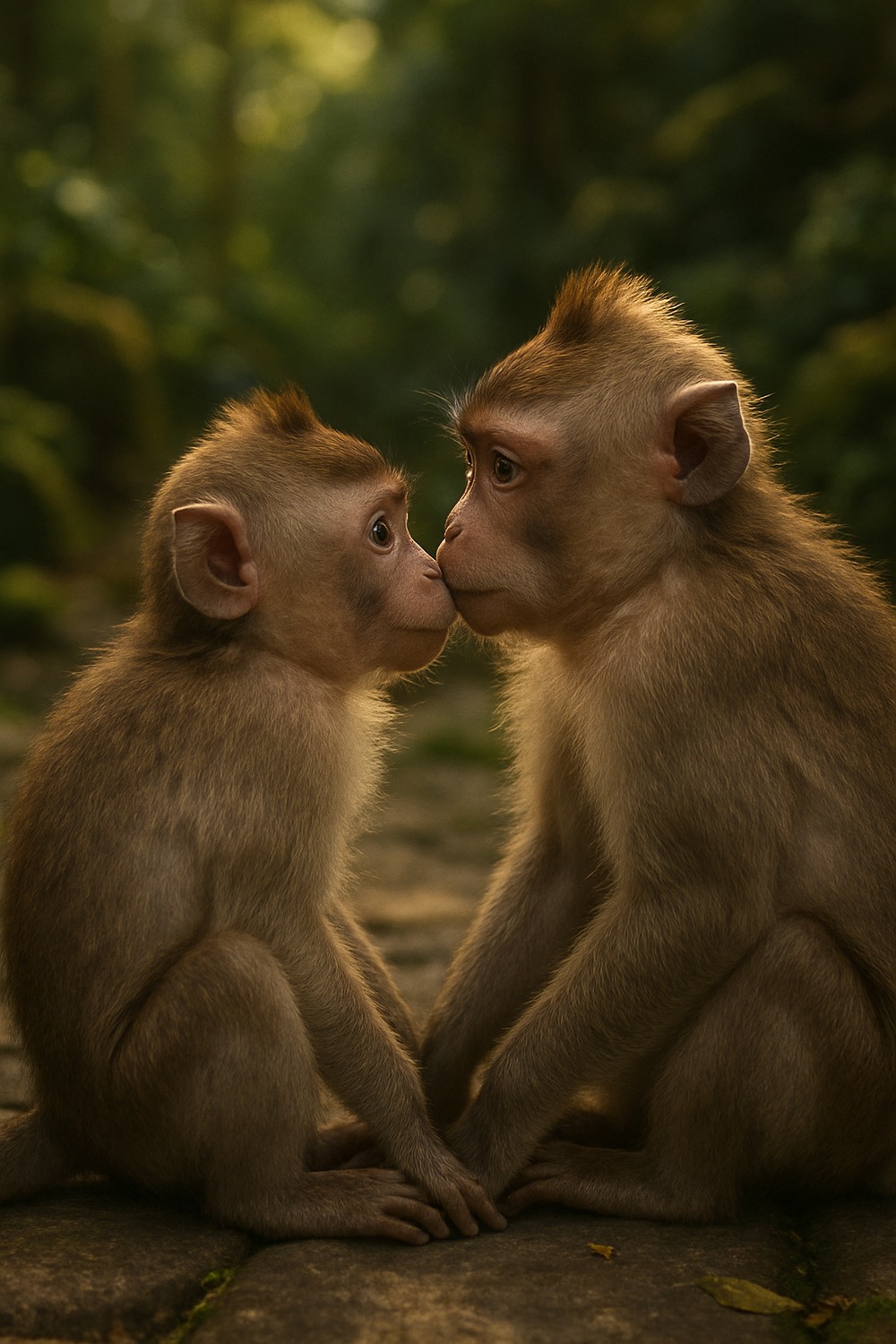
One Calm Nuzzle That Stopped Everyone Cold
Here’s the thing about watching an animal cross back from trauma into trust: it doesn’t look dramatic. No cinematic swell. No obvious turning point you can point to afterward. Punchy just — reached out one day. Calm, unhurried, completely matter-of-fact. He nuzzled the cheek of another young macaque like it was the most natural thing he’d ever done. Because twelve months before that moment, this animal wouldn’t release a stuffed toy. And now he was choosing real, living, reciprocal connection.
That last detail kept me reading about this for another hour.
Turns out the brain — even a traumatized primate brain — holds onto more plasticity than we give it credit for, especially when the right social conditions are present. Sotomaru didn’t fix Punchy. She just kept closing the distance, consistently, until he believed it was safe to do the same.
The Mama Doll is retired now. Sits on a shelf in the keeper’s office, slightly matted from months of small hands gripping it in the dark.
By the Numbers
- Illegal wildlife trafficking removes an estimated 30,000–40,000 crab-eating macaques from the wild every year — despite the species holding Least Concern status on the IUCN list (2022). The numbers don’t quite add up, and sanctuaries across Southeast Asia are absorbing the difference.
- Up to 60% faster recovery of functional group behavior — that’s what studies on primate social rehabilitation found when a traumatized animal was paired with a patient social mentor rather than placed directly into the general population.
- Grandma Sotomaru: credited with bridging more than a dozen traumatized youngsters into the resident group.
- In Harlow’s original 1958 cloth-mother experiments, infant macaques spent 17–18 hours a day clinging to soft surrogate objects. Not for food. Just for contact. The need for physical comfort in this species isn’t learned — it’s structural.

Field Notes
- Crab-eating macaques use stone tools in the wild — specifically to crack open shellfish. It’s one of only a handful of documented non-human primate tool behaviors, and it hints at a cognitive complexity that makes their emotional lives harder to dismiss than people tend to assume.
- The “grandmother effect” — older females stabilizing social groups after their own reproductive years — is well-documented in elephants, orcas, and humans. In macaque rehabilitation contexts, it’s only recently being studied with any rigor.
- Object attachment in traumatized macaques tends to fade naturally once stable social bonds form. Which suggests the stuffed toy was never really a crutch. More like a placeholder — something to hold onto until something real showed up.
Why Punchy’s Story Matters Far Beyond One Monkey
The real lesson in orphaned macaque healing — the one that keeps sanctuary workers going on underfunded mornings when nothing seems to be working — is that recovery isn’t primarily a medical event. It’s a social one. Punchy didn’t need a more sophisticated protocol or a larger enclosure. He needed someone willing to show up, day after day, at a careful and respectful distance, until the gap between them felt crossable.
In primate social biology, that’s not a small thing.
It’s actually everything.
Which raises a question that’s hard to shake once you’ve watched it happen: how much of healing — for any creature, of any species — comes down to finding one soul patient enough to close the distance?
Punchy doesn’t need Mama Doll anymore. He’s out on a sun-warmed ridge somewhere, nuzzling other macaques, living a life that looked genuinely impossible a year ago. That happened because one elderly monkey kept showing up. Small act. Enormous consequence. If you want more cases like this one — and some of them are even stranger — there’s more waiting at this-amazing-world.com.


