The Giant Geoduck: A Clam That Lives Over 160 Years
Something alive right now has been filtering seawater since before the first transcontinental railroad was laid — and it’s not a tree, not a tortoise, not anything most people would guess. The Pacific geoduck, buried three feet under cold Pacific sediment, has been doing this longer than most institutions humans consider ancient. Say it “gooey-duck.” Everyone mispronounces it the first time, and that small embarrassment is usually where the fascination begins.
A Clam Unlike Any Other
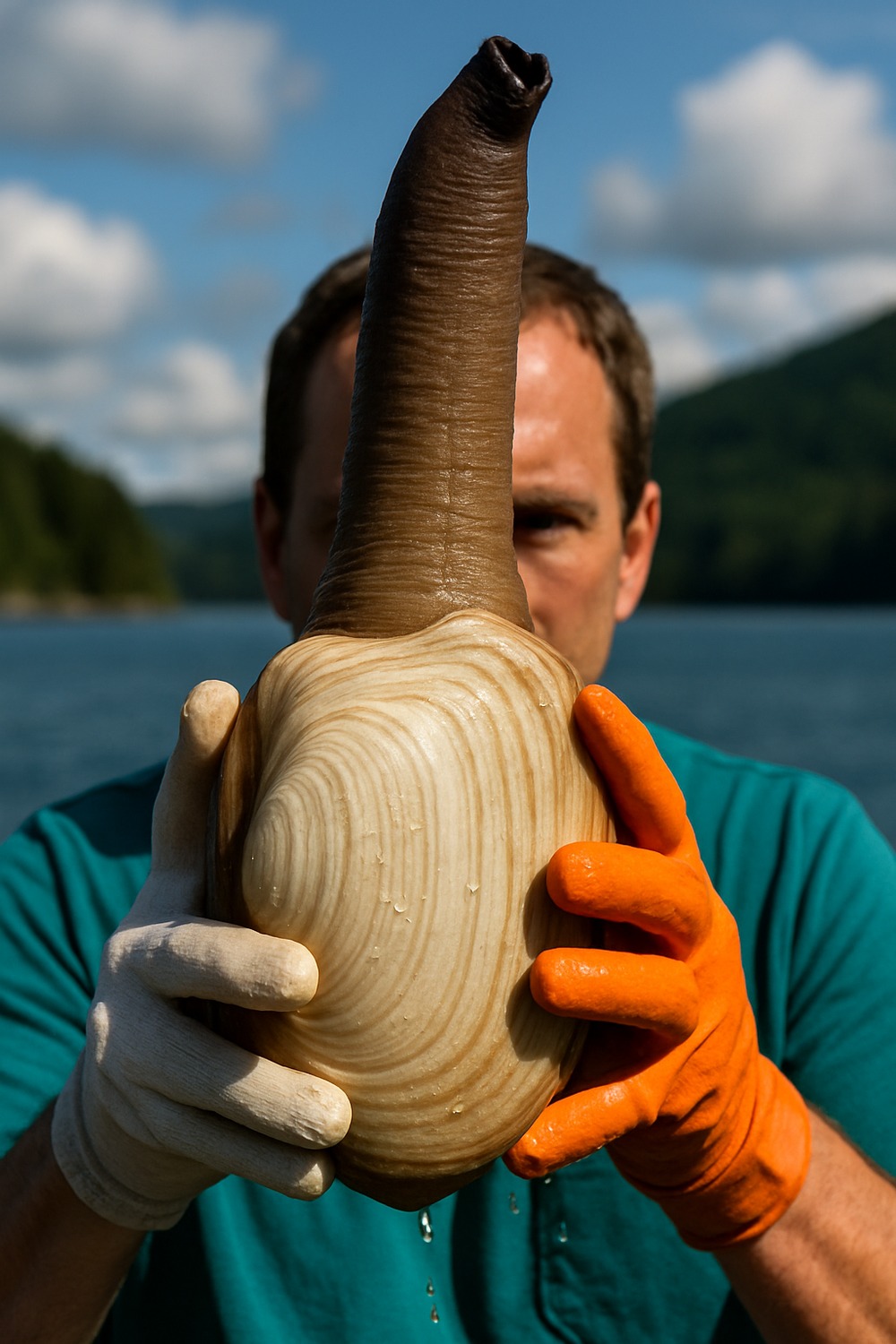
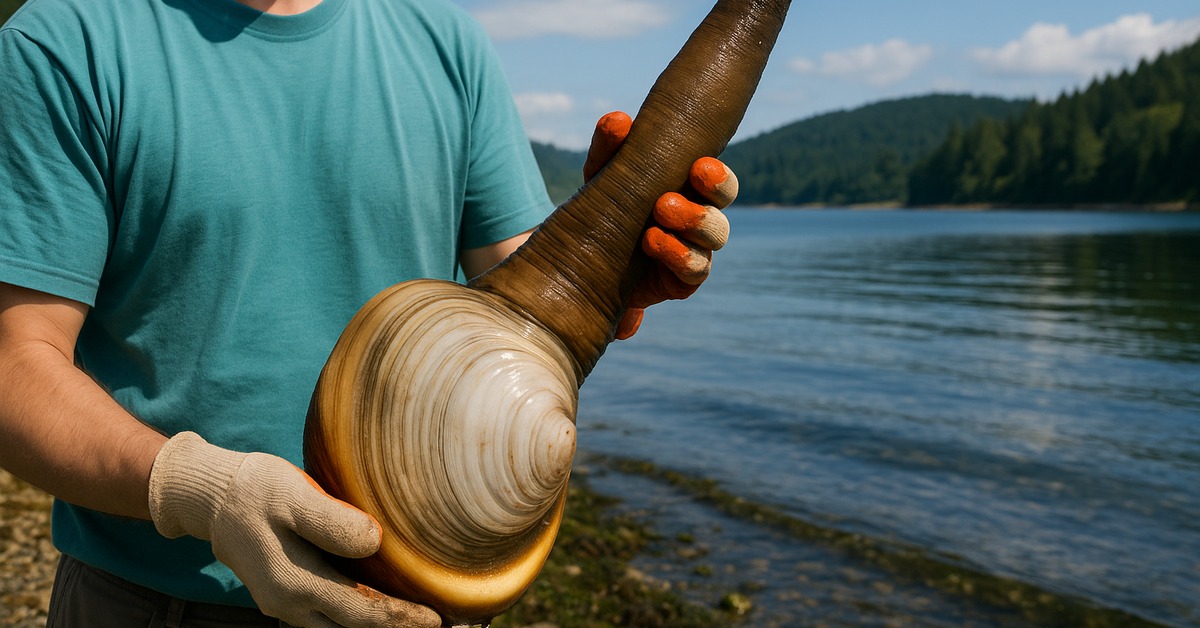
The shell is almost beside the point — tops out around eight inches, which sounds respectable until you see what comes next. The siphon is the thing: a muscular, extensible neck that pushes nearly three feet past the shell’s edges when fully relaxed. Two openings sit at the tip of that remarkable appendage, one pulling in seawater loaded with microscopic algae and dissolved oxygen, the other pushing filtered water back out. It’s a simple system, almost comically simple, and it works so well that the geoduck never needs to move to eat.
Which is convenient, because it can’t. Not really. I’ve seen footage of the siphon retracting in slow motion and it’s genuinely unsettling — something that large, that deliberate, vanishing back into the sand without a sound.
Geoducks belong to the species Panopea generosa (part of the family Hiatellidae, if you want to get technical about it), native to the western coast of North America from Alaska’s Aleutian Islands down to Baja California. Their preferred habitat is soft sediment — the kind a young clam can sink into fast after settlement. And once they’re in, that’s it. No migration. No relocating. Scientists who study them have noted, with what I can only describe as affectionate exasperation, that the geoduck has essentially perfected the art of doing almost nothing for an extraordinarily long time.
The Secret to an Extraordinary Lifespan
Confirmed specimens have reached 168 years of age. The species average runs well above a century — a geoduck born in the 1850s could theoretically still be filtering seawater today, having outlasted wars, technological revolutions, and at least four or five generations of the marine biologists who study it. Age gets determined by counting growth rings on the shell, same principle as a tree trunk, each ring representing roughly one year, the rings growing tighter and more compressed as the clam gets older. It’s a record written in calcium carbonate, which researchers read like a slow-motion diary of the ocean floor.
What nobody fully understands yet is how geoducks keep cellular decay at bay for so long. Their telomeres — the protective caps on chromosome ends that typically shorten as an organism ages — don’t degrade at the rate you’d expect. Most animals experience senescence, a gradual breakdown of the cellular repair systems that leads to aging and eventually death. Oxidative stress, another major driver of biological aging, seems to be managed differently in geoduck tissue too. But the exact molecular mechanisms remain unclear. Scientists have working theories. They don’t have the full picture. Not yet.
Built for the Deep and the Dark
Life buried three feet underground in cold murky sediment sounds miserable. For a geoduck, it’s optimal. That depth puts adult animals safely beyond the reach of most predators — sea otters, moon snails, and starfish being the main threats during the vulnerable juvenile phase. Once an adult geoduck is entrenched, almost nothing can dig it out efficiently enough to bother. The shell helps some, but depth is the real defense.
That siphon, extended up through layers of sand into the open water column, functions like a biological snorkel connecting a buried, sedentary creature to everything it needs above. Temperature matters too, maybe more than people realize. Geoducks thrive in the cool waters of the Pacific Northwest, where temperatures in their preferred depth range rarely climb above 12 degrees Celsius. Cold water holds more dissolved oxygen and supports richer phytoplankton blooms. But there’s something else: some researchers believe the geoduck’s cold, slow metabolic pace is directly connected to its longevity (and this matters more than it sounds). Animals with slower metabolisms tend to live longer — think tortoises, think bowhead whales. The geoduck fits this pattern almost perfectly, operating at a cellular tempo so measured that time seems almost irrelevant to it.
A Delicacy Worth Waiting For
Before it was international luxury product, it was dinner. Indigenous communities along the Pacific coast — including the Suquamish and Lekwungen nations — harvested geoduck as a traditional food source for thousands of years. Despite its deeply weird appearance — or maybe because of it — the geoduck has since become one of the most coveted seafood items on the planet. In China, Japan, and South Korea, fresh geoduck can command prices in the hundreds of dollars per pound at high-end restaurants. The texture is crisp and snappy. The flavor is clean, briny, with a sweetness that raw seafood fans find almost addictive. It gets served thinly sliced in hot pot, sashimi-style, or briefly seared, valued for both its taste and what its freshness signals to the table.
Commercial harvesting is tightly regulated now, and the economics explain why. Washington State alone runs a geoduck fishery worth tens of millions of dollars annually, but geoducks don’t reach harvestable size — roughly two pounds — until they’re between five and eight years old. Overharvesting even a limited area can take decades to recover from. Dive harvesters use pressurized water wands to loosen sediment around a clam before pulling it free by hand, a labor-intensive method that naturally caps extraction volume. Aquaculture operations in British Columbia and Washington have expanded to absorb some of the demand, with farmed geoducks grown from hatchery juveniles in subtidal lease areas. It’s become a significant industry. The clam, turns out, has been worth waiting for in more ways than one.
What Geoducks Teach Us About Aging
And here’s where it stops being just a story about an unusual seafood item. Researchers at institutions including the National Institutes of Health and various university marine biology programs have started analyzing geoduck genetics and cellular chemistry — looking for something that might tell us how biological aging actually works, and whether anything in a 160-year-old clam’s toolkit could be relevant to human medicine.
What changed? The discovery that these animals barely get cancer, despite living so long — that finding reframed the entire research conversation.
Why does this matter? Because given how long geoducks live and how fast their cells replicate during early growth, you’d expect tumors to show up regularly. They don’t. Researchers have documented surprisingly low rates of neoplasia — abnormal cell growth — in aged geoduck tissue, mirroring what’s been found in naked mole rats and bowhead whales. The pattern suggests that evolutionary pressure toward extreme longevity may also select for unusually robust cancer-suppression mechanisms (researchers actually call this the “longevity-cancer resistance link,” and it’s generating serious attention in biogerontology circles). Most researchers will tell you upfront it’s a long shot for human medicine. But the logic is hard to dismiss: if something in this animal’s biology suppresses cellular decay for over a century and a half, it’s worth understanding what that something is. Whether those mechanisms can be isolated in ways that inform human medicine is still an open question. But it’s not a crazy one anymore.
A species that resists both time and tumors, buried in the dark where no one was looking — and we nearly overlooked it entirely.
The Ocean’s Quiet Giants
You’ll never spot a geoduck on a rocky beach at low tide. There’s no drama to find on the surface — just a small hole in the sand and, if you’re patient and lucky, the brief retraction of a siphon vanishing below. But beneath that stillness sits a creature of real biological sophistication, one that’s been quietly outliving almost everything around it across millions of years of evolutionary history. Longevity doesn’t always look dramatic. Sometimes the longest lives are the quietest ones — anchored in cold dark sediment, filtering the sea one microscopic meal at a time, year after patient year.
Something almost philosophical lives inside what the geoduck represents, if you sit with it for a minute. It doesn’t roar or sprint or cross thousands of miles of open ocean. It doesn’t migrate toward anything, doesn’t compete for territory. The geoduck just stays, and persists, and waits — and that strategy has worked remarkably well for something like 168 years at a stretch. Watching a creature thrive for that long by doing almost nothing, you stop calling stillness a limitation.
How It Unfolded
- Pre-contact era — Indigenous communities of the Pacific Northwest, including the Suquamish and Lekwungen nations, harvest geoduck as a staple food source for thousands of years before European contact.
- 1869 — The species Panopea generosa is formally described by Western science, though the animal’s extraordinary lifespan goes unrecognized for nearly another century.
- 1970s–1980s — Commercial geoduck harvesting expands significantly in Washington State and British Columbia; regulatory frameworks begin developing in response to overharvesting concerns.
- 2004–present — Genetic and cellular research into geoduck longevity accelerates; findings on telomere stability and low neoplasia rates attract attention from biogerontology researchers studying aging and cancer resistance.
By the Numbers
- 168 years — maximum confirmed age of a Pacific geoduck
- ~3 feet — maximum extension length of the siphon
- ~8 inches — typical shell length at full adult size
- ~2 lbs — minimum harvestable weight, reached between ages 5–8
- 12°C — upper temperature threshold of preferred Pacific Northwest habitat
- Tens of millions USD — annual value of Washington State’s geoduck fishery
- Hundreds of dollars per pound — price range at premium Asian seafood markets
Field Notes
- Geoduck larvae are free-swimming for roughly two weeks before settling into sediment — the only truly mobile phase of their lives.
- Shell growth rings compress significantly in older animals, making precise age-reading in specimens over 100 years a specialized skill.
- Sea otters are a primary predator of juvenile geoducks, not adults — depth is the primary defense mechanism once a clam is established.
- Farmed geoducks are indistinguishable in flavor from wild-harvested ones, according to blind taste tests conducted by aquaculture researchers in British Columbia.
- The name “geoduck” derives from a Lushootseed word, gwídəq, meaning roughly “dig deep” — which is, as names go, exactly right.
Frequently Asked Questions
Q: How long can a Pacific geoduck actually live? The Pacific geoduck is among the longest-living bivalves on Earth, with confirmed specimens reaching 168 years of age. Researchers determine age by counting annual growth rings on the shell, similar to reading tree rings. Most geoducks in the wild live well over a century under favorable conditions.
Q: Why is the geoduck so expensive in Asian markets? Geoducks are prized in China, Japan, and South Korea for their distinctive crisp texture and clean, sweet oceanic flavor. Combined with their slow growth rate, the difficulty of harvesting them by hand, and strict fishing regulations that limit supply, demand routinely outpaces availability — driving prices to extraordinary levels in premium seafood markets.
Q: Can geoducks be farmed sustainably? Yes — geoduck aquaculture has grown significantly in Washington State and British Columbia, offering a more controlled alternative to wild harvesting. Farmed geoducks are raised from hatchery-produced juveniles and planted in subtidal lease areas, where they grow for several years before harvest. When properly managed, farming reduces pressure on wild populations while meeting growing international demand.
Editor’s Take — Alex Morgan
The geoduck keeps ending up in the wrong conversation. People talk about it as a luxury export, a fisheries management problem, an internet curiosity. What it actually is — a living model for studying why some organisms simply refuse to age the way biology says they should — gets buried under the jokes about its appearance. The cancer-resistance research alone deserves wider attention than it’s getting. Somewhere under a few feet of Pacific mud, a clam older than living memory is quietly making the case that we’ve been looking for longevity secrets in the wrong places.
What the Pacific geoduck keeps hidden from casual observers is staggering when you start adding it up — the age, the cellular resilience, the cancer resistance, the quiet cultural history stretching back millennia along the Pacific coast. For Indigenous communities it’s been sustenance and tradition for longer than any written record tracks. For seafood markets it’s become liquid gold shipped across the Pacific in temperature-controlled containers. For marine biologists it’s a puzzle with implications that reach well beyond fisheries management. And for the rest of us, standing on a beach watching unremarkable gray water, it’s down there right now. Buried. Patient. Filtering. A Civil War-era clam doing what it’s always done, completely indifferent to the fact that we find it extraordinary. It doesn’t need our attention to survive another century. It just needs time, and time, it turns out, is the one resource it has never once run short of.