


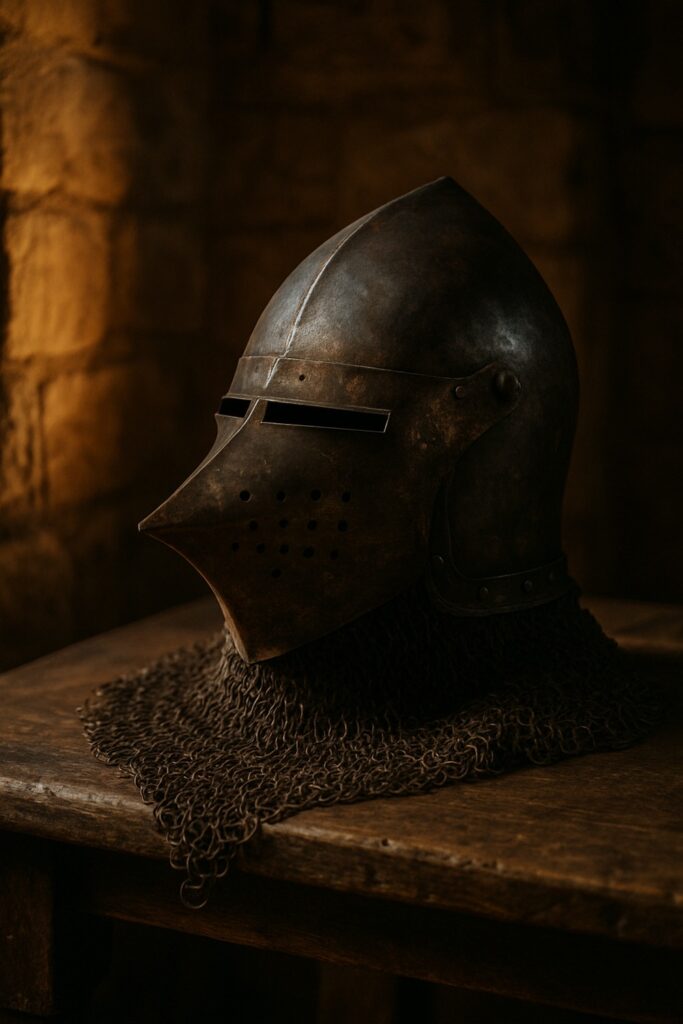
It is 1385. A French knight lowers his visor before the charge, and his entire world shrinks to a slit of light barely wider than his thumb. He can’t see left. He can’t see right. He rides anyway.
That detail — the sheer deliberate blindness of it — is what sent me down this particular rabbit hole at an unreasonable hour. Because the hounskull bascinet helmet wasn’t a compromise soldiers reluctantly accepted. It was the most trusted piece of military technology in 14th-century Europe. Men chose it. Preferred it. Staked their faces on it, literally, across the muddiest killing fields the continent had to offer.
The Hounskull Bascinet Helmet That Terrified Enemies
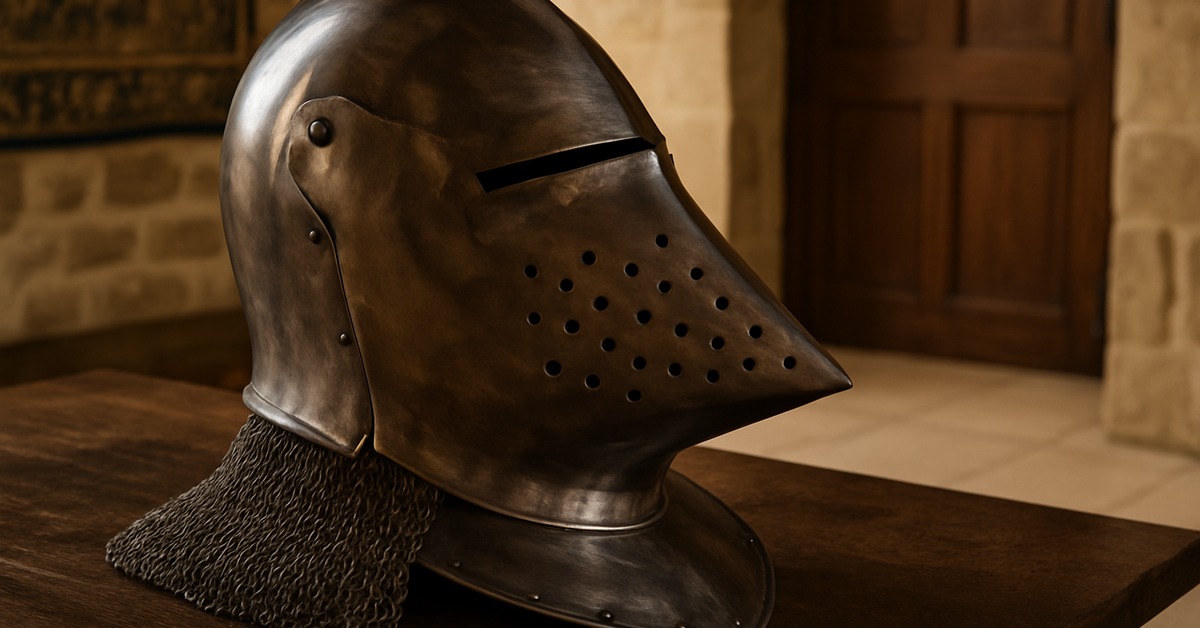
The name comes from the shape — a long, thrusting visor that reads unmistakably as a dog’s snout, or a pig’s, depending on who you asked. The hounskull bascinet emerged as the dominant European battle helmet from roughly the 1350s onward, and historians like Claude Blair, whose research on medieval arms and armor remains foundational, have tracked how fast it spread — England, France, the Holy Roman Empire, all within a generation or two. That’s remarkably quick adoption for an era without printing presses or supply chains.
The shape wasn’t decorative. That forward-jutting visor was a geometry problem, solved in iron.
A sword thrust aimed straight at a knight’s face would hit the angled steel and skid sideways rather than punch through. The same principle as the bow of a ship — built to deflect, not absorb. War had a new face, and it looked like nothing human. Which, if you were the person on the receiving end of a cavalry charge, was probably the point.
What That Narrow Slit Actually Did to Vision
This is the part that genuinely stopped me.
The visor’s single horizontal slot measured somewhere between 10 and 12 millimeters in height. To put that in context: it gave the wearer roughly a 20-degree vertical field of view. The human eye’s natural vertical range is 135 degrees. Peripheral vision? Gone. The ability to glance sideways without rotating your entire head? Eliminated. Armor historians at the Wallace Collection in London have noted that this trade-off was considered entirely acceptable given what the helmet protected against. Which raises the obvious question — how did anyone actually fight effectively like that?
Training. Years of it. Relentless, grinding, repetitive drilling in full kit until the body stopped needing eyes to know where the threat was coming from. Knights didn’t just wear this armor occasionally — they lived in it, marched in it, practiced in it until their nervous systems compensated for the missing sensory input. That kind of spatial intuition isn’t a skill you can pick up quickly. It was built slowly, over years, inside steel.
Breathing Inside a Steel Face: How They Survived
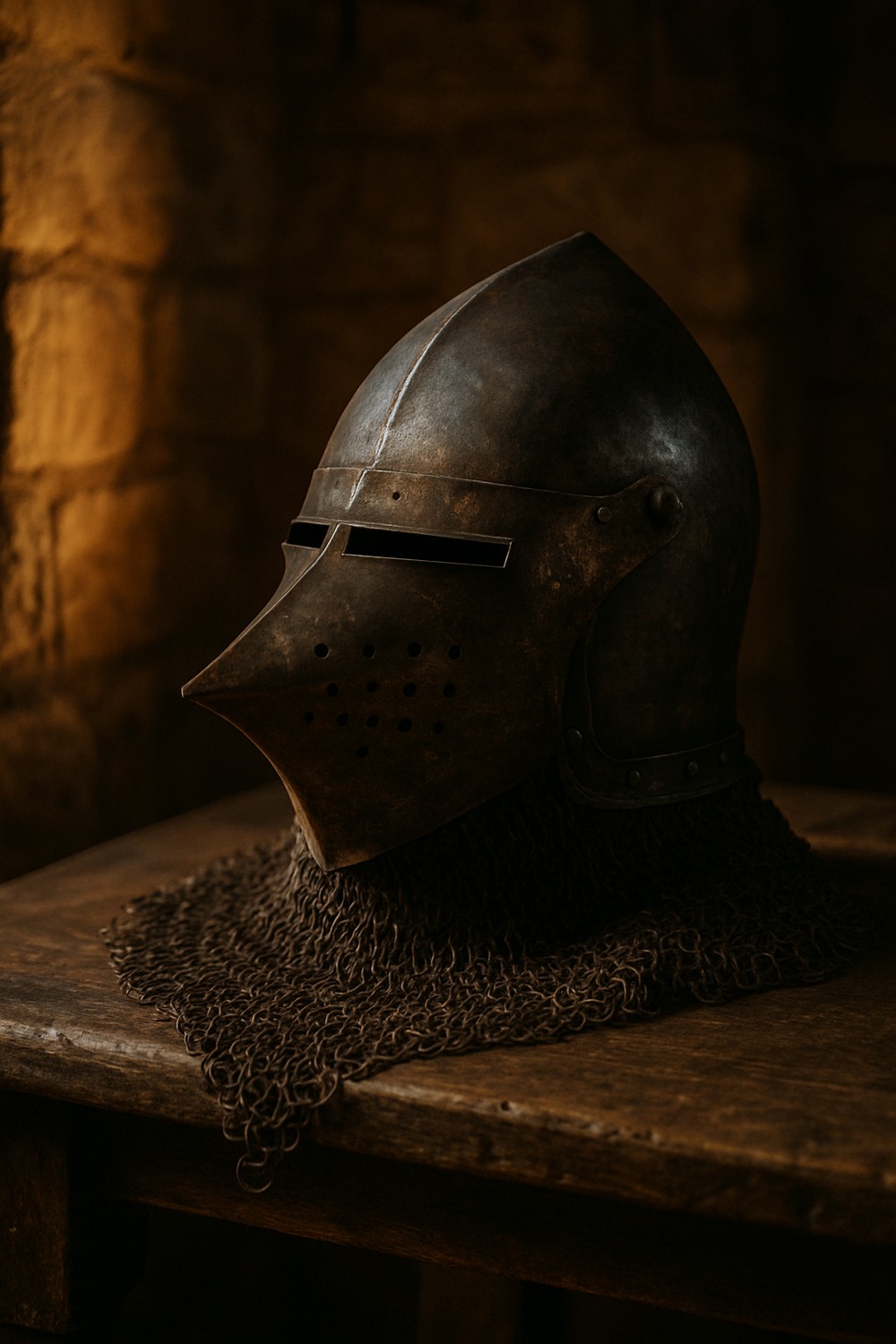
Those small perforations along the lower snout of the hounskull bascinet? Not decorative. Life-support.
For more information on the bascinet’s construction and ventilation design, the engineering detail is striking: a fighting man in full exertion inside sealed plate armor generated heat at a rate that would cook him from the inside without adequate airflow. Those tiny holes — drilled in rows along the snout, carefully placed — channeled just enough moving air to keep a man conscious and functional. Not comfortable. Functional.
Medieval soldiers wore this helmet through the muddy campaigns of the Hundred Years’ War, in the scorched summer heat around besieged Calais, across hours of hard riding before a single blow landed. Inside the steel, temperatures climbed. Sweat soaked through padded liners. And those perforations, small as they were, made the difference between a fighting man and a man slowly losing consciousness inside his own protection.
It worked. That’s the thing. It actually worked.
The Weight That Wore Warriors Down All Day
A replica hounskull bascinet at Tryon Palace in North Carolina weighs approximately 2.2 kilograms. Just the helmet. Sitting directly on the skull and brow, hour after hour, over terrain that was rarely flat and never forgiving. Add a full suit of plate armor and that knight is carrying somewhere between 20 and 25 kilograms of steel — distributed across the body, yes, but still present for every step of every march into every engagement.
Medieval knights were elite athletes. People tend to forget that. The hounskull bascinet was only wearable because the men wearing it had spent years building the physical capacity to wear it, move in it, and fight in it without slowing down. The helmet didn’t make you a warrior. You had to arrive as one.
And yet soldiers wore it voluntarily. Eagerly, even. Because the alternative — taking a lance to the face — was worse.

The Design Detail That Actually Saved Lives
Here’s the physics problem the pig-face was quietly solving.
That projecting snout created a gap — a few centimeters of engineered empty space — between the steel surface and the wearer’s actual face. When a war hammer or a mace landed on that visor, it had to travel through the entire projecting structure before it reached bone. The outer steel deformed. The force spread across the helmet’s geometry. The skull inside survived hits that should, by rights, have been fatal.
Crumple zones. That’s the modern term for it. The same principle that makes car crashes survivable today — sacrifice the outer structure to protect what’s inside — was being worked out in iron by craftsmen with hammers and fire in the 1300s. They didn’t have the vocabulary for energy displacement or force distribution. They had something better: generations of watching what happened to men who wore the wrong helmet, and the craft knowledge to fix it.
That last fact kept me reading for another hour.
By the Numbers
- By the 1380s, the hounskull bascinet was standard issue across most of Western Europe — it displaced earlier helmet designs within a single generation (Wallace Collection armor records, London)
- The visor slot measured roughly 10–15mm, giving wearers about a 20-degree vertical field of view, compared to the human eye’s natural 135-degree vertical range
- A full Gothic plate suit from the same period: 15 to 25 kilograms total — technically less than a modern soldier’s combat load, but distributed in ways that made it far harder to carry
- Skilled armorers could complete a bascinet in under a week; the curved geometry of the helmet made it among the most technically demanding pieces in the entire suit, requiring different techniques than flat or gently curved plate

Field Notes
- The visor was removable — knights unlatched it during marches for airflow, snapped it back seconds before contact. Modern reenactors frequently miss this detail and treat the visor as fixed.
- The pig-face made individual knights nearly impossible to identify on the battlefield, which directly accelerated the development of heraldic visual language — surcoat designs, shield symbols, crest devices — as a way to tell friend from enemy when every face looked the same. The hounskull bascinet didn’t just change how men fought; it changed how they communicated.
- Surviving examples show unsmoothed dents, old repairs, patches over patches.
- These weren’t display pieces. They were tools worn until they failed, then fixed and worn again.
Why the Pig-Face Still Matters Centuries Later
Stand in front of one of these helmets in a museum and you’re looking at engineering without a laboratory. No metallurgical science. No computer modeling. No controlled impact testing. The people who built the hounskull bascinet had observation, craft tradition passed through apprenticeships, and feedback from the worst possible classroom — actual combat, actual casualties, actual dead men whose helmets had failed them in ways that could be studied and corrected.
The designs survived centuries of warfare. Replicas sit in museum cases from London to North Carolina. That’s not luck. That’s the result of accumulated practical intelligence, refined under conditions that punished error immediately and permanently.
Every person who stops in front of one of these helmets and tries to imagine looking out through that narrow slit — they’re touching something real about human problem-solving under pressure. The men who wore these weren’t superhuman. They were exhausted, often frightened, frequently cold and hungry. But they built the best protection available with the materials and knowledge they had.
And it worked well enough that we’re still talking about it seven hundred years later.
The hounskull bascinet is a reminder that the gap between life and death has sometimes been the width of a carefully angled piece of steel — and that the people who survived long enough to refine the design were doing something we’d recognize today as engineering, even if they’d never have used the word. If this kind of history keeps you up past reasonable hours, there’s more waiting at this-amazing-world.com.


