


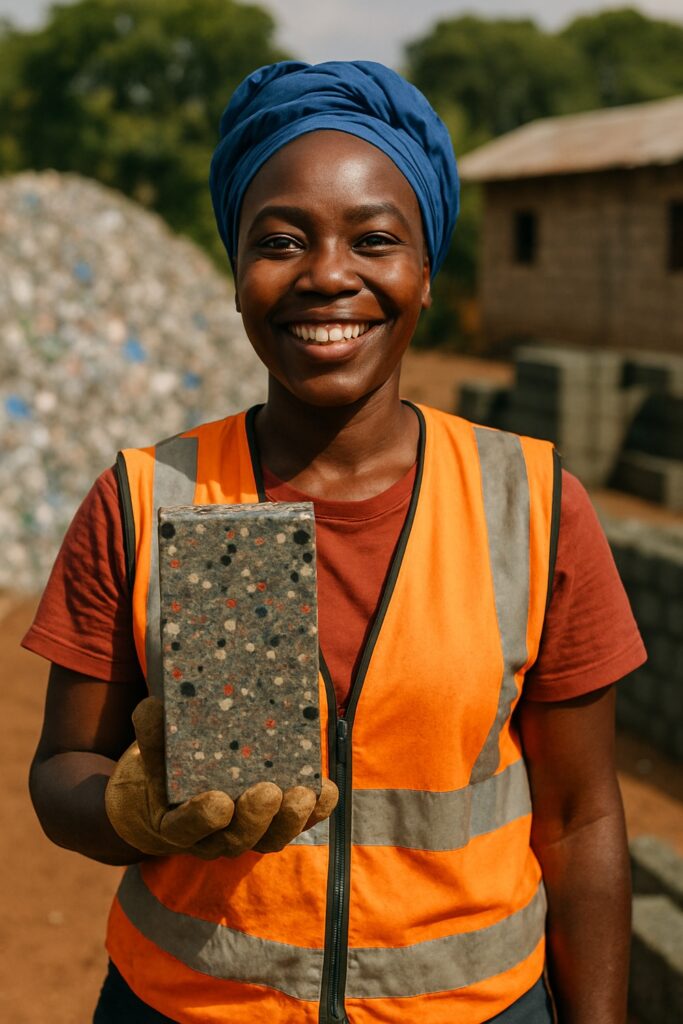
Plastic waste bricks stronger than concrete — the phrase sounds like a headline engineered to go viral and disappear. Except the walls are real, the lab data is real, and somewhere on the outskirts of Nairobi right now, someone is stacking them. Local entrepreneurs and engineers across sub-Saharan Africa are pulling plastic bottles and crushed packaging out of clogged waterways and informal landfills, melting them down, and pressing the result into bricks that independent university tests confirm can outperform standard concrete by a factor of five. This isn’t prototype territory anymore.

From Landfill to Load-Bearing Wall
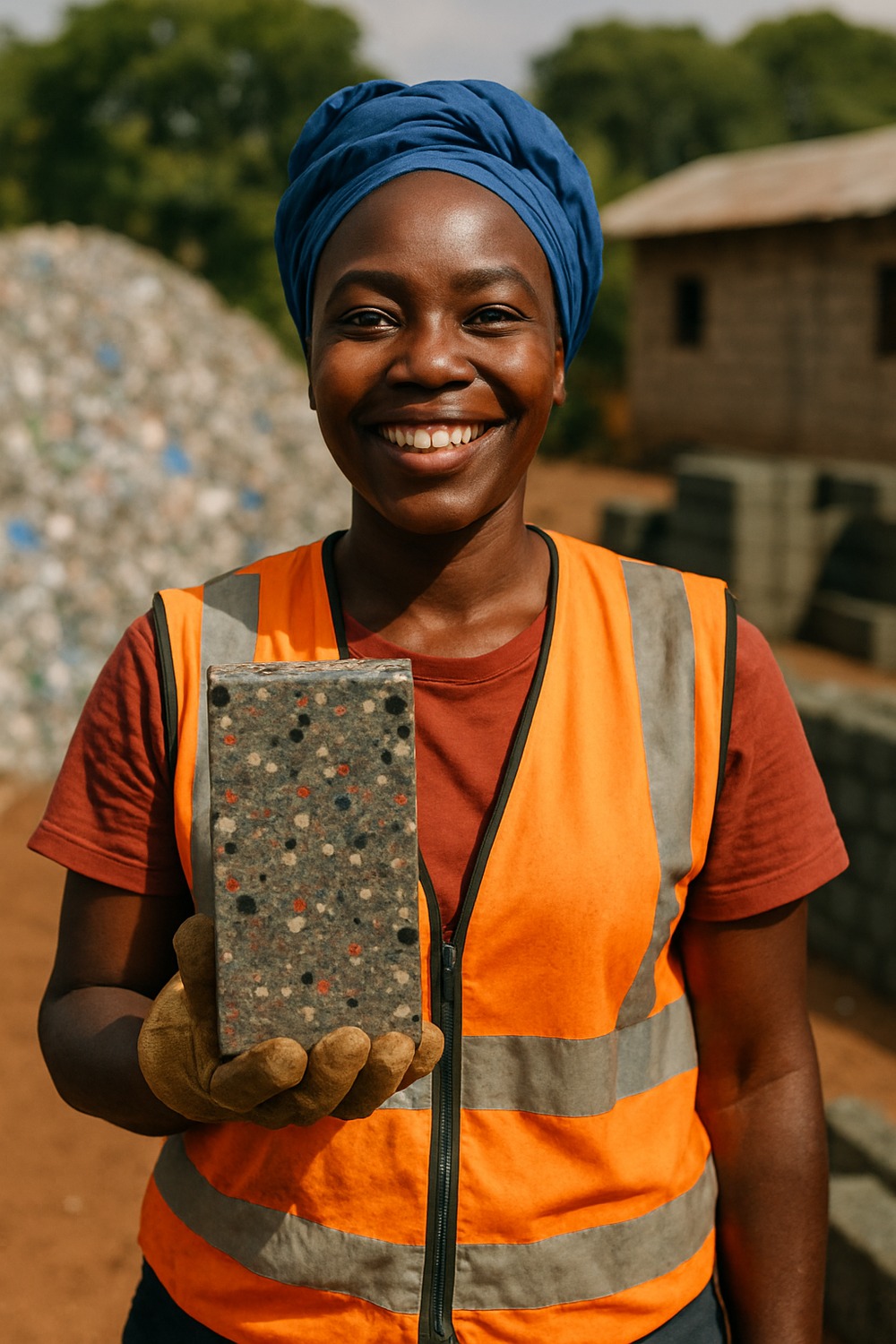
It starts exactly where most people stop looking: overflowing city dumps, polluted riverbanks, the tangled debris fields of informal settlements. Startups and social enterprises across sub-Saharan Africa have built collection networks that pull in enormous volumes of discarded plastic — polyethylene bags, PET bottles, industrial packaging scraps — material that would otherwise spend centuries fragmenting into microplastics and quietly infiltrating food chains and freshwater systems. Collected, sorted, shredded, cleaned. Then comes controlled heating, hot enough to melt the plastic without burning it.
The molten material gets combined with sand and locally sourced aggregates, compressed under hydraulic pressure into uniform brick shapes, and left to cool. What comes out surprises engineers who encounter it for the first time. The strength comes down to polymer chemistry: plastic’s internal chains flex under stress rather than fracturing the way rigid concrete does.
That matters enormously in regions where buildings must absorb heavy seasonal rains, scorching dry heat, and occasional seismic tremors — sometimes all within the same calendar year. Independent laboratory analyses at universities in Kenya and South Africa have consistently confirmed compressive strength readings that outperform standard residential concrete blocks. The interlocking designs common to these bricks cut mortar requirements significantly, which lowers both cost and the skill level a construction crew needs to build something that won’t fall down.
Affordable Enough to Change Everything
Why does this matter beyond the engineering lab? Because for a family earning a modest income in a rapidly urbanizing African city, a thirty-percent cost reduction isn’t a footnote — it’s the difference between a permanent home and another decade in precarious temporary shelter. Field reports and studies from pilot projects in Rwanda, Ghana, and Côte d’Ivoire put plastic-composite bricks at roughly that margin cheaper than conventional concrete alternatives, provided local plastic collection infrastructure is already in place. Schools, health clinics, and community centers built with these bricks have stretched public budgets further per financial cycle. Nonprofits working in disaster zones have experimented with rapid-deployment production units that can be stood up close to areas needing urgent reconstruction.
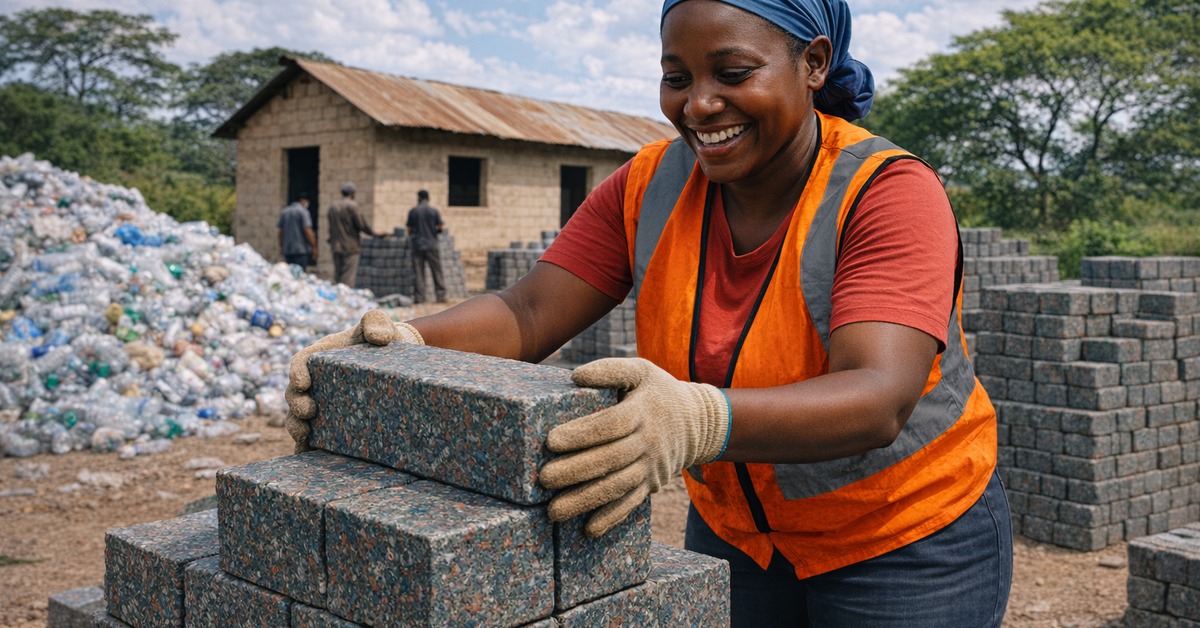
Beyond the bricks themselves, the supply chain generates real employment at neighborhood level. Plastic collectors — many of them women and young people who previously worked informal waste-picking with little income security and no protections — are being folded into structured schemes with fairer wages and safer conditions. Even modest manufacturing facilities producing thousands of bricks daily need machine operators, quality inspectors, logistics staff, and salespeople. In communities where formal work has historically been scarce, those roles create ripple effects well beyond individual paychecks.
Local contractors and hardware retailers are adapting too, learning new installation techniques and stocking plastic bricks alongside conventional materials, slowly normalizing a product that still makes cautious buyers — raised on century-old construction methods — slightly nervous.
Here’s the thing: the supply chain economics and the environmental story are the same story, and that convergence is genuinely rare in green innovation.
The Cautions Scientists and Engineers Raise
Nobody credible is dismissing the concerns. The biggest one is time. Concrete has centuries of real-world performance data behind it. Plastic-composite bricks have barely a decade — and nobody can yet say with confidence how they’ll behave after thirty, fifty, or a hundred years of ultraviolet exposure, moisture infiltration, and the relentless biological pressures of tropical climates.
Researchers working in persistently damp environments have raised legitimate questions about chemical compounds potentially leaching from certain plastic types into surrounding soils or building interiors over time (researchers actually call this “thermal degradation leachate risk,” and it matters more than it sounds). These aren’t hypothetical objections engineered to kill a promising idea. Monitoring programs currently running in Kenya and Rwanda are building the long-term datasets needed to answer them properly.
The data trail on long-term durability is thin enough that any builder, buyer, or government procurement officer who feels uneasy isn’t being irrational — they’re being honest about what the field still doesn’t know.

Scaling a Revolution Responsibly
Scalability is the word that sobers every policy conversation about these bricks. Africa’s housing deficit runs to tens of millions of units continent-wide. Closing even a fraction of that gap would demand collection volumes, processing infrastructure, and quality control systems operating at a magnitude that makes current pilot projects look like proofs of concept — which, to be fair, is exactly what they are.
And then there’s the regulatory tangle. Mixed waste streams mean inconsistent plastic quality, which creates real technical challenges for maintaining uniform brick strength. Regulatory frameworks for novel building materials vary wildly between countries, and in some places plastic bricks occupy a legal grey zone that blocks official adoption by government housing programs. Investors weighing large-scale production facilities have to balance genuine market opportunity against those uncertainties carefully.
How It Unfolded
- 2010 — Early experiments with plastic-sand brick composites begin in small Kenyan workshops, largely undocumented and outside formal research channels.
- 2016 — Rwandan startup Eco-Brixs draws international press coverage; first independent compressive strength tests published by a Nairobi university confirm results exceeding standard concrete blocks.
- 2019 — Pilot housing projects in Ghana and Côte d’Ivoire demonstrate the thirty-percent cost reduction; the concept moves from curiosity to viable construction option in NGO procurement conversations.
- 2024 — Long-term leachate and UV-degradation monitoring programs formally launched in Kenya and Rwanda; regulatory working groups convene in three countries to define certification pathways for plastic-composite building materials.
By the Numbers
- 5× — the confirmed compressive strength advantage of plastic-composite bricks over standard concrete blocks in independent lab tests
- ~30% — cost reduction versus conventional concrete alternatives in pilot projects across Rwanda, Ghana, and Côte d’Ivoire
- Tens of millions — the estimated housing unit deficit across the African continent that this technology is being positioned to address
- Less than 10 years — the real-world performance record currently available for plastic-composite brick construction
Field Notes
- Plastic types matter: polyethylene and PET produce different structural properties, and inconsistent feedstock is one of the main quality control headaches at scale
- Interlocking brick designs — common across most African manufacturers — reduce mortar use and lower the skill threshold required for construction crews
- Several manufacturers are experimenting with additives (volcanic ash, rice husk silica) to improve UV resistance and reduce leachate risk in high-humidity climates
- South Africa and Kenya lead on university-level research; Rwanda currently has the most advanced government engagement with potential regulatory frameworks
Frequently Asked Questions
Are plastic waste bricks actually stronger than concrete?
Independent laboratory tests at universities in Kenya and South Africa have confirmed compressive strength readings up to five times higher than standard residential concrete blocks. The structural advantage comes from polymer chain flexibility — plastic bends under stress where concrete cracks.
How are these bricks made?
Collected plastic is sorted, shredded, and cleaned, then melted under controlled heat (hot enough to liquefy without combustion), combined with sand and local aggregates, compressed under hydraulic pressure into brick molds, and cooled. Most manufacturers use interlocking shapes that reduce mortar requirements.
What do they cost compared to regular bricks?
Pilot project data from Rwanda, Ghana, and Côte d’Ivoire puts them roughly thirty percent cheaper than conventional concrete alternatives — assuming local plastic collection networks are already functional. Without that supply chain, cost advantages shrink considerably.
What are the safety concerns?
Two main issues: long-term durability data is limited to under a decade of real-world use, and certain plastic types may leach chemical compounds into soil or building interiors over time, particularly in high-humidity environments. Monitoring programs in Kenya and Rwanda are actively building the datasets needed to assess both risks.
Which African countries are leading in this area?
Kenya and Rwanda have the most established ecosystems, combining active startups, university research partnerships, and early government engagement. Ghana, South Africa, and Côte d’Ivoire have significant pilot projects underway. Nigeria and Ethiopia are emerging markets watching the regulatory picture closely.
Editor’s Take — Alex Morgan
I’ve watched a lot of green innovations cycle through the “promising pilot” phase without ever escaping it. What feels different here is the convergence: the environmental problem and the economic problem turn out to have the same solution, which almost never happens this cleanly. The durability gap is real and deserves honesty, not PR spin. But the families already living in homes built from reclaimed plastic aren’t waiting for a fifty-year dataset. They moved in, and the walls are holding. That’s not nothing.
Promising early results don’t build an industry on their own. That takes patient capital, cross-sector coordination, and government policy that actively creates certified pathways for sustainable materials rather than leaving innovators to navigate ambiguous rules alone. Africa’s plastic brick pioneers have already proved the harder conceptual point — that environmental crisis and human ingenuity aren’t opposites, that cleaning a river and sheltering a family can turn out to be the same act. The walls rising from reclaimed waste may yet prove more durable than anyone initially dared to claim. But getting from inspiring case studies to genuine scale is, as ever, where the real work begins.


