



The dents were still in them. Nearly 2,000 years underground, and the bronze still held the shape of whatever hit him hard enough to buckle the metal — and he’d had them repaired and worn them again anyway.
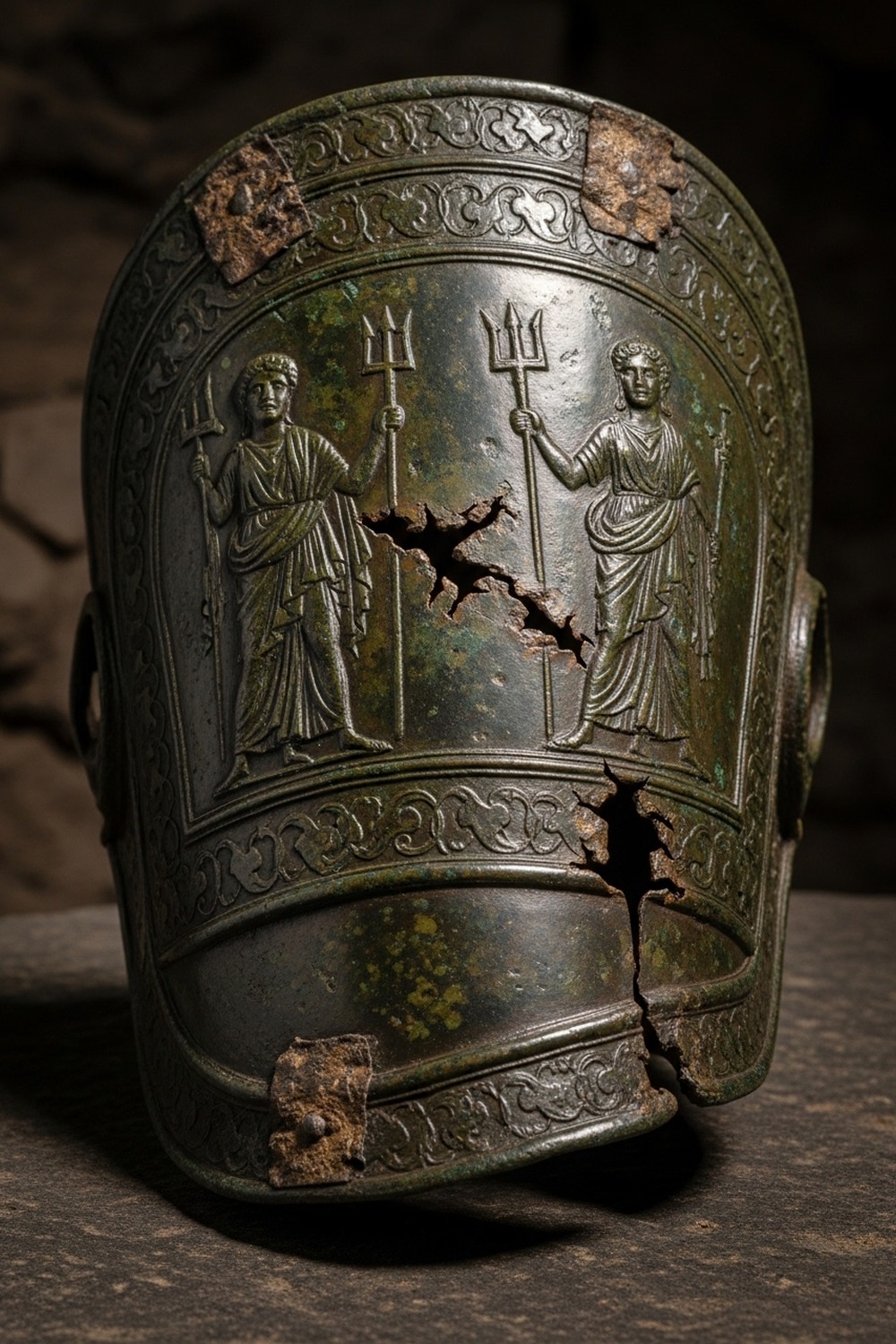
When archaeologists dug into the gladiator’s barracks at Pompeii, they pulled out a pair of bronze greaves — leg guards, custom-fitted to someone’s actual legs — and the damage pattern on those greaves told a story no inscription could. Scratched. Patched. Bent back into shape. The repairs weren’t subtle. Someone had worked the metal carefully, closed up the wounds in the bronze, and handed them back to whoever wore them. That man walked back into the arena. More than once.
What Pompeii Gladiator Armor Actually Looked Like
These weren’t decorative pieces. The curve of the metal was shaped around real muscle and bone — specific legs, specific calves, a specific height. They fit one person.
And they’re engraved with Jupiter and Neptune, which sounds like ornamentation until you sit with it for a minute. According to Wikipedia’s overview of Roman gladiatorial combat, fighters wore armor specific to their class and fighting style, and every piece had meaning in context. So what does it mean that this particular man chose the king of the gods and the god of the sea, etched into the bronze wrapped around his legs? He wanted every advantage available to him. Practical protection and divine protection, layered on top of each other, because you can be the best fighter in the room and still walk out broken.
The engravings weren’t decoration. They were a request.
The Dents Tell a Story No Scroll Could
It is some afternoon in the first century AD. A gladiator in Pompeii hands over his leg guards after a fight — or maybe after several — and someone examines the damage and decides: repairable. Worth fixing. And then it happens again.
Archaeologist Andrew Wallace-Hadrill, who spent decades inside Pompeii’s material culture, has made the argument that everyday objects often preserve more human truth than written records ever could. These greaves prove that. You can see the patches. You can trace where the metal was worked back into shape after absorbing a blow that should have ended someone’s leg. That’s a physical timeline of survival — one fight represented in each repair, each dent that got smoothed back down. No diary. No name carved anywhere we’ve found. But the damage pattern on a pair of bronze leg guards tells you this person kept going back. You can read more stories like this at this-amazing-world.com.
That’s not a ceremonial object.
That’s a life.
The Ivory Dagger Changes Everything About Status
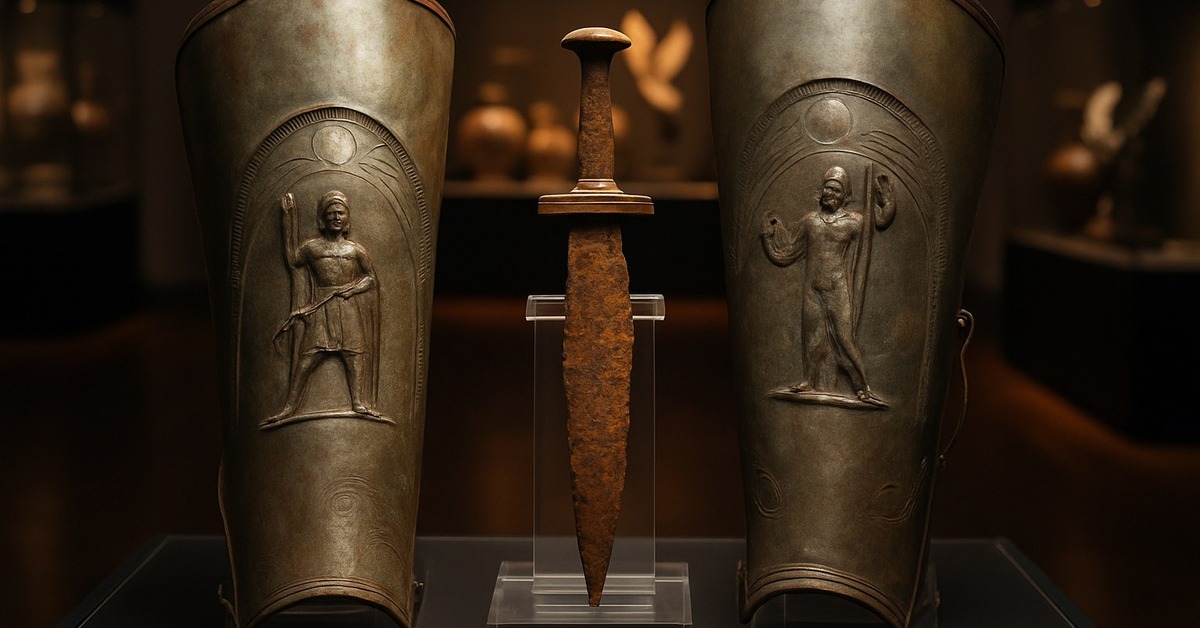
Found alongside the Pompeii gladiator armor: a dagger with ivory inlay. That detail is doing a lot of work.
Ivory wasn’t cheap, and it wasn’t handed to just anyone. A gladiator carrying an ivory-inlaid weapon occupied a specific, genuinely complicated position in Roman society. Not free, often. Not a criminal, necessarily. Gladiators existed in this strange social stratum where they were simultaneously degraded — legally, officially — and wildly famous, occasionally wealthy, sometimes beloved. Some were volunteers. Men who did the math on the money and the fame and the desperate need for either, and signed up anyway.
This wasn’t someone given the cheapest blade available and pointed toward the sand. Whoever owned these objects had earned something — or been given something — that communicated standing. And in a world where your position in society determined almost everything about how you’d eventually die, that mattered more than it might seem.
Pompeii Froze This Story Mid-Sentence
Vesuvius erupted in 79 AD and stopped Pompeii on a Tuesday afternoon. The Pompeii gladiator armor survived not because someone chose to save it — because no one had time to save anything.
The barracks where the greaves were found still contained the remains of gladiators. Some chained. Some not. The whole complex — weapons, helmets, training equipment, personal effects — abandoned in a single instant, buried under four to six meters of ash and pumice, and left there for seventeen centuries before anyone started digging. The greaves didn’t outlive their owner by plan or intention. They outlived him by accident.
That’s somehow the strangest part of it.

The Gods Engraved on Bronze Had a Purpose
Roman gladiators were deeply embedded in religious ritual — the games themselves were frequently tied to religious festivals or the funeral rites of wealthy citizens. Armor marked with divine imagery wasn’t aesthetic flourish. Scholars studying Roman religious practice have noted that personal objects used in dangerous contexts were regularly marked this way to invoke specific protection. Not to show off the craftsman’s skill. To make a specific ask of a specific god.
This man was working inside a fully coherent belief system that said: honor the gods correctly, and maybe they notice. The Jupiter and Neptune engravings were part of his strategy. As real and functional to him as the bronze they were cut into. That last detail kept me reading for another hour — the idea that the armor was simultaneously physical protection and a kind of ongoing negotiation with forces he couldn’t control.
He covered every angle he could think of.
By the Numbers
- Pompeii sat under four to six meters of volcanic ash after Vesuvius erupted in 79 AD — preserving the site well enough that systematic excavation, when it finally started in the 1740s, found objects essentially frozen in place.
- Roughly 1 in 5 bouts in the early Imperial period ended in a fighter’s death, according to historian Kathleen Coleman’s analysis of mosaic records and inscriptions.
- The Colosseum held 50,000–80,000 spectators. Roughly the capacity of a modern NFL stadium.
- A successful gladiator could earn the equivalent of a Roman legionary soldier’s full annual salary for a single fight — which explains, at least partly, why some free men walked into the arena voluntarily despite knowing exactly what the odds were.

Field Notes
- The Gladiators’ Barracks in Pompeii — a large quadriporticus near the amphitheater — was found during 18th and 19th century excavations still containing weapons, helmets, and human remains.
- Not all of them were slaves or prisoners. By the 1st century AD, a significant portion of gladiators were free volunteers — some chasing fame, some in financial freefall, and at least a few who, by all available evidence, genuinely wanted the life.
- Bronze greaves like these were associated with specific gladiatorial classes — the murmillo, the hoplomachus — meaning the style of leg armor told a knowledgeable spectator exactly what kind of fighter they were watching before the bout started. The armor announced the man before he ever moved.
Why These Greaves Still Matter Today
The Pompeii gladiator armor sitting behind museum glass isn’t just an impressive old object. It’s the closest we can come to a specific human being who left almost nothing else behind. We don’t know his name. We don’t know his record, how many he won, whether he earned his freedom or died before he reached it. But we know the shape of his legs. We know he took damage and came back. And we know someone chose to repair his armor rather than replace it — which means either he was valuable to someone, or he was cared for by someone, or both.
A pair of battered bronze greaves becomes the most human thing in the room. More honest than a portrait. More specific than anything a historian wrote down. Just a man, his gods, the hits he absorbed, and the repairs that sent him back out anyway.
Pompeii has a way of doing this — handing you something so precise it catches you off guard. These leg guards with their dents and their patches aren’t a symbol of gladiatorial Rome. They’re one person. Someone who fought, got hurt, got put back together, and walked out again. We’ll almost certainly never know his name. But we know he kept going. And sometimes that really is the whole story. There’s more like this at this-amazing-world.com — and the next one goes somewhere even stranger.


