


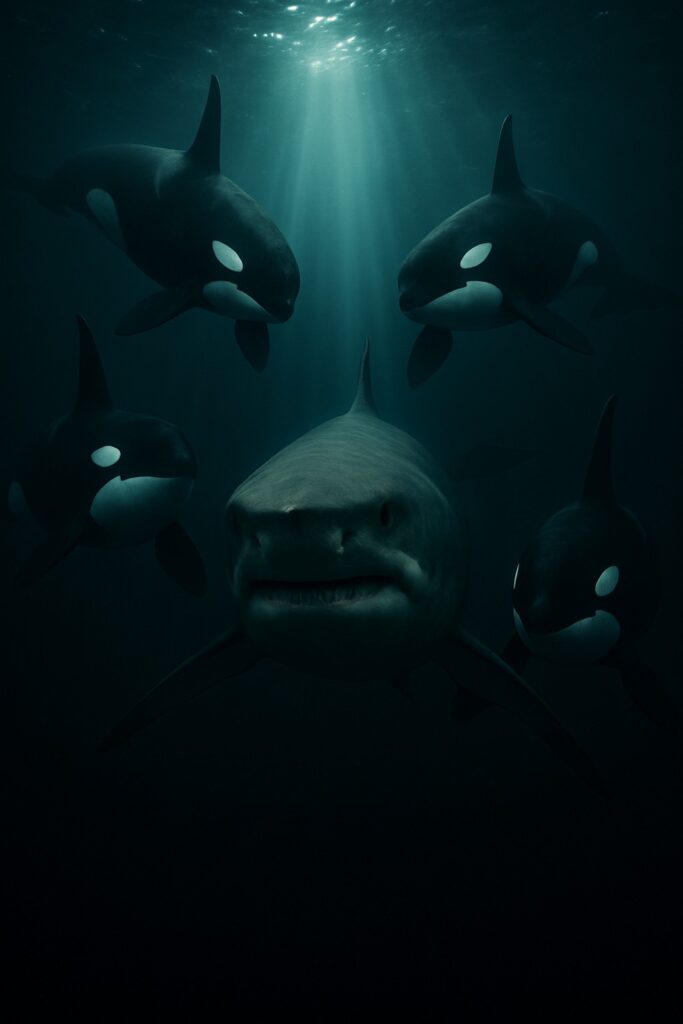
Nobody was watching when it started. Two orcas, a specific stretch of South African coastline, and a hunting technique so precise that marine biologists are still arguing about what to call it.
Their names are Port and Starboard. They’ve been working the waters off Gansbaai since around 2015, and what they’ve done to the local great white population is unlike anything researchers had documented before. Shark-watching boats return empty now. The great whites are gone. And the way two orcas pulled that off — quietly, methodically, over years — is genuinely hard to get your head around.
How Orcas Hunting Great White Sharks Actually Works
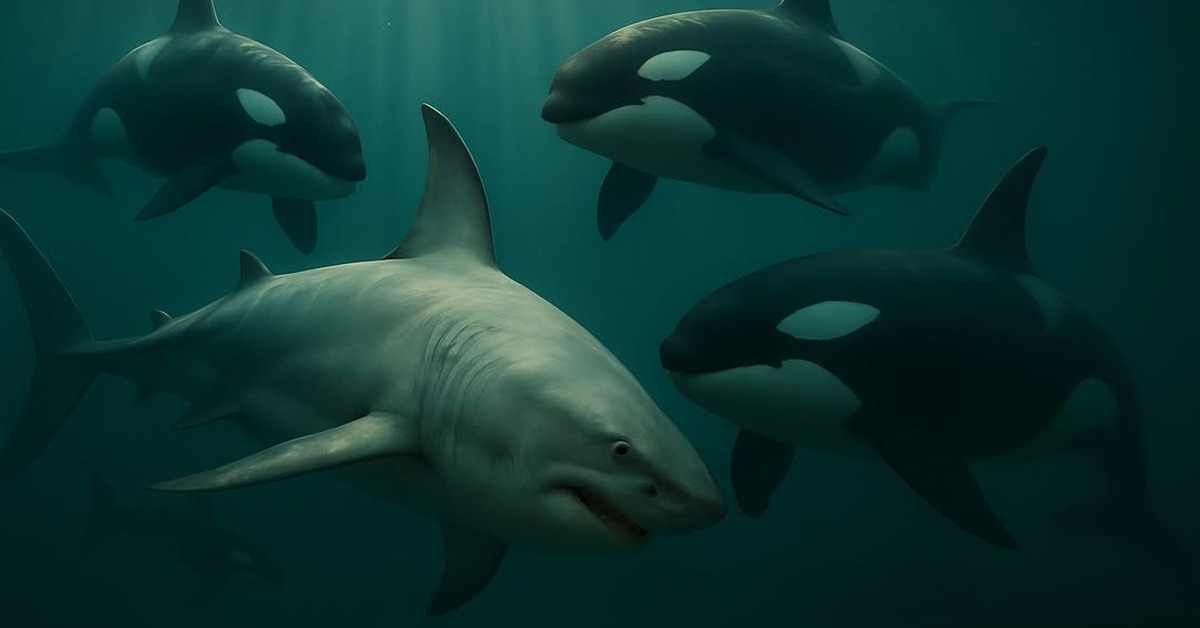
Port and Starboard are identifiable by their collapsed dorsal fins — one bends left, one bends right, which is how they got their names. Working as a pair, they locate a great white, herd it, then flip it upside down. That inversion triggers something called tonic immobility — a paralytic state that locks certain shark species into a kind of frozen stillness when they’re inverted. Researcher Alison Towner, who’s spent years studying Gansbaai’s sharks, has described the precision of what happens next as almost surgical.
Once the shark is immobile, the orcas extract the liver. Just the liver.
One organ, sometimes weighing over 200 pounds in a large great white, packed with squalene — a lipid-dense compound that functions like jet fuel for a marine predator. The rest of the carcass drifts away untouched. Like someone who broke into a vault, took exactly one thing, and left everything else sitting there.
The Great White Capital of the World Has Gone Quiet
Gansbaai earned that nickname honestly. The stretch of water between Dyer Island and Geyser Rock — called Shark Alley — held one of the densest concentrations of great white sharks on the planet. Cage diving operators built entire businesses around it. Researchers flew in from everywhere. For decades, an encounter was essentially guaranteed. Then Port and Starboard showed up, and the orcas hunting great white sharks through that corridor changed the whole picture. Whole seasons passed without a single confirmed white shark sighting.
The sharks didn’t die. They fled.
Tracking data showed individuals that had patrolled those waters for years suddenly moving hundreds of miles away — sometimes within days of an orca encounter, and in some cases not returning for months. For a species that’s held its range for millions of years, that’s not just unusual. It’s almost without precedent.
What Happens When an Apex Predator Vanishes Overnight
Great whites don’t just hunt — they regulate. Their presence keeps other predator populations in check, shapes where prey species congregate, and holds the structure of a coastal food web together. When the orcas hunting great white sharks cleared out Gansbaai’s whites, that regulatory pressure just… disappeared. And something moved in to fill the space. Broadnose sevengill sharks — previously held in check by great whites — began appearing in the shallows in numbers nobody expected, moving into zones they’d largely avoided before.
Ecologists call this a trophic cascade. It sounds like jargon. It’s not complicated. When you pull something out of the middle of a web, everything connected to it shifts — and the shifts move in directions nobody predicted and, honestly, nobody’s fully tracking yet.
The cascade is still unfolding.

Two Orcas, One Strategy, Decades of Dominance Undone
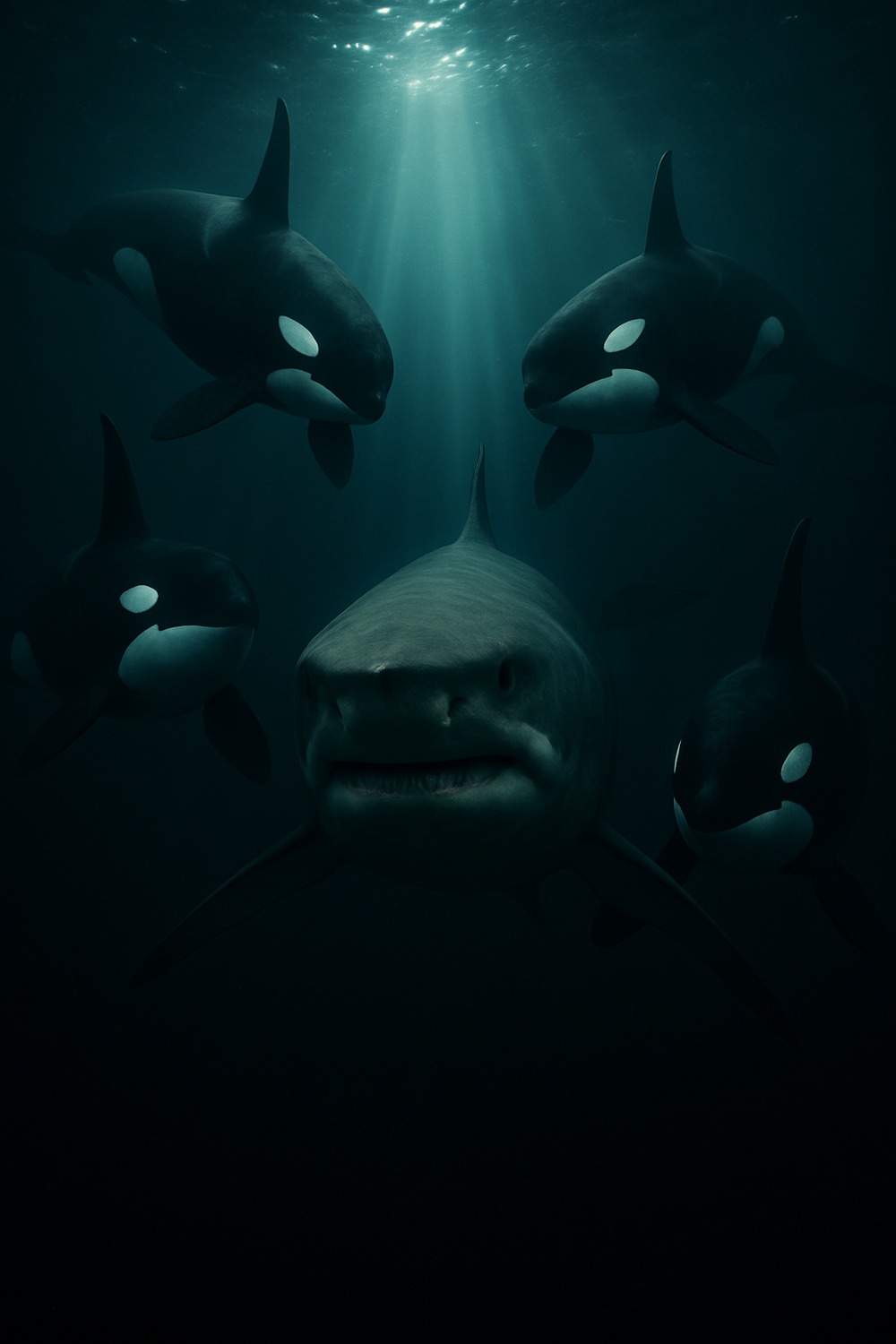
Turns out Port and Starboard aren’t acting on instinct alone. Orcas are among the most cognitively sophisticated predators alive, and what these two have developed is a refined, coordinated technique built around a very specific shark vulnerability. Tonic immobility isn’t widely known outside marine biology, but it’s been documented across multiple shark species. The orcas appear to have learned — and remembered — exactly how to exploit it.
That last fact kept me reading for another hour.
Because it spreads. Orca populations in other regions have been observed targeting shark livers too, including off Norway and near New Zealand. Whether they worked this out independently or whether the knowledge is moving through orca populations the way information moves through human cultures — that’s a question researchers are genuinely trying to answer right now. Both possibilities are significant. They’re significant in completely different ways.
By the Numbers
- Since 2015, at least 8 great white shark carcasses have washed ashore near Gansbaai with livers cleanly removed — all attributed to Port and Starboard, per South African Shark Conservancy monitoring reports
- A large great white’s liver can account for up to 24% of its total body weight — on a 1,500-pound shark, that’s over 350 pounds of organ tissue pulled out in a single encounter
- Some displaced Gansbaai great whites relocated over 300 miles away within days — one of the longest predator-avoidance movements on record for the species
- Broadnose sevengill shark sightings in Gansbaai’s inshore zones increased by a reported 40–50% in the years following the great white exodus, according to monitoring data cited by Towner and colleagues

Field Notes
- Tonic immobility in sharks can last anywhere from a few seconds to nearly 15 minutes
- Squalene — the compound that makes shark livers so calorie-dense — is also used in human cosmetics and pharmaceutical manufacturing. It’s been commercially harvested from sharks for decades, which means some populations were already under pressure before orcas entered the picture at all.
- Port and Starboard belong to a small, poorly understood orca subpopulation off South Africa’s coast. Unlike the well-documented orca clans of the Pacific Northwest, their social structure, range, and communication patterns are still largely unmapped — which makes studying their behavior even harder than it sounds.
- The technique works. That’s the part that’s hard to explain away.
Why This Rewrites What We Know About Ocean Power
For a long time, the great white sat at the top of the popular imagination as the ocean’s ultimate predator. That was always a simplification — orcas have been capable of killing great whites for as long as both species have existed — but what Port and Starboard have demonstrated goes beyond a single predator-prey encounter. The sustained, deliberate pressure these two animals have applied to orcas hunting great white sharks in one specific, bounded stretch of coastline has restructured that ecosystem in real time.
That’s not an ambush. That’s closer to a campaign.
It also forces a harder question about how stable apex predator dominance actually is. If two animals can destabilize a population of great whites that held territory for millennia, what does that say about every other ecosystem where the balance feels fixed and permanent? The ocean doesn’t do permanent. It never did. We just weren’t watching closely enough to see it move.
Port and Starboard are still out there. The sevengill sharks are still pushing into new territory. The food web is still adjusting to a hole that didn’t exist ten years ago — and what fills that hole, and what gets displaced when it does, is playing out right now in real water with no clear ending. If this kind of story is what keeps you up at night, there’s more at this-amazing-world.com. The next one is stranger.


