


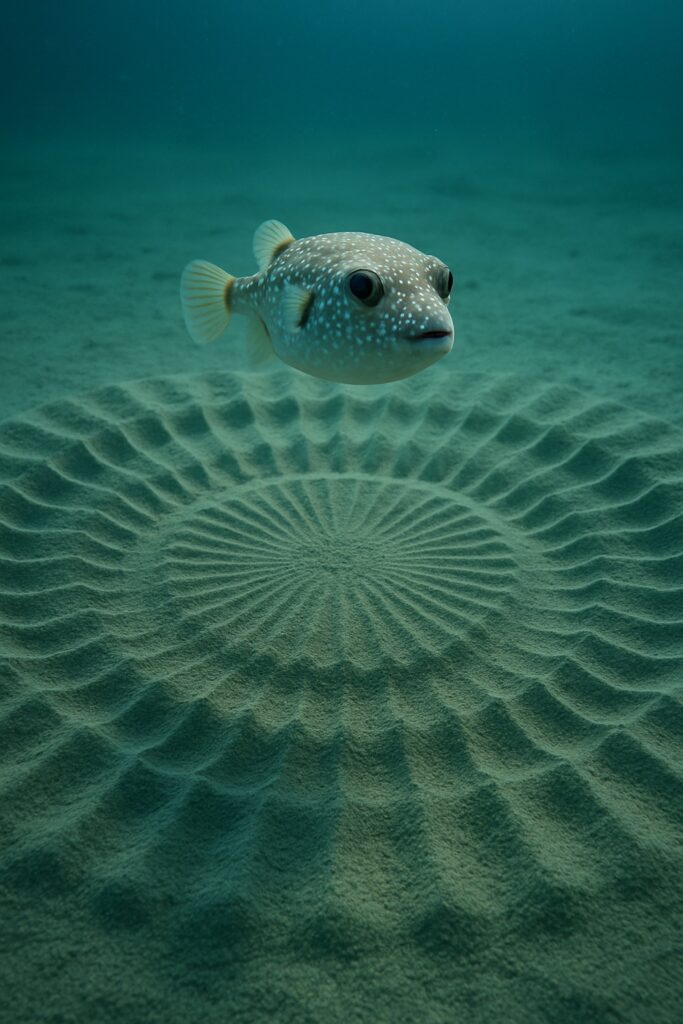
Nobody knew what was making the circles. That’s where this story starts — not with the fish, but with the mystery.
Off the coast of Japan, near Amami-Oshima Island, underwater photographer Yoji Ookata kept finding these enormous geometric patterns on the seafloor. Nearly two meters across. Perfectly symmetrical ridges radiating outward like something carved by a compass. He first documented them in 1995, and for years after that, nobody had a convincing explanation. Currents, maybe. Shifting sediment. Some kind of geological process. Anything but what it actually was.
The Pufferfish Sand Mandala That Baffled Scientists for Years
It took until 2013 for a team of Japanese scientists, publishing in research on the white-spotted pufferfish, to confirm the answer: one small fish was doing all of this. On purpose. Alone.
The species is Torquigener albomaculosus. About 12 centimeters long. And what it builds is nearly 20 times its own body size — which, if you want a human-scale comparison, is roughly like a person constructing a sand sculpture the size of a city block using only their hands, over the course of a week, with no tools and no guarantee anyone shows up to see it.
That last fact kept me reading for another hour.
How He Actually Builds It: Fins, Patience, Physics
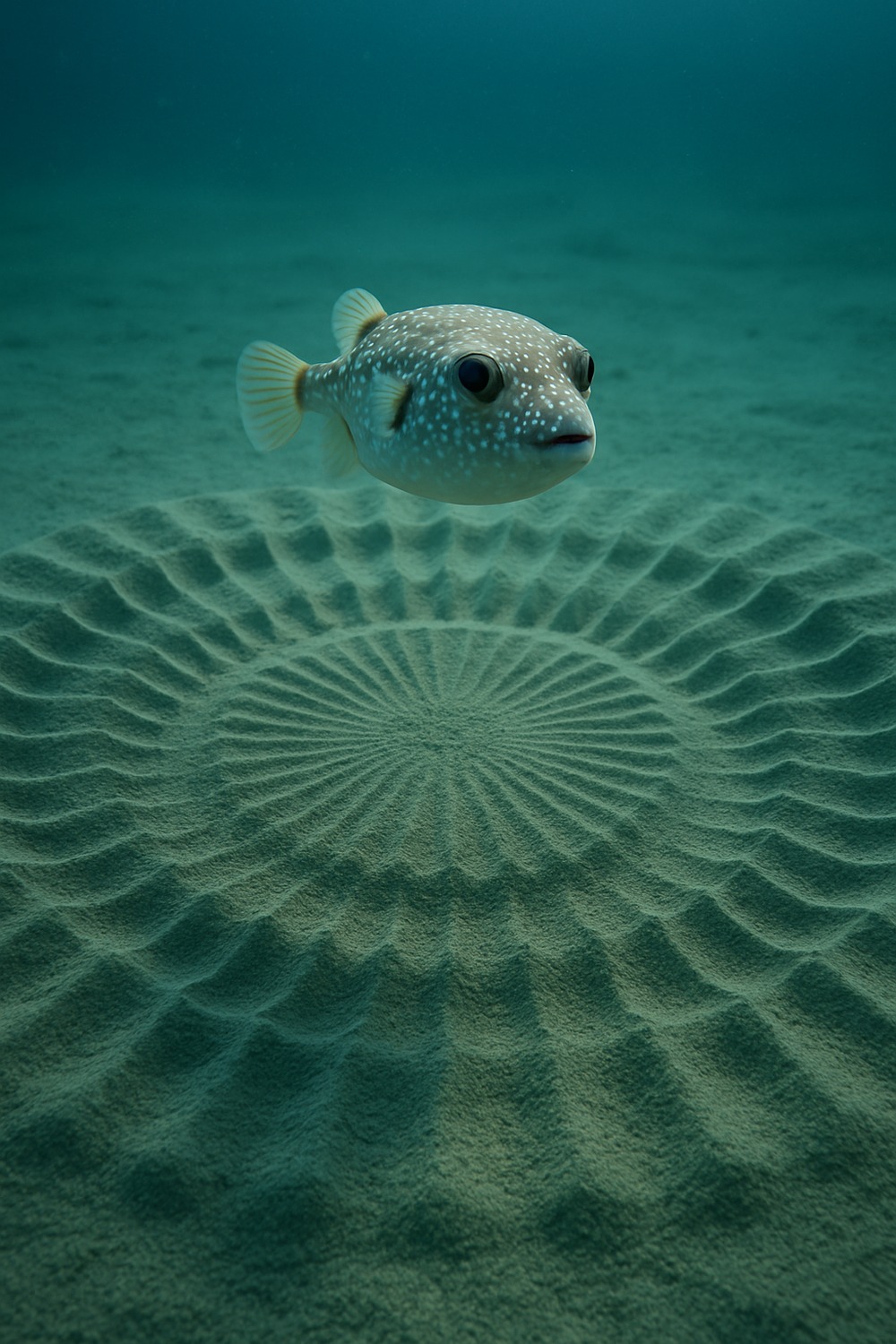
He starts at the center and works outward. Swimming in repeating patterns, beating his fins against the seafloor to push sand into ridges and valleys that radiate with near-perfect symmetry. The valleys aren’t decorative — they’re functional. They channel fine sediment toward the middle of the circle, where it settles into a smooth, cushioned nest.
Every groove has a structural purpose.
He does this for up to seven days. No recorded breaks. No assistance. Ocean currents degrade the structure continuously, which means that by the time he’s finishing the outer edge, parts of what he built on day one are already eroding. He keeps going anyway. If you’re wondering whether that qualifies as one of the most complex animal constructions on Earth, scientists largely think it does.
What the Female Is Actually Looking For
When a female arrives at a pufferfish sand mandala, she doesn’t make a snap decision. She inspects it. Swims along the ridges, assesses the texture of the center, evaluates the geometry. Researchers believe the precision of the ridges correlates with the male’s physical fitness and age — a more symmetrical structure signals a stronger, more capable mate.
It’s architecture as a résumé.
If she approves, she lays her eggs right in the center — in the soft sediment he spent days engineering to be perfect for exactly that purpose. And if she doesn’t approve? He starts over. A week of work, dismissed in minutes. And he just begins again. No record of a male giving up.
The Part That Stops You Cold
There’s something almost unbearably earnest about this. A tiny fish — with no brain capable of conscious planning as we understand it — produces something that looks, to human eyes, like art. The patterns echo mandalas created by Buddhist monks. They resemble crop circles. When photos surfaced online in the early 2010s, a lot of people assumed they were faked.
The pufferfish sand mandala looked too intentional to be real.
But it is real. Unrehearsed. Driven entirely by instinct and millions of years of evolution selecting for males who could build better, more precise structures than their rivals. Which raises the obvious question — why didn’t anyone connect the fish to the circles sooner? Turns out the fish is so small, and the structure so disproportionately large, that researchers kept looking past him. Nobody was looking for a 12-centimeter animal when the evidence in front of them was two meters wide.
And here’s the thing — he decorates it.

Shells, Fragments, and the Detail That Changes Everything
It’s not just sand. Males actively collect shells and coral fragments and place them along the ridges. This wasn’t immediately obvious to researchers because the decorations are small and the overall pattern dominates your attention. But when scientists looked closely, they found deliberate placement of materials that weren’t native to the site.
He’s not just sculpting. He’s curating.
The decorations may also help break the current, protecting the eggs once they’re laid. And once a female deposits her eggs in the center and they’re fertilized, the male guards them for about six days while they develop. The ridged structure that looked like courtship display turns out to have practical engineering value too — slowing water flow, reducing turbulence, keeping the eggs oxygenated and protected.
The love letter is also a cradle.
By the Numbers
- The completed sand mandala measures approximately 1.8 to 2 meters in diameter — documented in a 2013 study in Scientific Reports by Hiroshi Kawase and colleagues at the Coastal Branch of Natural History Museum and Institute in Chiba, Japan.
- Roughly 15–17 times the builder’s own body length.
- The male works continuously for up to 7 days to complete a single structure — one of the longest sustained construction periods documented in any non-mammalian species.
- Females have been observed spending several minutes inspecting a single nest before making a mating decision. For context: most fish courtship lasts seconds.
Field Notes
- The species wasn’t formally described and named until 2014 — nearly two decades after Ookata first photographed the circles — partly because the fish is so small and the structure so large that connecting the two took targeted research dives, not just observation.
- Fine sand at the center has a measurably different grain size than the surrounding seafloor. The male’s fin movements appear to sort sediment by size — coarser material pushed outward to the ridges, finer particles concentrated in the nest. No apparent intentionality. Just repeated motion, producing precision.
- Similar structures, though less elaborate, observed in related species.
- Several other pufferfish in the genus Torquigener have since been seen building comparable circular patterns, which suggests this behavior evolved across a lineage rather than appearing once in a single species.
Why a Fish Building a Nest Should Matter to All of Us
The pufferfish sand mandala sits at this strange intersection of instinct and artistry that science still struggles to fully categorize. We know the evolutionary mechanism — females who chose mates with better structures had more successful offspring, and the trait compounded over generations. Knowing the mechanism doesn’t make the result feel any less strange.
The fish doesn’t know it’s beautiful. It just builds.
What this quietly challenges is our assumption that elaborate construction requires intelligence. Planning. Consciousness. We’ve treated those things as prerequisites for complexity and beauty. The pufferfish collapses that assumption completely, and leaves you genuinely uncertain about what else we’ve been too quick to claim as uniquely human. That’s not a comfortable place to land, but it’s an honest one.
A tiny fish on a dark seafloor moves his fins for seven days and creates something that looks like sacred geometry. Nobody taught him. Nobody’s watching. He does it because somewhere in his biology, it’s the only thing that matters right now. That’s not just a nature story — it’s a story about effort, and standards, and what creatures will do when something that functions exactly like love is on the line. There’s more where this came from at this-amazing-world.com, and if anything, the next one is stranger.


