The Seahorse Smaller Than Your Thumbnail That Hid From Science
Nobody was looking for them. That’s the part that keeps getting me — divers had been swimming through these reefs for years, trained eyes scanning the coral, and the pygmy seahorse was just… there. Two centimeters long. Hiding in plain sight.
In 1969, a marine biologist accidentally brought a chunk of coral into a lab and found seahorses living on it that no one had ever documented. They weren’t tucked in some impossible deep-ocean trench. They were on shallow reefs that humans had been actively exploring. We just had absolutely no idea what we were looking at — or rather, what we were looking past.
How Pygmy Seahorse Camouflage Rewrote What We Know
The accidental discovery belonged to George Bargibant, a technician at the Nouméa Museum in New Caledonia. He was preparing a sea fan coral specimen — a Muricella species — when he noticed two tiny seahorses clinging to it, almost invisible against the coral’s surface. What made it extraordinary wasn’t just their size. It was how perfectly their bodies matched the coral’s color, texture, and even the shape of individual polyps. Bargibant had essentially stumbled into a masterclass in biological mimicry that had gone completely undetected. Wikipedia’s entry on pygmy seahorses describes the species named after him — Hippocampus bargibanti — as the first confirmed pygmy seahorse ever recorded.
So how many more were out there?
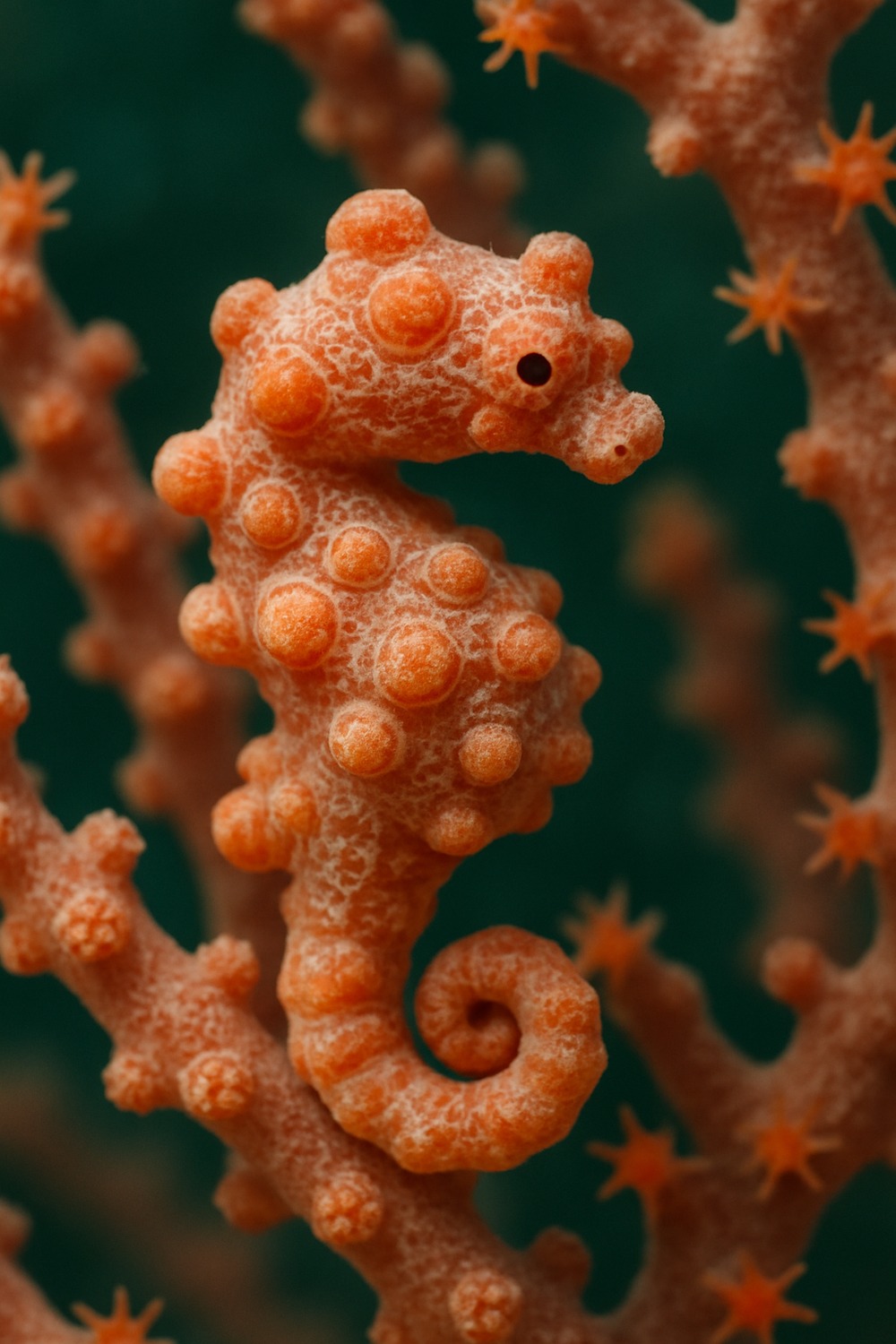
That question is what stings a little. The divers who’d been swimming those reefs weren’t sloppy. They weren’t inexperienced. The camouflage is just that good. Not roughly similar to the coral. Not approximately matching. Identical — down to the bumpy tubercles that mirror the coral polyps surrounding them. That last detail kept me reading for another hour.
A World the Size of Your Open Hand
Most animals move. They hunt across territory, migrate, explore. A pygmy seahorse doesn’t. It finds one sea fan coral — sometimes just a single branch — and that becomes its entire universe. Hunting ground. Sleeping spot. Nursery.
Some individuals spend their whole lives on one coral structure without ever leaving. It sounds impossibly constrained until you realize the coral gives them everything: camouflage, food, shelter, and a built-in partner, since pygmy seahorses tend to pair up and share their chosen branch. For more on the strangely intimate lives of ocean creatures that most people never hear about, this-amazing-world.com goes deep into the biology that doesn’t make the headlines.
The relationship between a pygmy seahorse and its coral host isn’t just behavioral convenience. It’s a survival lock. Remove the seahorse from its specific coral species and its camouflage stops working. The body is tuned — evolved, shaped, colored — for one host and essentially one host only. That’s not flexibility. That’s a very specific bet on one reef, one branch, one future.
The Fathers Carrying Entire Futures Inside Them
Like all seahorses, pygmy males carry the young. The female deposits eggs into a brood pouch on the male’s body, and he fertilizes and gestates them until birth. But in a species where your whole world fits in a palm, this takes on different weight. The pygmy seahorse camouflage that keeps adults invisible from predators is also, in a very real sense, protecting the next generation — a male carrying young is still anchored to that same coral branch, still depending entirely on his body’s disguise to survive long enough to give birth.
Survival geometry as much as parenting.
The brood numbers are small. Single digits, sometimes fewer than ten offspring per birth cycle. For a creature that never wanders far and depends entirely on one specific reef ecosystem, those numbers feel fragile. Each birth matters enormously.
The Coral Triangle and the Secrets Still Locked Inside It
Nearly every known pygmy seahorse species lives within the Coral Triangle — the dense, biologically staggering zone spanning Indonesia, the Philippines, and Papua New Guinea. It contains over 600 species of reef-building coral and more than 2,000 species of reef fish. It’s the most biodiverse marine region on Earth.
And here’s the thing: we’ve barely catalogued it. Researchers are still finding new species of fish, invertebrates, and yes, pygmy seahorses, in reef systems that haven’t been formally surveyed. The pygmy seahorse camouflage that hid these animals from science for so long is still doing its job in waters we haven’t properly looked at yet.
At least nine distinct species have been confirmed. Most were identified only in the last twenty years. The species count doubled in a single decade between the early 2000s and 2010s.
Which raises the question that keeps marine biologists up at night: what else is out there, still invisible, still waiting for someone to look closely enough at the right piece of coral?
The Camouflage Isn’t Just Visual — It Goes Deeper
Turns out the pygmy seahorse doesn’t just match the color of its host coral — it matches the texture in three dimensions. The small, rounded protuberances on its skin, called tubercles, mirror the coral polyps almost exactly in both shape and placement.
And the color match isn’t fixed at birth. Researchers believe juveniles may calibrate their coloration after settling on their host coral, essentially developing their disguise in real time based on their specific environment. Adaptive camouflage operating at a resolution that’s almost hard to accept.
The implication is significant. A pygmy seahorse raised on one color variation of its host coral may not be able to effectively camouflage on a different one. Their survival isn’t just tied to the coral species — it may be tied to the specific colony. Or even the specific branch. That’s an extraordinary degree of biological specialization, and it makes reef degradation a uniquely catastrophic threat to these animals. Not a gradual pressure. More like pulling the floor out from under them.
By the Numbers
- The first confirmed pygmy seahorse species, Hippocampus bargibanti, was discovered in 1969 when George Bargibant found two individuals on a museum specimen — decades after divers had regularly explored the reefs where they live (source: Journal of Natural History, 2003).
- More than half the known species found within the last two decades.
- The smallest pygmy seahorse species, Hippocampus satomiae, measures just 13.8 mm in height — making it the smallest known seahorse on Earth, and one of the smallest vertebrates in the ocean.
- The Coral Triangle covers just 1.6% of Earth’s ocean surface but contains approximately 76% of all known coral species and over 35% of the world’s coral reef fish — the ecosystem on which virtually every pygmy seahorse depends entirely.
Field Notes
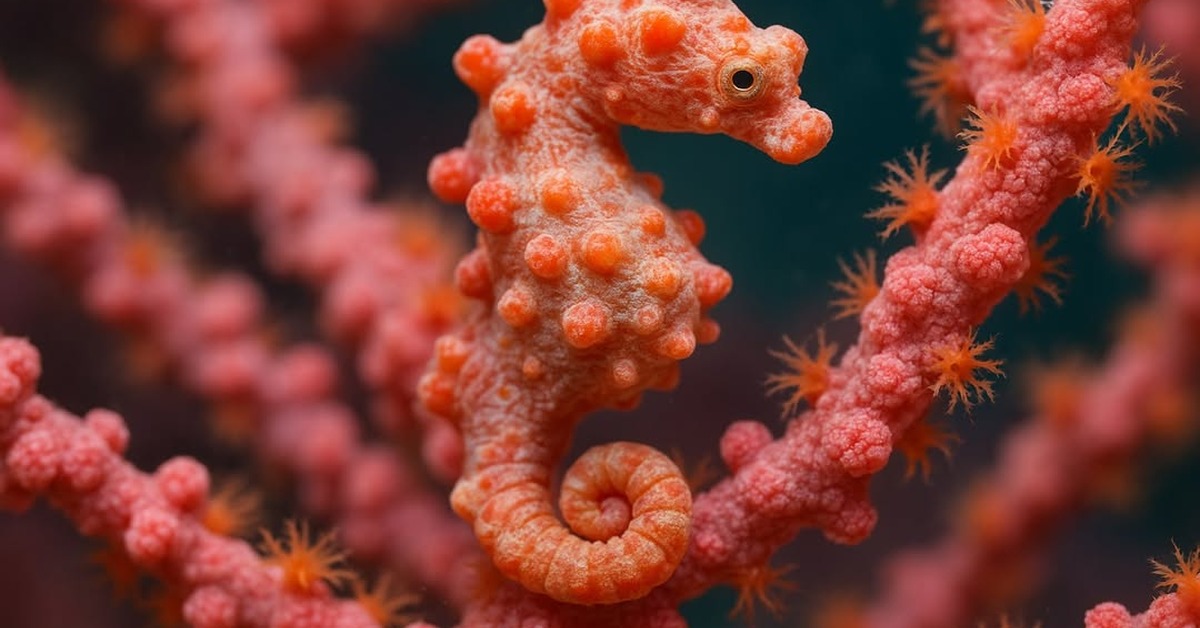
- Pygmy seahorses were initially thought to be juveniles of larger species. It wasn’t until researchers examined their anatomy closely that the scientific community accepted them as fully mature adults of their own distinct species. Their size is not a developmental stage. It’s the destination.
- Local dive guides in Indonesia and the Philippines have developed extraordinary skills at locating them — often finding individuals that trained researchers walk past completely.
- The color variations between pygmy seahorse populations on different coral colonies can be so distinct that researchers initially classified some individuals as separate species before DNA analysis confirmed they were the same. Camouflage fooling scientists just as effectively as it fools predators. Which feels appropriate, honestly.
Why a Two-Centimeter Animal Matters to All of Us
The story of pygmy seahorse camouflage is, at its core, a story about the limits of human observation. These animals existed on reefs we were actively studying, and we missed them for most of recorded marine science history.
That should recalibrate how we think about what we know.
Coral reefs are declining globally at a rate that the scientific community describes, without hyperbole, as catastrophic. Bleaching events, ocean acidification, and direct human pressure are dismantling ecosystems that took thousands of years to build. For a creature whose entire survival is locked to one specific coral host, reef degradation isn’t an abstract threat. It’s an extinction clock running on a species we might not have named yet.
When we lose a coral colony, we might be losing a seahorse species we haven’t documented. When we lose a reef, we might be erasing an entire biological story we never got to read. The urgency isn’t just conservation sentiment — it’s about preserving the library before we’ve finished cataloguing what’s in it.
One accidentally collected coral sample changed everything in 1969. It turned a gap in our knowledge into a window onto one of the ocean’s most refined survival strategies. And if one technician’s accidental find could do that, the math on undiscovered species in uncatalogued reefs is almost dizzying. The pygmy seahorse didn’t hide from us. We just hadn’t learned to look. There’s more like this at this-amazing-world.com — and the next one is even stranger.