



Somewhere in southern Madagascar, there’s a tortoise alive today that was already old when the First World War ended. It hasn’t done anything dramatic. It’s just been waiting, slowly, in a cracked forest that’s disappearing around it.
In the spiny forests of southern Madagascar — sun-bleached, brutal, and almost nothing like what most people picture when they think “forest” — a creature that outlasted ice ages is quietly vanishing. It moves at a pace that would try your patience. Its shell looks like someone sat down with a ruler and compass and got to work. And none of that, not the beauty, not the age, not the ecological history, is enough to save it right now.
The Radiated Tortoise Madagascar Forgot to Protect
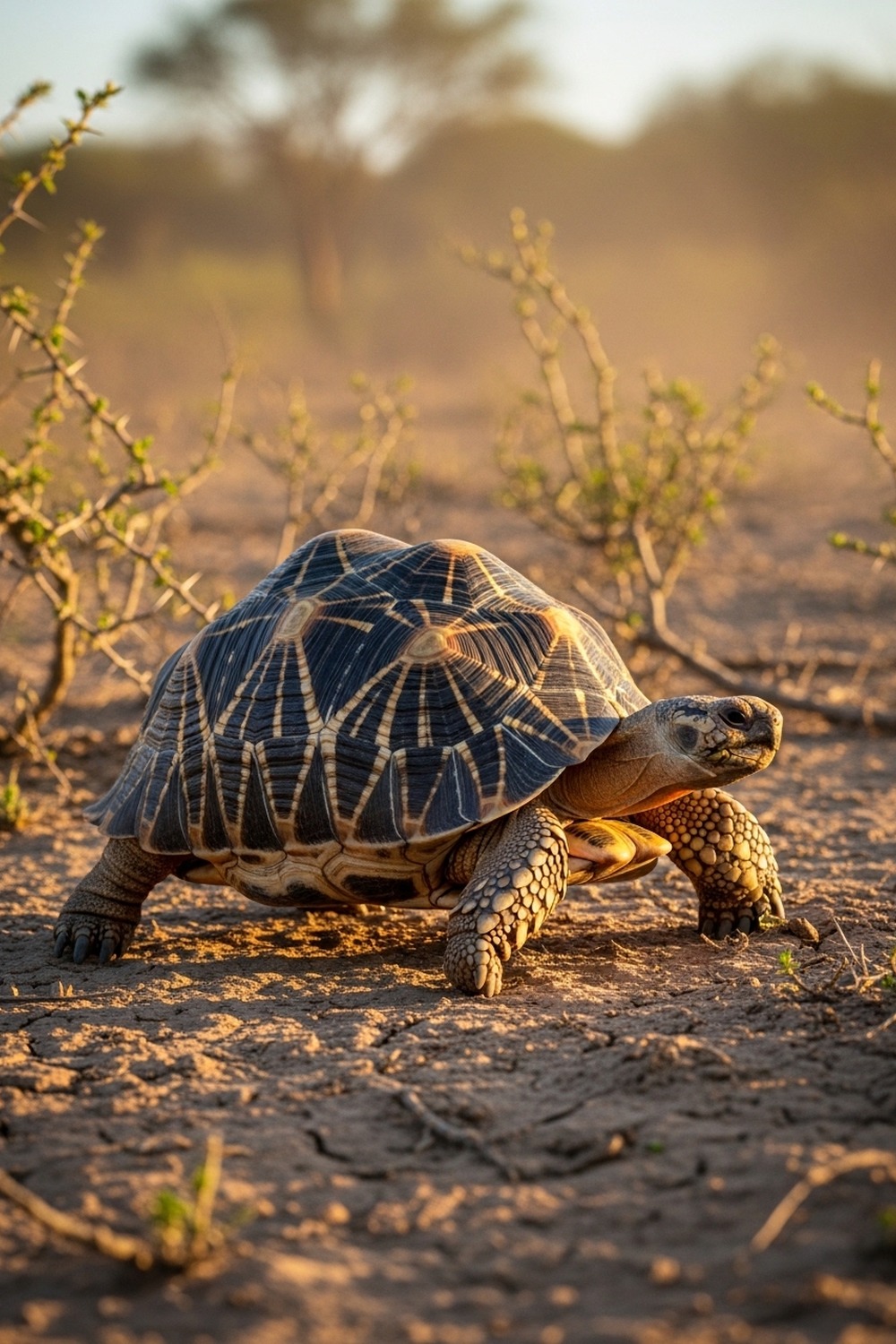
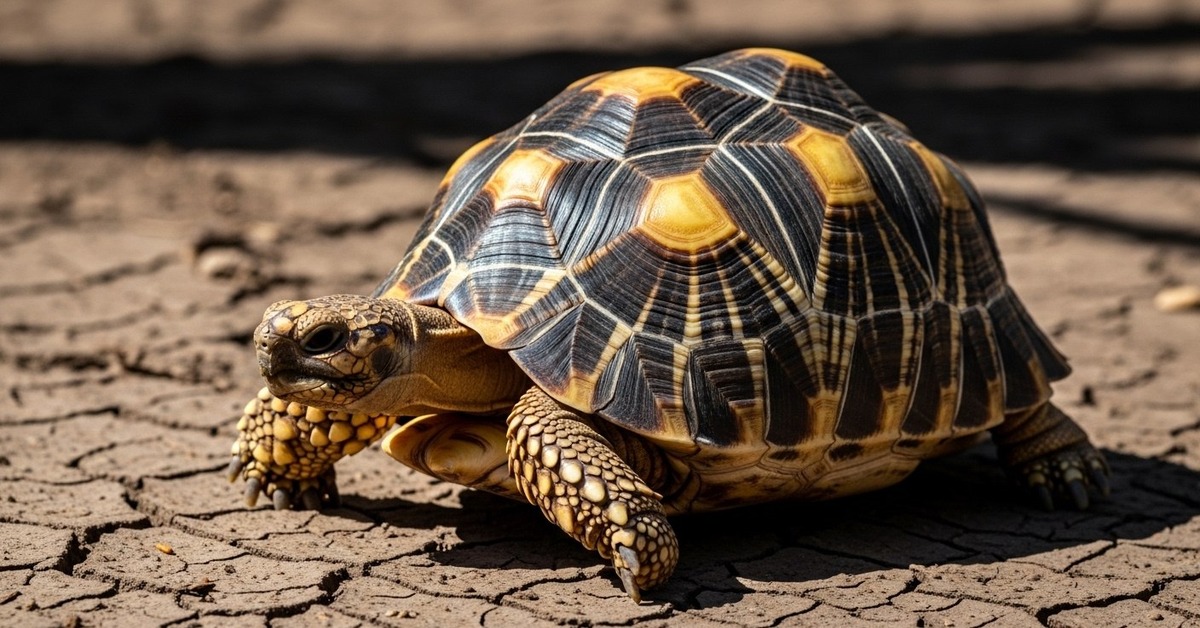
The animal in question is Astrochelys radiata — the radiated tortoise, named for the starburst of bright yellow lines radiating outward from the center of each scute on its domed shell. Dr. Rick Hudson of the Turtle Survival Alliance and other researchers have watched populations fall so sharply they’ve called it a “catastrophic collapse” over the past two decades. The species is now Critically Endangered on the IUCN Red List.
Which raises the obvious question: how does an animal that survived millions of years vanish this fast?
The shell pattern, by the way, is unique to every individual. No two are identical. It’s essentially a fingerprint, except it’s been carved in keratin and carried through decades of monsoon seasons, predator encounters, and 104-degree heat. That detail kept me reading for another hour when I first found it.
How These Tortoises Survive the Unlivable
The spiny forest of southern Madagascar is not a friendly place. Temperatures regularly crack 40°C. Rain is scarce. The soil bakes solid. Most animals take one look and find somewhere else to be.
The radiated tortoise cracked the code. When heat peaks, they dig into the earth and enter aestivation — their metabolism drops to almost nothing, and they just… wait it out. For more on animals that completely rewrite your assumptions about what survival looks like, this-amazing-world.com has stories that’ll rearrange how you think about life on this planet.
And they do all of this slowly. A radiated tortoise might cover less than a mile in an entire day. They’re not running from the heat. They’re outlasting it. Patience, it turns out, is a survival strategy older than most species on Earth — and it worked, right up until it didn’t.
A Shell That Made It a Target
Here’s the thing about being extraordinarily beautiful: it makes you valuable to the wrong people.
That shell — the one that looks too deliberate to be accidental — made the radiated tortoise irresistible to collectors worldwide. The illegal pet trade exploded in the early 2000s, pulling thousands out of the wild. A 2018 confiscation in Toliara recovered over 10,000 live individuals from a single smuggling operation. One operation. Ten thousand animals. It’s one of the largest reptile seizures ever recorded, and it barely made the news outside conservation circles.
At the same time, the spiny forest was being cleared for agriculture and charcoal production. The landscape these tortoises had perfected living in — the one that looked inhospitable to everyone else — started disappearing under axe and fire. Two threats hitting at once, neither letting up, in a place with almost no resources to fight either.
A Century of Life, Vanishing in Decades
These animals live long. Not “long for a reptile” long. Genuinely, absurdly long. Radiated tortoises regularly exceed 100 years in the wild, and some documented individuals have pushed well past that — one recorded case beyond 188 years, which would make it among the longest-lived vertebrates ever documented on Earth.
A tortoise alive today in Madagascar’s southern scrublands may have hatched around 1910. It survived both World Wars. The entire twentieth century. Commercial aviation. The internet. And now, within a single human generation, its population has dropped by an estimated 80% or more.
Eighty percent. Gone.
Not over millennia. Not over centuries. Within living human memory. And recovery is brutal to even think about, because females don’t reach sexual maturity until around age 20. Every individual lost to the pet trade or habitat clearance isn’t just one tortoise gone — it’s decades of future breeding potential erased. The math doesn’t work in anyone’s favor.

The Deeper Problem Nobody Talks About
Even where radiated tortoises are legally protected, enforcement is nearly impossible. Madagascar is one of the world’s poorest countries. A single tortoise can fetch hundreds — sometimes thousands — of dollars on international black markets. For communities with almost nothing, that’s not a temptation. That’s a lifeline.
Turns out the most dangerous threat to a century-old tortoise isn’t a predator or a drought. It’s poverty compounded by global demand. The collector in Europe or North America who pays for an exotic pet rarely thinks about the chain of decisions their purchase triggers ten thousand kilometers away, in a cracked forest under a scorching sun. The law exists. The pressure to break it exists too, for reasons that are completely understandable. Conservation here isn’t just a wildlife problem. It’s an economics problem wearing a wildlife problem’s face.
By the Numbers
- Over 80% population decline in roughly 60 years — three generations — per IUCN Red List assessments updated through 2023.
- The 2018 Toliara seizure recovered approximately 10,000 live radiated tortoises from a single illegal operation, making it one of the largest reptile confiscations ever recorded anywhere.
- Some individuals documented beyond 188 years old.
- Southern Madagascar’s spiny forest — the tortoise’s only real home — has lost an estimated 70% of its original cover to agricultural expansion and charcoal production, and the clearing hasn’t stopped.

Field Notes
- Males court females with a distinctive rhythmic head-bobbing display — consistent enough that field researchers use it to identify reproductive activity without disturbing the animals.
- Radiated tortoises appear to seek out social proximity, feeding close together and resting near familiar individuals. For an animal stereotyped as solitary and slow, that’s a more complex social life than most people expect.
- Early European explorers reported seeing them in the thousands along Madagascar’s southern coast. Those densities haven’t existed for over a century. Many locals under 40 have never seen one in the wild.
Why This Story Is About More Than a Tortoise
Biologists call the radiated tortoise an indicator species. Its health reflects the health of the entire spiny forest ecosystem. These tortoises disperse seeds, shape ground cover, and have been doing it long enough that the forest itself evolved partly around them. When they go, they don’t just leave a gap. They leave a system that doesn’t know how to function without them — and the ripple effects spread outward for decades in ways that are genuinely hard to predict.
There’s something else worth sitting with, though.
This animal’s ancestors survived the asteroid that killed the dinosaurs. They survived the great extinctions. They survived Madagascar’s own turbulent geological history. The thing that finally pushed them to the edge of gone wasn’t geological or cosmic. It wasn’t a drought or a disease or a rival species. It was us — specifically, the intersection of global consumer demand and local poverty, in a place most of the people doing the consuming will never visit or think about.
That’s not a comfortable thought. I’m not sure it’s supposed to be.
Somewhere in what’s left of Madagascar’s spiny forest, an ancient tortoise is moving slowly across the earth — carrying a century of survival on a shell that looks hand-drawn, in a landscape that keeps shrinking. The window to change what happens next is narrow and getting narrower. If this kind of story keeps you up at night, there’s more at this-amazing-world.com — and the next one is even stranger.


