


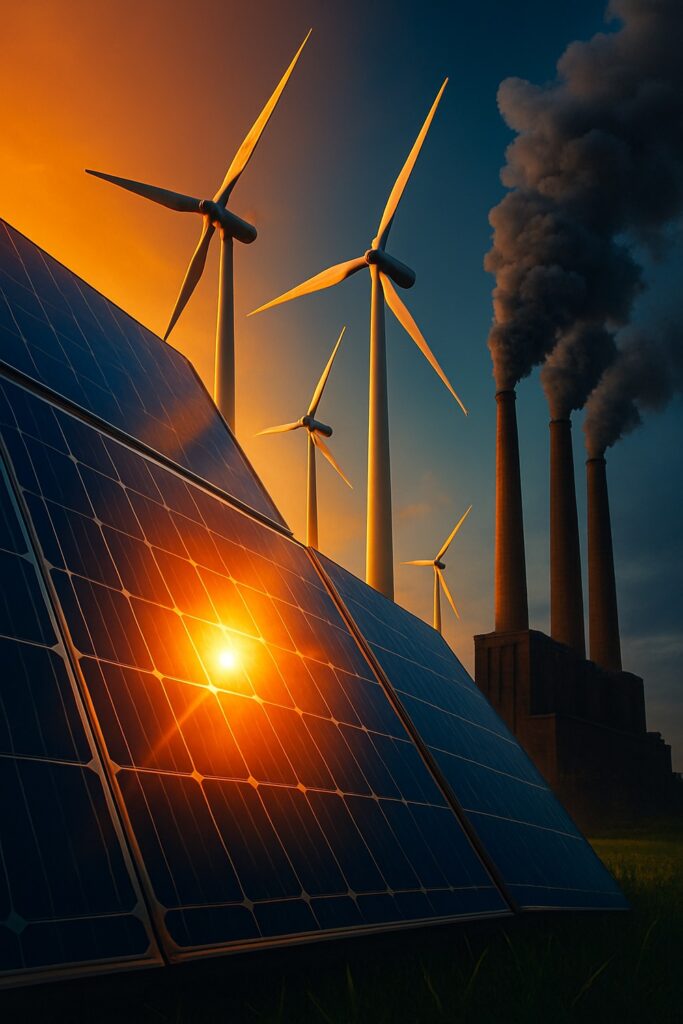
Renewables overtook coal in global electricity generation in 2023 — and the grid didn’t flinch. No headlines. No ceremony. Just a quiet crossing of a line that analysts had penciled in for the 2030s, arriving ahead of schedule while most of the world was arguing about something else entirely. The fuel had changed. The lights stayed on.
For over a century, coal ruled the grid. It powered the factories of the Industrial Revolution, lit the cities of the twentieth century, and supplied the energy that lifted billions out of poverty. So how did solar panels and wind turbines — technologies dismissed as fringe just a decade ago — climb past the ancient king of fossil fuels? And more urgently: can they keep going?
The Historic Moment When Solar and Wind Surpassed Coal
According to the International Energy Agency (IEA), led by executive director Fatih Birol, renewables overtook coal in global electricity output in 2023 — a milestone that analysts once predicted would not arrive until the early 2030s. Solar generation alone grew by 23% in 2023, reaching over 1,600 terawatt-hours globally. Wind added another 2,300 terawatt-hours. Together, they crossed a line that would have seemed fantastical to energy planners just fifteen years ago.
The full scope of that transition is documented in the IEA’s World Energy Supply and Consumption data, which tracks every joule of electricity the planet produces. What’s striking isn’t just the numbers — it’s the speed. Coal didn’t collapse slowly, like a glacier retreating over geological time. It lost its crown in a sprint. Utility executives who built their careers around coal contracts are now managing decommissioning schedules instead of expansion plans.
How the Grid Changed Faster Than Anyone Expected
Walk through the deserts of Rajasthan, India, today and you’ll see something that looks almost cinematic: field after field of solar panels stretching to the horizon, absorbing light that would otherwise bake empty earth. India added over 18 gigawatts of solar capacity in 2023 alone, making it one of the fastest-growing renewable markets on the planet. Meanwhile, Texas — a state synonymous with oil — now generates more wind power than any other US state, enough to power roughly 25 million homes on peak days.
Where policy aligned with falling costs, renewables exploded. The pattern holds across every continent. The geographic reach of this shift is explored in depth in our feature on how the global energy transition is reshaping economies.
But the human element here is easy to miss in the data. In villages across sub-Saharan Africa, solar microgrids are delivering first-ever electricity to communities that coal infrastructure never reached — not because of ideology, but because solar is now simply cheaper to install than running transmission lines. That’s a profound inversion of how energy access has worked for generations.
The Cost Collapse That Rewrote the Rules
Between 2010 and 2023, the cost of utility-scale solar power fell by approximately 90%, according to the International Renewable Energy Agency (IRENA). Onshore wind dropped by around 70% over the same period. These aren’t marginal improvements — they represent the kind of cost curve that economists usually associate with semiconductor technology, not heavy infrastructure.
Why does this matter? Because in 2023, new solar and wind capacity was cheaper to build and operate in most countries than new coal plants — and in many regions cheaper than running existing coal plants that had already paid off their construction debt. That’s a structural shift, not a subsidy story.
One decade. Ninety percent cheaper. Here’s the thing: no other energy technology in history has moved that fast — not natural gas, not nuclear, not the original coal revolution itself. The speed is worth sitting with.
History has a way of treating the people who ignored this kind of evidence unkindly.

Why Renewables Overtook Coal — But Haven’t Won Yet
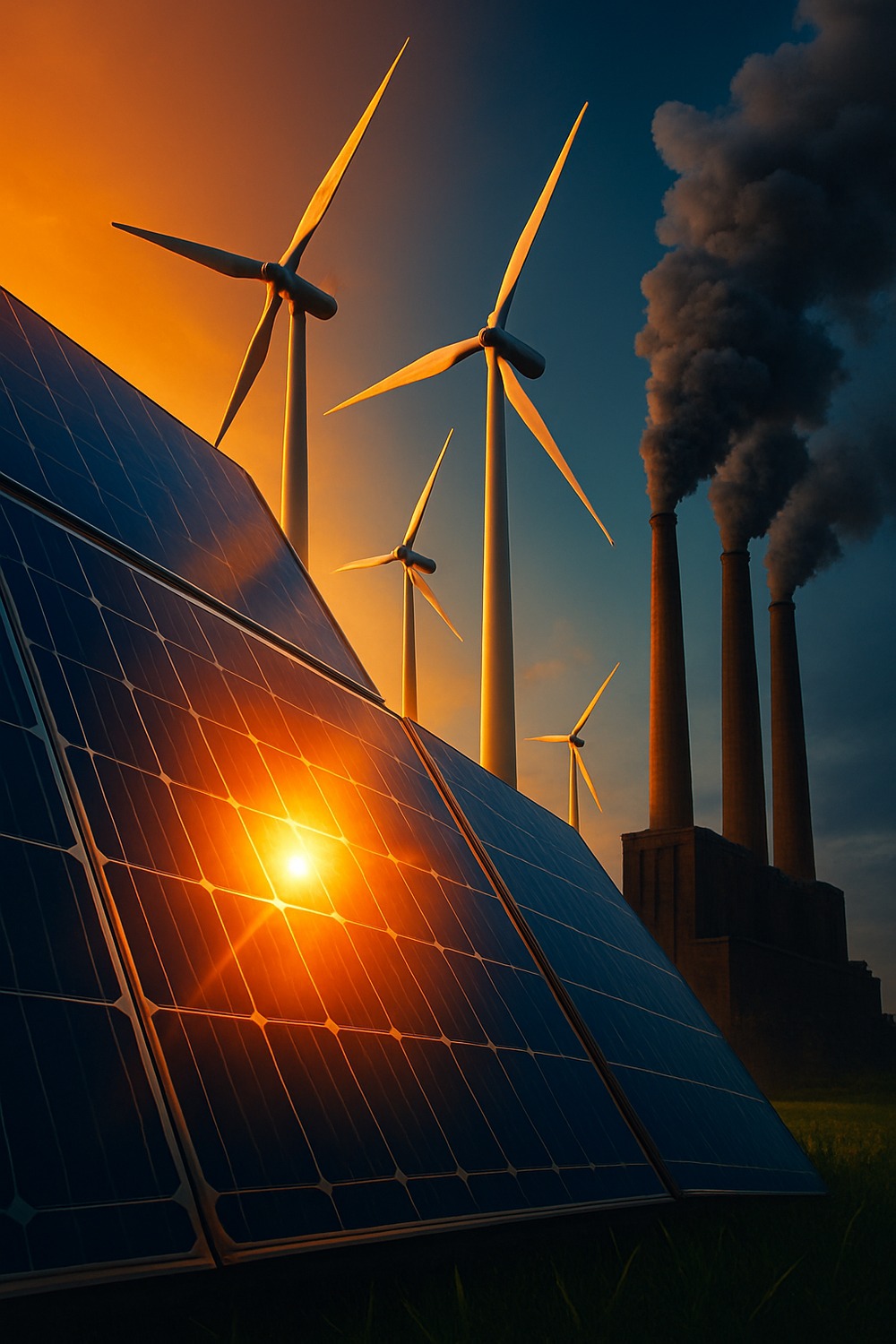
Even as renewables overtook coal in global electricity generation, fossil fuels — coal, oil, and natural gas combined — still supplied approximately 60% of the world’s electricity in 2023. Coal alone retained a roughly 35% share of the global mix, primarily because of massive continued use in South and Southeast Asia, where economies are still industrializing rapidly. Renewables overtook coal globally, yes, but coal hasn’t left the building.
China, the world’s largest coal consumer, has simultaneously become the world’s largest installer of solar and wind capacity — a paradox that defines the entire transition. Enormous volumes are still burning across Bangladesh, Vietnam, Indonesia, and parts of China’s industrial heartland. Understanding why renewables overtook coal in generation statistics while coal persists in the overall mix requires a distinction most headlines skip: generation share versus total volume. Renewables passed coal in share partly because coal use declined in wealthy nations, not only because renewables grew everywhere. Both things are true, and both matter for where this goes next.
The Long Shadow of Coal — and What Came Before It
Coal’s dominance had deep roots. Britain’s Industrial Revolution, running almost entirely on coal from the 1760s onward, made coal-fired steam synonymous with modernity itself. For a hundred and fifty years, no energy source came close to matching its energy density, abundance, or the infrastructure built around it. Oil and gas expanded the fossil fuel empire but never displaced coal from power generation; coal simply shared the grid.
New technologies don’t replace entrenched systems overnight (and this matters more than it sounds). They grow alongside them, quietly gaining share, until one day the numbers tip. We’ve seen this before with natural gas displacing coal in US power generation after 2008. The mechanism is familiar. The speed this time is not.
And if the current trajectory holds, IRENA projects renewables could supply 90% of global electricity by 2050. That projection assumes aggressive investment in grid storage, transmission upgrades, and policy frameworks that are — in many countries — still being argued over in legislative chambers. The gap between the physics and the politics is where the real story lives.

How It Unfolded
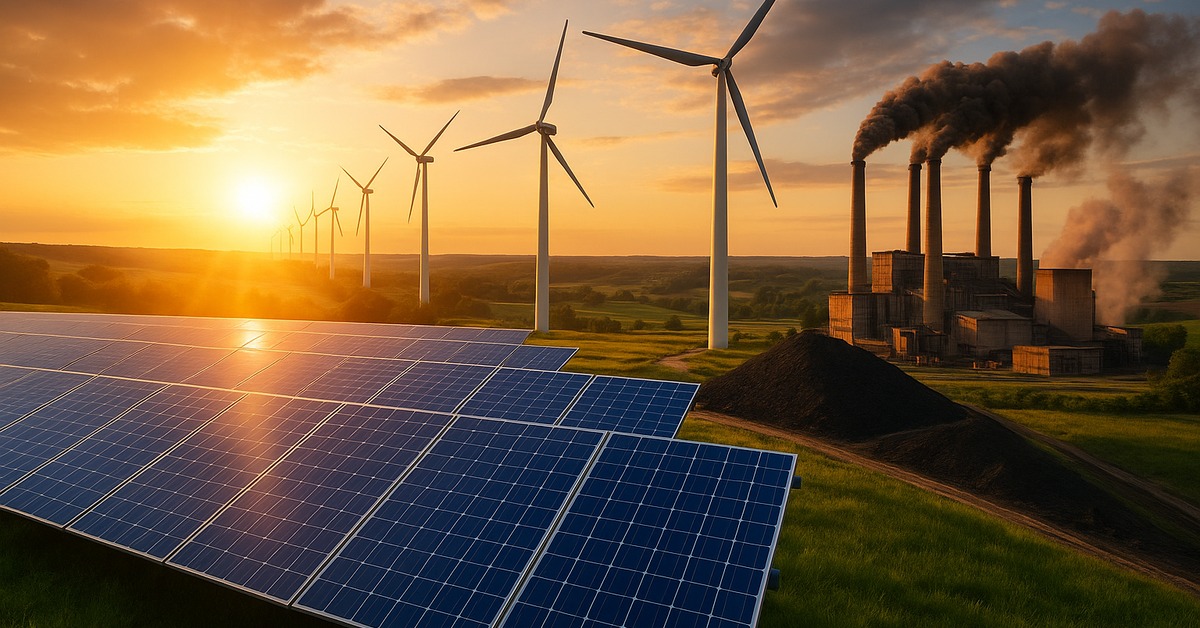
- 1760s — Britain’s Industrial Revolution establishes coal as the foundational fuel of the modern world; coal-fired steam becomes synonymous with industrial capacity
- 2008 — Natural gas begins displacing coal in US power generation, offering the first modern template for a fuel-to-fuel transition within a national grid
- 2010–2023 — Utility-scale solar costs fall by approximately 90%; the economics of new coal construction collapse in most developed markets
- 2023 — Renewables overtook coal in global electricity generation for the first time on record, arriving nearly a decade ahead of analyst projections (IEA, 2024)
By the Numbers
- Renewables overtook coal in global electricity generation in 2023, with solar contributing over 1,600 TWh — a 23% year-on-year increase (IEA, 2024)
- Utility-scale solar fell by approximately 90% in cost between 2010 and 2023 (IRENA, 2023)
- Wind power generated roughly 2,300 TWh globally in 2023, enough to power the entire European Union for over a year (IEA, 2024)
- Renewable capacity additions in 2023 reached a record 295 gigawatts of solar alone — 3× the rate recorded just five years earlier (IEA, 2024)
Field Notes
- Solar panels now generate electricity on cloudy days with meaningful efficiency — modern photovoltaic cells respond to diffuse light, not just direct sunlight, which is why the UK and Germany have become significant solar producers despite their famously grey skies.
- China installed more solar power in 2023 alone than the entire installed solar capacity of the United States — and simultaneously remained the world’s largest coal consumer.
- Coal plants that close don’t simply disappear from the grid’s memory: their transmission infrastructure, trained workforce, and physical footprint often become the foundation for renewable energy projects built on the same land, a process energy planners call “repowering” that’s accelerating across Appalachia, Germany’s Ruhr Valley, and Australia’s Hunter region.
Frequently Asked Questions
Q: When exactly did renewables overtook coal in global electricity, and what does that milestone actually mean?
2023 is the year — solar and wind combined generated more electricity globally than coal for the first time on record, according to the IEA. Renewables now hold a larger share of global electricity production than any single fossil fuel, though total fossil fuel use across coal, gas, and oil still dwarfs renewables in absolute terms. It’s a threshold, not a finish line.
Q: Why does coal still power so much of the world if renewables are now cheaper?
Cheap new capacity doesn’t instantly replace existing infrastructure. Coal plants built over the past decades represent trillions of dollars in sunk investment, and in rapidly growing economies like India and Indonesia, energy demand is rising faster than renewables can scale. Grid reliability, storage limitations, and the political economy of coal employment all slow the transition in places where coal still dominates.
Q: How important is battery storage to the future of renewable energy?
Battery storage is arguably the most critical technical variable in the entire energy transition. Solar and wind generate power intermittently — when the sun shines and the wind blows — and without affordable large-scale storage, grids must maintain backup capacity from dispatchable sources like gas or hydro. Battery costs have fallen dramatically, but utility-scale storage that can balance a national grid through multi-day weather events remains an engineering and economic challenge that no country has fully solved.
Editor’s Take — Alex Morgan
What stays with me isn’t the 90% cost drop or the terawatt-hours — it’s the villages. Standing at the edge of a solar microgrid in rural Kenya a few years back, watching a child do homework under a light her grandmother never had, you realize the IEA’s statistics are landing somewhere specific and human. The milestone of 2023 matters. But the more consequential story is what happens when the energy system that wealthy nations built for themselves finally stops being the only option available to everyone else.
Every energy transition in history has looked, in hindsight, inevitable — and at the time, impossible. Coal replaced wood and muscle over centuries; oil reshaped coal’s dominance over decades; and now, in what might be the fastest energy shift the industrial world has ever seen, renewables are climbing toward a grid that humanity has never actually built before: one that runs on sunlight and wind rather than buried carbon. What we do in the next ten years will determine whether this milestone was a turning point or merely a footnote. The planet’s atmosphere doesn’t grade on a curve. What side of this shift are you on?


