


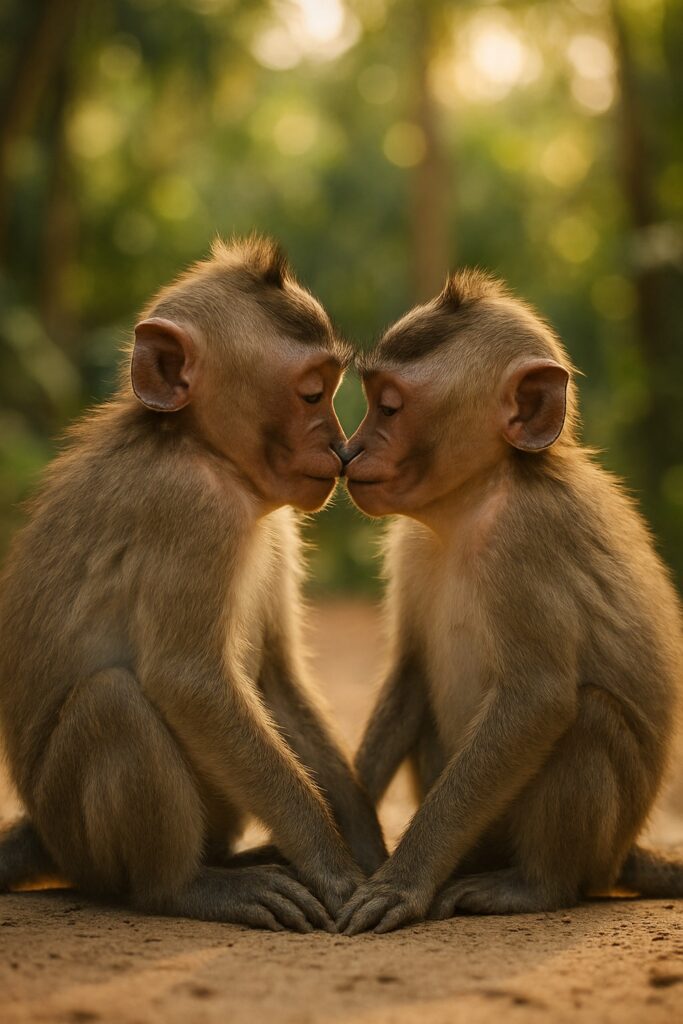
Nobody handed Punchy a therapy plan. They handed him a stuffed toy, almost as an afterthought, and he grabbed it like it was the only solid thing left in the world. Which, at that point, it probably was.
When rescuers pulled him out of whatever situation had left him hypothermic and trembling, the little crab-eating macaque was in genuine crisis. The keepers named the plush toy Mama Doll. For weeks it went everywhere with him — to sleep, through feeding, whenever the noise got too loud or the world felt like too much. What nobody fully clocked at the time was that this wasn’t just a sweet detail. The doll was doing actual neurological work. And what came after it? That’s the part worth paying attention to.
The Rescued Macaque Who Wouldn’t Let Go
Crab-eating macaques — Macaca fascicularis — range across 10 countries in Southeast Asia, from Myanmar all the way to the Philippines. Common enough that people underestimate them. But widespread distribution doesn’t make orphaned infants resilient. Primatologist Frans de Waal, who has spent decades studying primate emotional lives, has documented how early social deprivation in macaques produces measurable neurological changes that can persist into adulthood. The brain literally rewires itself around the absence of connection.
So what made Punchy different?
He had the doll first. And then — eventually, slowly — he had something better. But that sequence mattered more than anyone initially understood, and it took a while before the keepers fully realized what they’d accidentally gotten right.
Mama Doll Was Doing Real Neurological Work
Back in the mid-twentieth century, Harry Harlow ran a series of experiments with rhesus macaques that genuinely changed how we think about attachment. Infant primates, it turned out, would consistently choose a soft, comforting surrogate “mother” over one that merely dispensed food. The finding rewrote our understanding of what infants actually need — and it wasn’t calories. It was contact. Softness. Predictable presence. Something that stayed.
The keepers at Monkey Mountain sanctuary were applying that exact science when they handed Punchy his plush toy, whether they framed it that way or not.
Soft contact. Something that didn’t leave. For a nervous system in freefall, that’s not a small thing — that’s the whole thing. Punchy carried Mama Doll everywhere: through feeding, through sleep, through the moments when the other animals got loud and his body wanted to spiral. The doll wasn’t a crutch. It was scaffolding. It held him up just long enough for real healing to get started.
That last part kept me reading for another hour — because the distinction between a crutch and scaffolding turns out to be the whole argument.
Then Grandma Sotomaru Entered the Picture
Every sanctuary has a few animals the staff talks about differently. With a particular kind of quiet reverence. At Monkey Mountain, that animal is Grandma Sotomaru — a veteran resident who the keepers credit with pulling more than a dozen traumatized youngsters back from the psychological edge.
She has a method, though calling it that feels too clinical for what she actually does.
She watches. From a distance, at first. Then a little closer. Then closer still, over days or weeks, until one day she’s just… there, nearby, and it doesn’t feel like an intrusion anymore. You can read more about how animal sanctuaries are rewriting the rules of trauma recovery, but what Sotomaru does resists that kind of framing. It feels less like a protocol and more like something she figured out on her own over years of watching frightened animals need things they couldn’t ask for.
She never rushed Punchy. Never pushed for contact. No agenda, no timeline. Just proximity, offered without strings. And somehow — because of course somehow — that patience was precisely what a shattered little macaque needed to start trusting the world again.
The Moment That Stopped Everyone Cold
Rescued macaque healing rarely announces itself. It tends to be incremental in the most unglamorous way: a slightly less panicked response to a loud sound, a meal eaten without hunching protectively over the food, two or three extra seconds of eye contact. The Monkey Mountain staff had learned not to hold their breath for dramatic moments. Small progress was still progress.
And then Punchy went and delivered a dramatic moment anyway.
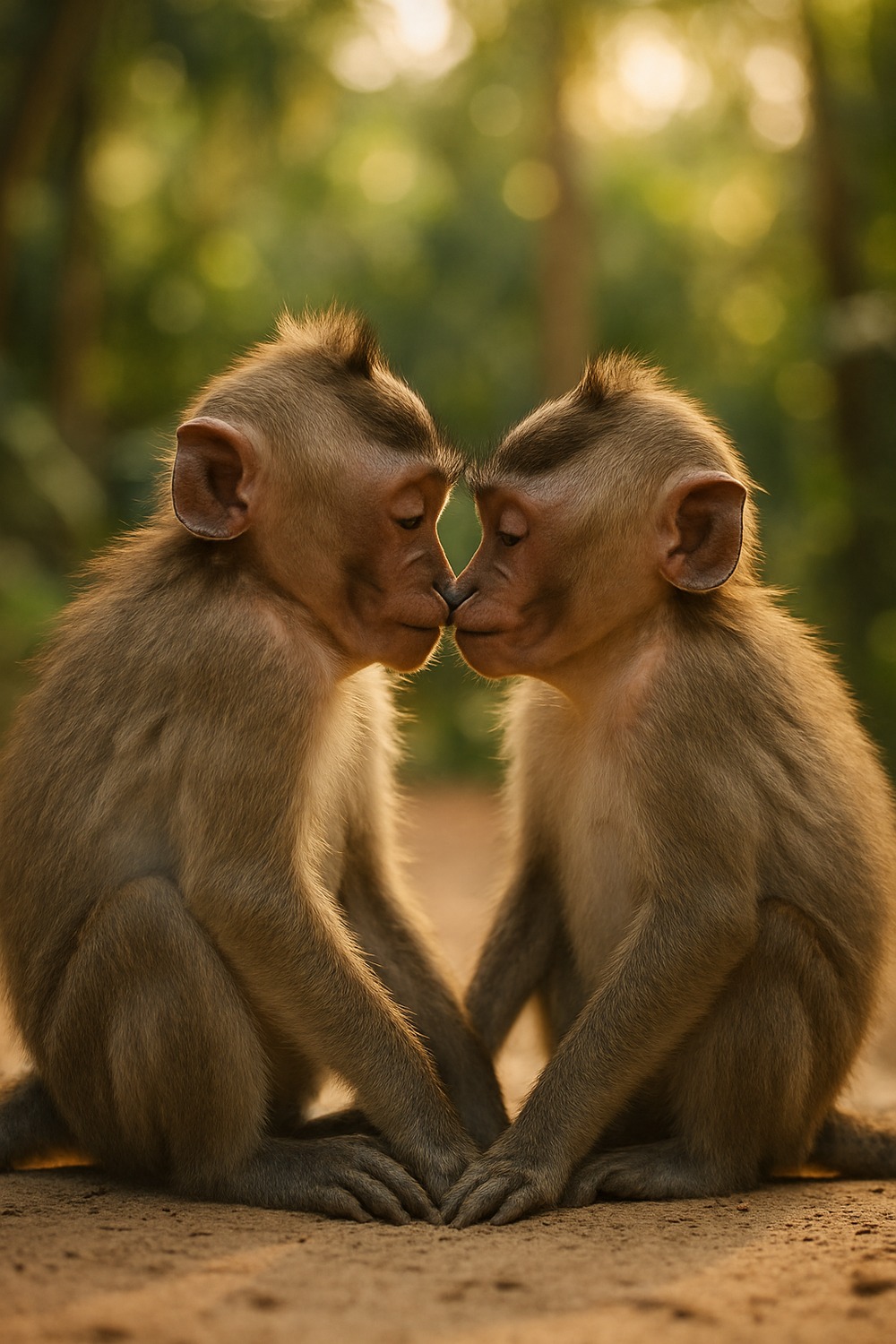
It happened on a sun-warmed ridge. Cicadas going full volume. Late afternoon light doing that golden thing it does in Thailand. And Punchy — unhurried, completely sure of himself — reached out and nuzzled the cheek of another young macaque.
No trembling. No flinching. Just connection.

What Punchy’s Recovery Actually Tells Us
Here’s the thing: researchers have known for decades that social mammals can recover from early trauma more completely than previously believed. But only under specific conditions. A 2021 review published in Developmental Psychobiology went looking for the single most consistent predictor of recovery in orphaned primates. Not the quality of veterinary care. Not enclosure size. Not diet.
It was this: one stable, patient social companion present in the early weeks of rehabilitation.
That’s the whole variable. One steady presence during the window when the developing brain is still deciding what kind of world it’s living in — whether the world is a place where connection is possible, or one where it categorically isn’t. Grandma Sotomaru wasn’t just being kind to Punchy. She was providing the exact neurological input his brain needed to rebuild its capacity for trust. The implications stretch well beyond wildlife rescue. They apply to how any social species — including ours — actually heals.
By the Numbers
- Orphaned infant macaques: survival rate below 30% without specialist intervention, per the IUCN Primate Specialist Group (2022) — despite the species’ reputation for adaptability across 10 countries.
- Grandma Sotomaru has been credited by Monkey Mountain keepers with successfully socializing more than a dozen traumatized young macaques. For a single animal acting informally as a social bridge, that’s a track record most rehabilitation programs would envy.
- 18 hours per day — the amount of time Harlow’s infant macaques spent in contact with soft surrogate figures.
- Recovery rates more than twice as high in primates with at least one stable social companion during rehabilitation, compared to those housed in isolation with identical medical care, per that same 2021 Developmental Psychobiology review.

Field Notes
- Crab-eating macaques wash their food before eating — one of only a handful of non-human primates known to do this. The behavior was first documented in a wild population in Thailand and has since been observed spreading culturally through groups, which says something about how much social complexity gets overlooked in species considered “common.”
- Mama Doll’s consistent smell and texture likely helped regulate Punchy’s cortisol levels during the most acute phase of his trauma. Not just comfort — active physiological stabilization.
- The “grandmother protocol” — Monkey Mountain keepers’ informal name for deliberately pairing traumatized newcomers with older, emotionally stable residents rather than age-matched peers. Calm, experienced animals model behaviors that distressed youngsters can’t access on their own yet. The name is unofficial. The results aren’t.
Why This Story Is About More Than One Monkey
The rescued macaque healing arc is a case study in what recovery actually requires. Not heroics. Not high-tech intervention. Not a complicated treatment protocol. Just proximity, offered patiently, without any guarantee that the frightened creature on the other side will eventually respond to it.
Grandma Sotomaru didn’t know Punchy would come around. She just kept showing up anyway.
Turns out that’s worth sitting with. Because the most powerful thing one being can offer another — across any species — might simply be the decision to stay close and not demand anything until the other is ready. That’s not a small thing to model. Most of us, honestly, are worse at it than an elderly macaque on a ridge in Thailand.
Mama Doll sits on a shelf in the keeper’s office now. A little worn. Retired. Punchy doesn’t visit it. He’s got Sotomaru, and the ridge, and a whole social world he built from scratch after starting with nothing but a stuffed toy and a tenuous grip on survival. The doll did exactly what it needed to do. Then it stepped aside and let real life take over.
Something about Punchy’s story keeps pulling at you. Maybe it’s the image of those tiny hands refusing to let go of a plush toy in the middle of a crisis. Maybe it’s the idea that one patient presence — a veteran macaque, a worn stuffed animal, something that simply stays — can be the actual variable between an animal that recovers and one that doesn’t. Healing doesn’t always look dramatic. Sometimes it looks like a calm little monkey nuzzling a friend on a warm afternoon, on a ridge full of cicadas, completely unbothered. More stories like this one live at this-amazing-world.com — and the next one is genuinely stranger than this.


