



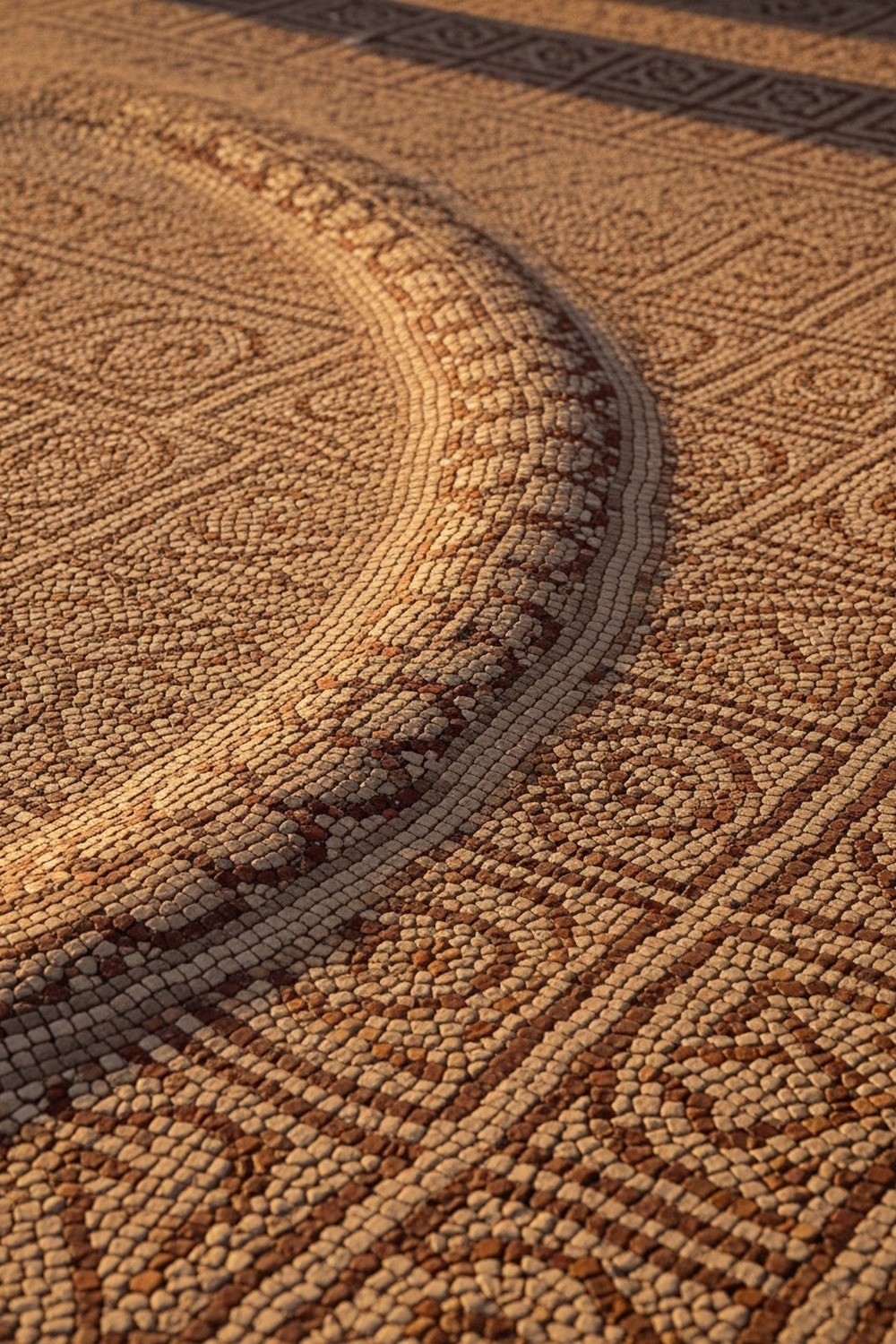
Here’s the thing about earthquakes: they’re supposed to destroy things. And yet, somewhere beneath modern-day Turkey, a Roman mosaic floor did something instruments weren’t there to record — it bent. The Roman mosaic earthquake record preserved in this villa floor isn’t a ruin. It’s a ripple, running diagonally across thousands of tesserae, pointing along a fault line with the precision of a compass needle. The earthquake didn’t erase the floor. It signed it.
Within the ancient Roman province of Asia Minor, archaeologists uncovered a villa floor that had done something no instrument was there to capture. It recorded ground movement across centuries, invisibly, in marble and mortar. The tesserae didn’t shatter. They bent, collectively, like a single breathing surface. How the builders made that possible — and what it means for every Roman floor we’ve walked past without reading — is the story here.


How a Roman Mosaic Became an Earthquake Record
Years of painstaking fieldwork in the Aegean coastal region of western Turkey brought this discovery into focus — a zone sitting directly above the North Anatolian Fault, one of the world’s most seismically active strike-slip fault systems, responsible for a chain of devastating earthquakes throughout the twentieth century. Researchers from the German Archaeological Institute, working across excavation seasons between 2017 and 2022, documented the anomaly with photogrammetric surface mapping: a subtle but measurable undulation running diagonally across the mosaic’s geometric field. The amplitude of the ripple is small — millimetres in most places — but its directionality is consistent and unmistakable. When the team overlaid their surface data onto regional fault maps, the alignment was exact. This wasn’t settling from moisture. This wasn’t the slow heave of tree roots. This was seismic displacement, preserved.
What surprises most people is the completeness. Roman mosaic earthquake records are rare not because earthquakes were rare — they weren’t — but because most floors cracked, buckled, or were buried beyond recovery. This one survived intact, its colors still vivid: deep terracotta, cream limestone, fragments of blue-green glass catching light the way they did two thousand years ago. The geometric pattern — interlocking meanders and stepped diamonds — remained legible across its full extent. Intact. Rippled. Readable.

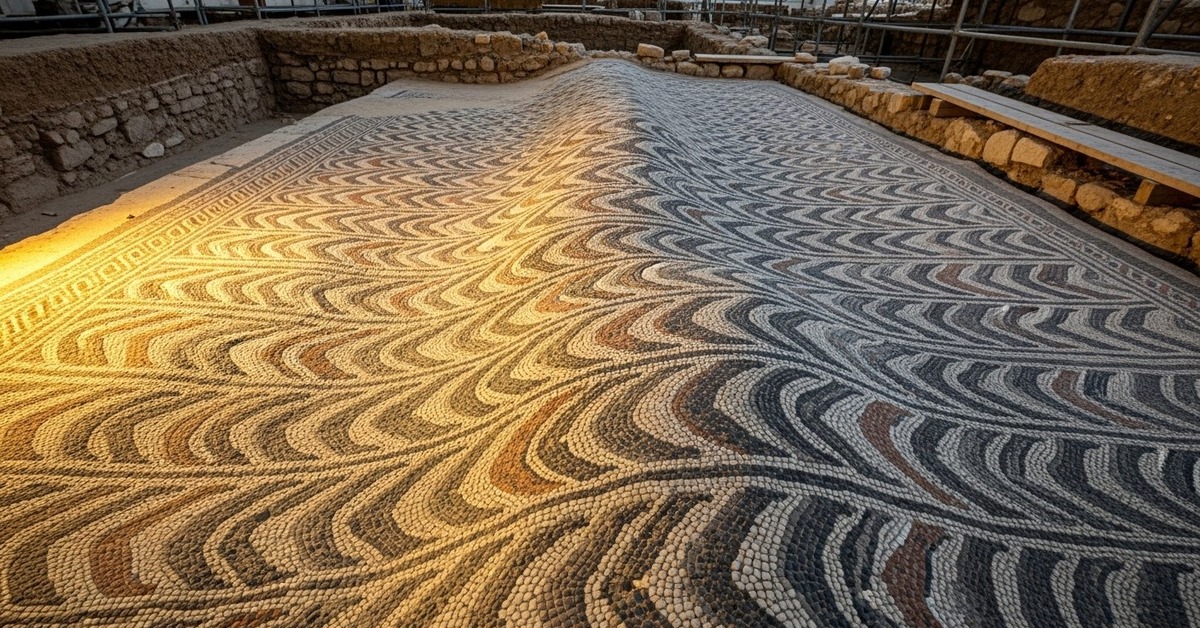
The floor measures approximately 11 by 14 meters. That’s a large surface to survive centuries of seismic country without a single tesserae gap. It shouldn’t have made it. The fact that it did tells you everything about how it was built.
Roman Engineering Built the Floor to Move
Roman builders working in earthquake-prone provinces weren’t naive about the ground beneath them. The architecture of seismic Asia Minor demanded flexible foundations, and the craftsmen who laid this floor understood that rigidity was the enemy of survival. The construction follows a system described in Vitruvius’s first-century BCE architectural treatise — a layered substrate of compacted rubble, then a sand bed, then a coarse mortar layer called the rudus, then a finer setting bed called the nucleus, and finally the tesserae themselves. Each layer was calibrated to absorb and redistribute force rather than concentrate it. The floor was engineered to behave, under stress, like a single flexible canvas rather than a brittle plate.
You can find similar engineering logic applied today in base-isolation systems used in modern earthquake-resistant structures — the principle hasn’t changed, only the materials. On this site in western Turkey, that ancient logic held for somewhere between 1,500 and 1,800 years before archaeologists arrived to read what the earth had written into it. The world is full of extraordinary geological stories; you can explore more of them at This Amazing World.
The critical detail is the sand layer. Sand doesn’t lock. Under seismic shear — the lateral sliding motion that dominates along strike-slip faults — a sand bed allows the upper structure to decouple slightly from the substrate below. The mosaic surface can shift as a unit rather than tearing at individual joints. Researchers estimate the sand bed here was approximately 40 to 60 millimetres deep, thicker than typical Roman residential floors in stable geological zones like central Italy. That extra depth wasn’t an accident. It was regional knowledge encoded in mortar.
Think about the scale of that knowledge transfer. No engineering school. No seismograph. Just generations of builders watching which floors survived and which ones didn’t, adjusting the recipe accordingly. The floor is a record of earthquakes. It’s also a record of learning.
Reading the Stones: What the Ripple Actually Tells Us
Why does this matter? Because a floor that stayed flat and simply rippled leaves a deformation vector that is clean — pointing, unambiguously, toward the fault — and that’s the kind of signal geologists spend careers trying to extract from noise.
Geoarchaeologists — specialists who read physical landscapes for embedded historical data — have been developing increasingly sophisticated tools for extracting seismic signatures from ancient structures. Work published by teams associated with the Earthquake Geology group at GFZ German Research Centre for Geosciences has demonstrated that deformation patterns in ancient floors can be cross-referenced against paleoseismic trench data to narrow down dates and magnitudes of historical earthquakes. The ripple in this mosaic, when analyzed against stratigraphic layers in nearby trenches, suggests displacement consistent with a magnitude 6.5 to 7.0 event — the kind of earthquake that would have been catastrophic for timber-frame structures nearby but that the villa’s flexible floor absorbed without fracturing. For more on how ancient structures encode seismic history, the Smithsonian’s science coverage has documented parallel cases from Greece, Italy, and the Levant.
What’s counterintuitive about a Roman mosaic earthquake record like this one is what it reveals about the earthquake itself — not just the floor. Traditional paleoseismology relies on fault trenches, displaced geological strata, and liquefaction features (researchers actually call this “paleoseismic proxy data”). Buildings, when they collapse, can provide rough timing through coin hoards or pottery assemblages buried in destruction layers. But a floor that didn’t collapse? That’s a different kind of data. It preserves the direction of motion, the relative magnitude of surface displacement, and the approximate duration of shaking — encoded in the geometry of the ripple’s wavelength and amplitude. Destruction tells you an event happened. Survival, sometimes, tells you more.
Pottery and coins found in the surrounding rooms date the villa’s occupation to the second and third centuries CE — a period that matches several known major earthquakes in western Anatolia recorded in ancient sources. The floor may have moved more than once. The ripple could be composite. That ambiguity is, itself, a finding.
The Roman Mosaic Earthquake Record in Global Context
Archaeoseismology — the study of earthquake evidence preserved in archaeological sites — has been growing as a discipline since the 1980s, when geologist Amos Nur at Stanford University began systematically cataloguing destruction layers at Bronze Age sites across the eastern Mediterranean. His argument: seismic events had been systematically underestimated as drivers of civilizational collapse. His 2008 book, co-authored with science writer Dawn Burgess, brought the case to a wider audience. Earthquakes didn’t just shake ancient cities. They ended them. Or nearly did.
And yet what the Turkish villa floor offers is a rarer counterpoint — evidence of a society that anticipated seismic stress, designed for it, and left a record of survival rather than collapse. The institute’s ongoing work at comparable sites in Ephesus, Sardis, and Hierapolis is building a regional picture of how Roman engineers calibrated their foundations to local fault conditions. The data set is growing. The picture it paints is of an ancient engineering culture far more seismically aware than historians have traditionally credited.
An ancient culture that absorbed this much knowledge without writing it down as engineering theory deserves more credit than it has ever received — and the floors may finally be making that case.
What researchers didn’t expect to find — and what makes this specific Roman mosaic earthquake record so scientifically valuable — is how precisely the deformation direction matches the fault orientation without any ambiguity introduced by structural collapse. In most archaeoseismic studies, buildings that fell leave complex, overlapping evidence. Walls topple in directions influenced by their own structural weaknesses, roof loads, and prior damage.
The implications extend forward as well as backward. If Roman floors in seismically active zones were systematically engineered to absorb and record ground motion, then every intact mosaic floor in Turkey, Greece, and the broader eastern Mediterranean is potentially an archive. Thousands of floors. Centuries of earthquakes. Most of them unread.
How It Unfolded
- 1st–2nd century CE — The villa floor is laid in Roman Asia Minor, using layered substrate construction standard to earthquake-prone provincial building practice.
- 1980s — Geologist Amos Nur at Stanford University begins formalizing archaeoseismology as a discipline, establishing methods for reading seismic signatures from ancient sites.
- 2017 — German Archaeological Institute teams begin photogrammetric surface mapping of the mosaic site in western Turkey, documenting the anomalous ripple pattern for the first time.
- 2022 — Analysis confirming alignment between the floor’s deformation vector and North Anatolian Fault geometry is completed, making this one of the clearest intact Roman mosaic earthquake records yet identified.
By the Numbers
- ~154 km/h — The speed at which seismic rupture can propagate along the North Anatolian Fault during a major event (USGS fault data).
- 11 × 14 meters — Approximate dimensions of the intact mosaic floor, an unusually large preserved surface for this region.
- 40–60 mm — Estimated depth of the sand absorption layer beneath the tesserae, thicker than typical non-seismic-zone Roman construction.
- Magnitude 6.5–7.0 — Estimated earthquake range consistent with the floor’s measured deformation amplitude, based on cross-reference with paleoseismic trench data.
- 1,500–1,800 years — Approximate time the floor lay buried and undisturbed before excavation, preserving the seismic signature intact.
Field Notes
- During initial photogrammetric scanning in 2019, the ripple in the mosaic was so subtle that the field team initially attributed it to uneven substrate settling — it took overlay against regional fault maps to confirm the seismic alignment, a realization that reportedly stopped the meeting mid-sentence.
- Roman tesserae in this region were sometimes set at slight angles to their geometric grid — a technique that allows adjacent stones to accommodate micro-movement without popping free of the mortar bed. It looks decorative. It’s structural.
- The villa’s painted wall plaster, found in collapse layers around the floor, shows no evidence of fire damage — suggesting the building wasn’t destroyed by post-earthquake fire, the most common secondary killer in ancient urban seismic events. The structure may have been deliberately abandoned rather than lost.
- Researchers still can’t determine whether the ripple represents a single seismic event or cumulative displacement from multiple earthquakes across the villa’s occupation period — and the current deformation pattern may not be distinguishable between those two scenarios without additional trench data from the immediate site perimeter.
Frequently Asked Questions
Q: What exactly is a Roman mosaic earthquake record, and how is it different from ordinary earthquake damage?
A Roman mosaic earthquake record is a preserved deformation pattern in an ancient floor caused by seismic ground motion rather than structural collapse or deterioration. Unlike typical earthquake damage — cracking, buckling, or destruction — this type of record forms when a flexibly engineered floor moves as a unit during shaking and retains that displacement permanently. The key difference is survival: the floor wasn’t broken, it was bent, and that bend preserves directional and magnitude information about the seismic event.
Q: How do archaeologists confirm that a floor ripple was caused by an earthquake rather than subsidence or other settling?
Confirmation relies on several independent lines of evidence converging. First, the direction of the deformation must align with known fault geometry — random settling doesn’t produce directionally consistent ripples across a large surface. Second, the wavelength and amplitude of the deformation are compared to ground motion models for the region. Third, nearby paleoseismic trench data — sediment layers displaced by past earthquakes — must match the approximate dating of the floor’s occupation. When all three lines point the same direction, as they do here, the seismic interpretation becomes robust.
Q: Does this mean Roman builders understood earthquake engineering in a modern sense?
Not in a theoretical sense — they didn’t have fault maps or seismographs. But the assumption that ancient builders were unaware of seismic risk is almost certainly wrong. The layered substrate found beneath this floor — thicker sand beds, carefully graded mortar layers — appears consistently in Roman construction across known seismic zones, and less consistently in geologically stable regions. That pattern suggests empirical knowledge: builders in earthquake country learned through repeated observation what kinds of foundations survived, and they passed that knowledge on. It’s engineering without equations. It worked for nearly two millennia.
Editor’s Take — Sarah Blake
What stays with me isn’t the engineering, remarkable as it is. It’s the idea that the floor was doing its job — absorbing, surviving, continuing — while no one was watching. The earthquake happened. The household may have fled, or sheltered, or lost someone. And the floor just… bent, and held, and waited fifteen centuries for someone to know what they were looking at. We talk about archives. We build them deliberately. This one built itself.
Every Roman mosaic floor in earthquake country is now a question. Not just an artifact, not just art — a potential record of ground motion that no instrument was present to capture, encoded in the angle of displacement between tiny stones. Thousands of such floors stretch across Turkey, Greece, Italy, and the Levant. Most haven’t been read for seismic data. Most may never be. But the ones that have survived intact in seismic zones — uncracked, rippled, still vivid — are waiting. The earth wrote something. We’re only just learning the alphabet.


