



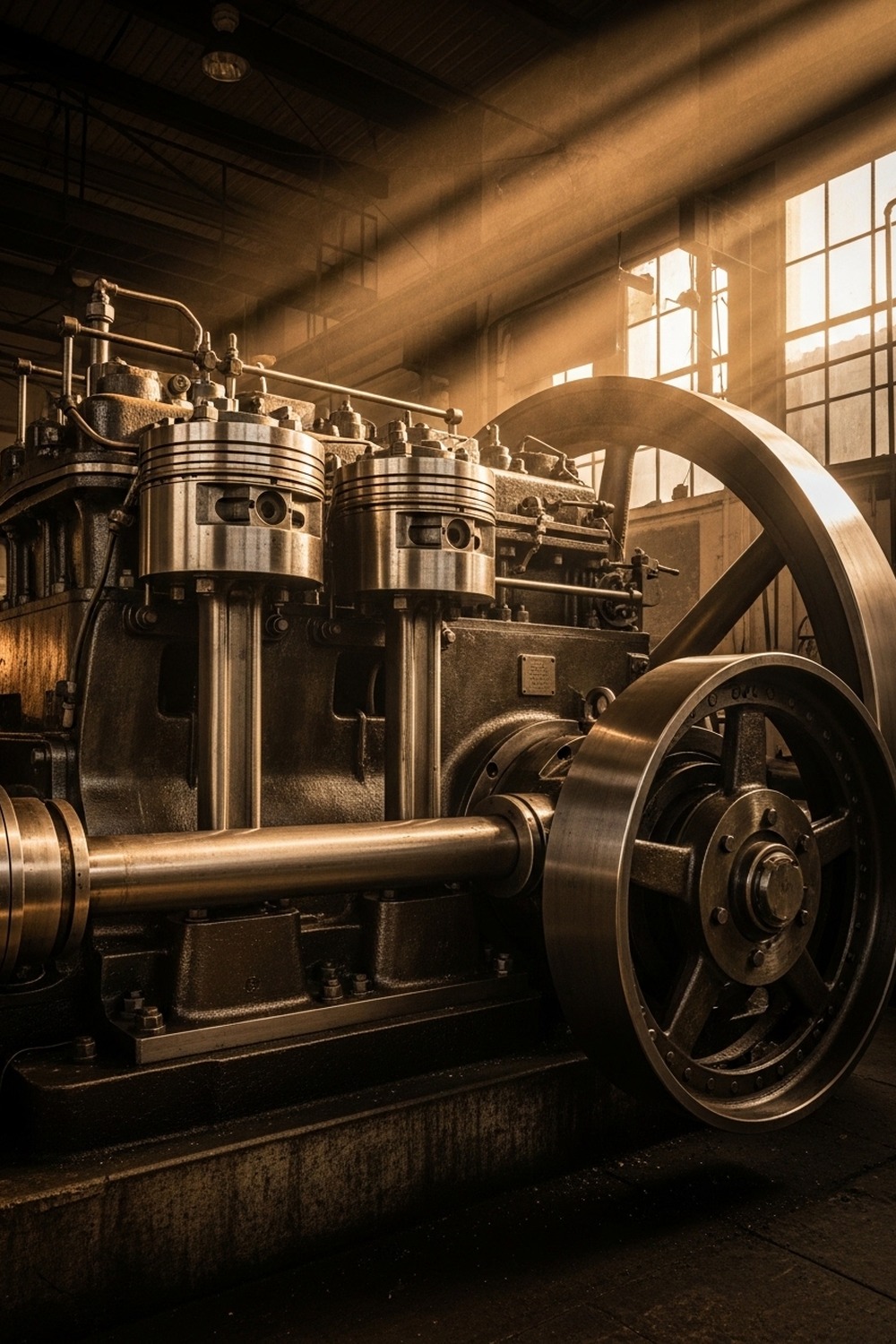
It is 1897. A engine fires in a workshop in Augsburg, Germany — and nothing burns to start it. No spark. No flame. The air itself did it.
Rudolf Diesel had been inside that workshop for years, surrounded by grease and scorched metal, circling a question most engineers had quietly abandoned: what if compression alone could replace ignition? The machine that answered it would eventually move nearly every ocean cargo, every highway truck, every hospital generator on Earth. He wouldn’t live to see most of it.
The Rudolf Diesel Engine Principle Nobody Expected
Compress air hard enough — and we’re talking compression ratios between 14:1 and 25:1 — and the temperature inside a cylinder spikes above 700°C. Hot enough to ignite diesel fuel the instant it’s injected. No spark plug. No ignition coil. Just physics doing what physics does when you push it past a certain threshold. Engineer and historian John Lienhard has written about how this “auto-ignition” principle, documented in Diesel’s original patent, struck his contemporaries as almost offensively elegant. Simple. Obvious, once you saw it.
Which raises the obvious question — why didn’t anyone notice sooner?
Part of it is that the first working prototype nearly killed everyone in the room. Early tests were violent. Components cracked. The engine backfired at unpredictable loads. Diesel kept iterating anyway, which is either admirable or alarming depending on your tolerance for engineers who won’t stop.
Early Numbers That Stunned the Industrial World
When the refined Rudolf Diesel engine finally stabilized, the efficiency numbers were almost embarrassing. Early diesel engines achieved around 26% thermal efficiency. Steam engines of the same era were delivering somewhere between 12 and 15%. That’s not a marginal improvement — that’s nearly double the energy extracted from the same fuel, and it’s the kind of statistic that made shipping magnates stop mid-sentence.
Think about what that gap meant in practice. Every ship crossing the Atlantic was hauling tons of coal just to feed its own engines. Less efficient combustion meant more coal. More coal meant less cargo space. Less cargo meant thinner margins. Diesel’s engine threatened to flip that entire equation, and the math was hard to argue with. You can read more about how engineering breakthroughs reshaped transportation history at this-amazing-world.com, but even in that context, these numbers stand apart.
Ships Crossed the Atlantic and Never Looked Back
It is 1912. The MS Selandia is launched — the first oceangoing motor vessel powered entirely by diesel. No sails. No coal bunkers eating up the hull. It crosses oceans and comes back, a floating proof of concept that nobody could quietly dismiss.
The Rudolf Diesel engine had traveled from a factory floor in Augsburg to the open Atlantic in under fifteen years. Railways followed. Then trucks. Then the generators powering remote hospitals, island communities, and deep-sea drilling platforms that had no other option.
By the mid-20th century, the global movement of nearly everything — food, medicine, steel, timber, cement — ran on descendants of that 1897 prototype. Not inspired by it.
Descended directly from it.

The Inventor Vanished Before Seeing Any of It
September 1913. Rudolf Diesel boards the SS Dresden in Antwerp, crossing the English Channel toward Harwich. He has dinner. He goes to his cabin. He is never seen alive again. His body surfaces in the North Sea ten days later. He’s 55 years old.
The theories range from suicide — he was nearly bankrupt by that point, undone by poor business decisions and a long string of licensing disputes — to something more deliberate, involving parties who wanted his patents buried and his influence ended. No one has closed the case. It remains officially unresolved.
That last fact kept me reading for another hour.
The man who designed an engine that would eventually power the ships crossing that very channel died in its water, before he could watch any of it happen.
By the Numbers
- 26% thermal efficiency in 1897 — nearly double what steam engines were managing at the time (MAN Energy Solutions, corporate history archives).
- The MS Selandia launched in 1912 as the first diesel-powered ocean vessel; within two decades, diesel-driven merchant ships had gone from near zero to dominating global shipping tonnage by volume.
- Modern large marine diesel engines can exceed 50% thermal efficiency — the highest of any heat engine type in commercial use today, which is a number that still surprises engineers when they say it out loud.
- Over 100,000 horsepower from a single large two-stroke marine diesel engine. Roughly 1,000 times what Diesel’s 1897 prototype produced on its best day.


Field Notes
- Diesel originally designed the engine to run on coal dust. The shift to liquid petroleum fuel came after pulverized coal experiments proved dangerously unstable — practical necessity, not original vision.
- “Diesel” as a standardized fuel name came well after his death.
- He held over 80 patents. Still died nearly broke — the licensing disputes and failed investments consumed most of what the engine should have made him. The man who built the machine that moves the world left almost nothing behind in his own accounts.
Why This Engine Still Shapes Everything You Touch
The Rudolf Diesel engine isn’t a relic. It’s not behind glass anywhere that matters.
Right now, the majority of the world’s freight — by sea, by rail, by road — is moving on engines that work on exactly the principle demonstrated in that Augsburg workshop in 1897. The ship that carried the phone in your pocket across an ocean ran on diesel. The truck that delivered what’s in your refrigerator ran on diesel. The generator that kept the hospital running through last winter’s outage ran on diesel. This isn’t background noise. It’s the skeleton the modern world is built on.
And it nearly didn’t happen. The engine exploded in early tests. The inventor died broke and unresolved. The technology could have been shelved, lost to bad timing or the wrong bankruptcy at the wrong moment. The fact that it survived long enough for the world to understand what it had — that’s worth sitting with.
Rudolf Diesel compressed air until it caught fire. Then he pushed that idea until it caught the world. One engineer. One workshop in Germany. One principle that became the mechanical heartbeat of global civilization — and a death in the English Channel that nobody has fully explained. The story should feel triumphant. The unresolved parts make it something stranger and more honest than that. If that kind of history keeps you up, there’s more at this-amazing-world.com — and the next one is even harder to put down.


