


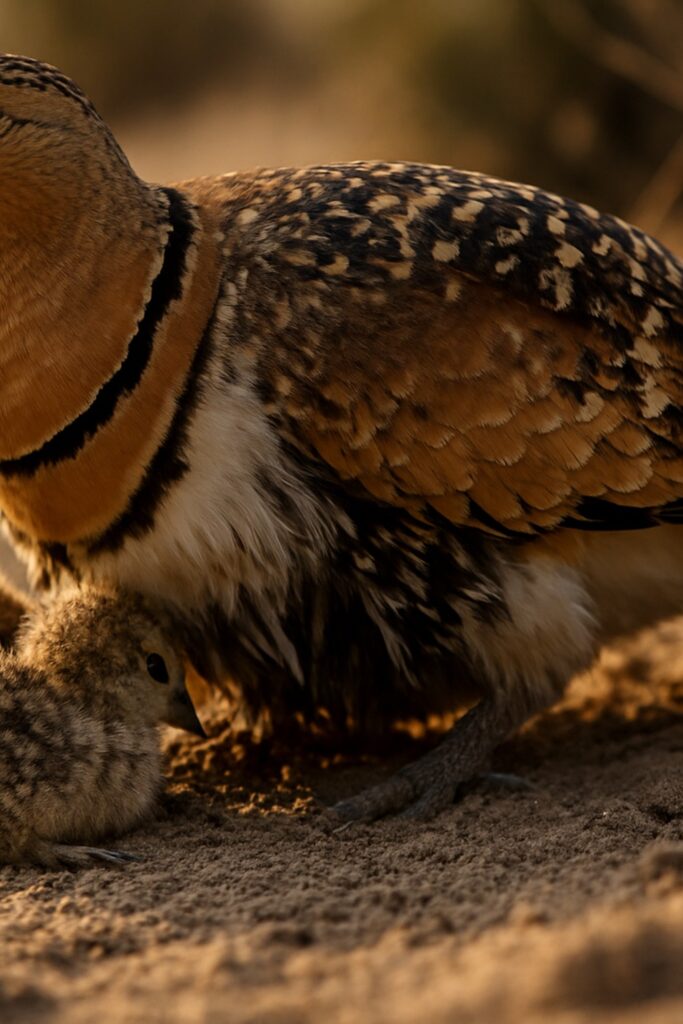
The male lands, settles over his chicks, and they immediately start stripping water from his feathers with their bills. He flew 30 kilometers through desert heat to bring it to them. The feathers hold maybe two tablespoons.
That’s the whole system. That’s how sandgrouse breed in the Kalahari — one of the most water-scarce environments on Earth — without ever relocating their nests to be near a water source. The sandgrouse water-carrying feathers aren’t just a neat trick. They’re a complete solution to a problem that should’ve been unsolvable.
How Sandgrouse Water-Carrying Feathers Actually Work
Not all feathers are built the same, and a sandgrouse belly feather under a microscope looks nothing like what you’d expect. Instead of the flat, interlocking structure most birds have, each feather branches into dense, tightly coiled barbules — tiny strands that curl back on themselves and create microscopic spaces between them. Those spaces trap water. Not just wet-surface water, but genuinely held water, the way a sponge holds it rather than the way a flat surface holds it.
Ornithologist Tom Cade, working with colleagues at the University of Pretoria in the 1960s, was among the first researchers to systematically document this. He measured how much water a single male could carry and got results that surprised the team: close to two tablespoons per bird, per trip.
Two tablespoons sounds trivial. In the Kalahari, after six weeks without rain, it’s the difference.
The Bird Wakes Before Dawn for This
Male sandgrouse are up before sunrise. Not because they’re early risers by nature — because the timing is load-bearing. Cooler air means slower evaporation from the feathers on the return flight. Predators are less active. And the math on how long those feathers stay saturated is unforgiving enough that starting late isn’t really an option.
They navigate from memory to waterholes that might be 20 to 30 kilometers out. Some documented round trips hit 60 kilometers total — one of the longest daily commutes recorded for any bird species, done specifically to hydrate offspring. Explore more extraordinary animal behaviors at this-amazing-world.com.
At the waterhole, the male wades in deliberately. He rocks forward, pressing his belly into the water, letting those coiled barbules saturate. It takes about a minute. Then he lifts off.
The Desert’s Clock Is Already Ticking
University of Pretoria researchers found that the sandgrouse water-carrying feathers can resist evaporation for close to an hour under controlled conditions. The tight coil structure slows moisture loss in a way a flat feather surface simply can’t.
Sixty minutes. Thirty kilometers. Full Kalahari sun. Chicks waiting.
The margin is real but it isn’t comfortable. That last fact kept me reading for another hour — the idea that this whole system works only because the feather microstructure buys just enough time, and the bird flies just fast enough, and the route is just short enough. Pull any one of those variables slightly in the wrong direction and the whole thing collapses. But it doesn’t collapse. It’s been running like this for longer than our species has existed.

The Chicks Do Something Remarkable Too
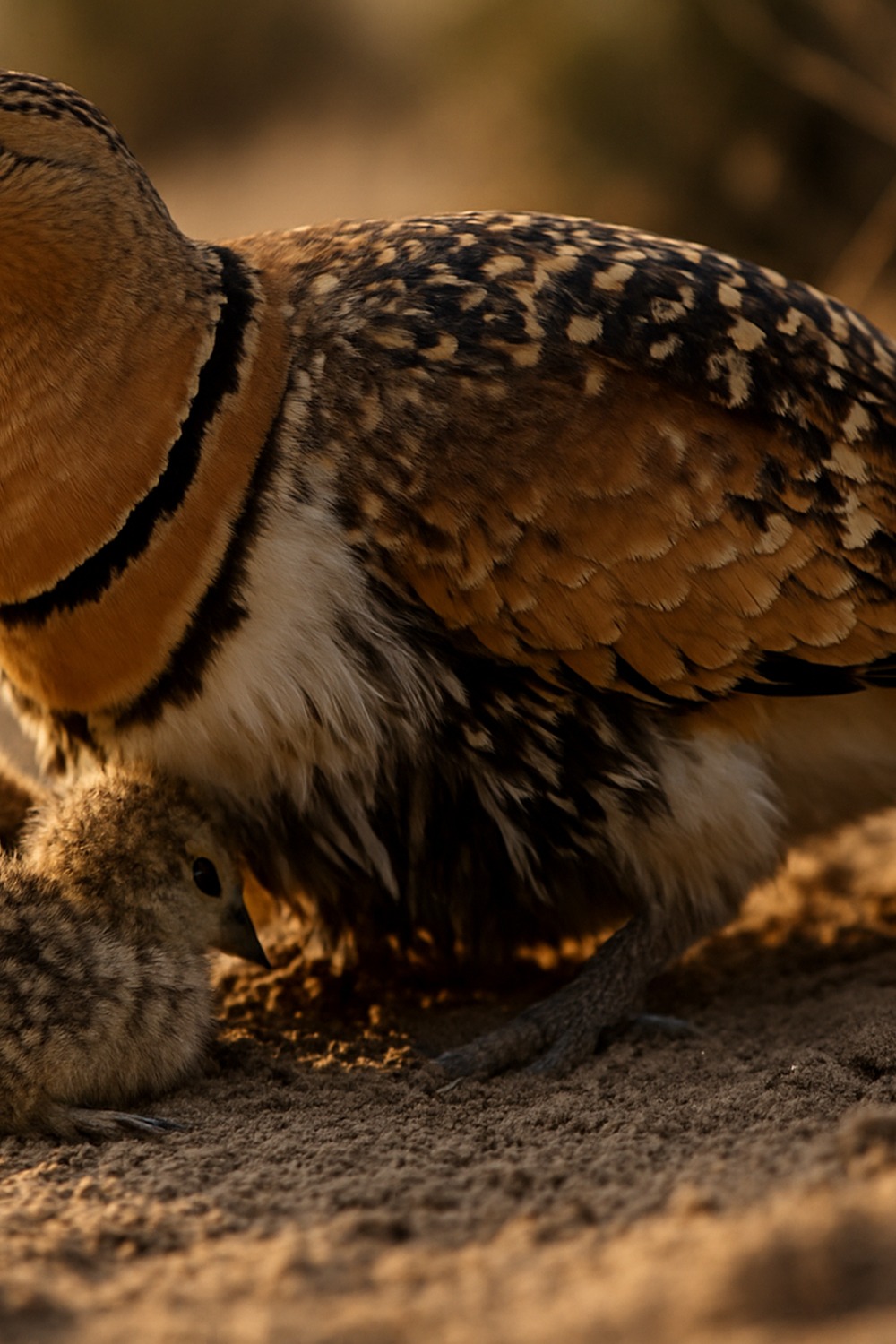
When the father lands, the chicks don’t wait passively. They push their bills into his belly feathers and strip the water out with a fast, practiced motion — almost like milking. Scientists watching this noted that even very young chicks, just days old, seem to know exactly how to do it. That’s not learned behavior. That’s instinct refined over thousands of generations of desert living, encoded into the birds before they’ve even opened their eyes properly.
And while he’s gone, the female stays at the nest. That’s not incidental — a nest left unattended in the Kalahari doesn’t stay safe. Jackals work those areas. So do monitor lizards, and raptors that are very good at spotting anything small and motionless against the sand. The division matters.
By the Numbers
- Feathers retain usable water for approximately 60 minutes — documented across studies spanning the 1960s through the 2000s.
- Males carry close to 25 milliliters per trip, roughly a tablespoon and a half, which is enough to get several chicks through the worst heat of the day.
- Round trips up to 60 kilometers recorded — making this one of the longest daily commutes documented for any bird species in service of offspring hydration.
- 16 recognized sandgrouse species exist across arid Africa, the Middle East, and Central Asia. Each population faces the same core problem. Each uses minor variations of the same feather-transport solution — which suggests this isn’t a quirk but a deeply stable evolutionary answer to desert breeding.

Field Notes
- Hundreds of birds at a single waterhole at dawn — part ritual, part collective predator defense.
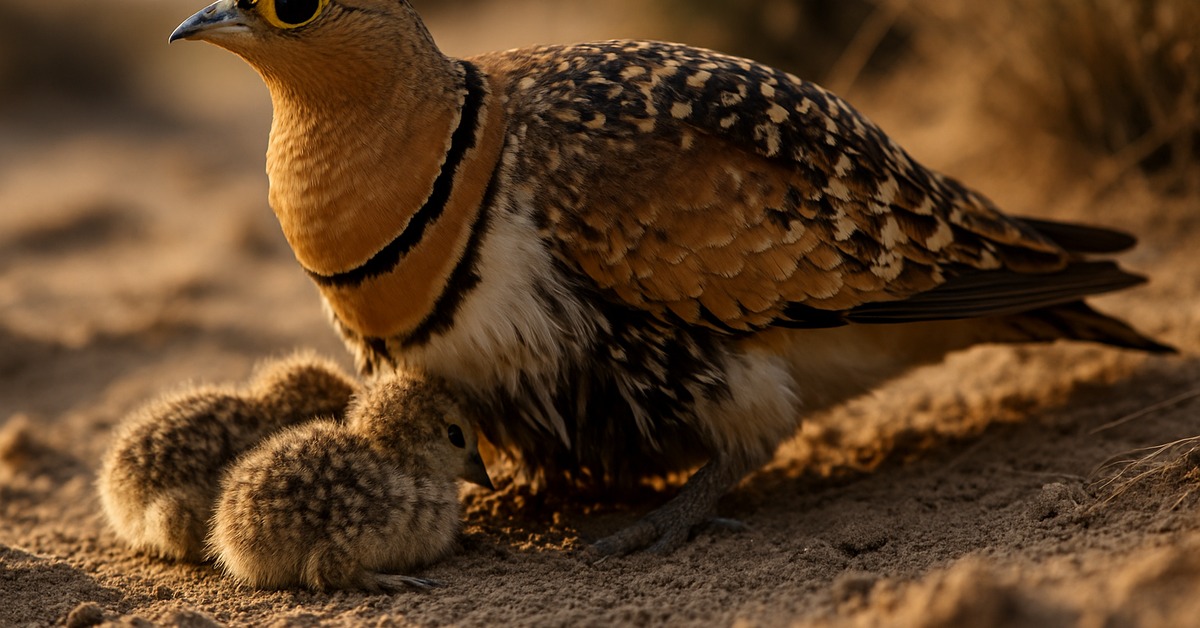
- The water-carrying belly feathers are exclusive to adult males. Females have different plumage built for camouflage during nesting. Young males develop the specialized feathers only after reaching maturity, which means juvenile males spend time observing before they can participate — essentially an apprenticeship built into the biology.
- Biomimicry engineers have studied the sandgrouse feather microstructure as a model for designing water-transport materials suited to arid environments. Millions of years of desert pressure produced a structural solution that human materials science is still trying to replicate cleanly.
Why This Story Rewrites Desert Survival Rules
For a long time, the working assumption was that desert animals dealt with water in one of two ways: store it internally like a camel, or extract it metabolically from food like many desert rodents do. The sandgrouse water-carrying feathers represent something different — a third strategy that nobody quite anticipated. External transport. Using the body as a vessel, not a reservoir. It means a bird can breed in landscapes with almost no accessible water, provided it can reach water periodically and make it back in time.
Which quietly changes something bigger. It expands the theoretical range of environments that can support complex animal life and multi-generational nesting. The constraint isn’t just “is there water here” — it’s “can water be reached and returned from here within a viable window.”
The chicks never move. They stay hidden, pressed against the sand, camouflaged. The male crosses the open terrain twice a day. Vulnerability stays concentrated in one place, in one bird, doing one job. It’s an elegantly minimized system.
There’s something almost stark about it when you picture the whole thing running: a bird lifting off in the grey pre-dawn, navigating alone across a landscape that evaporates things, carrying water in the coils of his own feathers, racing the sun home. No drama about it. No hesitation. Just the job, every morning, for the entire breeding season.
The Kalahari doesn’t leave room for improvisation, and the sandgrouse doesn’t improvise. It’s running a system so precisely calibrated it genuinely looks engineered — and it’s been doing so without modification for longer than humans have been around to notice. Nature keeps pulling this: quietly solving problems that seem impossible, in places we don’t think to look. If that kind of thing pulls you in, there’s more waiting at this-amazing-world.com. The next one is stranger.


