


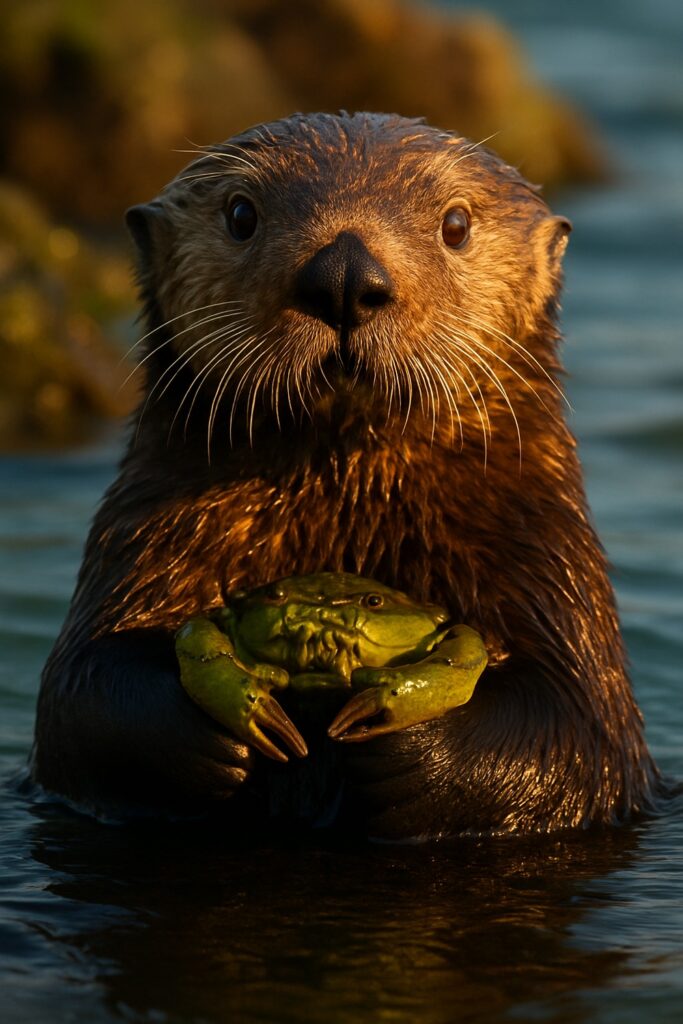
Nobody planned for this. The traps failed, the volunteer crews failed, the monitoring spreadsheets failed — and then a few dozen hungry otters showed up and started eating their way through California’s most stubborn ecological nightmare.
At Elkhorn Slough, a seven-mile tidal estuary tucked south of Santa Cruz, European green crabs had spent years systematically destroying eelgrass beds and collapsing oyster populations. Scientists tried traps. They tried hand-removal crews. They tried monitoring programs. Nothing really worked. Then the otters showed up hungry — and everything started changing.
How Sea Otters Invasive Crabs Became Nature’s Pest Control
European green crabs (Carcinus maenas) likely arrived in the United States hidden in ship ballast water sometime in the early 19th century. They’ve since spread aggressively along both coasts, shredding seagrass beds and outcompeting native species wherever they land. Researchers like those studying Elkhorn Slough documented the damage for decades — and watched human-led removal efforts fall consistently short.
So what actually changed?
The otters came back. Not because of some grand rewilding program with press releases and ribbon-cutting. Just because protection worked, slowly, over generations. And nature quietly filled the gap that science was struggling to close with spreadsheets and volunteer hours.
A Fur Trade Hangover That Almost Cost Everything
Sea otters were hunted to the edge of extinction during the 18th and 19th centuries — their dense, luxurious fur made them irresistible targets for traders working Pacific routes. By the early 1900s, fewer than 2,000 were left globally. At Elkhorn Slough specifically, otter numbers sat at just a few dozen individuals as recently as the 1980s. The ecosystem those otters once regulated had been running without them for nearly 200 years. You can explore this-amazing-world.com for more stories of species returning from the brink in ways that reshaped entire habitats.
Two centuries is a long time for an ecosystem to develop bad habits.
The green crabs moved in. The eelgrass retreated. The fish nurseries that depend on eelgrass thinned out. And the whole thing spiraled — quietly, steadily, mostly out of public view — until the predator that once kept it all balanced finally started coming home.
What Happens When Apex Predators Return to Their Turf
Ecologists call it a trophic cascade — when a top predator’s return sends ripple effects all the way down the food chain. With sea otters and invasive crabs at Elkhorn Slough, the cascade has been striking. Researchers tracking the slough over two decades found that otter-dense areas showed measurable eelgrass recovery compared to areas without them. Where eelgrass grew back, juvenile fish returned. Where juvenile fish returned, the broader food web started knitting itself back together, link by link.
It sounds almost too clean. But the data keeps pointing the same direction. The otters aren’t following a conservation plan. They’re just eating — compulsively, constantly, because their metabolism demands it.
And that hunger might be the most powerful restoration tool on the California coast right now.

The Math Behind One Otter’s Daily Appetite
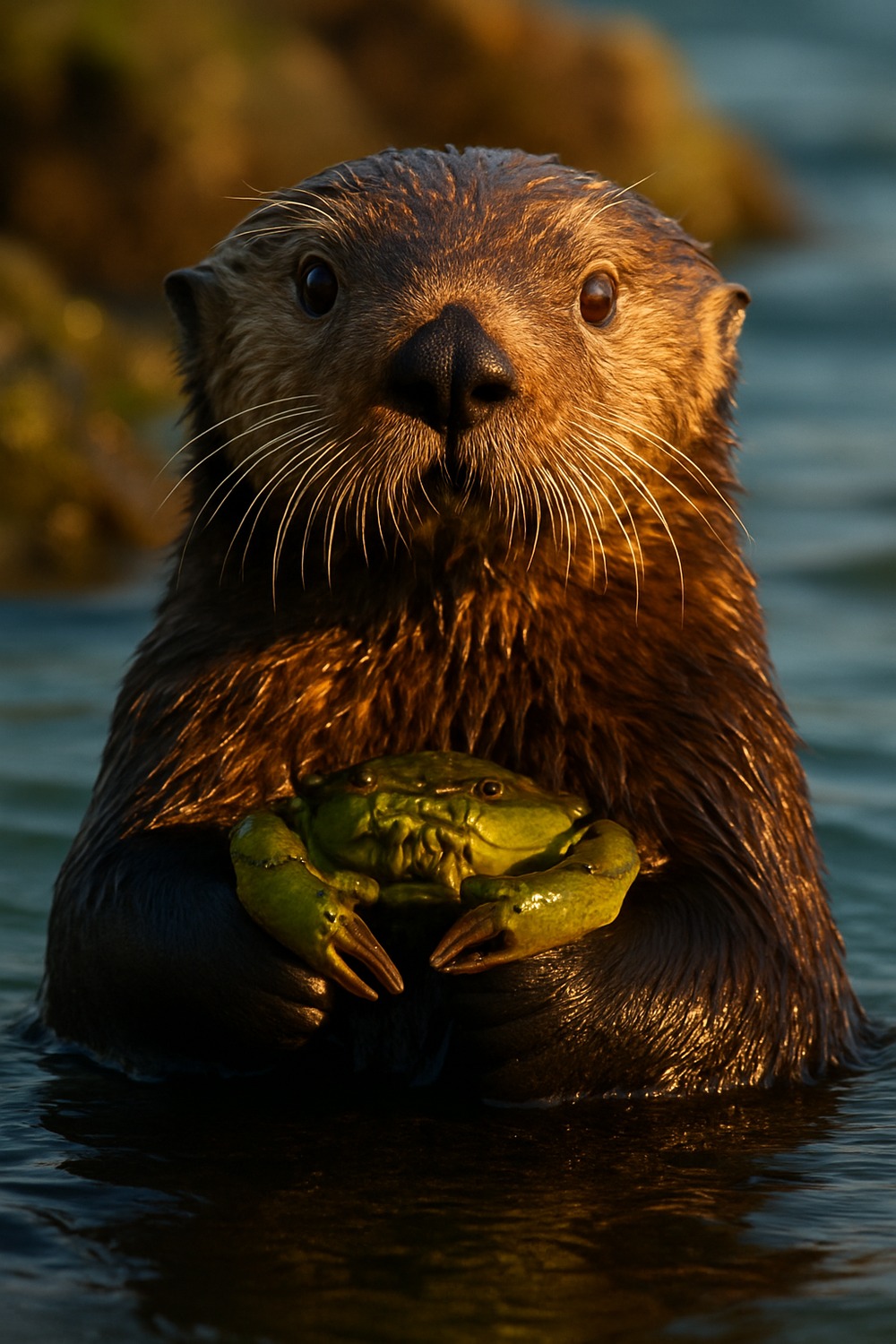
Here’s the thing — a sea otter’s caloric demand is staggering for its size. Unlike most marine mammals, otters don’t have blubber. They rely entirely on their fur and a furiously fast metabolism to stay warm in water that hovers near 50°F year-round. To maintain that metabolic furnace, an adult otter needs to consume roughly 25% of its body weight in food every single day.
For a 60-pound otter, that’s about 15 pounds of crab, urchin, clam, or whatever else is available. Every day. No days off. For their entire lives.
That last fact kept me reading for another hour.
At Elkhorn Slough, green crabs have become a primary menu item. They’re abundant, they’re accessible in the shallow tidal zones otters prefer, and they’re apparently easier to crack open than some of the harder-shelled prey otters deal with elsewhere. The crabs, in a dark twist, may have made themselves too easy a target by colonizing exactly the habitat where otters hunt best. Which is either poetic justice or just ecology doing what ecology does — it’s hard to tell the difference sometimes.
By the Numbers
- European green crabs first showed up on the U.S. Atlantic coast around 1817 — but didn’t reach the Pacific coast until the 1990s, which means the West Coast invasion is geologically recent and already devastating in ways researchers are still measuring.
- California sea otter population: roughly 50 animals in the early 20th century. By the 2020s: over 3,000. That entire recovery traces back to the 1911 international fur trade ban and subsequent protections under the U.S. Marine Mammal Protection Act.
- Eelgrass beds in otter-occupied zones at Elkhorn Slough increased by over 600% in some survey areas between the mid-1990s and 2010s, per research published in Proceedings of the National Academy of Sciences.
- Dozens of crabs per otter per day.
- With several hundred otters now active in and around the slough system, the cumulative predation pressure on green crab populations has become ecologically significant in a way that no human removal program ever achieved at scale — not even close.

Field Notes
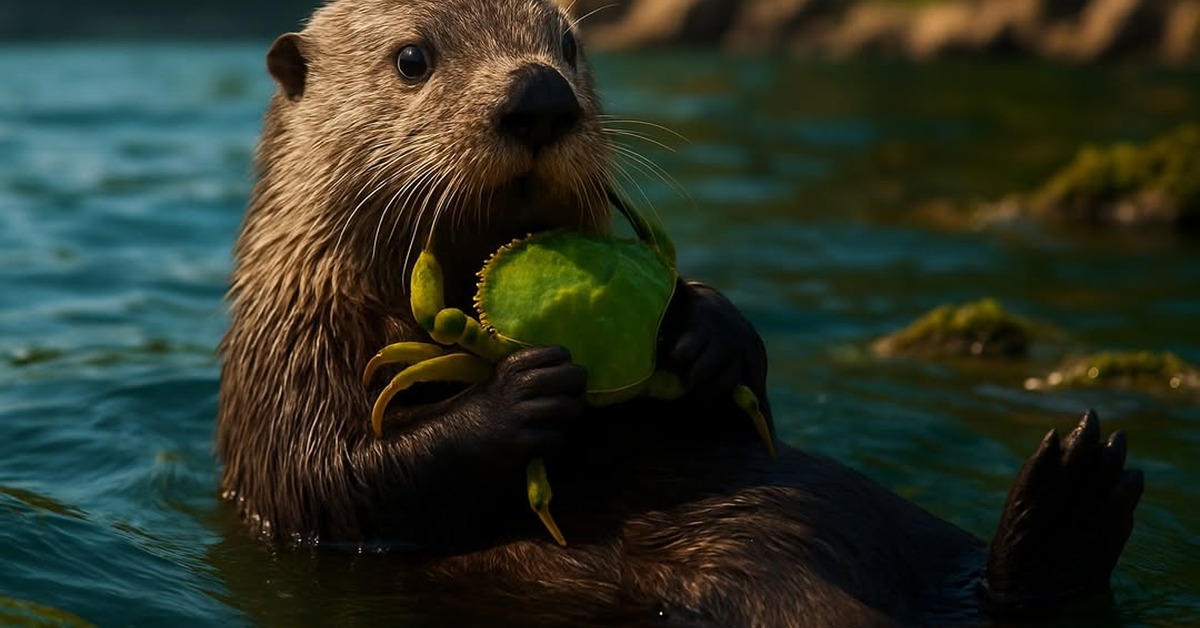
- Sea otters carry a favorite rock in a loose skin pouch under their forearm and use it to crack open hard-shelled prey while floating on their backs. Some individuals have been observed using the same rock for years.
- Tool use. In a marine mammal. With a personal rock they keep.
- Female otters at Elkhorn Slough have been documented teaching their pups how to hunt green crabs specifically — meaning crab-hunting behavior is being actively passed down through otter generations, culturally reinforcing the predation pressure on the invasive species without any human involvement whatsoever.
- Green crabs don’t just eat other species — they physically destroy habitat by uprooting eelgrass while burrowing and foraging. Which means their removal allows vegetation to recover even faster than it would if the crabs had simply been outcompeted by native species.
Why This Story Is Bigger Than One Estuary
The lesson from Elkhorn Slough isn’t just about sea otters and invasive crabs. It’s about what ecosystems can do when they’re given back a missing piece. For decades, the dominant approach to invasive species management has been direct human intervention — trapping, poisoning, physical removal, massive labor hours, significant cost. Those tools aren’t useless. But they’re fighting biology with logistics, and biology almost always has more stamina.
Turns out the pattern is everywhere once you start looking.
Wolves and elk in Yellowstone. Sharks and reef systems across the Pacific. Lynx and hare populations in boreal forests. Remove the predator, watch the system destabilize. Restore the predator, watch it reorganize. The machinery was always there. We just kept pulling parts out of it without reading the manual.
And those parts are expensive to replace. Human intervention at Elkhorn Slough cost researchers and volunteers years of effort and significant funding — with modest results. The otters, operating purely on appetite, appear to have done more in a shorter timeframe simply by being present and hungry. That’s not an argument against conservation science. It’s an argument for letting conservation science work with biology instead of trying to route around it.
Sea otters aren’t saving Elkhorn Slough out of altruism. They’re saving it because they’re hungry and the crabs are right there. But the result — eelgrass growing back, fish returning, an estuary slowly exhaling after decades of damage — is the same either way. Sometimes the most sophisticated solution is an ancient one we nearly lost forever. If this kind of story keeps you up at night, there’s more at this-amazing-world.com — and the next one is even stranger.


