


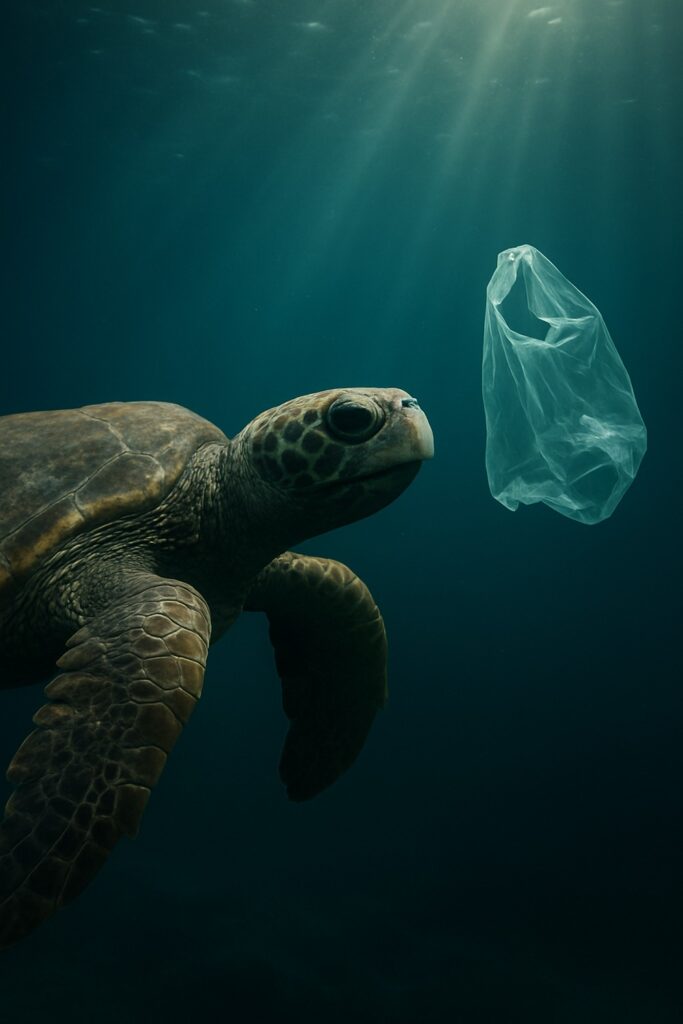
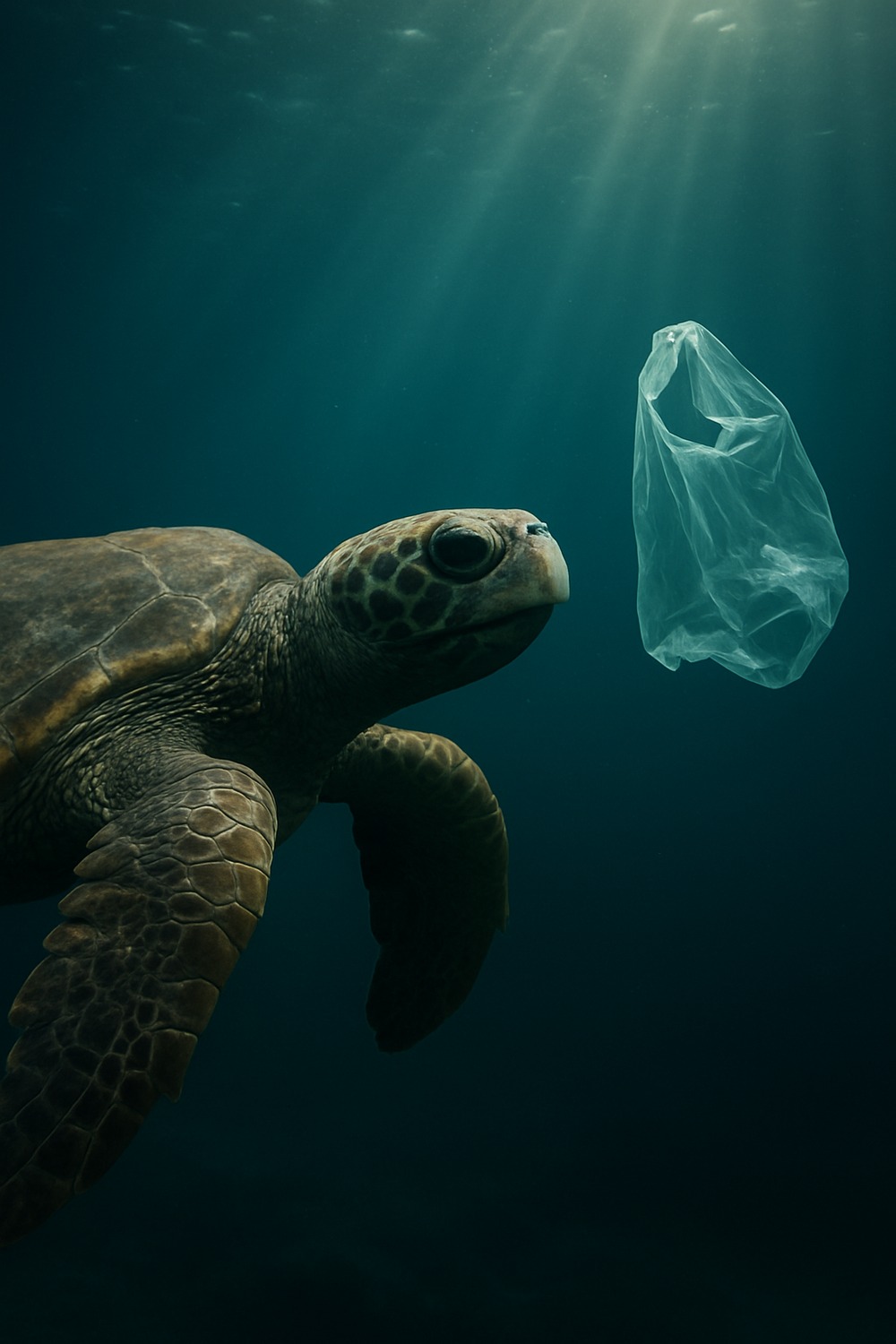
Nobody designed a plastic bag to kill a sea turtle. That’s almost the worst part — it just drifts there, translucent, catching the light, moving with the current the same way a jellyfish has for the last 500 million years.
And a loggerhead turtle, running behavioral software that’s older than the Himalayas, can’t tell the difference. One bite. That’s the whole tragedy in miniature. But here’s where it gets less depressing — briefly — because one country got tired of waiting for a global solution and just did something. What happened to their plastic numbers is genuinely worth knowing about.
Why Sea Turtle Plastic Bags Look Like Dinner
A loggerhead sees the world mostly through motion and shape. A translucent plastic bag drifting on a current moves like a jellyfish. Catches light like a jellyfish. According to marine biologist Dr. Qamar Schuyler at the Australian Institute of Marine Science, soft plastics are disproportionately deadly to sea turtles because they match the visual and tactile profile of prey these animals have hunted for over 100 million years.
Evolution never built in a warning system for polyethylene. Why would it? The effects of pollution on sea turtles have only become measurable in the last few decades — a geological eyeblink — and the animal’s threat-detection system has had approximately zero time to catch up.
The ingestion part is bad. What happens after is worse.
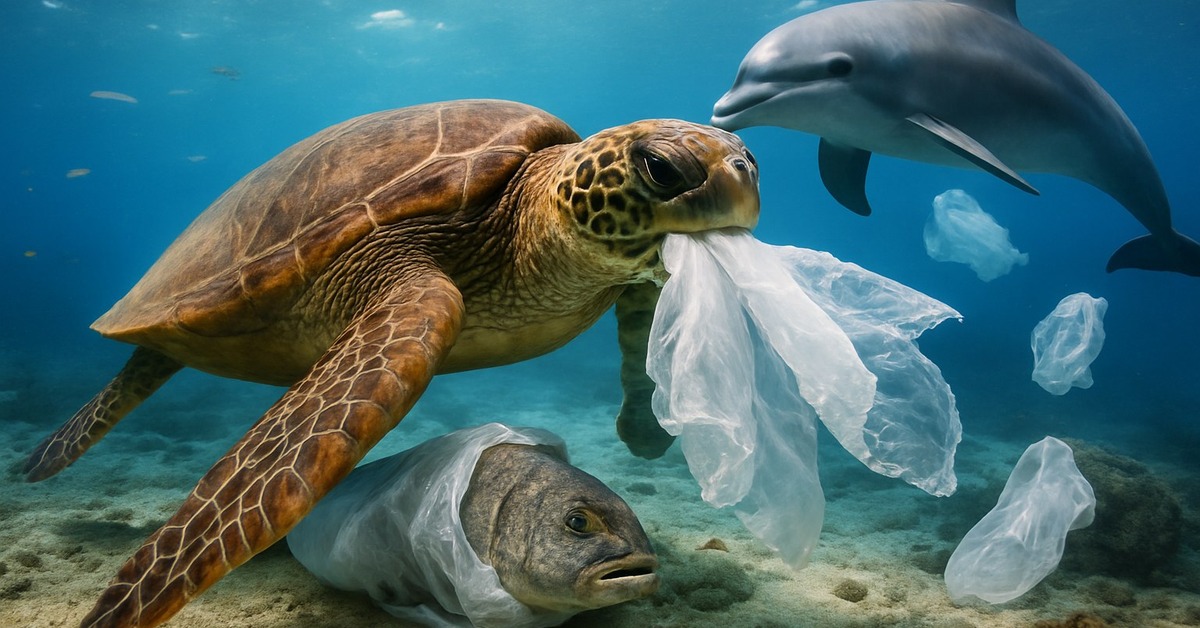
A sea turtle’s throat is lined with backward-pointing spines called papillae — evolved to grip slippery jellyfish and stop them from escaping back out. Those same spines trap plastic. Once it’s in, it’s not coming back out. The turtle feels full. Stops eating. And slowly starves with a stomach packed with something that will never, under any circumstances, break down into anything useful. That last detail kept me reading for another hour the first time I came across it.
Portugal Did Something Most Countries Just Talked About
In 2015, Portugal started legislating against lightweight plastic bags — the kind that weigh almost nothing, cost almost nothing to produce, and persist in marine environments for up to 500 years. Stores charged for them. Reusable alternatives became normal. By 2017, usage had dropped by more than 70%.
That’s not a rounding error. That’s millions of bags per year that never made it into the Tagus River, never floated out into the Atlantic, never reached the feeding grounds of the loggerhead turtles that actually nest on Portuguese beaches. The numbers moved fast once the policy was clear.
Portugal isn’t the only country that’s tried. But it is one of the cleaner case studies in what happens when legislation actually follows through rather than stalling in committee for a decade. If you’re curious about other conservation wins that came out of nowhere, this-amazing-world.com has a few that are genuinely strange.
The bags disappeared. And the turtles swimming off the Algarve coast had slightly better odds. That’s the whole story — it doesn’t need to be more dramatic than that.
The Scale of This Problem Keeps Getting Bigger
Here’s where the sea turtle plastic bags story stops being a regional conservation footnote and becomes something else entirely.
An estimated 8 million metric tons of plastic enter the ocean every single year. One garbage truck of plastic per minute, every minute, all year. Lightweight single-use plastics — bags, wrappers, straws — make up a disproportionate share of what ends up in marine ecosystems specifically because they’re light enough to travel. They blow off streets. Float down rivers. Ride ocean currents across entire basins, from a convenience store in one country to a sea turtle’s stomach in another.
The Pacific Garbage Patch. The Mediterranean’s plastic density. Fragments washing up on beaches in the Maldives, in Iceland, in places with almost no human population for hundreds of miles. Plastic doesn’t stay where you put it.
That’s the part most people genuinely underestimate.
And what’s waiting at the other end of those currents? Turtles. Whales. Seabirds. Animals running behavioral programs millions of years old, completely unprepared for a material humans invented sometime around 1955.

The Biology Makes This Worse Than You Thought
Ingestion is one problem. Entanglement is its own separate category.
Sea turtles surface to breathe. A plastic bag or discarded fishing net wrapped around a flipper can prevent a turtle from reaching the surface effectively — leading to infection, limb loss, or straight-up drowning. Researchers studying loggerhead turtles in the Mediterranean have documented animals that survived entanglement but with permanent deformities: shells warped by plastic rings that were there during growth, the animal’s body literally reshaping itself around the obstruction over years.
Turns out, the damage isn’t always fast or obvious. Sometimes it’s slow, cumulative, invisible until it’s too late. A turtle ingesting small plastic fragments over months accumulates what amounts to an internal blockade — reduced gut motility, hormonal disruption from chemical leaching, malnourishment hidden behind a false sense of fullness.
A slow erasure. Happening underwater, where no one’s watching.
By the Numbers
- An estimated 52% of the world’s sea turtles have ingested plastic debris, according to a 2015 study in Global Change Biology — more than half of an entire ancient lineage that survived multiple mass extinctions.
- Portugal cut lightweight plastic bag usage by over 70% between 2015 and 2017. One of the steepest declines recorded in Europe in that period.
- A single leatherback sea turtle was recovered with 11 pounds of plastic in its stomach — bag fragments, sheeting, rope — one of the highest recorded plastic loads in any individual marine animal.
- Average use time for a single-use plastic bag: 12 minutes. Time to break down in the ocean: up to 500 years.

Field Notes
- Sea turtles have been navigating Earth’s oceans for over 100 million years — they were already ancient when the asteroid hit. Plastic pollution has become one of the most rapidly escalating threats in their entire evolutionary history, and it appeared in essentially no time at all on any meaningful timescale.
- Papillae can’t distinguish prey from plastic.
- Young sea turtles in the “lost years” — the early phase of life when they drift with surface currents before settling into adult habitats — are especially vulnerable to plastic ingestion because they inhabit exactly the same surface zones where lightweight plastic debris concentrates most heavily. Wrong place, wrong time, every time.
What One Country’s Choice Actually Means
The Portugal example doesn’t matter because it solved the ocean plastic crisis. It didn’t. It matters because it proved that behavior can change fast when policy is clear and enforced rather than aspirational and vague.
Sea turtle plastic bags interactions are a downstream consequence of upstream decisions: what gets manufactured, how it’s sold, what waste infrastructure exists to catch it before it reaches a river. Every bag that doesn’t get made is one that can’t end up lodged in papillae. That’s not idealism. It’s arithmetic.
Other countries have moved. The EU rolled out broader single-use plastic restrictions in 2021. Kenya, Bangladesh, and Rwanda have implemented some of the strictest plastic bag bans anywhere in the world. Each policy is imperfect. Each one still matters.
The sea turtle doesn’t know any of this. She’s following instincts that predate human civilization by a margin that’s almost impossible to actually feel in your gut. She sees something translucent drifting in the current and she makes the decision that evolution rewarded for 100 million years running.
What’s changed isn’t her. It’s the ocean she’s swimming through.
That part is entirely on us.
Sea turtles have outlasted ice ages, mass extinctions, and the slow grind of continental drift. What they haven’t had time to adapt to is a world producing 380 million metric tons of plastic every year — a material that’s been around for less than a single human lifetime. Portugal showed that one policy shift can actually move the needle. Other countries are proving it too. Slowly. Not fast enough. But moving. There’s more at this-amazing-world.com, and honestly, the next one is stranger than this one.


