Seahorse Courtship: The Synchronized Color Dance at Dawn
Paired seahorses perform the seahorse courtship dance every single morning — and for a long time, researchers assumed they were watching tenderness. They weren’t. What looks, from a distance, like two animals quietly in love is actually something closer to a systems check before launch: a chromatic, choreographic protocol that either primes both bodies for pregnancy or tells them, wordlessly, that today isn’t the day. Romance was always the wrong frame.
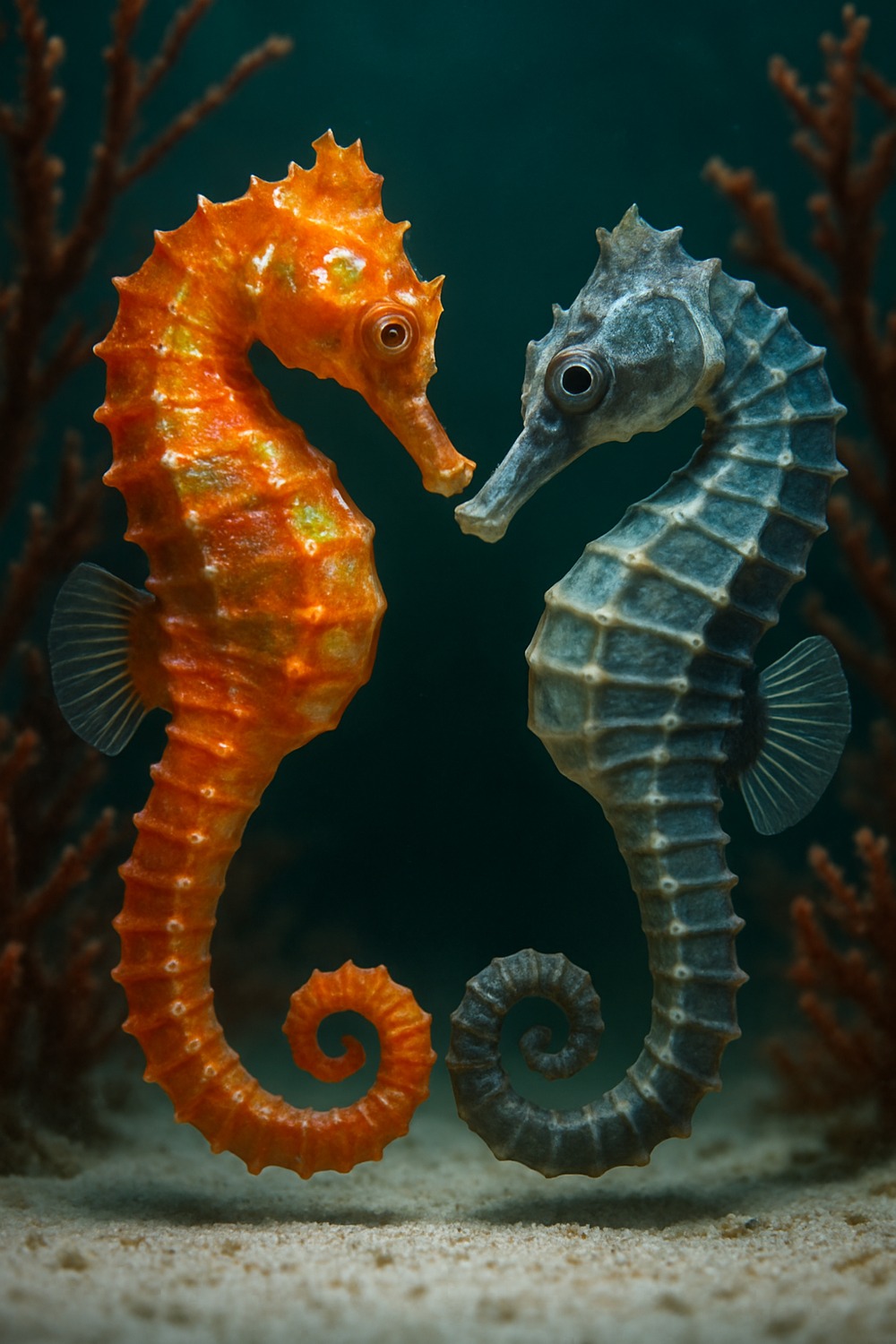
Off the seagrass beds of the Indo-Pacific and along the rocky shallows of the Atlantic, paired seahorses meet each morning for a display so synchronized it looks rehearsed. They change color in unison, mirror each other’s movements, spiral upward through the water column together. Marine biologists have been chasing the question of what, exactly, is being communicated in all that choreography — for decades.
What the Seahorse Courtship Dance Actually Signals
Dr. Amanda Vincent of the University of British Columbia — arguably the world’s leading seahorse researcher — spent years documenting seahorse behavior in the wild and concluded that these morning greeting rituals serve a purpose far beyond simple bonding. Her fieldwork, published in the early 1990s and expanded through Project Seahorse, showed that pairs who performed longer, more elaborate daily dances had measurably higher reproductive success rates.
The dance isn’t romantic theater. It’s biological calibration — these animals dancing not because they feel good about each other, but to stay physiologically aligned, to keep their reproductive cycles locked in step so that when egg transfer finally happens, both partners are ready at the cellular level. The timing window is extraordinarily narrow.
Color Changes Drive the Ritual’s Hidden Language
Seahorses are masters of chromatic communication. Specialized pigment cells called chromatophores (researchers actually call this a “chromatic negotiation” during active courtship) allow them to shift hues rapidly — from pale cream to deep amber, from mottled brown to vivid yellow. During courtship, these changes don’t happen randomly. Studies conducted at the Zoological Society of London found that color synchrony between partners escalates as the morning ritual progresses, with both individuals converging on similar hues within minutes of beginning their dance. This convergence appears to signal mutual hormonal readiness. You can read more about how color plays a surprising role in marine animal communication in this deep-dive on this-amazing-world.com.
What makes this particularly striking is that seahorses are largely monochromatic in their resting state. That burst of coordinated color during the seahorse courtship dance isn’t ambient display — it’s deliberate signaling. Like a conversation conducted entirely in light.
The Mechanics of a Morning Meeting
Why does any of this matter? Because the ritual’s structure reveals exactly how much biological work the dance is actually doing.
Studies clocked these sessions at anywhere from 6 to 38 minutes, with longer sessions correlating with closer proximity to egg transfer days. The ritual follows a recognizable sequence: brightening begins first. Then the circling. Then the synchronized rising through the water — sometimes called the “pre-dawn promenade” in behavioral literature. At first light, the male approaches the female’s territory, or in many established pairs, both individuals converge on a shared anchor point, often the same piece of coral or seagrass stem they’ve used for days or weeks. Pairs that skipped or shortened the ritual showed reduced pregnancy rates in captive observation settings, according to research published in the journal Animal Behaviour in 2003.
Short sessions aren’t failures. They’re information. A truncated dance may indicate that one partner isn’t physiologically ready, buying the pair more time before attempting transfer. The ritual is a daily status check encoded in color and motion.
Inside the Seahorse Courtship Dance and Egg Transfer
Unlike virtually every other vertebrate species on Earth, it’s the male who becomes pregnant — and the seahorse courtship dance is precisely what makes that pregnancy possible. The female deposits eggs into a specialized brood pouch on the male’s abdomen, where he fertilizes them internally and carries the developing young for 10 to 25 days depending on the species. But that transfer only works when both partners are precisely synchronized. If the female releases eggs before the male’s pouch is hormonally primed to receive and protect them, the pregnancy fails.
The daily courtship ritual appears to be the mechanism that gets them to that synchrony. Not foreplay. A launch sequence.
A ritual mistaken for affection is, structurally, one of the most efficient reproductive systems in the vertebrate world — and that distinction deserves more than a footnote in how we talk about animal behavior.
And the seahorse courtship dance isn’t a display of affection layered on top of reproduction — it’s the engine of reproduction itself. Remove the ritual and you disrupt the hormonal signaling that makes successful pregnancy possible. That’s why pairs in degraded habitats, where daily routines are disrupted by boat traffic, pollution, or seagrass loss, show significantly lower birth rates than undisturbed populations.
A Ritual Older Than Most Ocean Ecosystems
Seahorses have existed in something close to their current form for roughly 13 million years, based on fossil evidence from Central Europe. Their courtship behavior almost certainly predates many of the reef and seagrass ecosystems they now inhabit. Compare that to the 10,000-year arc of human agriculture, and you get a sense of how deeply this ritual is embedded in the animals’ biology. The daily dance isn’t a recent behavioral innovation — it’s an ancient protocol refined across millions of generations. Not learned. Inherited at a level that makes it essentially inseparable from the species itself.
Here’s the thing: at least 14 of the 46 recognized species are currently listed as Vulnerable or Endangered by the IUCN, and the forces driving those declines — habitat destruction, the traditional medicine trade — are dismantling populations that have been performing this same ritual since before the Mediterranean Sea existed in its current form. If the ritual disappears because the animals disappear, something genuinely irreplaceable goes with it.
The window to prevent that is narrowing faster than most people realize.
How It Unfolded
- Early 1990s — Dr. Amanda Vincent publishes foundational fieldwork on seahorse pair-bonding and morning courtship rituals through Project Seahorse, establishing the behavioral baseline researchers still reference today.
- 2003 — Research published in Animal Behaviour formally links ritual duration to reproductive success in captive populations, quantifying what field observers had long suspected.
- 2004 — IUCN lists multiple seahorse species under Appendix II of CITES, marking the first coordinated international recognition of trade-driven population decline.
- 2021 — IUCN updated seagrass loss estimates to approximately 7% per year globally — putting seahorse habitat destruction on a trajectory faster than tropical rainforest loss, and forcing a reassessment of species survival projections.
By the Numbers
- At least 37 million seahorses are estimated to be traded globally each year for traditional medicine and the aquarium trade, according to TRAFFIC and IUCN data compiled through 2020.
- Courtship rituals in Hippocampus kuda (the spotted seahorse) last an average of 9 minutes per session under natural conditions, but extend to over 30 minutes during the 24-48 hours immediately preceding egg transfer.
- Male seahorses can give birth to anywhere from 5 to 2,500 young in a single brood depending on species — Hippocampus abdominalis, the big-bellied seahorse, holds the record for largest recorded litter size.
- Seagrass meadows — the primary habitat for most seahorse species — are declining at approximately 7% per year globally, a rate roughly 3× faster than tropical rainforest loss (IUCN, 2021).
Field Notes
- Separated pairs that reunite after several days often need to rebuild their color synchrony from scratch — suggesting the morning ritual continuously recalibrates a shared physiological state, rather than simply confirming an established one.
- During birth, male seahorses experience something functionally equivalent to labor contractions, with muscular pumping motions lasting hours; some males have been observed giving birth while simultaneously beginning the next morning’s courtship ritual with their female partner.
- Despite their monogamous reputation, roughly 25% of seahorse species show opportunistic partner-switching under laboratory conditions when population density drops — a behavioral flexibility suggesting their famous fidelity is ecological rather than hardwired.
Frequently Asked Questions
Q: What does the seahorse courtship dance look like in practice, and how long does it last?
At dawn, both partners brighten in color, mirror each other’s movements, and rise together through the water in synchronized spirals — that’s the seahorse courtship dance in its most recognizable form. Sessions last anywhere from six minutes to over half an hour depending on how close the pair is to egg transfer. Established pairs tend to run shorter, more efficient sessions than newly bonded individuals still calibrating to each other.
Q: Do seahorses really mate for life, or is that a myth?
Seahorses are serially monogamous within a breeding season, meaning they maintain a single partner throughout that season’s reproductive cycle. True lifelong pairing across multiple seasons does occur in some species, but it’s not universal. Some species find new partners between seasons — particularly if the previous partner died or habitat conditions shifted significantly.
Q: Why does the male seahorse carry the pregnancy instead of the female?
The evolutionary logic isn’t fully settled. The leading hypothesis involves paternity certainty — by receiving eggs directly into his own pouch and fertilizing them internally, the male can be sure of his genetic investment in a way external fertilization doesn’t guarantee. His brood pouch also provides a tightly controlled microenvironment with precise osmoregulation that mimics conditions in the female’s reproductive tract, significantly improving embryo survival compared to broadcast spawning.
Editor’s Take — Alex Morgan
What stays with me, after everything, is how long we watched this ritual and called it sweetness. Thirteen million years of choreography, and our first instinct was to reach for a Valentine’s Day metaphor. The science has since corrected that — but the correction hasn’t fully traveled yet. Most people still think of seahorse pairs as nature’s romantics. They’re actually nature’s most precise reproductive engineers. That gap between public perception and biological reality is, to me, the real story here — and it’s wider than it has any right to be.
Every morning, in warm shallows around the world, seahorse pairs are running a ritual that has outlasted ice ages and continental drift. It’s tempting to call it beautiful — and it is — but it’s also deeply functional in a way that challenges how we think about the relationship between behavior and biology. What if the courtship isn’t separate from reproduction, but actually is reproduction? That question reaches far beyond seahorses. How many other animal rituals are we watching without understanding that they’re not decoration — they’re the mechanism itself?