


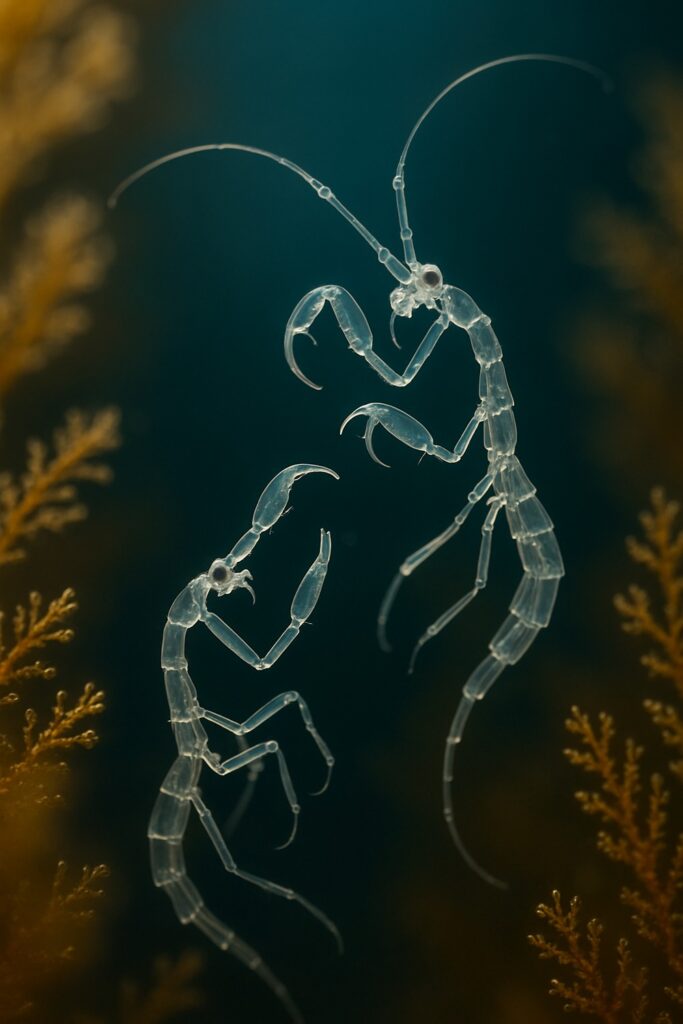
Here’s a paradox worth sitting with: the skeleton shrimp amphipod has been colonizing nearly every wet surface on this planet for millions of years, and most of us have never once registered that it exists. Not because it hides deep. Because it hangs right in front of you — transparent, wire-thin, utterly still — and your brain simply refuses to file it as an animal.
Picture something barely the length of your fingernail, so thin and clear it nearly disappears in water. It clings to coral, seaweed, and even other animals — hanging inverted, feeding mid-current, doing absolutely nothing to announce itself. Most divers swim right past them. Most researchers walked past them too, for a long time. These tiny creatures have been hiding in plain sight for millions of years.
Skeleton Shrimp Amphipod: What Is This Thing?
The skeleton shrimp belongs to the family Caprellidae, a group of amphipod crustaceans documented across oceans worldwide. Despite the name, they share more biology with sand fleas and whale lice than with anything you’d find at a seafood restaurant. Marine biologist Dr. Victoria González at the University of Cádiz has spent years studying how these animals exploit complex underwater structures in Mediterranean habitats — and even managed aquarium ecosystems. Her work keeps circling back to the same question: how does something this fragile-looking survive so effectively in such a physically demanding environment?
The body is the answer. Long, segmented, almost wire-thin — built less like a swimmer and more like a piece of animated thread. When they press against a frond of kelp or a coral branch, they become part of the scenery. Predators don’t just miss them. They look directly at them and still don’t register what they’re seeing.
How They Cling to Everything Without Falling Off
What makes the skeleton shrimp amphipod genuinely worth stopping to think about is the grip. Their rear appendages — called pereopods — end in curved hooks that lock onto surfaces the way a climber’s carabiner locks onto a rope. They don’t just hold on; they anchor with enough strength to resist surging currents. Some species spend their entire lives attached to a single patch of bryozoan or hydroid colony, never letting go except to mate or feed.
And all of that gripping happens while they’re simultaneously doing everything else. Feeding, fighting, reproducing. Front limbs stay free, reaching into the current to snatch particles. Back half stays locked in place. They’re essentially one-handed rock climbers who never stop working — the whole arrangement is efficiency taken to a biological extreme, and it works so well that the basic design hasn’t needed much updating in millions of years. For a deeper look at how ocean creatures engineer their survival, this-amazing-world.com has more stories that’ll genuinely change how you see the sea.
Eating Upside Down on a Moving Branch
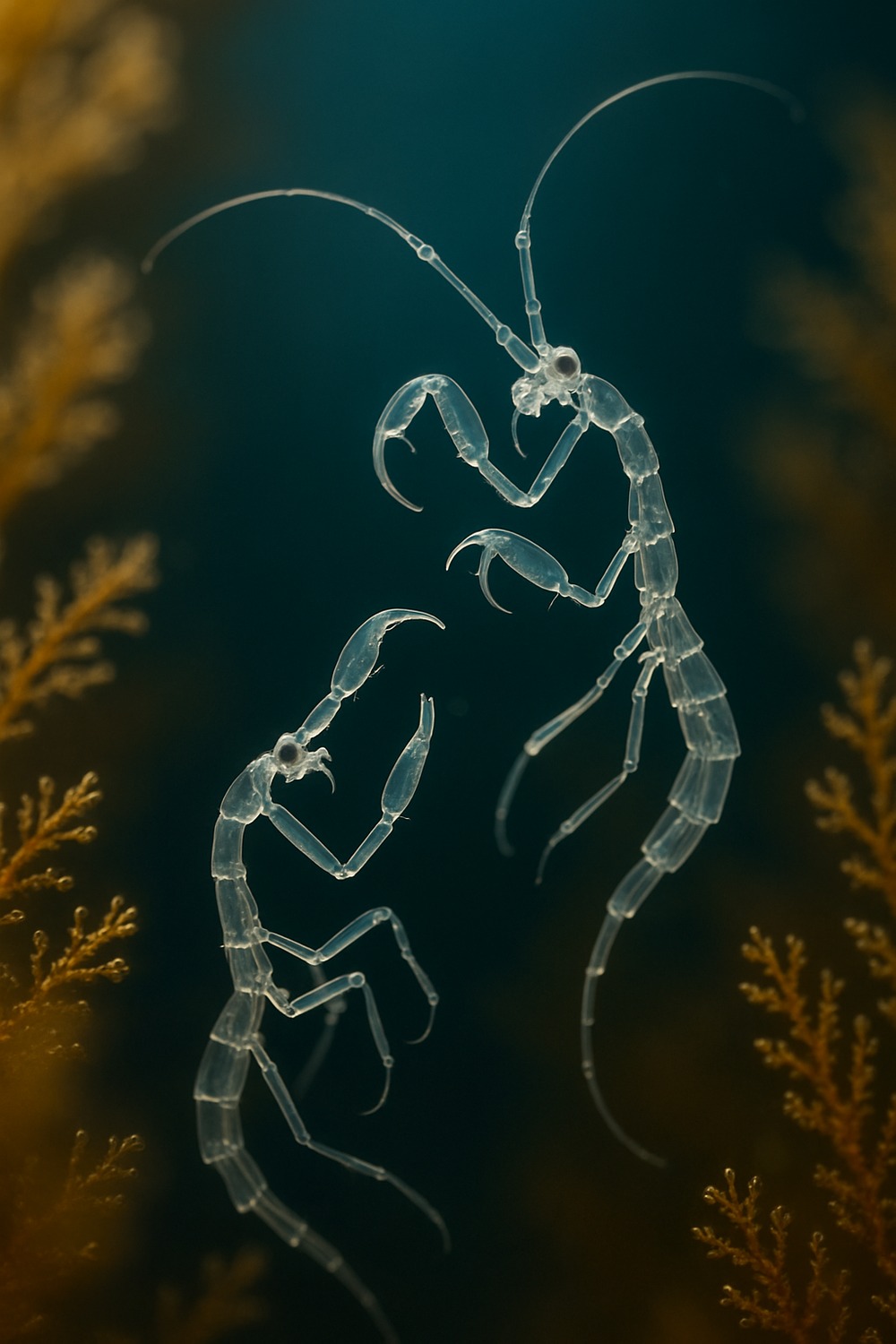
Feeding is where things get genuinely strange for the skeleton shrimp amphipod. Often found hanging inverted on coral branches swaying with every wave, they just… eat like that. Their front limbs — called gnathopods (researchers actually call these specialized grabbing tools) — are shaped almost like tiny claws, capable of seizing organic particles, algae, and even small invertebrates from the passing water column.
All while the branch they’re standing on is actively swinging through the current like a slow-motion pendulum.
Imagine balancing on a rope bridge in a windstorm, catching food with both hands while your feet are hooked to the rope. That’s a skeleton shrimp’s Tuesday. Every day. All day. It’s one of the most quietly extreme feeding strategies in the marine world, and it got almost no attention for decades because the animal doing it is too small and too transparent to notice.
Invisible by Design — But Not for the Reason You Think
Transparency isn’t just camouflage here. It’s deeper than that. The skeleton shrimp amphipod has almost no pigmentation and a body plan so narrow that light passes through it with minimal obstruction. Against a branching coral or a web of algae filaments, it doesn’t create a shadow. Barely even a silhouette. Dr. González’s research suggests this isn’t passive invisibility — it’s an active match between body shape and habitat structure that’s been refined over evolutionary time. The animal isn’t hiding exactly. It’s structurally synchronized with its environment.
That distinction matters more than it sounds — because it means no amount of familiarity with the reef prepares your eye to actually see one.
And they can reposition within seconds if they need to. A threat approaches, the skeleton shrimp flattens against the nearest surface and goes still. No fleeing. No shell to retreat into. Just stillness and transparency, and suddenly there’s nothing there to find.
Before we get into just how many of these creatures might be sharing a single square of seafloor with you — the number is genuinely unsettling.

Turns Out They’re Everywhere You Haven’t Looked
Skeleton shrimp amphipods aren’t rare. They’re abundant — often numbering in the thousands per square meter in productive coastal habitats. Tide pools, deep reef systems, Arctic kelp beds, inside home aquariums that owners thought were perfectly maintained and empty. They hitch rides on live rock, on macroalgae, on coral frags shipped between collectors. They travel the world tucked inside ecosystems people are actively buying and selling, completely unnoticed.
Why does this matter? Because it means the skeleton shrimp isn’t some remote deep-ocean curiosity — it’s already inside systems we think we control and understand.
Partly size explains the invisibility. Partly transparency. But there’s something harder to admit underneath all that: we simply weren’t looking. The ocean isn’t just full of large dramatic creatures we’ve catalogued and named. It’s packed with these — small, translucent, endlessly adaptable animals that have colonized nearly every wet surface on the planet and are doing just fine without our attention or approval. An animal that thrives at the edge of human perception, completely indifferent to being noticed, is in some ways more unsettling than anything with teeth.
How It Unfolded
- 1827 — Caprellidae first formally described by naturalist Wilhelm de Haan, though specimens had been collected without recognition for decades prior.
- 1980s — Surge in caprellid research as marine ecologists began using amphipods as bioindicators for coastal pollution monitoring.
- Early 2000s — Dr. Victoria González and colleagues begin systematic documentation of Mediterranean caprellid populations in Posidonia seagrass beds, revealing densities far higher than anyone had estimated.
- 2020s — New species continue to be pulled from understudied Indo-Pacific reef systems; taxonomists estimate hundreds remain undescribed.
By the Numbers
- Caprellidae contains over 350 described species, with new ones still being pulled from understudied reef systems around the Indo-Pacific — taxonomists haven’t finished counting.
- Adults typically measure 2mm to 20mm in length.
- The smallest are thinner than a human hair and visible only under magnification, which goes a long way toward explaining why they went uncatalogued for so long in so many habitats.
- Over 5,000 individuals per square meter in some Mediterranean Posidonia seagrass beds.
- Some caprellid species complete their entire life cycle — birth to reproduction — in under three weeks under warm water conditions, giving them one of the fastest generational turnovers among marine crustaceans of their size class.

Field Notes
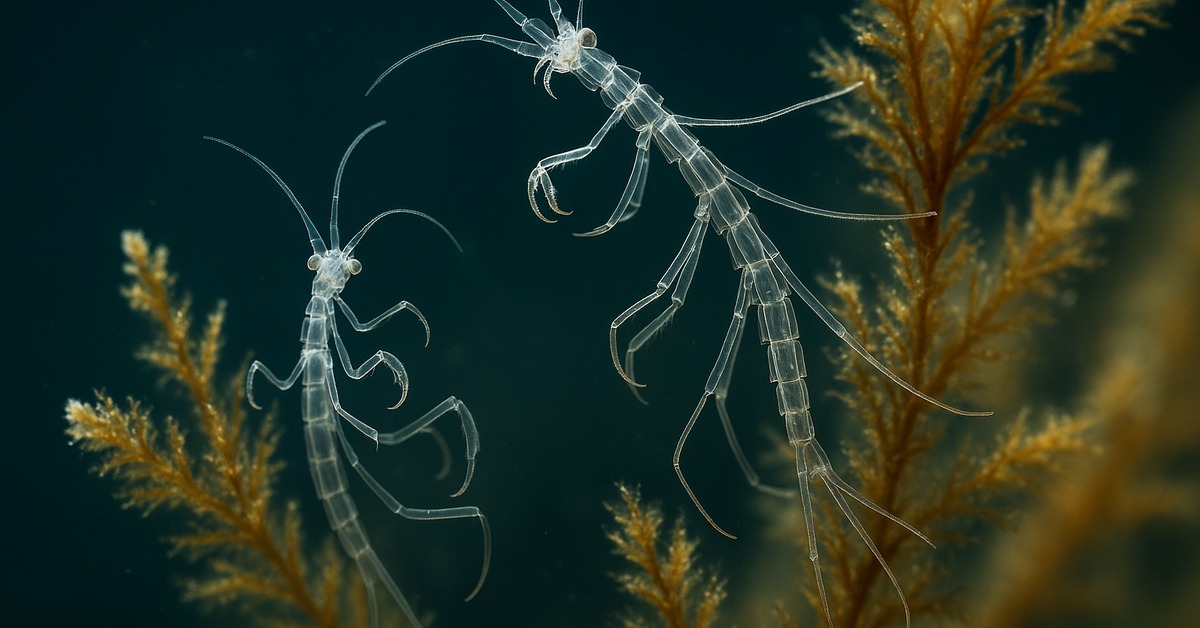
- Male skeleton shrimp wrestle. Proper, prolonged wrestling matches — gripping each other with their gnathopods in contests that can last several minutes. The winner typically stays physically attached to the female until she’s ready to mate, guarding her from rivals in a strategy called mate-guarding that shows up across many crustacean groups. For animals measured in millimeters, that’s an enormous investment of energy.
- Potential water quality bioindicators — their populations crash fast when pollution hits.
- A handful of caprellid species live commensally on jellyfish, sea turtles, and even whale skin, riding larger animals through open water and feeding on micro-organisms stirred up by their host’s movement. At what point does a hitchhiker become a parasite? Researchers are still arguing about it.
Why the Ghost Creature Actually Matters to All of Us
The skeleton shrimp amphipod isn’t a keystone species in the dramatic, wolves-in-Yellowstone sense. It doesn’t reshape landscapes. It doesn’t make for a good documentary poster.
But it’s a connector. A creature that links algae and coral surfaces to larger food chains by processing organic matter that would otherwise drift past unused. Fish larvae eat them. Larger crustaceans eat them. Filter feeders compete with them for the same particles. Pull them out of a system and you’ve quietly removed a thread that runs through the whole fabric — and you probably wouldn’t notice what you’d done until something downstream started fraying.
Treating something this ecologically embedded as invisible, simply because it’s small, is the kind of oversight that tends to look worse in hindsight than it does in the moment.
Researchers don’t fully understand how skeleton shrimp choose their specific hosts, or how they find mates in a world where they’re nearly invisible even to each other. That’s not a failure of science. It’s a reminder that the ocean keeps its secrets well, and the smallest ones tend to keep them longest.
Editor’s Take — Alex Morgan
What stays with me isn’t the transparency or even the grip strength — it’s the population density. Over five thousand animals per square meter, invisible to the naked eye, in a seagrass bed you could wade through without a second thought. We talk a lot about what we’re losing in the ocean. Rarely do we reckon with what we never actually registered having. The skeleton shrimp was always there. We just decided, without deciding, that nothing that small was worth looking for.
The skeleton shrimp won’t make headlines. It won’t go viral the way a whale breach or a glowing deep-sea fish might. But it’s out there right now — on a swaying coral branch somewhere in the Mediterranean, or a Pacific tide pool, or possibly your neighbor’s saltwater tank — doing something extraordinary that nobody’s watching. Small doesn’t mean simple. Invisible doesn’t mean unimportant. If this kind of story keeps you up at night, there’s more at this-amazing-world.com, and the next one is even stranger.


