



Here’s the thing about the Spain NATO bases at Rota and Morón de la Frontera: they were never just real estate. They were a bet — placed in 1953, renewed in 1988, quietly assumed ever since — that a NATO ally’s soil was permanently available terrain. Madrid just called that bet. Publicly. Without diplomatic softening. And the alliance doesn’t quite have a playbook for what comes next.
Spain’s refusal to let its jointly operated bases support strikes against Iran isn’t a procedural disagreement between allies. It’s a stress test of the entire post-Cold War military architecture — one that exposes the gap between the shared-threat logic that built these installations and the shared-values logic that was supposed to hold them together. When those two things come apart, what exactly keeps NATO’s infrastructure from fracturing along the seam?

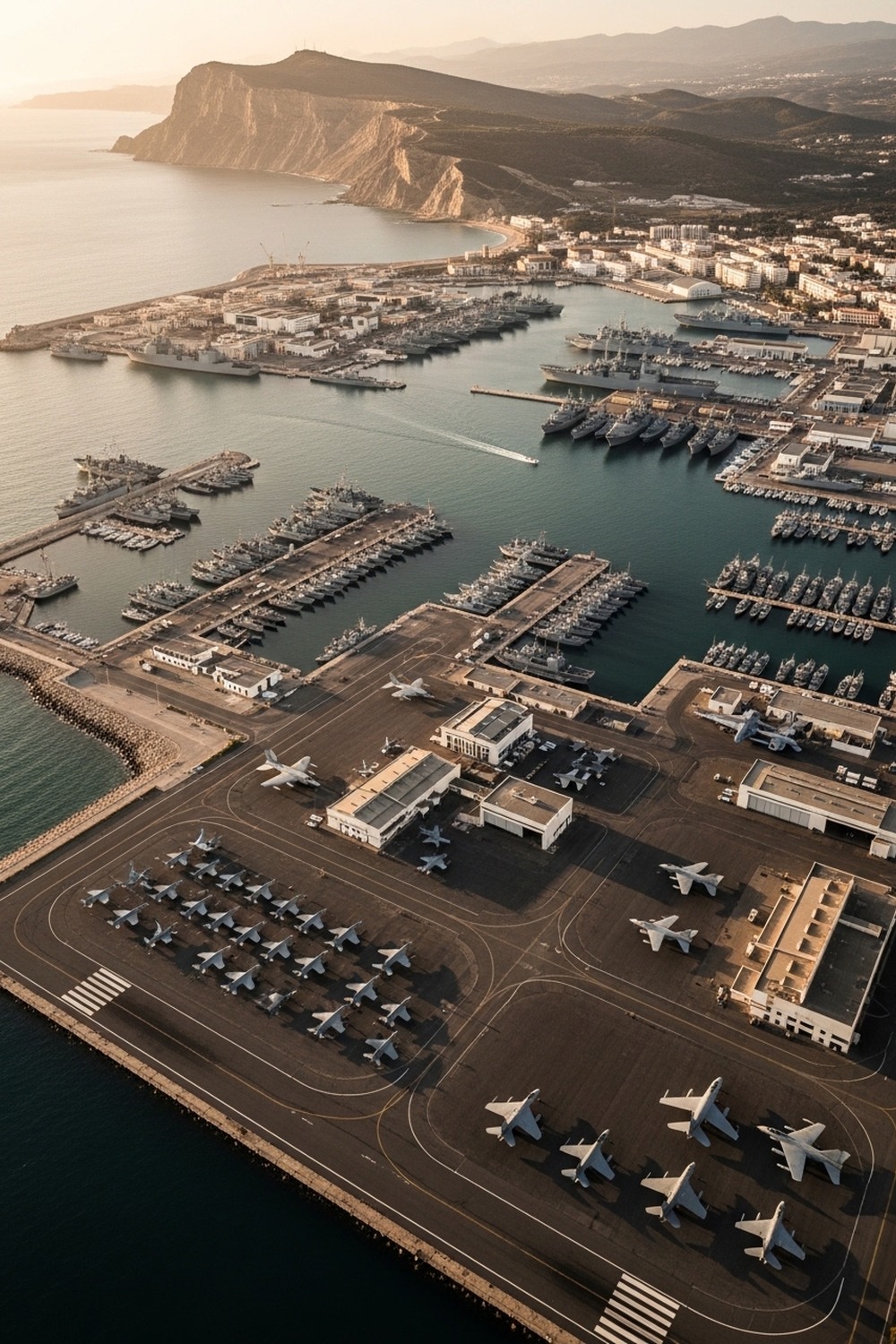
The Architecture of Rota: More Than a Naval Outpost
Naval Station Rota, carved into the Atlantic coastline near Cádiz in the province of Andalusia, has been a cornerstone of U.S. military presence in Europe since the 1953 Pact of Madrid first opened Spanish territory to American basing rights. The current legal framework — the Agreement on Defense Cooperation signed in 1988 — transformed that Cold War arrangement into something more permanent and more layered. By 2015, Rota had become the forward homeport for four U.S. Navy destroyers equipped with the Aegis Ballistic Missile Defense system, part of NATO’s European Phased Adaptive Approach. That wasn’t incidental. U.S. Naval Forces Europe specifically designated Rota as the anchor for BMD operations across the continent — a role that makes it functionally irreplaceable in any near-term contingency planning.
Approximately 3,500 U.S. military personnel and 2,000 dependents are stationed there. Those numbers aren’t symbolic. They represent a logistical ecosystem that took decades and billions of dollars to build.
Rota doesn’t just host ships. It moves them. Its deep-water port handles resupply, crew rotation, and rapid-deployment logistics for operations spanning the Mediterranean, the Atlantic, and beyond. When U.S. European Command needs to project force eastward, southward, or across the Atlantic simultaneously, Rota is often the node that makes the geometry work — not a symbol of alliance, but the physical mechanism through which alliance commitments become operational reality. That’s precisely what makes Spain’s refusal so structurally significant. It’s not a diplomatic statement. It’s a load-bearing wall suddenly declared off-limits.
Morón de la Frontera adds the air dimension. Near Seville, it hosts U.S. Air Force units, Special Purpose Marine Air-Ground Task Forces, and functions as a rapid-response hub for crises in Africa and the Middle East. Together, these two installations aren’t redundant capabilities — they’re complementary ones. Lose access to both simultaneously and you’ve lost the axle on which a significant portion of U.S. force projection in the region turns.
How a 1988 Agreement Became a Political Fault Line
Why does this matter beyond the immediate crisis? Because the legal ground Madrid is standing on was built into the agreement itself.
The 1988 defense cooperation agreement governing both bases was built on a very specific set of assumptions. Spain had joined NATO three years earlier, in 1982, and the bilateral framework with Washington was designed to reflect a shared threat environment — Soviet naval activity in the Atlantic, instability in North Africa, the need for coordinated European defense. What the agreement didn’t fully anticipate was a situation where the U.S. wants to use Spanish-hosted infrastructure for a military campaign that Spain considers illegal, disproportionate, and diplomatically catastrophic. The 1988 text includes consultation clauses, but those clauses weren’t written with this kind of political rupture in mind. For readers interested in how military geography shapes political outcomes across the broader world — a dynamic far older than NATO — the tension between base access rights and host-nation sovereignty remains one of the most underreported forces in global geopolitics and the physical world that shapes it. Geography doesn’t just influence strategy. It constrains it.
Spain’s Socialist-led government under Prime Minister Pedro Sánchez has been consistent in its position. Since 2023, Madrid has increasingly aligned with the bloc of European governments — including Ireland, Norway, and Slovenia — that have taken the strongest stances against Israeli military operations in Gaza and beyond. That alignment hardened through a series of votes at the United Nations, through diplomatic statements, and through the domestic political calculus of a government that depends on left-wing coalition partners deeply hostile to U.S. Middle East policy. By 2025, when Washington’s campaign against Iran began taking shape, Spain’s position wasn’t a surprise to anyone paying attention.
What changed is that the trajectory hit infrastructure. Abstract diplomatic disagreements become concrete when they touch bases, runways, and port access. A Spanish “no” inside a UN General Assembly vote costs Washington something. A Spanish “no” at Rota costs Washington something different entirely — and something much harder to route around.
The Broader European Fracture Inside the Alliance
Spain isn’t alone. That’s the part of this story that Washington’s more hawkish voices are working hardest to minimize. According to analysis published by the BBC’s diplomatic correspondents tracking European response to the U.S.–Israel campaign, the coalition of European NATO members who’ve refused to enable or endorse military action against Iran now includes several founding members of the alliance whose strategic contributions Washington cannot simply dismiss. France has been notably quiet about supporting the operation. Germany’s government, locked in its own political turbulence, has stopped short of any language that could be read as endorsement.
The pattern of European response suggests this isn’t a bilateral Spain–U.S. problem. It’s a systemic signal that the alliance’s political consensus on Middle Eastern operations — never airtight to begin with — has developed cracks that predate this specific crisis by years. History has a way of treating the people who dismissed these kinds of structural warnings as routine alliance friction unkindly.
The Spain NATO bases situation at Rota and Morón crystallizes a tension that defense analysts at the Royal United Services Institute in London have been tracking since at least 2019: NATO was designed to defend its members from external aggression, not to function as a platform for power projection in regions where member states hold fundamentally different foreign policy positions (analysts actually call this the “out-of-area” problem, and it has never been cleanly resolved). The alliance has always had to manage that gap. What’s different now is the geographic specificity. It’s not a question of vague political disagreement. It’s a question of whether specific runways and specific port berths are available for a specific operation — and Madrid has answered that question.
And that answer will have lasting effects on base access negotiations for years. Host-nation agreements are renegotiated on cycles measured in decades. But the political memory of this moment — of an ally publicly refusing, publicly condemning, and publicly holding its ground — is going to be present at every table where those future negotiations happen.


Spain NATO Bases and the Future of Force Projection
The U.S. Department of Defense’s European posture review, conducted in 2021 under the Biden administration, explicitly identified Rota as irreplaceable in the short to medium term for BMD coverage and Atlantic fleet operations. No European base replicates Rota’s combination of deep-water port capacity, proximity to both the Atlantic and the Mediterranean, and existing Aegis infrastructure. Sigonella in Sicily covers part of the Mediterranean equation. Lajes in the Azores covers part of the Atlantic. But neither base — individually or together — substitutes for what Rota provides, and both are subject to their own host-nation political dynamics, Italy’s and Portugal’s respectively. That 2021 review didn’t model the scenario now unfolding, because the assumption then was that base access from a NATO ally was essentially guaranteed for NATO-connected operations. That assumption no longer holds.
Nobody was planning for this.
Without Rota, the four Aegis destroyers homeported there either need to be relocated — a process measured in years and hundreds of millions of dollars — or operated from less optimal positions that extend transit times, increase fuel costs, and reduce the effective coverage window for ballistic missile defense. Each day of reduced BMD coverage over southern Europe is a day of elevated risk for the alliance members those systems are supposed to protect. Morón’s unavailability for SPMAGTF operations means African and Middle Eastern rapid-response timelines extend. Every hour added to response time is a decision window narrowed for commanders.
Pentagon planners are already stress-testing alternatives, and the options aren’t attractive. Relocating to Portugal requires Lisbon’s political cooperation — not guaranteed given Portugal’s own domestic pressures. RAF Mildenhall and Lakenheath are too far north for Mediterranean operations to run efficiently. Souda Bay in Crete is operationally useful but lacks Rota’s port infrastructure. Turns out the U.S. built its European military architecture around access it treated as permanent — and now it’s learning, concretely, what impermanence costs.
What Holds the Architecture Together — If Anything
NATO has survived internal political fractures before. France withdrew from the alliance’s integrated military command structure in 1966 under de Gaulle and didn’t return until 2009 — a 43-year gap that the alliance managed, painfully, by routing around French territory and renegotiating basing rights across West Germany and elsewhere. The parallel isn’t perfect: Spain hasn’t withdrawn from NATO’s command structure, it’s made a specific operational refusal on specific grounds. But the historical comparison is instructive. Alliances absorb political shocks better than they absorb structural ones. The question is which category Spain’s refusal ultimately falls into. If it’s political — temporary, tied to this specific conflict, resolvable through diplomacy — the architecture survives largely intact. If it’s structural — a symptom of deeper divergence between U.S. and European threat perceptions and moral frameworks — the architecture faces something more serious than any single operational setback.
Defense scholars at the Atlantic Council published analysis in early 2024 warning that European NATO members were increasingly treating U.S. military operations outside the Euro-Atlantic area as politically discretionary rather than alliance-obligatory. That framing matters. An ally that treats your military operations as something it can opt into or out of based on domestic political calculus isn’t providing the same kind of alliance guarantee the post-1949 architecture assumed. The Spain NATO bases dispute is the clearest real-world test of whether that Atlantic Council warning was prescient or premature. The early evidence suggests prescient.
Stand at the waterfront in Rota on a clear day and you can see the destroyers moored in the harbor — gray hulls, radar arrays, the quiet machinery of deterrence. Spanish fishermen’s boats move past them on the same water. Children from the nearby town cycle along the coastal path. The base and the city have coexisted for seven decades, each making a kind of peace with the other’s presence. That coexistence isn’t in danger. What’s in danger is the political compact that made the base’s mission possible — the agreement, however implicit, that Spain and the United States were pointing in the same strategic direction. They’re not pointing in the same direction anymore. And the gap between them is visible from the waterfront, if you know what you’re looking at.
How It Unfolded
- 1953 — The Pact of Madrid grants the United States basing rights in Spain during the Franco era, establishing the earliest version of the Rota and Morón arrangements in exchange for economic and military aid.
- 1982 — Spain joins NATO, transforming its bilateral U.S. basing agreements into a multilateral alliance context and triggering a national referendum on continued membership in 1986 that Spain’s Socialist government narrowly won.
- 2015 — The U.S. Navy formally homeports four Aegis-equipped destroyers at Rota as part of NATO’s European Phased Adaptive Approach, cementing the base’s role as the continent’s primary ballistic missile defense hub.
- 2025 — Spain publicly refuses to allow the Spain NATO bases at Rota and Morón to be used in support of U.S.–Israel military operations against Iran, triggering the most significant public rupture in U.S.–Spanish defense relations since the Cold War.
By the Numbers
- 3,500 — U.S. military personnel stationed at Naval Station Rota, plus approximately 2,000 dependents, making it one of the largest American military communities in Europe.
- 4 — Aegis BMD-equipped destroyers homeported at Rota as of 2015, providing ballistic missile defense coverage across southern Europe under NATO’s European Phased Adaptive Approach.
- 43 years — France’s absence from NATO’s integrated military command structure between 1966 and 2009, the closest historical parallel to a major ally refusing operational cooperation.
- 1988 — The year the current U.S.–Spain Agreement on Defense Cooperation was signed, establishing the legal framework under which both Rota and Morón de la Frontera are jointly operated.
- 2 — Primary U.S. military installations in Spain affected by Madrid’s refusal, both of which serve functions the Pentagon’s own 2021 European posture review described as irreplaceable in the short to medium term.
Field Notes
- The 1986 Spanish NATO membership referendum — held after Spain had already joined the alliance — remains one of the only cases in democratic history of a country holding a public vote on whether to stay in a military alliance it had joined just three years earlier. The “yes” to remaining in NATO won by a margin of 52.5% to 39.8%, but with the condition that U.S. nuclear weapons be removed from Spanish territory and that Spain remain outside NATO’s integrated military command — a unique dual status that lasted until 1999.
- Rota’s Aegis destroyers don’t just defend Europe. They’re part of the U.S. Navy’s global BMD architecture, and their forward positioning in Spain cuts transit time to the eastern Mediterranean by days compared to departure from U.S. East Coast ports — a detail that makes their availability a real-time operational variable, not a theoretical one.
- The 1988 defense agreement includes a clause allowing Spain to deny basing access for operations it determines are inconsistent with Spanish law or international obligations — a provision that was largely theoretical for decades but now functions as the precise legal mechanism Madrid is invoking.
- Analysts at RUSI and the Atlantic Council still can’t fully model how a sustained denial of Rota’s facilities would affect NATO’s overall BMD posture in southern Europe, because the alliance’s contingency planning has never seriously run scenarios in which a willing, capable host nation refuses access during an active crisis. The models don’t exist yet — and building them now, under pressure, is not the same as having built them in advance.
Frequently Asked Questions
Q: What exactly are the Spain NATO bases at Rota and Morón, and why do they matter so much to U.S. military operations?
Naval Station Rota and Morón Air Base are jointly operated U.S.–Spanish military installations governed by the 1988 bilateral defense agreement. Rota, on Spain’s Atlantic coast, is the homeport for four Aegis ballistic missile defense destroyers and a major logistics hub for U.S. European Command. Morón hosts Air Force units and serves as the primary rapid-response base for crises in Africa and the Middle East. Together they represent infrastructure the Pentagon’s own 2021 posture review identified as irreplaceable in the near term.
Q: Can the U.S. legally force Spain to allow use of these bases for operations Madrid opposes?
No. The 1988 Agreement on Defense Cooperation explicitly preserves Spain’s sovereign right to deny basing access for operations it determines are inconsistent with Spanish law or international obligations. The agreement was structured this way deliberately, partly in response to Spanish domestic political sensitivities after the 1986 NATO referendum. Washington can apply diplomatic pressure and flag the issue in alliance consultations, but it has no legal mechanism to compel Spanish cooperation. The refusal stands on solid legal ground.
Q: Doesn’t this prove NATO is falling apart — or is that an overreaction?
It’s an overreaction, but not by as much as NATO’s institutional voices would like. The alliance has survived serious internal fractures before — France’s 43-year absence from integrated command being the most dramatic example. What’s different now is the real-time operational specificity of the refusal: not a withdrawal from institutional structures, but a denial of access at a named base during an active crisis. That’s a category of disruption NATO’s contingency frameworks weren’t fully designed to handle, and dismissing it as normal alliance friction understates what’s actually been revealed.
Editor’s Take — Sarah Blake
What gets me about this story isn’t the diplomatic drama — it’s what the drama reveals about the assumptions baked into infrastructure. The U.S. poured decades and billions into Rota on the quiet presumption that a NATO ally’s soil was essentially guaranteed terrain. Spain just demonstrated that presumption was always a political arrangement, not a physical fact. The base is still there. The runways are still there. But the operational logic that made them useful is now conditional — and conditioning is the first step toward unavailability. That’s worth sitting with.
Military alliances are routinely described in the language of values — shared commitments, common principles, collective defense. But they run on infrastructure. On port depth and runway length and the specific coordinates where a ship can refuel. When the political scaffolding holding that infrastructure in place starts to shift, the consequences aren’t felt in press conferences. They’re felt in transit times, in coverage gaps, in the quiet recalculations happening right now inside planning offices from Stuttgart to the Pentagon. The Spain NATO bases dispute at Rota and Morón isn’t a headline that will age out in a news cycle. It’s a stress fracture. And stress fractures have a way of growing in the dark, quietly, until the weight of the next crisis tells you exactly how deep they go.


