



Spain NATO bases don’t make headlines by existing — they make headlines by becoming unavailable. Rota and Morón de la Frontera have anchored American military power in the Western Mediterranean for decades, quietly, without friction. Then Madrid said no. And the architecture that everyone assumed was permanent started showing its fault lines.
Spain’s refusal to allow U.S. military operations against Iran to be launched or supported from Spanish soil has exposed a tension that’s been quietly building inside NATO’s architecture for years. These aren’t minor outposts. Rota alone hosts thousands of U.S. Navy personnel and anchors ballistic missile defense across the European theater. When a host nation draws this kind of line, it doesn’t just make headlines — it forces a reckoning with the foundational logic of every post-Cold War basing agreement still in effect.

The Bases Themselves: What Rota and Morón Actually Do
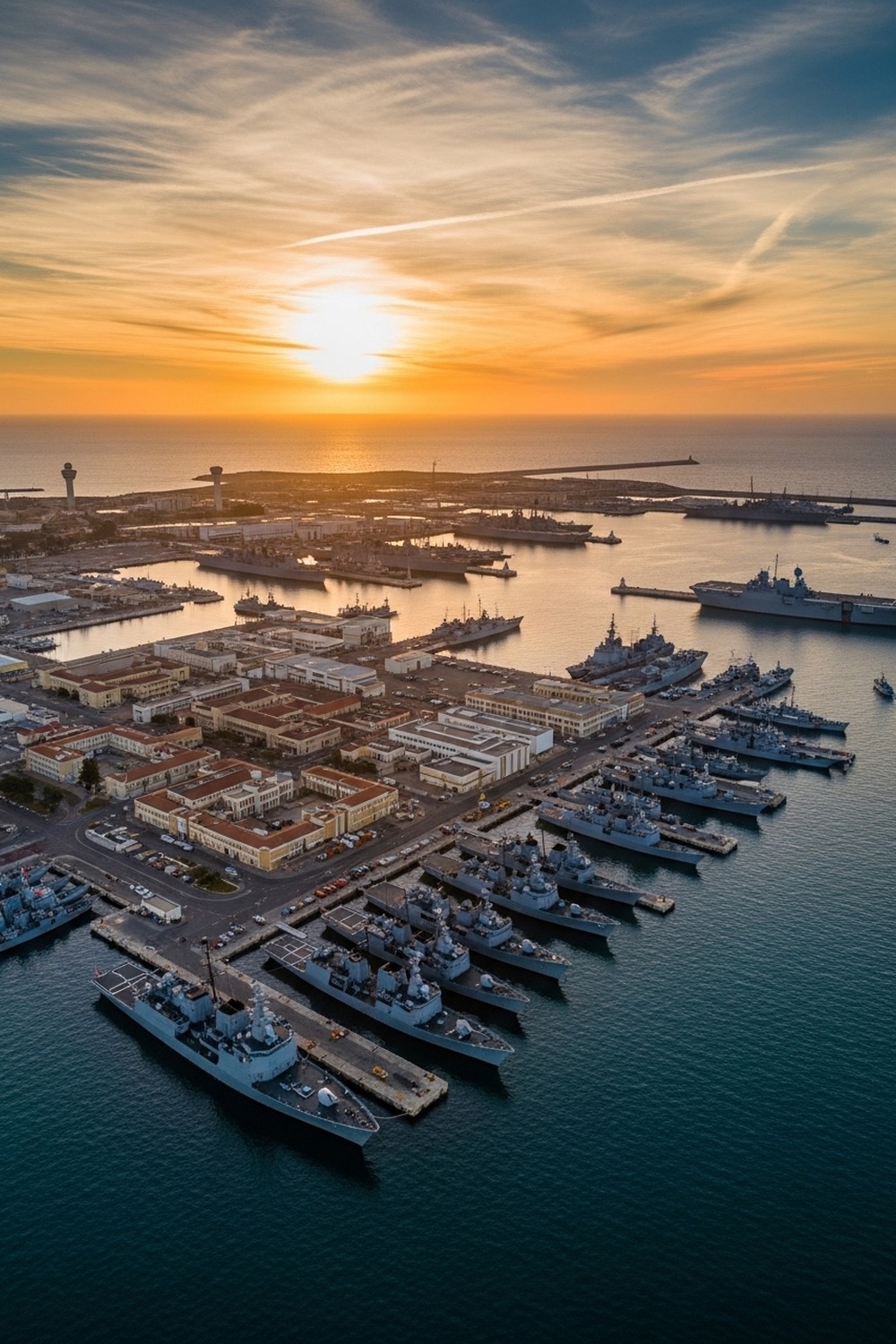
Naval Station Rota, positioned on Spain’s Atlantic coast near Cádiz, has been jointly operated by the U.S. and Spain since a 1953 agreement that predates NATO membership itself — Spain joined the alliance in 1982. Under the 1988 U.S.-Spain Defense Cooperation Agreement, both Rota and Morón de la Frontera were formalized as dual-use installations, meaning Spanish sovereignty is acknowledged even as American forces operate there in significant numbers. That legal framework is not a formality. It’s exactly the mechanism Spain is now invoking to deny access.
Since 2014, Rota has served as home port for four Aegis destroyers assigned to NATO’s ballistic missile defense mission in Europe — a mission that matters far beyond the Mediterranean. The U.S. Navy’s 6th Fleet had long relied on it as a forward logistics hub before that, which means the base carries two distinct strategic functions that don’t separate cleanly when access gets complicated.
Morón de la Frontera, in Andalusia’s interior, is an air base with a different profile but no less strategic weight. It’s a rapid-response platform. The U.S. Marine Corps Air-Ground Task Force that deployed to protect American personnel during the 2014 Libya evacuations staged from Morón. It’s the kind of base that doesn’t make the news until something goes wrong, and then everyone suddenly knows exactly where it is. That’s precisely the dynamic playing out now — except this time, the base is in the news because it’s been made unavailable, not activated.
Together, these two installations represent something irreplaceable about America’s military posture in the Western Mediterranean and Eastern Atlantic. There is no easy substitute for either. Cádiz — the westernmost major port city in continental Europe, with direct Atlantic access — isn’t something you replicate by repositioning assets to Naples or Sigonella. Position is not just real estate. It’s operational time, fuel, and reach.
Spain’s Political Calculus — and Why It’s Not That Simple
Understanding why Spain made this call requires understanding what kind of country Spain has become in its foreign policy identity. Prime Minister Pedro Sánchez leads a coalition government that includes Sumar, a left-wing alliance deeply skeptical of military interventionism. But the refusal to enable operations against Iran isn’t purely ideological — it reflects a broad consensus across Spanish civil society that has roots in the country’s experience with the 2003 Iraq War.
Then-Prime Minister José María Aznar’s decision to support the U.S.-led invasion despite overwhelming domestic opposition cost his party the 2004 election, an electoral earthquake that arrived just days after the Madrid train bombings. That sequence of events is burned into the collective memory of Spanish politics in a way that has no real parallel in other NATO countries. For more context on how geopolitics shapes global events, see the in-depth analysis across topics at this amazing world.
Spain’s 2024 recognition of Palestinian statehood — alongside Ireland and Norway — was another signal. Madrid has been systematically repositioning itself as a European voice for a different kind of international order, one that prioritizes multilateralism and international law over bilateral security arrangements with Washington. That’s not isolationism. Spain contributes meaningfully to NATO operations. But it means the country draws distinctions that Washington has historically expected its European partners not to draw — or at least not loudly. The Sánchez government is drawing them loudly.
What makes this particularly complex is that Spain isn’t violating the 1988 agreement by refusing access. The agreement gives Spain the right to say no to specific operations that conflict with its foreign policy. Madrid is using the treaty exactly as written. Washington’s frustration, if there is any, has to be directed at the agreement’s architecture — not at Spain’s legal position.
How Alliance Architecture Fractures — Slowly, Then All at Once
Why does this matter beyond the immediate standoff? Because history suggests that moments like this don’t stay contained.
France’s 1966 withdrawal from NATO’s integrated military command — under de Gaulle — is the most dramatic precedent, but it required decades of tension before it became a formal break. More instructive, perhaps, is Turkey’s 2003 refusal to allow the U.S. to use its territory for the northern invasion route into Iraq. That decision, made by the Turkish Grand National Assembly against American expectations, reshaped the entire operational plan for the war. It permanently altered the texture of U.S.-Turkey relations. The BBC’s ongoing Middle East coverage has tracked how such geopolitical pivots compound over time, rarely resolving cleanly. Spain NATO bases Rota and Morón now sit inside a similar historical moment — not because war is imminent between the U.S. and Spain, but because the question of what these bases are actually for has been thrown open in a way it hasn’t been since the Cold War ended.
Post-Cold War basing logic rested on a particular assumption: that NATO allies shared not just a threat perception but a values architecture that would prevent serious divergence on major security questions. That assumption has been eroding since at least 2003. What Spain’s position on Iran reveals is that the erosion has reached the physical infrastructure layer. When a host nation starts attaching political conditions to base access in real time — not in treaty negotiations, but in the middle of an active crisis — the operational reliability of that infrastructure changes fundamentally. Planners have to start building in uncertainty they previously didn’t need to account for.
Turns out, Spain’s position isn’t an outlier. It’s a crystallization.
Germany spent years agonizing over whether to allow certain weapons transfers. France hedged on sharing intelligence. Now Spain is drawing a hard line on base access. Each individual decision looks like a one-off. Together, they look like a pattern — and planners who aren’t modeling for that pattern are planning for an alliance that no longer quite exists.
Spain NATO Bases and the Question That Outlasts This Crisis
The immediate crisis will resolve — through diplomacy, through de-escalation, or through the messy adaptation that crises usually produce. What won’t resolve quickly is the underlying question the Spain-Iran moment has surfaced: what is the binding logic of NATO’s basing structure when member states have genuinely divergent views on when force is legitimate?
The alliance was designed around a consensus threat — Soviet expansion — that made this question largely theoretical. That era is over. And Spain NATO bases Rota and Morón are forcing the conversation into the open in a way that’s hard to step back from.
Since 2011, upgrades to Rota’s missile defense infrastructure alone have run into the hundreds of millions of dollars. The MDA — the U.S. Missile Defense Agency — designated Rota as a core node in the European Phased Adaptive Approach that year, a decision that locked in American investment in Spanish soil for a generation. That investment was made on the assumption of political continuity. History has a way of treating the strategists who confused treaty signatures for political consensus unkindly.
What Spain’s current posture suggests is that political continuity inside NATO cannot be assumed the way it once was — not because the alliance is collapsing, but because member democracies are producing governments that reflect genuinely different publics. Sánchez didn’t invent Spanish skepticism about American military adventurism. He’s representing it.
Senior NATO officials have, for years, discussed the need for more explicit political frameworks around base usage. And the alliance’s 2022 Strategic Concept addressed a lot — but the question of intra-alliance political divergence on out-of-area operations wasn’t resolved with any new mechanism. That gap is now visible in a very concrete location: a naval station on the Atlantic coast of Andalusia, where American destroyers sit at pier, and the political ground beneath them has shifted.


How It Unfolded
- 1953 — The U.S. and Spain signed the Pact of Madrid, establishing the original framework for American military installations on Spanish territory, including early versions of Rota and Morón.
- 1982 — Spain joined NATO, formally integrating its bilateral military agreements with the alliance’s collective defense architecture and creating a new layer of political expectation around base usage.
- 1988 — The Agreement on Defense Cooperation updated the legal framework for both bases, explicitly preserving Spanish sovereignty and Spain’s right to condition or restrict access — the clause now at the center of this dispute.
- 2014 — Four Aegis destroyers were home-ported at Rota as part of NATO’s European missile defense mission, deepening American investment and strategic dependence on the base.
- 2025 — Spain officially refused Washington’s request to use Rota and Morón in connection with operations against Iran, triggering a visible fracture in U.S.-Spain military relations and renewing debate about the durability of Cold War-era basing logic.
By the Numbers
- ~4,500 — U.S. military personnel and dependents stationed at Naval Station Rota as of 2024, making it one of the largest American military communities in Europe.
- 4 — Aegis-class destroyers home-ported at Rota since 2014 as part of NATO’s European Phased Adaptive Approach ballistic missile defense system.
- $400 million+ — Estimated U.S. investment in upgrades to Rota’s infrastructure between 2011 and 2020, including missile defense facilities and port expansion.
- 1988 — Year of the bilateral Defense Cooperation Agreement whose sovereignty provisions Spain is currently invoking to restrict base access.
- 2 — NATO member states that formally refused to allow U.S. use of their territory for the 2003 Iraq operation: Turkey and, in a limited capacity, Germany — a precedent Spain’s current position echoes directly.
Field Notes
- Rota’s geographic position at the confluence of the Atlantic and Mediterranean isn’t just strategic — it’s genuinely irreplaceable. A 2019 U.S. Naval Institute analysis found that no other available European base offers equivalent access to both ocean theaters simultaneously, a fact that makes Spain’s leverage here considerably greater than its NATO spending share would suggest.
- Buried inside the 1988 agreement is a provision allowing Spain to request the removal of U.S. forces entirely with one year’s notice (researchers who study alliance cohesion call this the “sovereign exit clause”) — it has never been invoked, but it surfaces in Spanish parliamentary debates whenever relations with Washington cool.
- Morón de la Frontera’s rapid-response function means it hosts a standing U.S. Marine Corps task force specifically designed for crisis evacuation in Africa and the Mediterranean — a mission that continues regardless of Spain’s position on Iran, since evacuation operations are distinct from combat support under the agreement’s terms.
- Researchers studying alliance cohesion at institutions like the RAND Corporation have noted that the Spain-Iran case may be the first instance since Turkey’s 2003 refusal where a NATO ally has publicly denied base access during an active U.S. military operation — but the exact legal distinction between “active combat support” and other uses remains genuinely contested.
Frequently Asked Questions
Q: What exactly did Spain refuse regarding the Spain NATO bases Rota and Morón?
Spain told Washington that neither Rota nor Morón de la Frontera could be used to launch, support, or facilitate military strikes against Iran. The refusal was grounded in the 1988 Defense Cooperation Agreement, which explicitly preserves Spanish sovereignty over how its territory is used. Spain didn’t demand U.S. forces leave — it drew a line around a specific operational use, which the treaty permits Madrid to do.
Q: Does Spain’s decision legally violate its NATO obligations?
No — and this is the part that matters most. NATO’s collective defense obligations under Article 5 apply to attacks on member states, not to discretionary operations outside alliance territory. Strikes against Iran are not an Article 5 scenario, which means Spain isn’t breaching any treaty by declining to participate or provide facilities. The 1988 bilateral agreement with the U.S. separately allows Spain to restrict access for operations it considers inconsistent with its foreign policy — a right Madrid is exercising precisely as the treaty intended.
Q: What’s the common misconception about how NATO bases work in host countries?
Most people assume U.S. bases in allied countries give Washington unconditional access and operational freedom. That’s not how the legal architecture actually works. Every basing agreement is a bilateral treaty with specific conditions, and most of them — including the 1988 Spain agreement — retain significant sovereignty rights for the host nation. The U.S. doesn’t own or control Rota and Morón; it operates there under license, essentially. Spain’s refusal isn’t a deviation from the rules. It’s the rules working exactly as designed.
Editor’s Take — Sarah Blake
What keeps striking me about this story is the investment figure. Hundreds of millions of dollars poured into Rota’s missile defense infrastructure on the assumption that political continuity is something you can bank on inside an alliance. Spain’s refusal doesn’t collapse that investment — but it reveals that the assumption was always softer than it looked on paper. What holds NATO’s basing architecture together isn’t treaty language. It’s political will. And political will, it turns out, is subject to elections.
Spain NATO bases at Rota and Morón will almost certainly still be operating next year, and the year after. No one is tearing up the 1988 agreement. But something has shifted in the texture of what these installations actually represent — not to military planners, who will adapt, but to the idea that shared infrastructure automatically means shared purpose. Somewhere on the Atlantic coast of Andalusia, American destroyers sit at their moorings in a country that just drew a line Washington didn’t expect. That line deserves to be taken seriously. What does an alliance look like when its physical architecture and its political consensus no longer move in the same direction?


