A Stray Cat Found an Abandoned Baby — And Refused to Leave
Nobody called her. Nobody trained her. A stray cat in a freezing Russian entryway found an abandoned newborn and made a decision — stay, warm him, and scream until someone came.
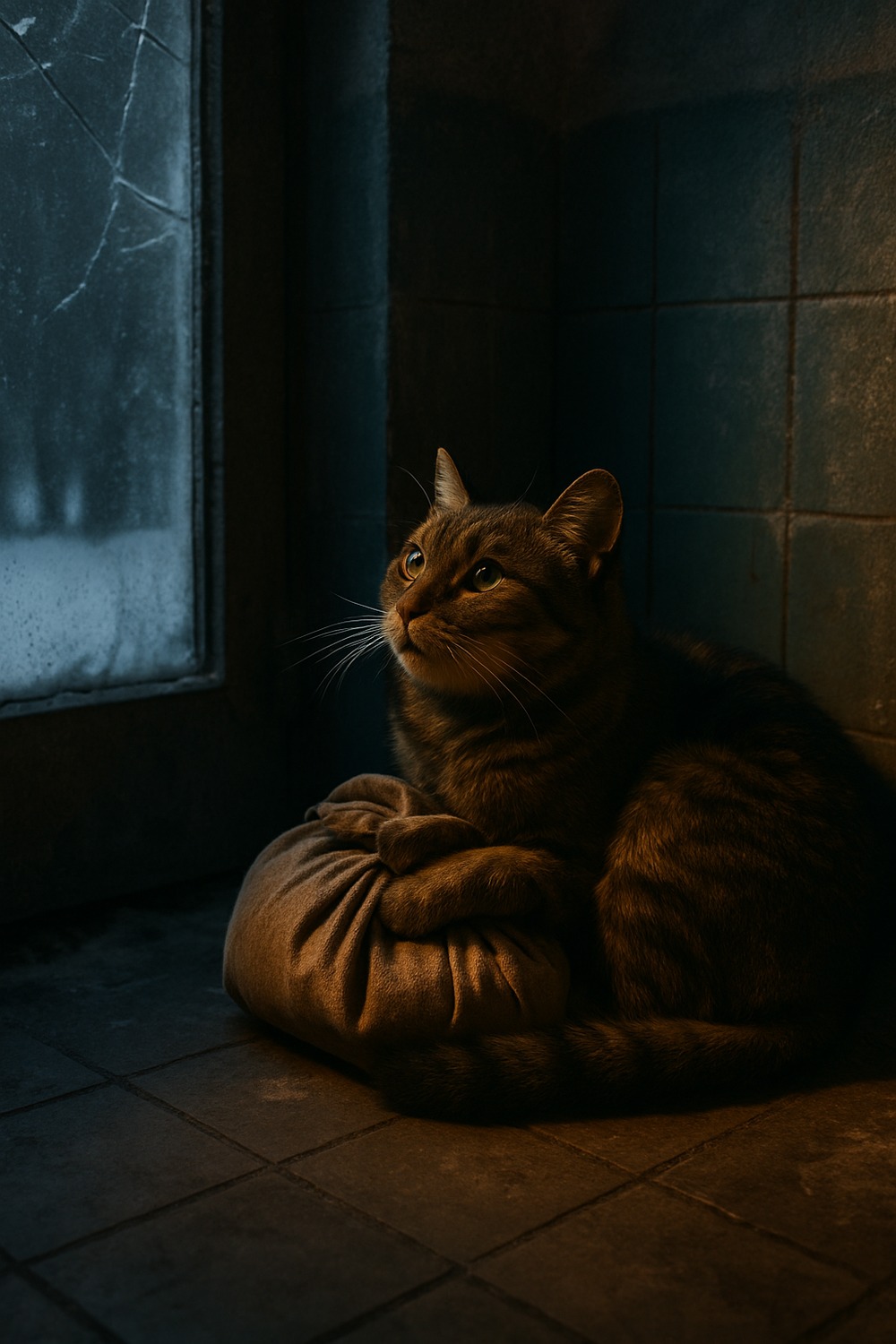
January 2015. Obninsk, Russia — a city about 100 kilometers southwest of Moscow, quiet in the way that places get quiet when it’s genuinely dangerous to be outside. Someone had left a newborn in an apartment building entryway. Wrapped, but exposed. The temperature that month hit -15°C. And before any human knew the baby was there, the cat did.
How a stray cat saves baby in freezing cold
Obninsk in January doesn’t forgive exposure. Hypothermia in a newborn can begin within minutes at those temperatures — not hours. According to research published by the National Institutes of Health on hypothermia, infants are at dramatically higher risk than adults because their surface-area-to-body-weight ratio is so much larger. They shed heat fast. Pediatric hypothermia researcher Dr. Geoff Hayward has put the window at under 30 minutes before a newborn left in freezing conditions reaches critical core temperature loss. Which means the timing here wasn’t comfortable. It was extremely close.
And somehow it ended well. Because of a cat.
She didn’t just sit there — she screamed
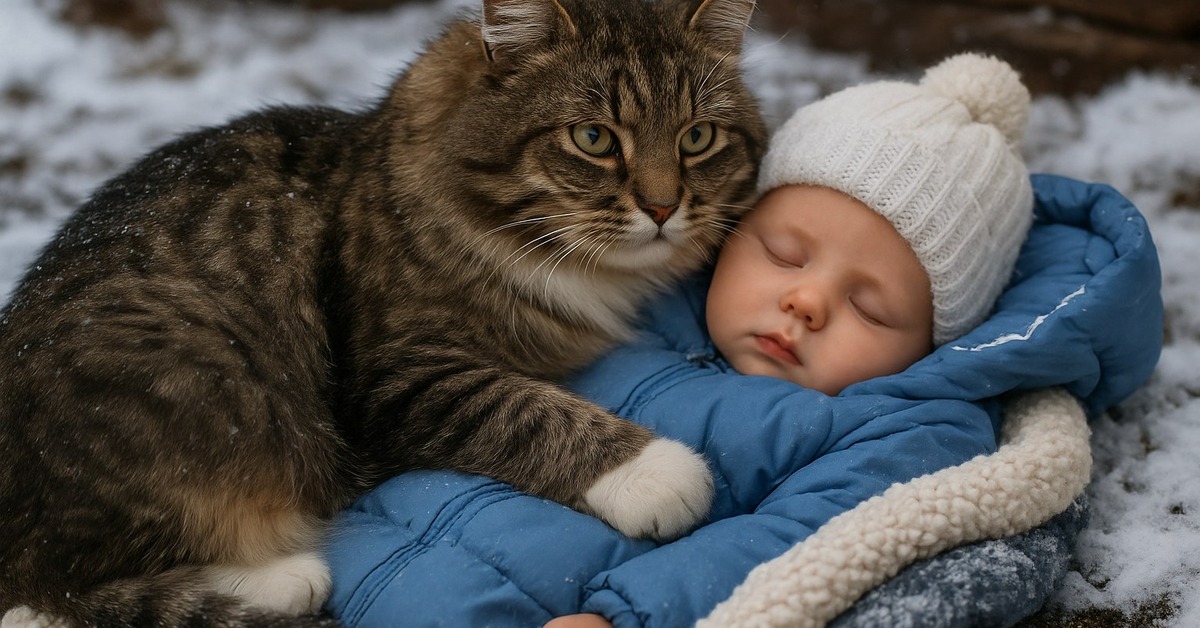
The cat curled herself around the infant. Fur, body heat, the stubborn warmth of something living that refused to move. But she didn’t stop there. She started vocalizing — loud, insistent meowing, the kind that carries through a closed door and a cold hallway. Residents came to check. They found a living baby, got him to a local hospital, and he survived. You can read more stories where animals changed everything at this-amazing-world.com.
A stray cat. No owner. No training. She chose to stay, and then she chose to be loud. Both decisions mattered.
The science behind that warmth isn’t small
Here’s the thing people gloss over: domestic cats run a core body temperature between 38 and 39 degrees Celsius. That’s roughly one to two degrees warmer than a healthy adult human. In a freezing entryway, that gap isn’t a footnote — it’s the margin between bad and catastrophic. A cat pressing its body against a newborn is functioning as a biological heating pad, one that breathes, adjusts, and stays put. The stray cat saves baby story isn’t just emotional. It’s thermal physics doing exactly what thermal physics does.
Cat fur also traps an air layer close to the skin. That trapped air slows heat loss — which is the same principle behind emergency mylar blankets, behind layered winter gear, behind every survival protocol humans have formalized over centuries. This cat did it instinctively.
Or did she?
Why she stayed — and what it tells us about cats
Cats aren’t supposed to do this. They’re solitary hunters, wired for self-preservation, not famous for cross-species altruism. And yet documented cases of cats alerting humans to danger, staying with injured or sick people, and protecting children from animals far larger than themselves have turned up across dozens of countries. This wasn’t the first time a cat did something like this. It won’t be the last.
Was it maternal instinct triggered by the sound of infant cries? Warmth-seeking behavior that happened to save a life as a side effect? Or something else happening in that small, seriously underestimated brain?
Nobody fully knows. That’s the honest answer.
Cats read us in ways we don’t fully understand yet
Turns out, cats have been studied far less than dogs when it comes to interspecies empathy and social cognition. And what researchers have found keeps catching them off guard. A 2019 study from Oregon State University found that cats display what’s called “secure attachment” to their owners — the same framework used to measure attachment in dogs and human infants. They monitor emotional states. They respond to distress. Dr. Kristyn Vitale, who led that research, described cats as far more socially sophisticated than their reputation gives them credit for.
That last finding kept me reading for another hour.
Which means the Obninsk cat wasn’t necessarily acting randomly. She may have responded to a distressed infant’s cry the way she’d respond to any vulnerable creature making a sound she recognized as wrong. Not a plan. Not a choice in the human sense. But not nothing, either.
By the Numbers
- 38–39°C: a domestic cat’s average core body temperature — warmer than an adult human, enough to matter critically when you’re a newborn in an unheated entryway (Journal of Feline Medicine and Surgery, 2014)
- Newborns lose heat up to 4 times faster than adults per unit of body weight, making the first hours of cold exposure disproportionately dangerous in ways that don’t scale like you’d expect (WHO cold stress guidelines, 2015)
- -15°C recorded in Obninsk that January
- 65% of cats in the 2019 Oregon State University study showed secure attachment behavior toward their owners — a figure nearly identical to what you’d see in dogs and human toddlers tested in the same attachment framework, which is not what most people would predict going in
Field Notes
- Cats purr at 25–150 Hz — a frequency range linked in some studies to tissue healing and reduced stress responses in nearby organisms. Whether the purring mattered here is genuinely unknown. But it probably didn’t hurt.
- She was a stray. No shelter. No guaranteed food. Typically more fearful of human spaces than owned cats — which makes her decision to stay inside that entryway and vocalize loudly even harder to explain away as coincidence.
- 1996, Buenos Aires: a stray cat reportedly kept three abandoned kittens and one human infant alive through the night using body heat. The pattern of cats gravitating toward vulnerable infants has appeared in documented cases across multiple continents, which at some point stops being a coincidence and starts being something worth studying properly.
What this story is really asking us to reconsider
The stray cat saves baby story is easy to flatten into a feel-good moment — viral content, lucky coincidence, proof that animals are sweet. That reading undersells it badly. What happened in that Obninsk entryway was a sequence of functionally deliberate actions: locate, warm, stay, call for help. Whether or not the cat “understood” what she was doing in any conscious sense, the outcome was what a trained first responder would have aimed for with the same tools.
We draw a clean line between human compassion and animal instinct. Stories like this one make that line harder to hold. Maybe it was always shakier than we wanted it to be.
The baby survived. He was found in time because a stray cat decided something small and cold and crying was worth staying beside. We don’t know what happened to her after. We don’t know if she was ever fed, sheltered, or thanked. We just know she was there when it mattered, and she was loud about it.
Some stories resist tidy explanations. A stray cat sat down next to a dying infant in the dark and refused to leave. The cold didn’t win. If that kind of thing keeps you up at night, there’s more waiting at this-amazing-world.com — and the next one is stranger still.