Thwaites Glacier: Why the Doomsday Glacier Terrifies Scientists
Thwaites Glacier melting has been measured down to the centimeter — six of them, gone in a single day — and yet the number that should unsettle everyone is the one scientists still can’t pin down: the threshold past which nothing stops it. A slab of ancient ice the size of Florida is coming apart at the bottom of the world, and the honest answer to whether anything can be done is that nobody knows yet.
Thwaites sits at the edge of West Antarctica, roughly 1,600 kilometers from the nearest human settlement, battered by winds that regularly hit minus 30°C. British and American researchers have been drilling through its blue-white crevasses for years, trying to understand what’s happening beneath the surface. What they’ve found in the warming Amundsen Sea isn’t ambiguous. It isn’t subtle. And it has earned this particular glacier a nickname that needs no embellishment: the Doomsday Glacier.
What Thwaites Glacier Melting Actually Looks Like
Numbers sound technical until you picture what they mean on the ground. In 2023, a joint research effort between the British Antarctic Survey and the International Thwaites Glacier Collaboration published findings confirming that the glacier’s retreat rate had doubled compared to projections made just a decade earlier. They used autonomous underwater vehicles — torpedo-shaped robots deployed beneath the ice shelf — to map the grounding line in unprecedented detail. The grounding line is the precise boundary where the base of the glacier lifts off bedrock and begins to float.
It’s been anchored in roughly the same place since the last Ice Age. It’s slipping now, retreating inland at a rate that has accelerated every year researchers have measured it. That single boundary — a line most people have never heard of — may be the most consequential geographic feature on the planet right now.
What makes the Thwaites situation genuinely alarming isn’t just the speed. It’s the geometry. The bedrock beneath Thwaites slopes downward as you move inland — which means that as the grounding line retreats, it exposes deeper, thicker ice to warm seawater. The more it melts, the faster it can melt. Glaciologists call this marine ice sheet instability (and this matters more than it sounds — it’s a feedback loop with no natural brake once it passes a certain threshold). Some researchers believe Thwaites may already be past it. Others aren’t ready to say that yet. The honest answer is that nobody knows for certain where the threshold falls.
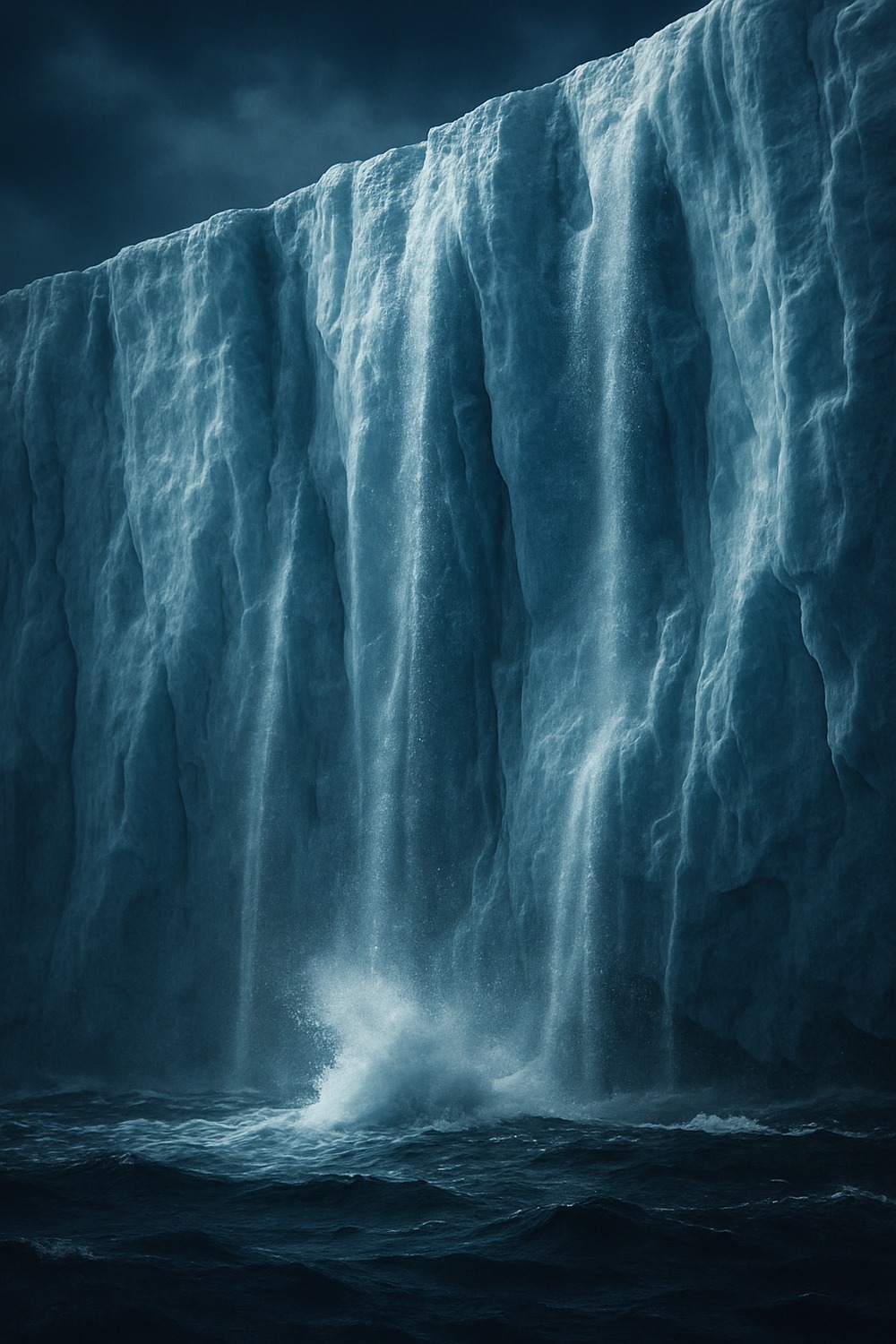
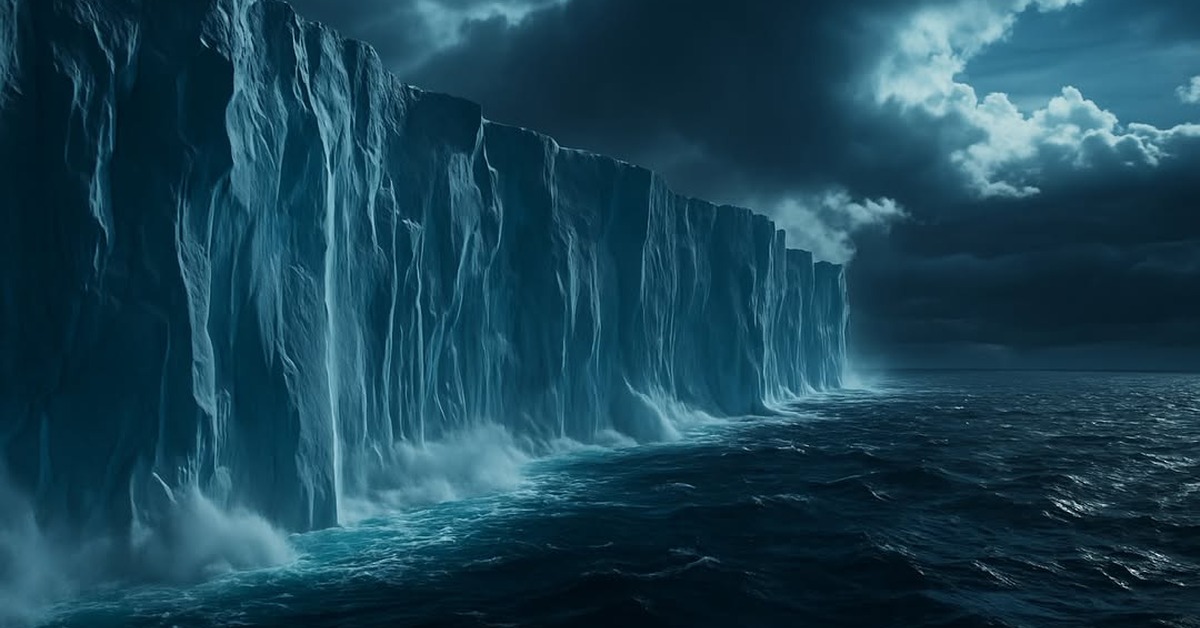
Stand at the calving front — the jagged wall of ice where chunks break off into the sea — and you’d hear it before you saw it. Low groans. Sharp cracks. Blocks the size of apartment buildings sliding into dark water. It looks catastrophic. But the real destruction is happening silently, invisibly, far below the surface where warm circumpolar deep water is doing its patient, relentless work.
The Ocean Beneath the Ice Is the Real Threat
Most people imagine glaciers melting from above — sunlight, warmer air, the slow drip of summer. Thwaites doesn’t work that way. The primary driver of Thwaites Glacier melting isn’t atmospheric at all. It’s oceanic. Warm water from the Amundsen Sea — a relatively shallow arm of the Southern Ocean — is infiltrating the cavity beneath the ice shelf, attacking it from below. This is the same mechanism that governs how the ocean quietly dismantles ice shelves across West Antarctica, but Thwaites is uniquely vulnerable because of its size and the shape of the seafloor beneath it.
What’s remarkable is that processes similar in scale — where hidden, deep forces drive outsized change — appear in other corners of the natural world too. The way warm Atlantic water drives ice loss in Greenland mirrors the dynamics reshaping Antarctica, just as nutrient cycling works invisibly in Alaska’s forests the way salmon carry the ocean’s chemistry deep into the land, systems connected across vast distances by currents you can’t see from the surface.
Why does any of this matter beyond Antarctica? Because in 2022, researchers from the University of Texas at Austin analyzing seismic and radar data found evidence that Thwaites had experienced a period of rapid retreat ending around 200 years ago — far faster than its current pace — before temporarily stabilizing. The implication was chilling: the glacier has a history of sudden, dramatic movement. Its current acceleration isn’t an anomaly. It may be a return to form.
Since the 1990s, the glacier has lost roughly 600 billion tons of ice. Scientists drilling through the ice in 2019 as part of the ITGC project measured water temperatures beneath the shelf at 2°C above freezing. Small number. Enormous consequence. At that temperature, the ocean is dissolving the glacier’s underbelly at a rate that ice simply cannot replace.
Why One Glacier Could Redraw the World’s Coastlines
Thwaites doesn’t operate in isolation. It functions as a buttress — a physical plug holding back the broader West Antarctic Ice Sheet. Remove it, and neighboring glaciers like Pine Island, Haynes, Pope, and Smith are exposed to the same warm water intrusion without anything blocking their seaward flow. The domino effect isn’t a worst-case scenario conjured for headlines. It’s the consensus physics. A comprehensive 2021 analysis published in Nature Geoscience modeled the cascading potential of West Antarctic Ice Sheet collapse and estimated a total sea level contribution of up to 3.3 meters — roughly 10 feet — over coming centuries if the process becomes self-sustaining. Even half a meter of sea level rise would displace tens of millions of people from low-lying coastal regions.
Watching a system this large accelerate with this little friction, you stop calling it a trend and start calling it a trajectory.
Miami sits barely two meters above current sea level across most of its metropolitan footprint. Mumbai’s densest neighborhoods hug a coastline that’s already experiencing more frequent flooding during monsoon seasons. Amsterdam has survived for centuries through an extraordinary system of dikes and pumps — but that system was designed for a different ocean. The Thwaites Glacier melting scenario doesn’t create these problems from scratch. It accelerates them past the point where engineering solutions remain viable. That’s the shift that matters.
Here’s the thing about what often gets lost in the coverage: the ice that’s already melted doesn’t refreeze. The changes Thwaites is driving today are, on any human timescale, permanent. Not reversible in fifty years if emissions drop. Not reversible in five hundred. The grounding line retreats. It doesn’t come back.
Can Science — or Engineering — Stop Thwaites Glacier Melting?
In 2018, researchers at the University of Cambridge proposed something that would have sounded like science fiction a decade earlier: building underwater curtains — essentially vast seabed walls — to block warm water from reaching the glacier’s base. The concept was published in the journal Cryosphere and immediately drew both serious scientific attention and skepticism in equal measure. Thwaites is approximately 120 kilometers wide at its front — building an effective thermal barrier across that span, in near-freezing water at depths reaching hundreds of meters, in one of the world’s most remote and storm-battered seas, would represent an engineering challenge unlike anything humanity has attempted. Similar geoengineering proposals have been floated for Greenland. None have been funded for deployment.
And then there’s the other option: glacial geoengineering using artificial snow injection — pumping seawater onto the glacier’s surface to rebuild ice mass from above. In theory, this compensates for what warm water removes from below by adding weight from above. In practice, the energy requirements are astronomical. A 2020 study from the Potsdam Institute for Climate Impact Research calculated that enough snow to meaningfully stabilize Thwaites would require roughly 12,000 wind turbines installed on the Antarctic ice sheet itself — infrastructure in a place where installing a single research station requires years of planning and millions of dollars. The math doesn’t currently work. That doesn’t mean it never will. But the window for it to work is closing alongside the glacier’s own grounding line.
Researchers aren’t sitting still. The ITGC — the International Thwaites Glacier Collaboration, a joint US-UK science program — has been running continuous monitoring since 2018, deploying everything from ice-penetrating radar to GPS sensors bolted directly to the glacier’s surface. They’re not trying to stop it. Not yet. They’re trying to understand it precisely enough to know what stopping it would actually take.
The Human Arithmetic of a World Reshaped by Water
Step back from the glacier itself for a moment and look at what the numbers mean on a populated planet. Roughly 680 million people currently live in low-elevation coastal zones — defined as areas within 10 meters of sea level. The Intergovernmental Panel on Climate Change’s 2022 report identified small island nations, South and Southeast Asian delta cities, and sub-Saharan African coastal communities as facing existential exposure. These aren’t abstract projections. In Bangladesh, roughly a third of the country sits within this zone. In Vietnam’s Mekong Delta, the land is already subsiding faster than sea level is rising — a combination that accelerates inundation even before Thwaites contributes a single additional centimeter to global ocean levels.
Brutal is the only honest word for the asymmetry here. Countries contributing least to the atmospheric carbon warming the Amundsen Sea are bearing the largest share of the early consequences. Thwaites Glacier melting is driven by industrial emissions concentrated in the northern hemisphere, but its most immediate human costs will fall on coastal populations in the global south who’ve had almost no role in producing them. That’s not a political statement. It’s the straightforward geography of where ice sits, where heat accumulates, and where vulnerable people live.
Picture the Mekong Delta at dusk — the particular quality of golden light over water that’s been farmed for four thousand years, small boats moving between rice paddies, children swimming in channels that flood a little higher each monsoon season. That delta is sinking and the ocean is rising to meet it. The people who live there didn’t cause Thwaites to melt. They’ll feel it first.
How It Unfolded
- 1966 — American glaciologist John Mercer first identified Thwaites and neighboring West Antarctic glaciers as potentially unstable, flagging the marine ice sheet as a long-term vulnerability.
- 1992 — Satellite observations began systematically tracking Thwaites, establishing the baseline against which all subsequent acceleration has been measured.
- 2014 — NASA and the University of Washington independently concluded that Thwaites’ retreat had likely passed the point of no return under current ocean warming conditions, triggering global headlines for the first time.
- 2023 — The International Thwaites Glacier Collaboration confirmed doubled retreat rates and published detailed seafloor maps showing historically rapid periods of collapse, signaling the glacier’s instability is not unprecedented but is now accelerating.
By the Numbers
- 600 billion tons of ice lost since the early 1990s, contributing approximately 4% of global sea level rise to date (ITGC, 2023).
- 120 kilometers — the width of Thwaites at its calving front, making it the widest glacier on Earth.
- Up to 3.3 meters (10.8 feet) — maximum projected sea level rise if the full West Antarctic Ice Sheet destabilizes, per Nature Geoscience (2021).
- Twice as fast — Thwaites’ current retreat rate compared to projections made just ten years ago (British Antarctic Survey, 2023).
- 680 million — people currently living in low-elevation coastal zones globally, directly exposed to sea level rise consequences (IPCC, 2022).
Field Notes
- In 2022, an autonomous underwater vehicle deployed by the ITGC captured the first-ever footage of the seafloor beneath Thwaites’ ice shelf, revealing corrugated ridges that record the glacier’s ancient retreat pulses — each ridge representing roughly one tidal cycle of backward movement, like a geological fingerprint of past collapses.
- Thwaites holds enough ice on its own to raise global sea levels by approximately 65 centimeters (about 2 feet) — but its role as a buttress for neighboring glaciers means the indirect contribution could be five times larger.
- Turns out the Amundsen Sea, which delivers warm water to Thwaites’ base, is one of the least-studied ocean regions on Earth — fewer than a handful of research expeditions had mapped it before the ITGC campaign began in 2018.
- Researchers still can’t determine with confidence whether Thwaites has already crossed a tipping point into irreversible collapse, or whether it remains in a reversible phase — the difference between those two answers has implications for whether any intervention is worth attempting at all.
Frequently Asked Questions
Q: How fast is Thwaites Glacier melting right now?
Thwaites is currently losing ice at a rate that has doubled compared to measurements taken in the early 2010s. Up to six centimeters of thickness can vanish in a single day when warm ocean water infiltrates its base. Since the 1990s, the glacier has shed approximately 600 billion tons of ice in total, and that rate continues to accelerate.
Q: Why is Thwaites called the Doomsday Glacier?
The nickname comes from the mathematics of what Thwaites’ collapse would trigger, not from any single dramatic event. Thwaites acts as a structural plug holding back the broader West Antarctic Ice Sheet. If it destabilizes fully, the cascading collapse of neighboring glaciers could contribute up to 10 feet of sea level rise over time — enough to permanently redraw coastlines and displace hundreds of millions of people. The name is grim because the projections are grim.
Q: Can we stop Thwaites Glacier melting with geoengineering?
Several proposals exist, including underwater curtains to block warm water and artificial snow injection to rebuild ice mass. Both face enormous practical obstacles — scale, cost, and the logistics of working in one of the planet’s most remote environments. A 2020 Potsdam Institute study estimated that effective snow injection would require roughly 12,000 wind turbines on the Antarctic ice sheet. No intervention has been funded for deployment. Research is ongoing, but no solution currently exists at the scale required.
Editor’s Take — Alex Morgan
What stays with me isn’t the projection numbers — it’s the corrugated ridges on the seafloor beneath the ice shelf, each one a tidal cycle of ancient retreat captured in sediment. Thwaites has done this before. The ocean has carved at it before. What’s different now is that the warm water driving the process isn’t cyclical — it’s directional, and it isn’t going to cool down on its own. The glacier isn’t just melting. It’s remembering how to collapse. That distinction matters more than any headline figure.
Somewhere beneath 800 meters of Antarctic ice, a robot the shape of a torpedo is mapping the floor of a cavity that has never seen sunlight. The data it sends back will tell us, with a precision that wasn’t possible ten years ago, exactly how much time remains to understand what’s happening down there. Whether that understanding leads to action — at the scale and speed the physics demands — is a question about human institutions and political will, not about glaciology. The ice already knows what it’s going to do. The question is whether we’ll decide, before it’s settled for us.