Meet Tina: The Tiny Stoat Taking Over the 2026 Olympics
Nobody designed Tina in a vacuum. She was already living in the Dolomites before anyone thought to put her on a podium.
She’s a stoat. Specifically, she’s a grinning, white-furred, whisker-twitching stoat named Tina, and she is about to become the most-held mascot in Winter Olympic history — tucked into the hands of over 2,900 athletes from across the world as they stand under the lights at Milano Cortina 2026. Not a bouquet. A stoat. And once you understand why, the flowers start to feel like the strange choice.
Why the Milano Cortina 2026 Mascot Is a Stoat
The stoat — Mustela erminea — is native to the alpine regions of northern Italy. That detail matters more than it sounds. Dr. Luigi Boitani, a wildlife ecologist who has spent decades studying Italian fauna, has noted that stoats are among the most adaptive predators in the alpine ecosystem. They hunt in terrain that would shut down most mammals. They change color with the season, going from brown to white within a single molt — six to eight weeks, sometimes less — in a process called seasonal polychromatism. By February, when the Games begin, a stoat in the Dolomites is indistinguishable from the snowpack around her.
She doesn’t just survive winter. She matches it.
That’s not a mascot decision made in a boardroom with a focus group. That’s a creature that has been doing exactly this, in exactly this place, for thousands of years before any committee convened.
Tina Isn’t Carrying Flowers — She’s Replacing Them
At most Olympic Games, medalists receive a small bouquet alongside their hardware. It’s a tradition. It’s also, if you think about it for more than thirty seconds, a logistical exercise in producing waste at scale. Tens of thousands of cut flowers, sourced internationally, handed out in ceremony and wilted within days. Most of them discarded before the athletes have even cleared the venue.
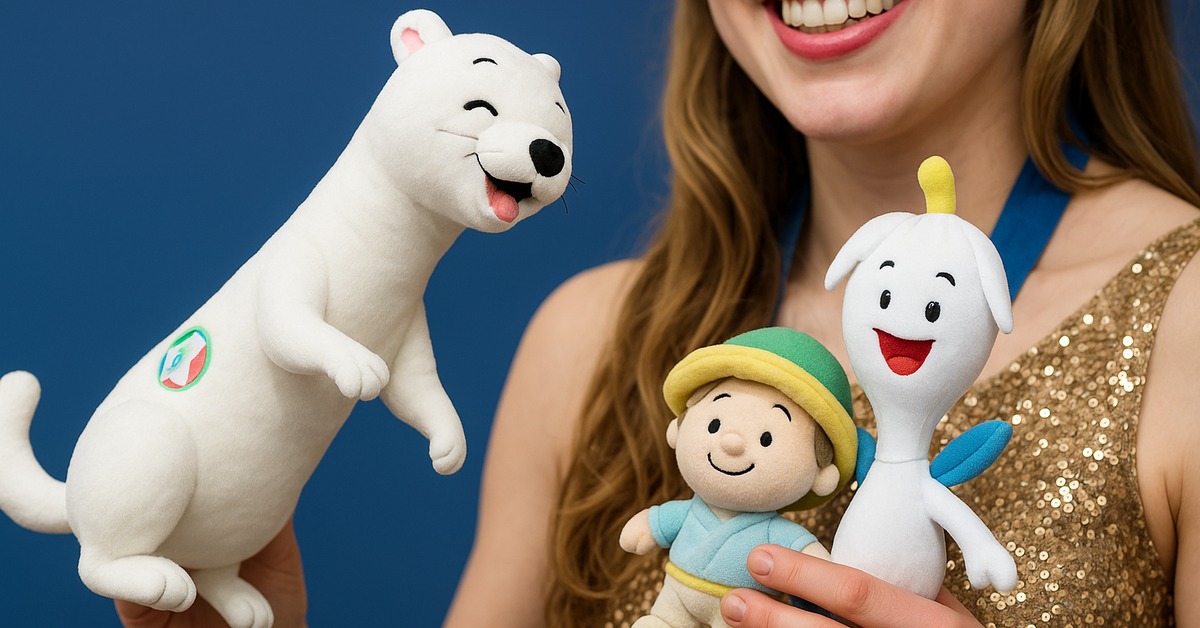
Milano Cortina 2026 made a different call. Athletes will receive a plush Tina instead — a soft, keepable, genuinely charming version of the mascot. Something they can take home. Something that doesn’t die on the flight back. You can read more about how global events are rethinking sustainability traditions in ways that turn out to be far more personal than they first appear.
Think about what that actually means over the full span of the Games.
A World Champion might still have Tina sitting on a shelf in 2045. The flowers she replaced would have been compost by the end of that same week. It sounds like a small swap until you really sit with the math — and the math is kind of staggering. That last detail kept me reading about this for another hour.
The Dolomites, the Stoat, and What the 2026 Games Stand For
The Dolomites are a UNESCO World Heritage Site, and they look like it. Pale jagged peaks. Frozen lakes. Villages half-buried in snowfall that accumulates through December and doesn’t apologize about it. This is where bobsledders and speed skiers and cross-country racers will push their bodies until something either breaks or wins. It is the kind of landscape that makes you understand, viscerally, why athletes train for years just to survive in it for minutes.
Tina fits here. That’s the point.
Over 2,900 athletes from dozens of nations are expected to compete. Every single one of them will hold her. Which raises an obvious question — what happens in the moment just before an athlete carries a plush stoat away from the most important podium of their life? That’s where things get a little stranger.
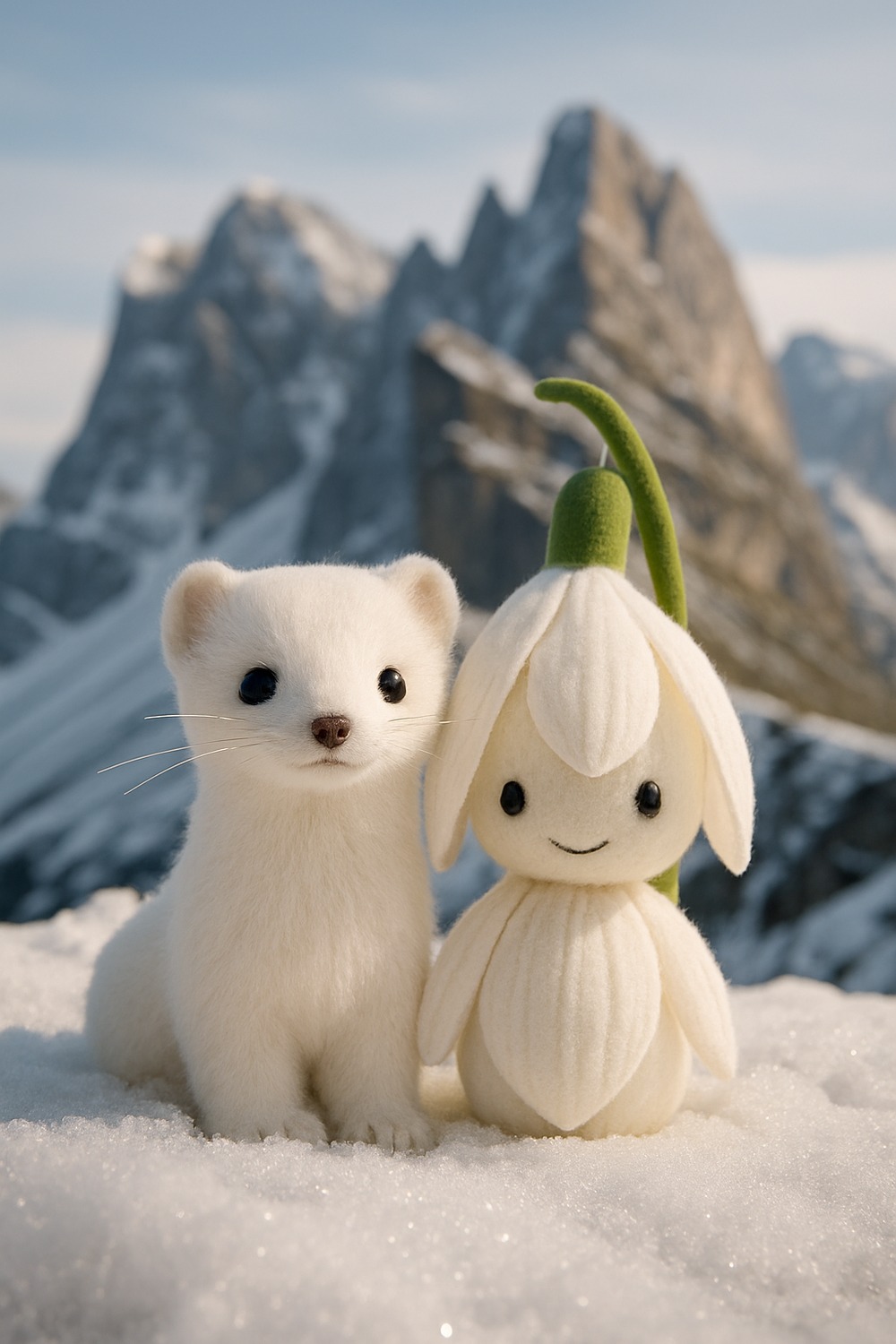
Meet Tina’s Companion — The Flo Is Quietly Stealing Hearts
Tina doesn’t stand alone in official imagery. Beside her sits The Flo — a snowdrop flower in full white bloom, petals open against an imagined alpine wind. Snowdrops have grown wild in the Italian Alps for centuries. They’re typically the first flowers to emerge from frozen ground at the end of winter, sometimes blooming while there’s still snow on the soil around them, nighttime temperatures well below freezing. In some Alpine regions they appear as early as January.
They’ve become cultural symbols of a very specific kind of stubbornness — not dramatic resilience, but quiet persistence. The refusal to wait for permission from the weather.
Put the two mascots together and something deliberate comes into focus. Stoat and snowdrop. Animal and plant. One survives by transforming. The other survives by refusing to be deterred. Together they make a mascot pairing that is about as philosophically loaded as a children’s plush toy has any right to be, and I mean that entirely as a compliment.
By the Numbers
- 2,900+ athletes expected to compete — making Milano Cortina 2026 one of the largest Winter Games in history (Milan Cortina 2026 Organizing Committee, 2024).
- The stoat’s seasonal color change — brown to white — typically completes within six to eight weeks, one of the more dramatic camouflage adaptations in European wildlife. By February in the Dolomites, she is essentially invisible against the snow.
- Floral waste at a typical Olympic ceremony: tens of thousands of cut flowers, many sourced internationally, most discarded within days of the Games ending.
- Snowdrops can bloom in January in Alpine regions, sometimes while the ground around them is still frozen solid.
Field Notes
- Stoats regularly kill prey much larger than themselves — rabbits, for instance — using a rapid spinning attack that disorients the target before the kill. Tina’s cheerful smirk is doing a lot of work.
- The name “Tina” was chosen through a public vote in Italy. Technically, she is a democratic stoat.
- The Flo’s source plant contains galantamine, a compound that’s been studied for its potential role in supporting cognitive function. She may be the most pharmacologically interesting flower to ever appear on an Olympic podium, though no one seems to be leading with that in the press materials.
Why This Mascot Moment Actually Matters
Most Olympic mascots are lovable and locationless. They could belong anywhere, to any Games, in any city. Swap the color scheme and the name and you’d never know the difference. Tina couldn’t belong anywhere else. She’s not designed to be universally palatable — she’s specific to a place, a season, an ecosystem that has existed in the Italian Alps long before the IOC ever scheduled anything there.
The bouquet replacement is doing something similar. It doesn’t announce itself as sustainability theater. It just makes one practical, human decision: an athlete who has trained their entire life for a single moment on a podium deserves a keepsake that lasts longer than a week. The rest follows from that.
Neither of these things needs a press release. They both speak without one.
What the Milano Cortina 2026 mascot represents — this compact, grinning, seasonally-transformed creature held up under stadium lights by the fastest and strongest people on the planet — is a quiet argument. That the natural world deserves a place at the table. That the best symbols for a Games aren’t invented from scratch but found, already existing, in the place where the Games actually happen.
Tina weighs almost nothing. She’ll sit in the hands of champions. She’ll outlast every flower ever handed to a medalist and photographed and forgotten. Beside her, The Flo will bloom — stubborn as any snowdrop in January, indifferent to the cold. Together they make the case without making a sound. If this kind of story is the sort that keeps you reading past midnight, there’s more at this-amazing-world.com — and the next one is stranger than this.