


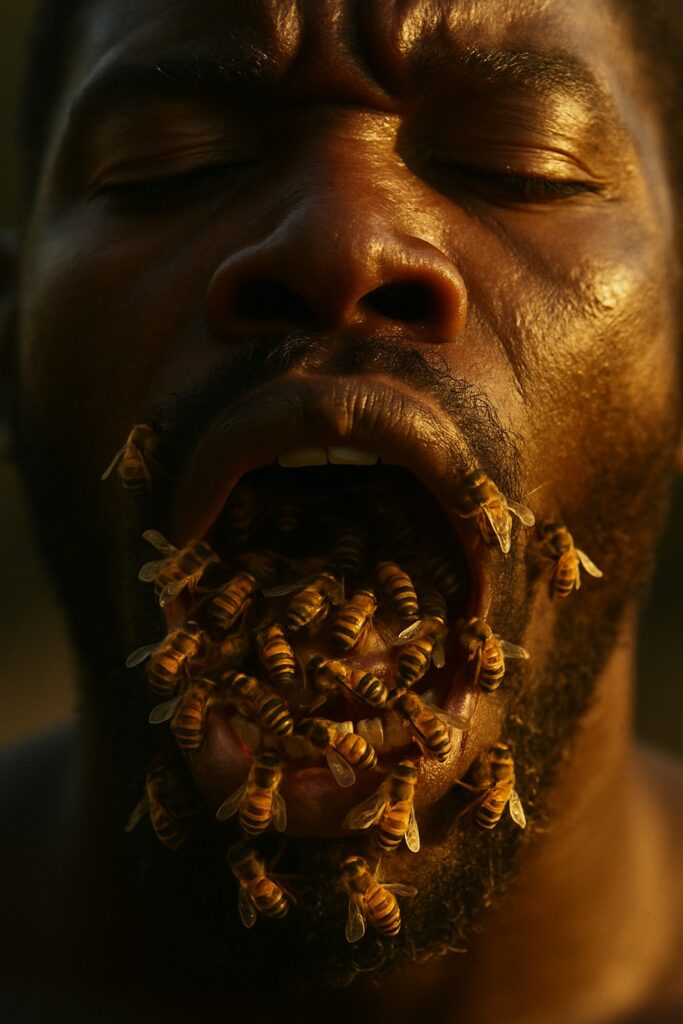
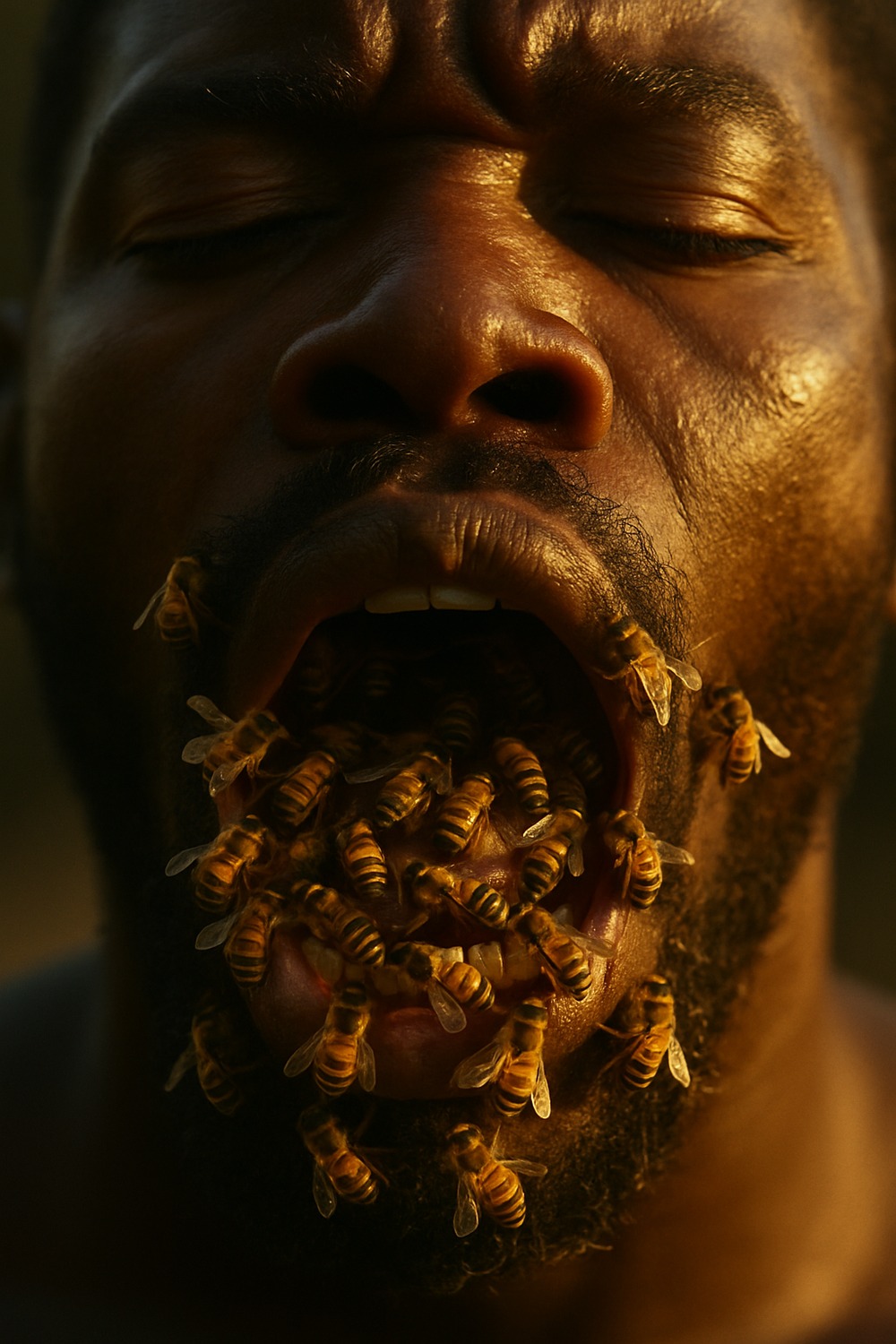
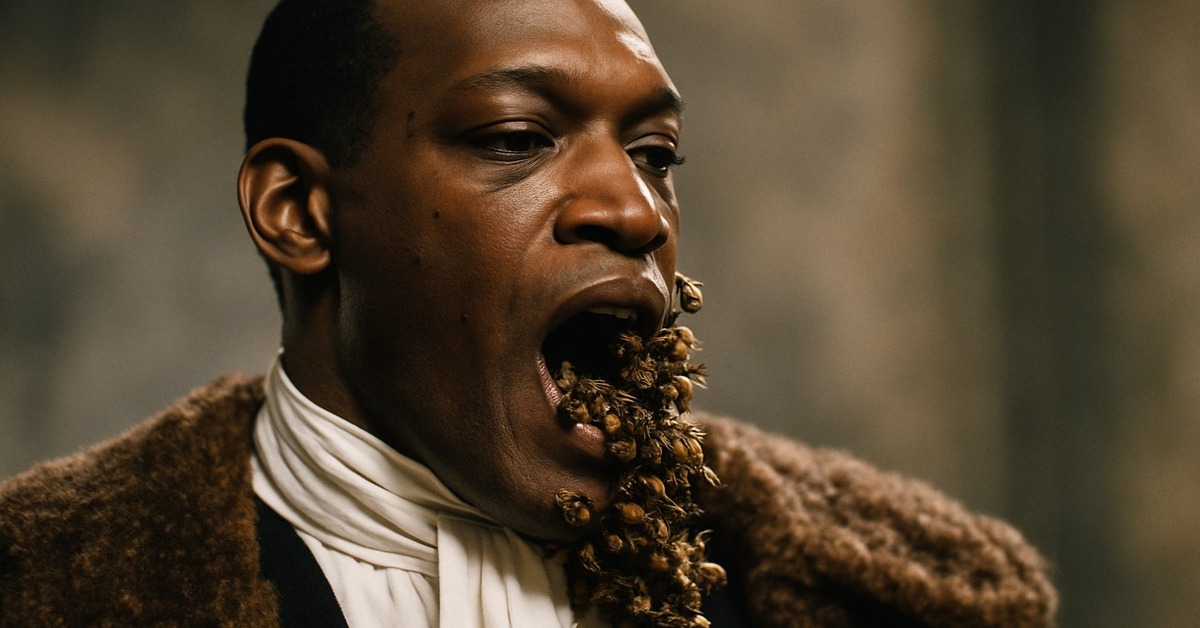
Four hundred honeybees crawling across a human tongue — and the Candyman live bees Tony Todd scene still holds up as cinema’s most extreme stunt negotiation thirty years later. Not because the bees were dangerous, exactly. Because the math was. A $1,000-per-sting deal that nobody thought would cost much ended up adding $23,000 to a budget that had no line item for pain.
Bernard Rose is directing a low-budget horror film in 1992 — adapted from a Clive Barker short story, shot partly on Chicago location, mostly on soundstage. Tony Todd, playing the mythic hook-handed Candyman, is standing with a professional bee wrangler on one side and a dental dam down his throat on the other. The scene calls for live bees. Hundreds of them. Crawling across his tongue, his teeth, pooling in the cavity of his open jaw. The question nobody asked loudly enough: what happens if something goes wrong?

The Negotiation That Changed Horror Stunt History
Tony Todd didn’t stumble into that beehive. He walked in with a contract clause. Before filming began on Candyman — the 1992 TriStar Pictures horror film that would gross over $25 million on a $9 million budget — Todd approached producers with a straightforward proposition: live insects, no CGI substitutes, but $1,000 for every sting he received. Producers agreed. It seemed, perhaps, like a reasonable gamble. Bee wranglers would manage the insects. Todd would stay still. How many stings could there realistically be? The answer, as the production history of the film would eventually confirm, was twenty-three. An unplanned line item that nobody in accounting had penciled in.
What made the negotiation remarkable wasn’t just the money. It was the leverage. Todd understood something that producers sometimes forget: certain physical performances can’t be faked without losing the scene entirely. A digitally composited swarm would never carry the same biological unease as real insects moving with their own autonomous logic across human skin. The bees didn’t know they were making a film. They followed pheromone cues, responded to warmth and carbon dioxide, and moved the way bees actually move — which is nothing like the way CGI bees move. Todd’s instinct was correct, and his performance is why that scene still makes audiences shift in their seats three decades later.
Twenty-three stings. Some came during filming. Some came during setup and reset between takes. Todd reportedly remained almost completely still throughout — a discipline that likely kept the number from climbing significantly higher. Bees sting when they feel threatened. Motion triggers the threat response. Stillness is the only real protection.
Bee Wranglers, Dental Dams, and the Science of Staying Still
Why does this matter? Because bee wrangling is a genuine film industry profession — and it operates at a stranger intersection than most people realize, somewhere between entomology, animal behavior, and production logistics.
The wrangler on the Candyman set was responsible for introducing the insects into Todd’s mouth in a controlled sequence, managing their behavior during takes, and extracting them safely afterward. What’s genuinely fascinating, and rarely discussed, is how closely bee behavior during those scenes mirrors what researchers at institutions like the University of California, Davis, have documented about honeybee thermal regulation. Bees instinctively cluster toward warmth — a human mouth, sitting at approximately 37°C, is a natural attractor. That’s not stagecraft. That’s biology driving the camera. The behavior you see in those frames isn’t trained; it’s thermotaxis (researchers actually call this a thermotactic response, and it’s the same mechanism that governs how bees cluster around a queen in winter). Much like how crows deliberately expose themselves to formic acid from ant colonies to exploit insect chemistry for their own purposes, animals follow biochemical signals in ways that look almost intentional but are entirely instinctual.
The dental dam was the one concession to safety that Todd insisted on alongside the per-sting deal. Fitted to guard his throat and airway, it prevented any bee from traveling deeper into his respiratory system. His gums, cheeks, lips, and the surface of his tongue remained unprotected — which is where the twenty-three stings landed. A honeybee sting delivers approximately 50 micrograms of apitoxin, a complex venom containing melittin, phospholipase A2, and histamine. Twenty-three stings across soft oral tissue delivers a cumulative venom load significant enough to cause systemic inflammation. An allergist was reportedly on standby for the duration of filming.
Pheromone management was the wrangler’s core strategy. Queen bee pheromones were used to direct the swarm’s general movement — worker bees follow the queen’s chemical signal with remarkable fidelity. Place the queen, and the workers follow. Keep the queen calm, and the swarm stays calm. Elegant in theory. Deeply contingent on nothing going wrong in practice.
What Bee Venom Actually Does to the Human Body
Melittin — the primary active compound in honeybee venom — is one of the most studied peptides in biomedical research. According to a 2021 research summary published by the Smithsonian Magazine covering work from the Harry Perkins Institute of Medical Research in Perth, Australia, melittin disrupts cell membranes with remarkable specificity. In a wound context, it triggers mast cell degranulation, histamine release, and a cascade of localized inflammatory responses. Multiply that by twenty-three stings concentrated in the soft and highly vascular tissue of the mouth, and the physiological burden becomes considerable. Todd described the experience in interviews as genuinely painful, though he consistently framed it as a price worth paying for the scene’s authenticity.
Twenty-three stings in oral tissue, endured voluntarily, for a take that might not even make the final cut — the fact that Todd held his position each time says something about commitment that no stunt classification adequately captures.
Here’s the thing about the Candyman live bees Tony Todd scene: it gets right what most depictions of bee encounters in film get completely wrong. Honeybees — Apis mellifera — are defensive insects, not aggressive ones. A bee crawling across a warm, still surface isn’t looking for a fight. It’s navigating. The stings Todd received were almost certainly stress responses from individual bees that felt trapped or compressed, not coordinated attacks. That distinction matters enormously when you’re deciding whether to open your mouth and hold still for four minutes while several hundred insects do what insects do.
And the bee subspecies chosen wasn’t incidental. Bee wranglers in film production typically work with Italian honeybees — a subspecies known for comparatively docile temperament. Africanized honeybees, which have a vastly lower sting threshold, would have made Todd’s twenty-three stings look modest. That selection was, in this context, a genuine production decision with genuine physiological consequences.
The Legacy: How Candyman Live Bees Tony Todd Rewired Practical Effects
Nineteen ninety-two was a pivotal year for the debate between practical and digital effects — Aladdin had demonstrated what computer animation could achieve, and Jurassic Park was in production. Horror filmmakers, though, were watching a different experiment: what happens when you do the thing for real? The American Humane Association, which began monitoring animal welfare on film sets under the Screen Actors Guild agreement from the 1980s onward, would have been involved in overseeing the use of live insects. Bees fall into a legal grey zone in some jurisdictions regarding animal welfare law — invertebrates are often excluded from standard protections — but the 1992 production apparently met responsible standards regardless. No bees were harmed in ways that weren’t incidental to the performance of their own natural behavior.
History has a way of treating the people who ignored this kind of evidence unkindly — and the producers who initially assumed twenty-three stings was an unlikely outcome were reading a very different risk calculus than the one Todd had already worked out.
Todd’s per-sting negotiation became something of a legend in Hollywood stunt and performance circles, establishing a conversation about how extreme physical demands on actors should be compensated. Standard Screen Actors Guild stunt pay rates cover defined categories of risk — Todd’s role blurred those categories entirely. He was the lead actor performing what amounted to a biohazard stunt, and his $1,000-per-sting deal quantified pain in a way the industry’s standard frameworks simply didn’t. In the years since, the story has been cited by actors and union negotiators as an example of creative compensation structuring for genuinely novel risk scenarios.
What the scene did for the film’s cultural footprint is harder to quantify but impossible to ignore. Candyman became a genuine cult phenomenon, spawning two sequels and a 2021 Jordan Peele-produced reboot. Practical effects leave a different trace in memory than digital ones. The body knows the difference, even when the conscious mind doesn’t.

How It Unfolded
- 1985 — Clive Barker publishes “The Forbidden,” the short story that would become the basis for Candyman, in his Books of Blood anthology.
- 1992 — Bernard Rose directs the film adaptation; Tony Todd negotiates his per-sting deal before cameras roll, ultimately receiving 23 stings across the shoot.
- 1992 — Candyman opens in October and grosses over $25 million worldwide against a $9 million budget, establishing the bee scene as one of horror’s defining practical effects moments.
- 2021 — Jordan Peele produces a direct sequel, written and directed by Nia DaCosta, that expands the Candyman mythology while deliberately echoing the bee imagery of the original.
By the Numbers
- 400 — approximate number of live honeybees in Todd’s mouth during filming of the key scene, 1992.
- 23 — total stings Tony Todd received across the shoot, at $1,000 per sting, adding $23,000 to the production’s unplanned costs.
- 50 micrograms — the volume of apitoxin delivered by a single honeybee sting; Todd received approximately 1,150 micrograms total across 23 stings.
- $25 million — Candyman‘s worldwide box office gross against a $9 million production budget, a near 3× return.
- 37°C — approximate temperature of the human oral cavity, which acts as a thermotactic attractor for honeybees navigating by heat signature.
Field Notes
- The dental dam Todd wore was custom-fitted and extended to guard his trachea — not a standard dental dam but a modified appliance designed specifically for the shoot. An allergist stood by on set for every take involving live bees, a protocol that wasn’t publicly disclosed until Todd discussed it in interviews years later.
- Italian honeybees (Apis mellifera ligustica), the subspecies almost certainly used in the production, have a sting-trigger threshold roughly three times higher than Africanized honeybees — a fact that likely made the difference between 23 stings and a scene that couldn’t be completed at all.
- Bee venom research has accelerated significantly since the 1990s: melittin, the primary peptide in apitoxin, is now being studied as a potential therapeutic agent for cancer cell targeting and HIV suppression, according to work published by the Harry Perkins Institute in 2020.
- Researchers still can’t fully predict individual bee sting behavior in close-contact scenarios like the one Todd endured. The interaction between human pheromone output — particularly stress-induced chemical signals — and bee defensive behavior remains incompletely modeled, meaning the wrangler was managing a system with genuine unpredictable variables at its core.
Frequently Asked Questions
Q: How did the Candyman live bees Tony Todd scene actually work on set?
Bee wranglers introduced approximately 400 live Italian honeybees into Todd’s mouth in controlled stages during filming in 1992. A custom dental dam protected his airway. Wranglers used queen pheromones to guide the swarm’s movement and keep the colony as calm as possible. Todd remained almost entirely still throughout each take — motion triggers defensive bee behavior, and stillness was his primary protection beyond the dental dam. An allergist was present on set for every take.
Q: Why didn’t Tony Todd use CGI bees instead of real ones?
CGI technology in 1992 couldn’t replicate the autonomous, biologically driven movement of real insects convincingly enough to satisfy the scene’s requirements. More importantly, Todd and director Bernard Rose understood that the scene’s horror came from its authenticity. Real bees move according to pheromone gradients, temperature cues, and individual defensive instincts — not a motion path algorithm. That unpredictability is exactly what makes the scene so viscerally effective, and Todd’s judgment that the practical approach was superior has been vindicated by the scene’s thirty-year staying power.
Q: Was Tony Todd’s per-sting deal unusual in Hollywood?
Yes, significantly. Standard Screen Actors Guild stunt rates cover broadly defined categories of physical risk — Todd’s situation didn’t fit cleanly into any of them. He was the lead actor, not a stunt performer, voluntarily subjecting himself to live insect stings across mucous membrane tissue. A common misconception is that this was a standard stunt deal. It wasn’t. His $1,000-per-sting negotiation was bespoke compensation structuring for a genuinely novel scenario, and it has since been cited in discussions about how the industry should approach extreme non-stunt physical demands on principal actors.
Editor’s Take — Alex Morgan
What stays with me isn’t the bees. It’s the stillness. Todd knew — on a physiological level — that the only thing standing between twenty-three stings and a number far higher was his ability to suppress every instinctive response his nervous system was firing at full volume. That’s not acting training. That’s something closer to biofeedback under extreme conditions. The fact that he also structured a financial instrument around the risk makes it one of the stranger intersections of entomology and labor economics in cinema history.
Horror films have always traded in the body’s involuntary responses — the flinch, the gasp, the instinct to look away. What the Candyman live bees Tony Todd scene understood, in 1992, was that the most effective horror is the kind where the audience’s nervous system recognizes the real thing. CGI triggers the visual cortex. Four hundred live bees triggers something older and deeper. The question worth sitting with is what it says about us that we’ll pay to watch someone suppress every survival instinct they have — and then applaud the discipline it took to hold still.


