



Nobody was looking for social behavior. That’s the part that keeps nagging at me. They were cataloguing fossils — routine work — and kept finding the same thing on slabs from Morocco, Ohio, Ontario, Germany: dozens of trilobites, same species, same life stage, packed together like they’d made an appointment.
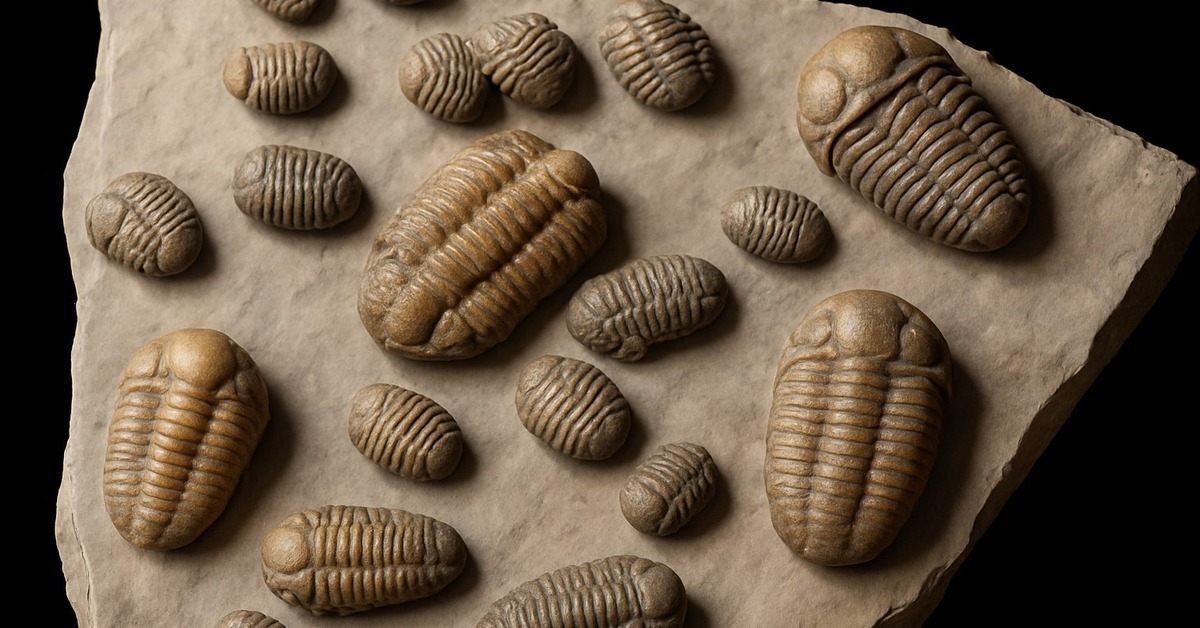
On one particular piece of Devonian rock pulled from Morocco’s Atlas Mountains, a group of phacopid trilobites sits frozen in formation. Dozens of them. Tight. Deliberate-looking. Scientists are now making a serious case that what we’re looking at is a gathering — one that happened roughly 500 million years ago, before anything with a backbone existed, before trees, before land animals of any kind.
What Trilobite Fossil Clusters Actually Tell Us
Paleontologists have been puzzling over these groupings for decades. Sites in Ohio, Ontario, and the Atlas Mountains have all produced the same striking image: tight assemblages of the same trilobite species, same developmental stage, clustered on ancient seafloors. Researcher Jean Vannier, who has studied soft-tissue preservation in early arthropods, has pointed to behavioral complexity in trilobites as something the field has chronically underestimated. The leading interpretation for these trilobite fossil clusters is that they represent molting or mating aggregations — but here’s the thing that made me stop: can a creature with no backbone and a brain smaller than a grain of rice actually have social instincts?
Apparently, yes.
The fossil record doesn’t lie about proximity. These animals came together intentionally, and the evidence keeps showing up from multiple continents. That’s not coincidence. That’s behavior.
Trilobites Dominated Earth Longer Than Dinosaurs
To understand why this matters, you need to appreciate just how long trilobites were a fixture on this planet. They first appeared around 521 million years ago and survived until the Permian extinction roughly 252 million years ago — a run of about 270 million years. Dinosaurs lasted around 165 million years. Trilobites outlasted them by more than a hundred million years, which is the kind of statistic that sounds made-up until you sit with it for a moment.
That’s a long time to develop habits. A long time for natural selection to favor any behavior — including gathering — that helped individuals survive. And molting, it turns out, was one of their most dangerous moments.
Think of it like this: if you had to temporarily remove your skeleton every time you wanted to grow, you’d probably want company too.
Shedding Skin Made Them Sitting Targets
Like all arthropods, trilobites had to shed their exoskeletons to grow. During molting, the hard outer shell splits open and the animal emerges soft, exposed, completely defenseless. In an ocean packed with predators, that window of vulnerability is roughly equivalent to wandering into open water with no armor and no speed. Trilobite fossil clusters appearing at consistent developmental stages strongly support the idea that individuals synchronized their molting — gathering in numbers to dilute individual risk. Safety in numbers isn’t a modern invention.
It’s an ancient calculus. Half a billion years old, apparently.
The Same Pattern Keeps Appearing Worldwide
What makes the trilobite fossil clusters so compelling isn’t any single site. It’s the repetition. Morocco. Ohio. Ontario. Germany. Every time researchers find a mass assemblage, the pattern holds: single species, single life stage, tight grouping, no signs of catastrophic burial. If these were random victims of a sudden sediment dump, you’d expect mixed species, mixed ages, chaotic scatter. Instead, the clusters look almost organized.
And then there’s the mating angle, which is frankly the stranger possibility. Some researchers believe these gatherings weren’t just about molting safety — they may have been spawning events, timed to tidal cycles or seasons, functionally identical to what horseshoe crabs do on modern beaches every spring.
The same behavior. Half a billion years apart.


Behavior This Old Rewrites What We Thought We Knew
Finding coordinated social behavior in trilobites forces a real rethink of when animal behavior actually started. For a long time, the working assumption was that group coordination required sophisticated nervous systems — actual brains with real processing power. Trilobites had simple ganglia, not brains as we’d recognize them. Roughly analogous, in computational terms, to a very basic reflex circuit. And yet here they are, coordinating. Gathering. Moving toward each other at specific life stages, in specific places, for what appear to be specific reasons.
That last fact kept me reading for another hour.
It pushes the origin of social behavior back further than many scientists expected — and it raises an uncomfortable question: if these animals were doing this 500 million years ago, what else were they doing that left no trace? Fossilization is selective. Most behavior disappears entirely. What we’re seeing in these clusters is almost certainly a fragment of something larger.
By the Numbers
- 270 million years on Earth — trilobites first appeared around 521 million years ago and survived multiple mass extinctions before finally going under in the Permian.
- Some trilobite fossil cluster sites contain upward of 50 individuals of the same species and life stage packed into a single square meter of ancient seafloor.
- Outlasted dinosaurs by over 100 million years.
- The Devonian period, when many clustering fossils date from, ran from about 419 to 359 million years ago — trilobites were already ancient by the time it started, and they survived the whole thing.

Field Notes
- Some trilobite species could roll into a tight defensive ball — preserved in fossils where the animal is found enrolled rather than flat. This wasn’t passive. It was a reflex response to threat, which means their nervous systems were doing something more than basic locomotion.
- Calcite eyes. Hundreds of individual lenses in some species — the same compound-eye architecture still used by insects today, which is either elegant continuity or a slightly unsettling reminder of how old some solutions really are.
- The Atlas Mountains as a trilobite archive — unusual geological clarity, Devonian seafloor preserved intact.
- The Moroccan fossil trade has made some of these specimens globally accessible, though it also means provenance isn’t always clean — museum-quality clusters and market-stall pieces come from the same formations.
Why Ancient Gatherings Still Matter Today
The story of trilobite fossil clusters isn’t really a paleontology curiosity (parenthetical caveat: it is, but it’s also more than that). It’s a window into one of the most fundamental questions in biology — when did life start behaving socially? The evidence now points to much, much earlier than anyone assumed comfortable. These creatures, armored and alien-looking, with compound calcite eyes and body plans nothing like ours, were already navigating the social logic of survival before complex life had established any foothold on land.
Every time a new cluster turns up — in a Moroccan market, a museum drawer, a quarry wall in Ontario — it adds another data point to a picture that keeps refusing to simplify. Trilobites weren’t just survivors, though their 270-million-year run is impressive enough on its own. They were, in their own ancient way, social animals. And that changes something about how we understand the deep history of behavior on this planet.
Five hundred million years ago, before trees, before anything walked on land, small armored creatures were finding each other on the seafloor and gathering together. We don’t fully know why. We may never recover enough evidence to be certain. But the fact that we can read their meeting in stone — frozen, intact, waiting in Devonian rock for someone to notice — is one of the stranger gifts the fossil record has given us. More of this kind of thing lives at this-amazing-world.com, and the next one is, genuinely, even stranger.


