Why Trump’s Hollywood Star Is the Most Attacked in History
Here’s the thing about Trump Hollywood Walk of Fame star vandalism: the star itself never changed. Same brass. Same terrazzo. Same coordinates on Hollywood Boulevard. What changed — violently, twice — was everything around it. Two strangers who’d never met destroyed the same five-pointed plaque in separate years using different tools, faced identical bail amounts, and ended up financially connected through the wreckage. No other star in the Walk’s 65-year history has come close to that record.
The Hollywood Walk of Fame stretches more than 1.3 miles along Hollywood Boulevard and Vine Street, holding over 2,700 stars honoring entertainers, directors, and public figures. Donald Trump’s star — awarded in 2007 for his work on The Apprentice — sits near 6801 Hollywood Boulevard. It has been smashed with a sledgehammer, attacked with a pickaxe, urinated on, covered in tiny walls, and replaced at private expense. Twice. The question isn’t just what drives people to do it. It’s what the doing reveals about the object itself.

The Star That Started as Spectacle
Conceived in 1953 by E.M. Stuart, then president of the Hollywood Chamber of Commerce, the Hollywood Walk of Fame was a deliberate act of civic mythmaking — a way to preserve the glamour of a district that was visibly decaying. Construction began in 1958, and the first stars were installed in 1960. Each star costs the honoree’s sponsor approximately $50,000 today, covering installation and a ceremony. The Hollywood Walk of Fame, as documented by the Hollywood Chamber of Commerce, has never been a neutral archive. It’s a commercial product shaped like a memorial.
Trump received his star in January 2007, nominated for his role as executive producer and host of NBC’s The Apprentice. Vanna White attended the ceremony. At that moment, it was a routine entertainment-industry transaction — not a political event. The cultural ground beneath it hadn’t yet shifted.
Then 2015 happened. Trump descended a golden escalator and announced his presidential campaign, and the star on Hollywood Boulevard transformed overnight. It didn’t move. Nobody changed it. But its meaning changed completely, which is its own kind of violence. A plaque that once signified reality-television success suddenly became a site where two Americas could see entirely different things — an honor or an insult, a monument or a target. The Hollywood Historic Trust, which maintains all Walk of Fame stars at its own expense with no public funding, found itself maintaining something far more volatile than terrazzo.
By 2016, the star had become a pilgrimage site. People posed for photographs with their middle fingers raised. Others left flowers. Some knelt. Others spat. The sidewalk had acquired the charged atmosphere of a contested memorial, and nobody had agreed to make it one.
Two Strangers, One Sledgehammer, One Pickaxe
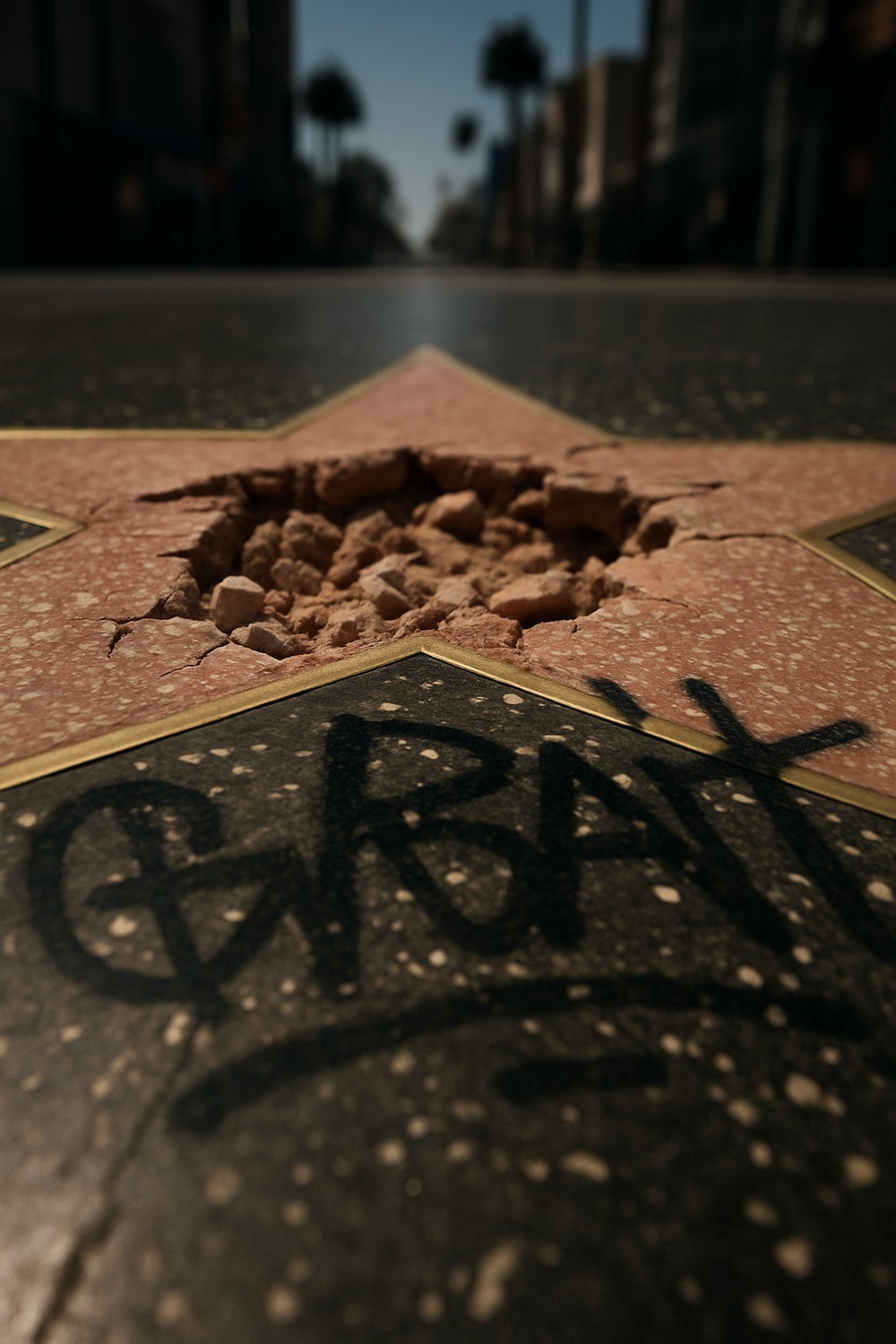
October 2016, weeks before the presidential election. James Otis — a 54-year-old activist and heir to a real estate fortune — arrived in the early morning hours with a sledgehammer and a pickaxe and methodically pried the bronze letters from Trump’s star, damaging the surrounding terrazzo. Otis later told reporters he intended to auction the pieces and donate the proceeds to women who had accused Trump of sexual assault. He was charged with felony vandalism, bail set at $20,000. The Hollywood Historic Trust repaired and replaced the star — covering the full cost themselves, as they always do — and the incident might have ended there, a single eccentric act absorbed by an indifferent institution.
It didn’t end there. The compulsive nature of these acts — the way they seem to demand repetition — resembles something researchers who study obsessive targeting behavior recognize immediately: it’s not about completion. It’s about the act itself.
July 25, 2018. Austin Clay, a 24-year-old from Glendale, California, walked up to the newly replaced star in broad daylight carrying a guitar-shaped pickaxe. He swung it. Hard. The star shattered. Arrested immediately, charged with felony vandalism, bail set at $20,000 — the exact same amount as Otis’s two years earlier. What happened next is genuinely strange: James Otis, the man who had attacked the same star in 2016, paid Clay’s bail. Two strangers. One target. One bail amount. One man paying to free the other. Clay ultimately pleaded no contest and received three years’ probation and a $4,400 fine.
The Hollywood Historic Trust replaced the star a second time. They issued no public statement of frustration. They simply repaired it — because that’s what the organization does. That quiet institutional persistence is, in its own way, as strange as the attacks themselves.
What Symbols Actually Do to People
Why does this matter? Because it separates impulsive rage from something far more deliberate — and the distinction changes everything about how we read these events.
Political scientists and sociologists who study symbolic violence — the use of physical acts against objects to communicate political meaning — have documented a consistent pattern: when legitimate channels of dissent feel blocked or ineffective, symbolic destruction rises. Dr. Erika Doss, a professor of American Studies at the University of Notre Dame, spent years researching memorial culture in America and published her findings in Memorial Mania (2010), tracing how public objects accumulate contested meaning until they become pressure valves. Doss found that Americans invest extraordinary emotional energy in public monuments and markers, far beyond what their creators intended. The Smithsonian Institution’s research into American material culture has similarly noted that objects in public spaces become proxies for larger arguments precisely because they’re permanent, visible, and — crucially — can be damaged. Attacking a symbol often functions as a form of testimony — a declaration that the object’s implied narrative is contested (researchers actually call this “agonistic memory”).
Both Otis and Clay planned their actions, brought appropriate tools, arrived at a deliberate time, and accepted the legal consequences. That’s not impulsive behavior. Premeditated symbolic destruction says something about how a society is processing conflict it can’t resolve through normal means — and the fact that two people arrived at the same target independently, years apart, suggests the star had become something neither the Hollywood Chamber of Commerce nor Donald Trump ever intended it to be.
When a piece of commercial brass in a sidewalk becomes worth a felony charge to two unconnected strangers, the object has stopped being an object. History has a way of treating the people who ignored that kind of evidence unkindly.
Attacking the Walk of Fame is legally identical to attacking any private property — it’s a commercial enterprise managed by a private Chamber of Commerce, not a government monument. And yet people treat it as though it were a public institution whose honors carry civic weight, which reveals exactly how successfully the Walk has manufactured cultural authority it was never officially granted.
The Trump Hollywood Star Vandalism Effect and What It Triggered
And the cascade, once started, didn’t stop at the star itself.
Following Clay’s arrest in August 2018, West Hollywood City Council unanimously passed a resolution calling on the Hollywood Chamber of Commerce to remove Trump’s star permanently, citing the cost of repeated repairs and the “repugnant” values they argued the star represented. The Hollywood Chamber of Commerce rejected the request — noting, correctly, that they had never removed a star and that the Walk of Fame’s integrity depended on that consistency. Their 2018 statement read, in part: “Once a star has been added to the Walk, it is considered a part of the historic fabric of the boulevard.” A 2019 Annenberg School for Communication study at the University of Southern California, examining institutional responses to contested memorials, found that organizations facing pressure to remove disputed markers almost universally default to the position that removal sets a precedent more dangerous than the controversy itself. The Hollywood Chamber of Commerce, without citing any academic framework, arrived at the same conclusion independently.
Counter-responses were equally theatrical. After Clay’s 2018 attack, a group of Trump supporters organized a 24-hour volunteer guard around the star — people sitting on folding chairs on Hollywood Boulevard, watching a piece of brass in the sidewalk through the night. Street artist Plastic Jesus responded by installing a tiny wall around a replica star, complete with miniature “Make America Great Again” signs. The miniature wall got more international press coverage than the guard. That’s the thing about symbolic battles: they have no rules of escalation, and the most absurd intervention often wins the news cycle.
Collectively, the Trump Hollywood Walk of Fame star vandalism cases cost the City of Los Angeles and the Hollywood Historic Trust an estimated tens of thousands of dollars in police response, legal proceedings, and repairs. Each star replacement runs roughly $3,000 to $5,000. Those numbers are small. The cultural cost is the one nobody’s figured out how to invoice.

How It Unfolded
- 1960 — The first Hollywood Walk of Fame stars were installed on Hollywood Boulevard, initiating a commercial memorial tradition managed by the Hollywood Chamber of Commerce.
- January 2007 — Donald Trump received his Walk of Fame star at 6801 Hollywood Boulevard, sponsored in connection with his work on NBC’s The Apprentice; the ceremony was attended by Vanna White.
- October 2016 — James Otis attacked Trump’s star with a sledgehammer in the early morning hours, prying off the bronze letters; the star was fully replaced by the Hollywood Historic Trust at their own expense.
- July 2018 — Austin Clay attacked the replaced star with a pickaxe in broad daylight; Otis later paid Clay’s $20,000 bail; Clay pleaded no contest and received three years’ probation.
By the Numbers
- 2,700+ stars currently on the Hollywood Walk of Fame, maintained entirely by the privately funded Hollywood Historic Trust (Hollywood Chamber of Commerce, 2024).
- $50,000 — approximate total cost for a sponsor to nominate, install, and host a ceremony for a new star as of 2023.
- $20,000 — bail amount set for both James Otis (2016) and Austin Clay (2018) following separate attacks on the same star.
- 2 — the number of times Trump’s star has been fully replaced; no other star on the Walk has required replacement due to vandalism more than once in its history.
- 65+ years — the Walk of Fame’s operational lifespan, during which zero stars have ever been permanently removed, including those of figures convicted of serious crimes.
Field Notes
- In the weeks following the 2016 attack, anonymous artists installed small pink plastic toy figurines around the star — dozens of them, arranged in a circle — which remained undisturbed for several days before city workers removed them. No one ever claimed credit.
- Exact repair costs for Trump’s star replacements have never been publicly disclosed by the Hollywood Historic Trust, though industry estimates for full terrazzo and brass star replacement range from $3,000 to $5,000 per incident, not including labor or police response costs.
- James Otis, who paid Austin Clay’s bail in 2018, stated publicly that he considered his 2016 attack to be “performance art” — a framing that the Los Angeles City Attorney’s office did not find persuasive.
- Researchers studying monument controversy still can’t fully explain why Trump’s star triggers sustained physical confrontation while stars belonging to other polarizing figures — including those of convicted criminals — have never been attacked. Whether that gap reflects Trump’s unique political status or something specific about the Walk of Fame’s cultural positioning remains genuinely unresolved.
Frequently Asked Questions
Q: How many times has the Trump Hollywood Walk of Fame star been vandalized?
Physically destroyed twice — once in October 2016 by James Otis using a sledgehammer, and once in July 2018 by Austin Clay using a pickaxe. Both attackers were charged with felony vandalism and faced $20,000 bail. Beyond full destruction, the star has been subject to numerous smaller incidents including spray-painting, urination, and temporary installations. The Hollywood Historic Trust has replaced the star both times at its own expense.
Q: Can the Hollywood Chamber of Commerce remove Trump’s star permanently?
Technically, yes — the Hollywood Chamber of Commerce manages the Walk of Fame and sets its policies. But as of 2024, no star has ever been permanently removed in the Walk’s 65-year history, including stars belonging to figures convicted of serious crimes. The Chamber rejected West Hollywood’s 2018 formal request for removal, citing the principle that removing stars sets a precedent that would undermine the Walk’s institutional credibility. That policy appears firm, regardless of political pressure.
Q: Why do people attack the star instead of, say, organizing a protest?
That’s precisely the question political scientists find most interesting. Symbolic destruction isn’t irrational — it’s a calculated act designed to generate attention and communicate that a symbol’s implied legitimacy is contested. Both Otis and Clay planned their attacks deliberately, brought tools, and accepted arrest. Research into what scholars call “agonistic memory” — the contested nature of public commemoration — suggests that people destroy symbols when they feel that official channels have failed to acknowledge their objections. The star becomes a stand-in for an argument that has no other physical address.
Editor’s Take — Sarah Blake
What stays with me is the Hollywood Historic Trust quietly replacing the star. Twice. No press conference, no complaint, no capitulation to removal demands — just terrazzo workers on Hollywood Boulevard doing their job. That institutional steadiness is either admirable or absurd depending entirely on your politics, which is probably the most honest summary of this whole story. The star itself is inert. It’s the humans — the ones attacking it, guarding it, miniaturizing it, paying each other’s bail — who are doing all the actual work of making it mean something.
Designed to manufacture permanence, the Hollywood Walk of Fame rests on a simple premise: bronze and terrazzo don’t change; celebrity does. What nobody planned for is that a sidewalk plaque could become a live document of a country’s unresolved arguments — attacked, repaired, attacked again, quietly repaired again. The star at 6801 Hollywood Boulevard isn’t unique because of who it honors. It’s unique because of what people keep deciding to do to it. And the fact that two strangers with pickaxes and sledgehammers ended up connected by a $20,000 bail amount and a piece of brass in the ground — what does that say about where we look for the symbols that matter most to us?