


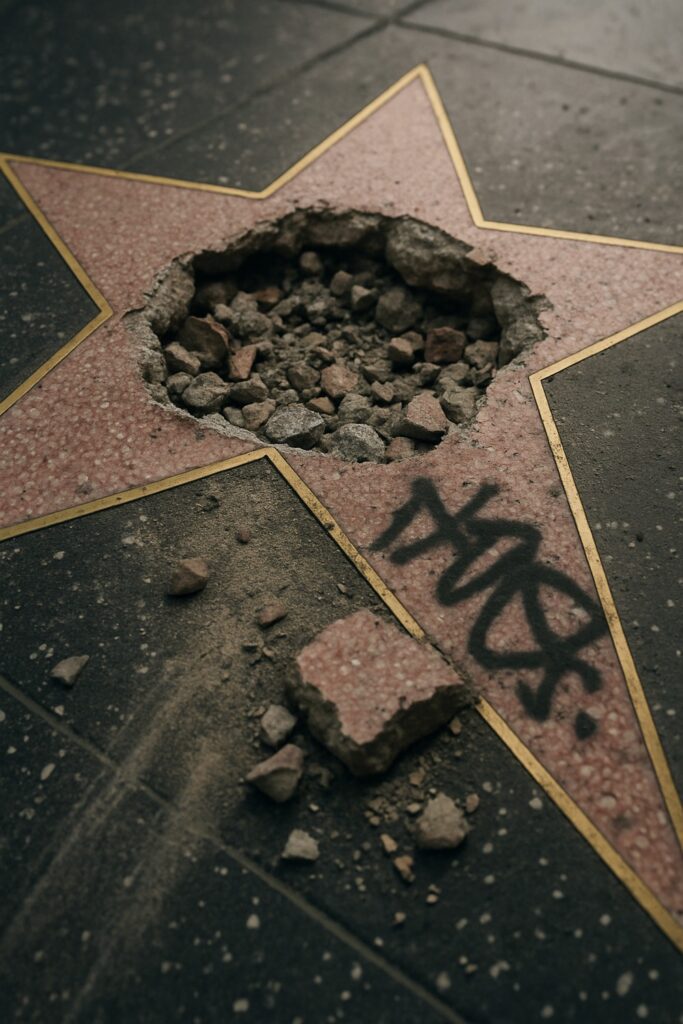
Here’s the thing about the Trump Hollywood Walk of Fame star vandalism — the star keeps winning. Not because it survives the hammer, but because every swing of that hammer makes it more impossible to ignore. A 3.5-square-foot terrazzo plaque, installed in 2007, has outlasted every attempt to erase it and become more loaded with meaning because of the attempts, not in spite of them.
Hollywood Boulevard has seen everything — premieres, protests, paparazzi stampedes. But the repeated destruction of Donald Trump’s star at 6801 Hollywood Boulevard has turned a brass-and-terrazzo plaque into something far larger than celebrity memorabilia. It’s a referendum in miniature, a proxy war fought with sledgehammers and spray cans, over fame, power, and who gets to decide what endures on the most famous sidewalk on earth.

The Star That Keeps Getting Smashed
Donald Trump received his star on the Hollywood Walk of Fame in 2007, recognizing his work as executive producer of the reality television series The Apprentice. For nearly a decade, it sat quietly among 2,700 others, scuffed by tourist sneakers, occasionally photographed by curious visitors. Then the 2016 presidential campaign changed everything. In October of that year, James Otis arrived on the boulevard before sunrise carrying a pickaxe and a sledgehammer. He pried off the bronze letters spelling TRUMP, filmed himself doing it, and posted the footage online within hours. The Hollywood Chamber of Commerce — the organization that owns and maintains all Walk of Fame stars — confirmed the damage and billed Otis for repair costs estimated at $3,300. Otis, a 52-year-old activist and heir to the Otis Elevator fortune, said he was protesting Trump’s treatment of women. He was charged with felony vandalism and agreed to pay $4,400 in restitution.
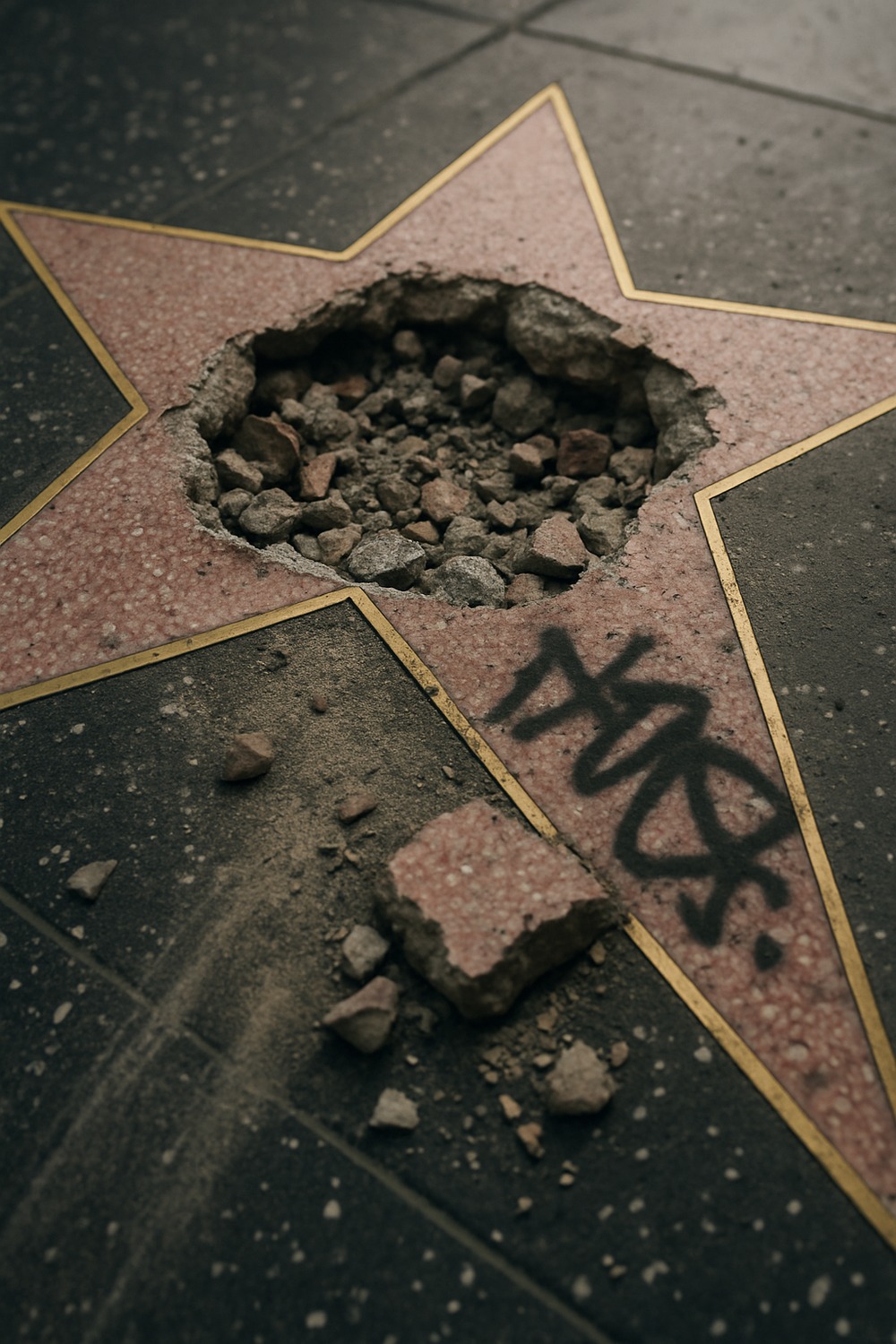
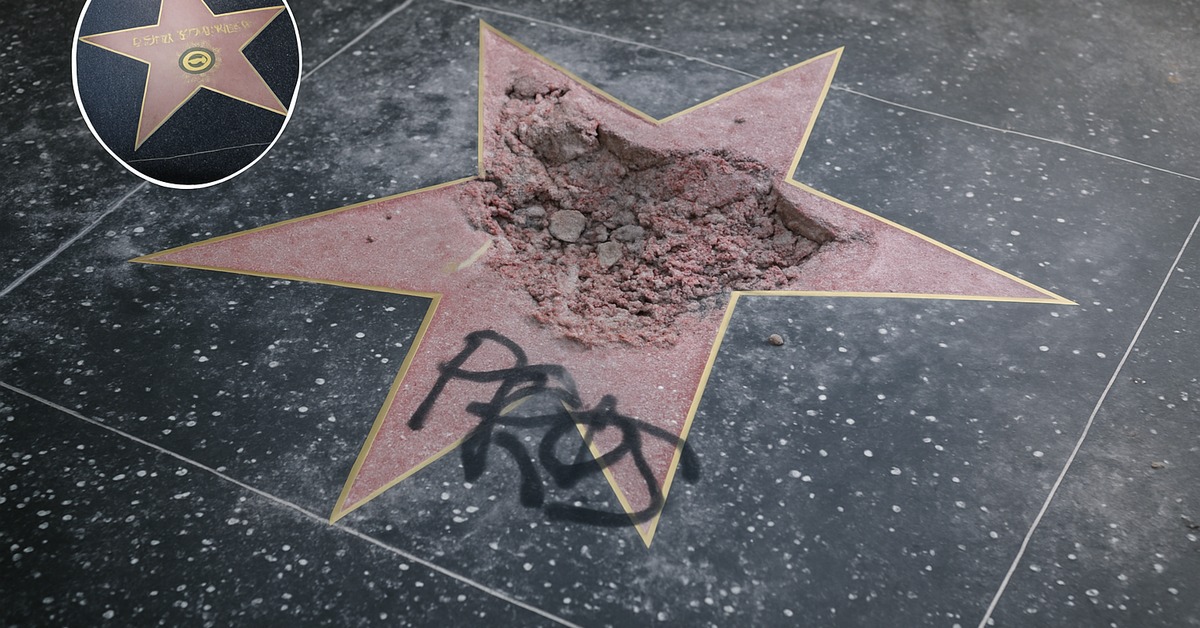
The repair crews came. The star was restored. And the world largely moved on — until July 25, 2018, when 24-year-old Austin Clay showed up with his own pickaxe and delivered a second assault so forceful it left a crater in the center of the plaque. Clay later told police he intended to auction the star’s remains and donate the proceeds to women who had accused Trump of sexual misconduct. He was arrested on the spot, charged with felony vandalism, and faced $20,000 bail. The man who posted that bail? James Otis. Two men, two years apart, connected by a cause and an unlikely personal bond — both willing to face felony charges for it.
Clay’s attack drew international coverage within hours. Photographers were already on the scene before police finished processing it. The crater measured roughly eight inches across.
Small, by any standard. Enormous, in its symbolism.
Why This Star Attracts Fury Others Don’t
Why does this matter? Because nearly 2,700 stars line the Walk of Fame across five miles of Hollywood Boulevard and Vine Street, and the overwhelming majority have never once been touched by anything sharper than a tourist’s heel.
Only a handful have attracted serious controversy, and the story of why Trump’s star became a recurring target says something unsettling about how we treat public monuments. It’s a dynamic not entirely unlike the bizarre intensity that surrounds other unexpected flashpoints — consider how a single act of brazen theft can become a story that a city can’t stop retelling, long after the object itself has been recovered. The star, like those stories, stops being about the thing itself. It becomes about the nerve it touched.
The Hollywood Chamber of Commerce has repeatedly refused calls to remove the star permanently — including a formal 2018 request signed by the West Hollywood City Council, which passed a resolution urging the Chamber to take it down. The Chamber’s response was categorical: it has never removed a star due to public controversy, and it doesn’t intend to start. CEO Leron Gubler said in 2018 that the stars belong to the entire community and that removing one would set a precedent that could destabilize the Walk’s integrity. The Chamber also noted, pointedly, that repair costs for vandalized stars are borne by the star’s original sponsor — not taxpayers.
By 2018, Trump’s star had been vandalized, surrounded by toy walls, covered in protest art, draped in tiny protest fences, and had a makeshift gravestone placed beside it. Counter-protesters periodically stood guard. On at least two occasions, rival demonstrations broke out on the same block simultaneously. It’s theatre — unscripted, genuinely dangerous, and entirely real.
Monuments, Memory, and the Politics of Public Space
Trump’s star didn’t arrive in a vacuum. It landed in the middle of a global reckoning over public monuments — who they honor, who decides, and what happens when the community around them changes its mind. Confederate statues were being toppled or removed across the American South throughout 2017 and 2018. In Bristol, England, a statue of slave trader Edward Colston was pulled down and thrown into the harbour in 2020. In Belgium, statues of King Leopold II were defaced and removed following protests. As Smithsonian Magazine has examined in depth, the question of monument removal forces communities to confront whether a public space can honor a person’s contributions without endorsing everything they’ve done or become. Trump’s star collapses that complexity into a single, walkable block of pavement.
A monument to a safely historical figure is one thing. What happens when the person being honored is still alive, still polarizing, still making front pages every other week? The Trump Hollywood Walk of Fame star vandalism incidents raised exactly that question — one that urban planners and cultural historians had been wrestling with long before 2016. His star sat on an active battleground while he was running for president, then serving as president. It wasn’t a memorial. It was a live wire embedded in concrete.
The data left no room for ambiguity about what the Chamber’s refusal to act created — and anyone watching closely could see it coming. Every act of vandalism generated a news cycle. Every repair became a statement. The star’s very persistence, battered and restored, started to function as a kind of political performance art neither side fully controlled.
Trump Hollywood Walk of Fame Star: What Happens After the Hammer Falls
After each vandalism incident, the Hollywood Historic Trust — the nonprofit arm of the Hollywood Chamber of Commerce that manages star restorations — coordinated repairs through licensed terrazzo craftspeople, a specialty trade with fewer than a thousand active practitioners in the United States according to the National Terrazzo & Mosaic Association’s 2019 membership survey. Terrazzo (researchers actually call this a “composite matrix finish,” which undersells how painstaking it actually is) requires skilled hand-finishing that simply can’t be rushed. The Trump star restoration in 2016 took approximately three days of on-site work. The 2018 repair, given the deeper structural damage, took longer and reportedly cost over $3,000 in materials and labor alone — though the Chamber has never released precise figures for individual star repairs.
Both Clay and Otis faced California Penal Code Section 594 felony vandalism charges, which apply when property damage exceeds $400. In California, felony vandalism carries a potential sentence of up to three years in state prison, though first-time offenders often receive probation and restitution orders rather than custodial sentences. Clay, who had no prior criminal record, ultimately pleaded no contest to a misdemeanor charge in 2019 and was sentenced to three years of probation and ordered to pay $9,000 in restitution — roughly three times the physical repair cost, to account for related city expenses. Otis had received a similar resolution following his 2016 incident.
And the Los Angeles Police Department’s Hollywood Division noted something worth sitting with: the Walk of Fame has no permanent security infrastructure — no cameras directly monitoring individual stars, no physical barriers. The stars are, by design, open to the public at all hours. That openness is the point. It’s also the vulnerability.
The Longer History of Stars as Contested Ground
Trump isn’t the first Walk of Fame honoree to attract organized opposition. Bill Cosby’s star has been repeatedly vandalized following his 2018 sexual assault conviction, with graffiti and physical damage reported as recently as 2023. Kevin Spacey’s star drew protest calls following sexual misconduct allegations in 2017. The stars of Charlie Sheen and R. Kelly have also been defaced. What sets the Trump case apart is volume, persistence, and the explicit political dimension. By 2022, Trump’s star had been vandalized at least four documented times and subjected to dozens of smaller acts of defacement — spray paint, stickers, physical objects placed on or around the plaque.
Established in 1958 by the Hollywood Chamber of Commerce as an economic revitalization project for a boulevard that had begun to decline, the Walk was as much a commercial enterprise as a cultural one from the very beginning — the first stars were installed in 1960, and honorees or their sponsors have always paid a sponsorship fee (currently $75,000) to cover installation and maintenance. Fame, in Hollywood, has always been partially transactional. Whether that transaction includes permanent civic honor — regardless of what happens next — is a question the Chamber has answered consistently: it does.
Stand on Hollywood Boulevard on a Tuesday morning before the tour buses arrive, and the stars stretch out in both directions farther than you can see. Marilyn Monroe. James Dean. David Bowie. And there, between the food truck receipts blowing past and the first tourists crouching for photographs, Trump’s star — repaired, re-polished, slightly brighter than its neighbors from all the recent restoration work. Unmissable. Unapologetic. Still there.

How It Unfolded
- 2007 — Donald Trump’s star is installed at 6801 Hollywood Boulevard, honoring his role as producer of The Apprentice; the ceremony is attended by Trump and the show’s cast.
- October 2016 — James Otis uses a pickaxe and sledgehammer to destroy the star days before the presidential election, making international headlines and facing felony vandalism charges.
- July 2018 — Austin Clay repeats the attack with his own pickaxe, is arrested immediately; Otis posts Clay’s $20,000 bail, deepening the story’s surreal continuity.
- 2019 — Clay pleads no contest to misdemeanor vandalism, receives three years’ probation and $9,000 in restitution; the Walk of Fame’s no-removal policy remains firmly in place.
By the Numbers
- 2,700+ stars currently on the Hollywood Walk of Fame, spanning five miles of Hollywood Boulevard and Vine Street (Hollywood Chamber of Commerce, 2023)
- $75,000 — the sponsorship fee paid by an honoree or their sponsor to cover star installation and a decade of maintenance
- At least 4 documented vandalism incidents targeting Trump’s star between 2016 and 2023
- $9,000 — restitution ordered against Austin Clay in 2019, approximately 3× the physical repair cost
- 1958 — the year the Hollywood Walk of Fame was established as a commercial revitalization initiative, with the first stars installed in 1960
Field Notes
- In the weeks following the 2018 attack, an anonymous artist placed a miniature brick wall around Trump’s star — a direct reference to Trump’s proposed border wall — that remained in place for nearly 48 hours before city workers removed it. The installation was photographed by hundreds of tourists and shared millions of times online before its removal.
- The Hollywood Chamber of Commerce has never removed a star for any reason — not criminal conviction, not public petition, not city council resolutions. The only stars ever taken off the Walk were removed to facilitate construction and then reinstalled.
- Terrazzo restoration, the craft used to repair the star after each attack, is one of the most labor-intensive flooring specialties in the world — individual chips are hand-set and hand-polished, and matching an existing star’s color and texture requires a craftsperson with years of experience.
- Researchers studying monument controversy still can’t fully predict which public figures will become recurring flashpoints for protest and which won’t — the variables of timing, political climate, and media amplification interact in ways that no existing model captures reliably.
Frequently Asked Questions
Q: Has the Trump Hollywood Walk of Fame star vandalism ever led to its permanent removal?
No. Despite multiple incidents of Trump Hollywood Walk of Fame star vandalism, the Hollywood Chamber of Commerce has consistently refused to remove the star. In 2018, the West Hollywood City Council formally requested its removal, citing the cost and disruption of repeated repairs. The Chamber rejected the request, reaffirming a longstanding policy that no star has ever been removed due to public controversy, and that doing so would set a destabilizing precedent for the entire Walk of Fame.
Q: Who pays for repairs after the star is vandalized?
Repair costs are covered by the original sponsor of the star — not the city of Los Angeles or public funds. In Trump’s case, the sponsors have absorbed or sought restitution for repair costs through the courts. Convicted vandals can be ordered to pay restitution that covers not just physical repair materials and labor but also associated city expenses, which is why Clay’s 2019 restitution order of $9,000 significantly exceeded the estimated $3,000 physical repair cost.
Q: Can anyone nominate someone for a Walk of Fame star?
A common misconception is that stars are awarded purely on merit by an independent committee. Nominations can be submitted by the public, but the honoree or their representatives must agree to participate and their sponsor must commit to the $75,000 fee covering installation and ten years of maintenance. The Hollywood Walk of Fame Selection Committee — composed of industry professionals and Walk of Fame committee members — reviews nominations, but financial sponsorship is a prerequisite. Without a committed sponsor, even the most popular nomination won’t proceed.
Editor’s Take — Sarah Blake
What stays with me isn’t the vandalism itself — it’s the repair. Every time the star is destroyed, a terrazzo craftsperson spends three days on their knees on Hollywood Boulevard, hand-setting chips of marble and polishing them back to a shine. That labor, invisible and unreported, is what makes the whole cycle possible. The protesters get the headlines. The Chamber issues its statement. And somewhere behind the news cameras, someone is quietly, professionally, putting it all back together again. That’s the part of this story that tells you something true about how monuments actually work.
The Hollywood Walk of Fame was built to celebrate permanence — the idea that fame, once granted, leaves a mark that outlasts the moment. But Trump’s star has demonstrated something the Chamber of Commerce never quite intended: a monument doesn’t have to be immovable to be powerful. It just has to keep coming back. Every crack in the terrazzo, every repair, every fresh news cycle adds a layer of meaning to 3.5 square feet of pavement that its original designers couldn’t have imagined. What does a city do when a monument refuses to stay smashed — and refuses to stay quiet?


