


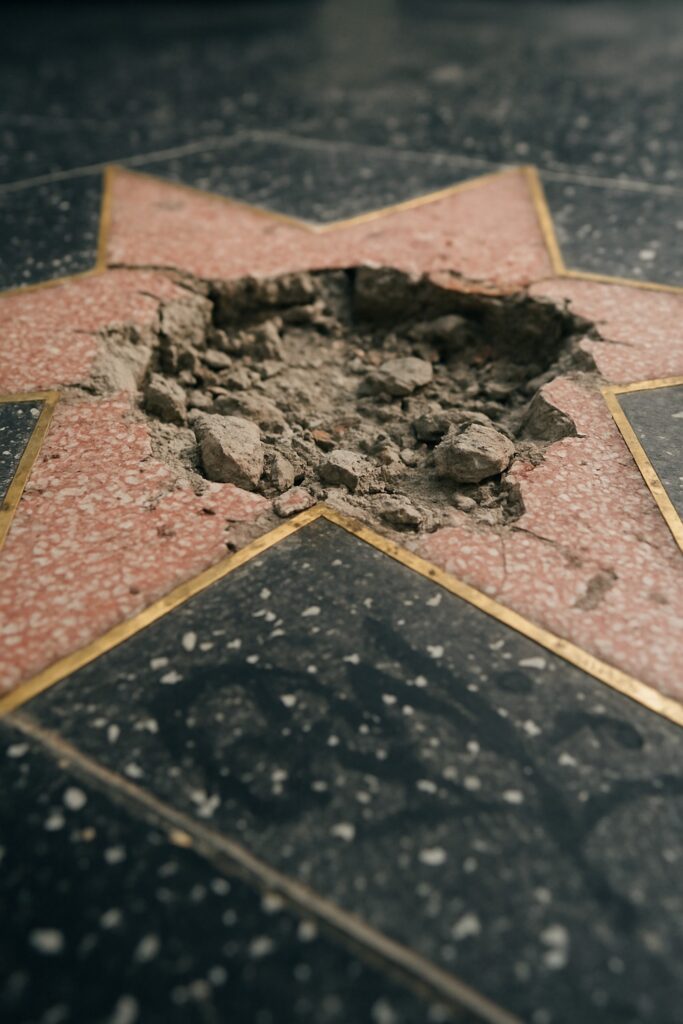
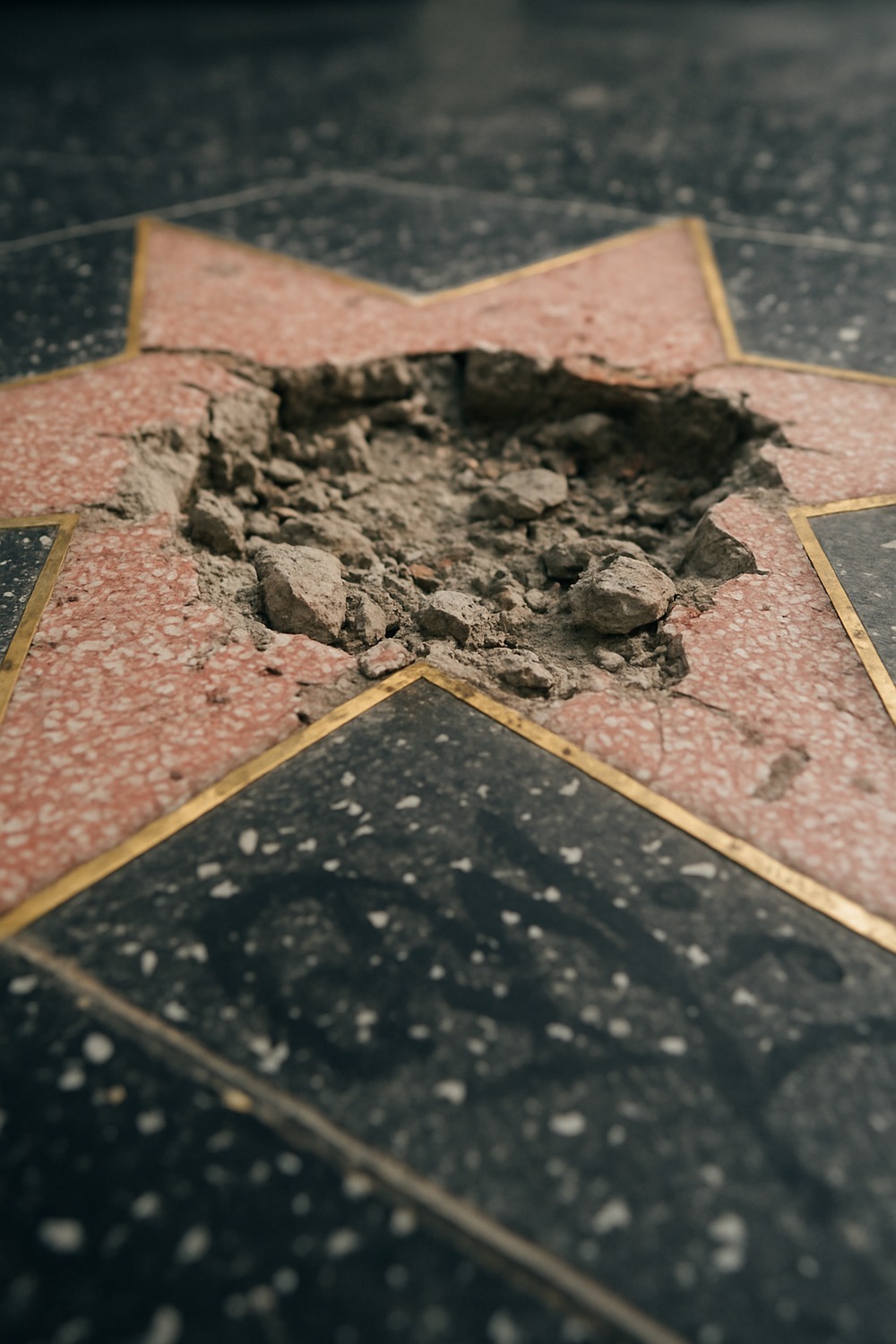
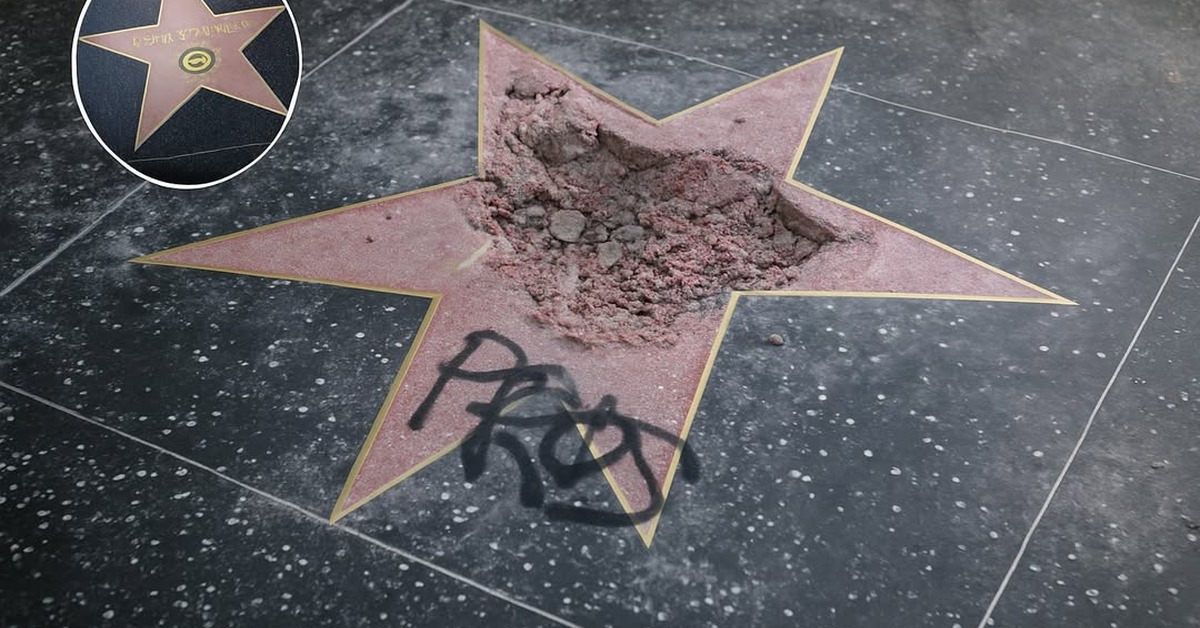
Here’s the thing about Trump Hollywood Walk of Fame star vandalism: the most revealing detail isn’t the pickaxe, or the bail amount, or even the man who swings the hammer. It’s that someone always comes back to repair it. A five-pointed patch of brass and terrazzo at 6801 Hollywood Boulevard has been destroyed to its base twice, and twice the Hollywood Historic Trust has quietly rebuilt it — no press conference, no complaint, no hesitation.
July 2018. Austin Clay doesn’t run after the pickaxe comes down. He swings again. Then he stands there and waits for the police. The star had already survived one sledgehammer attack in 2016, been repaired, and now lay shattered a second time. The Hollywood Historic Trust would rebuild it again. And the question hanging over all of it — over the brass, the terrazzo, the activists, the bail bondsmen — is deceptively simple: what, exactly, are people trying to destroy?

The Walk of Fame’s Most Contested Five-Pointed Plaque
Dedicated in 1960, the Hollywood Walk of Fame was the brainchild of E.M. Stuart, then president of the Hollywood Chamber of Commerce, conceived as a way to revitalize a boulevard starting to fray at its edges. Today it stretches 1.3 kilometres along Hollywood Boulevard and Vine Street, holding more than 2,700 stars embedded in charcoal terrazzo — each one a five-pointed shape inlaid with brass lettering and a central medallion denoting the honoree’s category. The Hollywood Walk of Fame, managed by the Hollywood Historic Trust under oversight of the Hollywood Chamber of Commerce, is maintained entirely at the Trust’s expense. Replacements cost somewhere between $5,000 and $10,000 per star.
Trump’s star has required that expenditure at least twice. No other star in the Walk’s 65-year history has come close to that record.
Donald Trump received his star in 2007, in the television category, for his work producing and hosting The Apprentice. It wasn’t controversial at the time — not publicly, anyway. The ceremony was standard, the star was installed, and for nearly nine years it sat there like every other, buffed occasionally by Trust workers, photographed by tourists, occasionally decorated with fans’ flowers. Then October 2016 arrived, and with it, James Otis and a sledgehammer. Otis later said he wanted the star auctioned off and the proceeds donated to women who had accused Trump of sexual misconduct.
Each time, the Trust rebuilt without public complaint. That quiet persistence is, in its own way, one of the stranger details in this whole strange story.
Two Strangers, One Sledgehammer, Same Bail Amount
What makes the Trump star’s history genuinely unusual isn’t just the frequency of attacks — it’s the connective tissue between them. James Otis attacked the star in October 2016, chipping away the brass letters with a sledgehammer. Charged with felony vandalism, he was released on $20,000 bail. Twenty months later, Austin Clay arrived with a pickaxe and did substantially more damage, effectively destroying the newly repaired star down to its base. Clay was also charged with felony vandalism. His bail was also set at $20,000. And the person who paid it was James Otis — the man who had attacked the same star less than two years earlier.
The whole sequence has the structure of something scripted, the kind of detail that, in any other context, you’d flag as too neat to believe.
Between those two major attacks, the star experienced dozens of smaller acts of protest. In August 2016 — a week before Otis arrived with his sledgehammer — activists built a miniature wall around it, complete with a tiny “Make America Great Again” sign. After Trump’s election in November 2016, someone left a handwritten sign reading “Shame.” In 2018, local street artist Plastic Jesus installed a tiny metal cage over the star containing miniature figures of children, referencing the family separation policy at the U.S.-Mexico border. Each intervention was documented, photographed, shared, adding another layer to what the sidewalk had become. It’s a useful reminder that reality often out-plots fiction — something explored in equally strange real-world obsessions like the compulsive logic behind a thief who struck the same target twice.
The star didn’t change. The context around it changed everything. That gap — between a fixed object and a shifting world — is precisely what made it such an irresistible target.
When a Sidewalk Becomes a Symbol Worth Destroying
Political iconoclasm — the deliberate destruction of symbols to make a political point — is older than democracy itself. Romans practised damnatio memoriae, erasing disgraced emperors from official monuments. Soviet-era statues fell across Eastern Europe after 1989. Confederate monuments came down across American cities in 2020. What does it mean when a sidewalk star joins that lineage? Because that’s exactly the argument being made every time someone shows up with a sledgehammer on Hollywood Boulevard.
Smithsonian Magazine’s examination of statue removal (researchers actually call this “symbolic displacement”) traces the impulse across centuries and concludes that the act is almost never really about the object — it’s about the story the object tells about power. That analysis fits Trump Hollywood Walk of Fame star vandalism into a very old pattern, even if the medium is unusually mundane: not a bronze general on a pedestal but a name in a sidewalk on a tourist street. An object this small shouldn’t carry this much weight — and yet here we are.
What’s counterintuitive is that the Walk of Fame was never designed as a monument to virtue. It’s a monument to celebrity — specifically to the commercial value of celebrity, funded in part by the honoree themselves. Stars don’t apply for a place on the Walk; they’re nominated. But the $50,000 sponsorship fee required to install a star is paid by the nominee or their studio. That transaction — fame purchased as much as earned — doesn’t sit easily with the idea of a civic monument. Yet that’s exactly how people treat it when they want to remove Trump’s star: as a statement of civic approval that can and should be revoked. Hollywood Walk of Fame star vandalism, in that reading, is an argument about whether the sidewalk lied.
In 2018, the West Hollywood City Council voted to recommend the removal of Trump’s star. The vote was unanimous. The Hollywood Chamber of Commerce declined. The star stayed.
The Trump Hollywood Walk of Fame Star Vandalism That Changed Nothing and Everything
Between 2016 and 2023, the Los Angeles Police Department logged multiple incidents at the star’s location, ranging from felony vandalism to misdemeanor defacement. Repaired without requesting public funds either time it was destroyed, the Hollywood Historic Trust has maintained a position consistent throughout: removing any star for political reasons would set a precedent that could unravel the entire Walk’s credibility. Stars have been awarded to individuals later convicted of serious crimes, and none have been removed. The Walk’s policy of permanence isn’t incidental — it’s structural. To remove one star is to acknowledge that the sidewalk means more than it pretends to mean.
History has a way of treating the people who ignored this kind of evidence unkindly — and the Chamber’s studied neutrality, whatever its intent, is itself a choice that the record will eventually have to account for.
And that’s the bind. The Hollywood Chamber of Commerce wants the Walk to function as entertaining public infrastructure — a place for tourists to photograph themselves next to Marilyn Monroe’s name. But Trump Hollywood Walk of Fame star vandalism has forced a much harder conversation about what public commemoration actually does. A star on that sidewalk isn’t just a name. It’s an implicit endorsement — a city saying, here is someone we chose to celebrate. When the person being celebrated becomes one of the most divisive figures in modern American history, the sidewalk stops being background and becomes foreground. The infrastructure becomes the argument.
Clay served no prison time. Charges were ultimately reduced. Otis paid the bail and made his point. The star was repaired again. As of 2024, it remains in place — sometimes clean, sometimes spray-painted, always photographed. The Trust keeps maintaining it. The LAPD keeps responding. And the pickaxe, presumably, is somewhere in an evidence locker in Los Angeles.

How It Unfolded
- 2007: Donald Trump receives his Hollywood Walk of Fame star in the television category, installed at 6801 Hollywood Boulevard without notable controversy.
- August 2016: Activists erect a miniature wall around the star, the first in a series of protest installations that would define the site as a political flashpoint.
- October 26, 2016: James Otis attacks the star with a pickaxe and sledgehammer, removing the brass letters; he’s charged with felony vandalism and posts $20,000 bail.
- 2018: Austin Clay destroys the newly repaired star with a pickaxe in July; James Otis pays his $20,000 bail; the West Hollywood City Council votes unanimously to recommend the star’s removal, a recommendation the Hollywood Chamber of Commerce declines.
By the Numbers
- 2,700+ stars currently embedded in the Hollywood Walk of Fame, maintained by the Hollywood Historic Trust (Hollywood Chamber of Commerce, 2024)
- $50,000: the sponsorship fee required to install a new star, paid by the nominee or their studio
- $20,000: bail amount set for both James Otis (2016) and Austin Clay (2018) — an exact match, paid in Clay’s case by Otis himself
- 2 full reconstructions of Trump’s star following felony vandalism — no other star in the Walk’s 65-year history has required more than one
- $5,000–$10,000: estimated replacement cost per star, covered entirely by the Hollywood Historic Trust without public funding
Field Notes
- Plastic Jesus — the artist who built the miniature wall protest in August 2016 — is the same street artist who installed a tiny cage over the star in 2018 referencing family separation policy, making him arguably the most persistent single contributor to the star’s protest history.
- Sixty-five years of operation, and the Hollywood Walk of Fame has never removed a star — not for criminal conviction, not for posthumous scandal, not for unanimous city council votes. The policy of permanent installation is explicit and has been restated multiple times specifically in response to the Trump controversy.
- Despite the political firestorm, Trump’s star consistently ranks among the most photographed on the entire Walk — partly because controversy drives foot traffic, and partly because the site has become a kind of open-air protest gallery that changes week to week.
- Researchers studying political iconoclasm still can’t fully explain why physical destruction of a symbol feels cathartic when it demonstrably changes nothing: the star is always repaired, the man retains his fame. Whether the act creates any measurable shift in public sentiment remains an open question in political psychology.
Frequently Asked Questions
Q: How many times has Trump’s Hollywood Walk of Fame star been vandalized?
Two major acts of felony vandalism — in October 2016 and July 2018 — resulted in the star’s complete destruction both times. Beyond those incidents, it has experienced dozens of smaller acts of protest, including spray painting, protest installations, and deliberate defacement. Trump Hollywood Walk of Fame star vandalism has occurred more frequently than any comparable incident in the Walk’s 65-year history.
Q: Can Trump’s star be permanently removed from the Walk of Fame?
Not under current policy. The Hollywood Chamber of Commerce, which governs the Walk of Fame, maintains a firm policy against removing stars for any reason — including criminal conviction or public pressure. In 2018, the West Hollywood City Council voted unanimously to recommend removal, but the Chamber declined, citing the precedent it would set. The Hollywood Historic Trust has repaired the star each time it’s been destroyed and has stated it will continue to do so.
Q: Did Austin Clay go to prison for destroying the star?
No. Clay was initially charged with felony vandalism and held on $20,000 bail — paid by James Otis, who had attacked the same star in 2016. Clay’s charges were ultimately reduced, and he did not serve prison time. Otis similarly avoided incarceration following his 2016 attack. Both cases were widely seen as examples of the legal system navigating politically charged vandalism where juries and prosecutors were reluctant to pursue the harshest outcomes.
Editor’s Take — Sarah Blake
What haunts me about this story isn’t the attacks — it’s the repairs. The Hollywood Historic Trust, quietly, without fanfare, has rebuilt that star twice at its own expense, knowing full well it’ll probably happen again. That’s not bureaucratic stubbornness. That’s a philosophical position: that the Walk means something permanent, even when permanence is the very thing people are trying to destroy. There’s a deep, unresolved tension in that. And nobody on either side of the argument seems to want to sit with it.
A sidewalk star is, objectively, nothing — forty-nine square inches of brass and terrazzo, flush with the ground, walked over by millions of feet that barely notice it’s there. And yet this particular square of pavement has absorbed more raw political energy than most dedicated monuments ever will. That might say something about the star. It almost certainly says more about what America does with fame — how it builds it into the ground, expects it to stay permanent, and then finds, to its surprise, that permanence is exactly what makes it intolerable. What does a country do when the myth it laid in concrete no longer matches the story it wants to tell about itself?


