


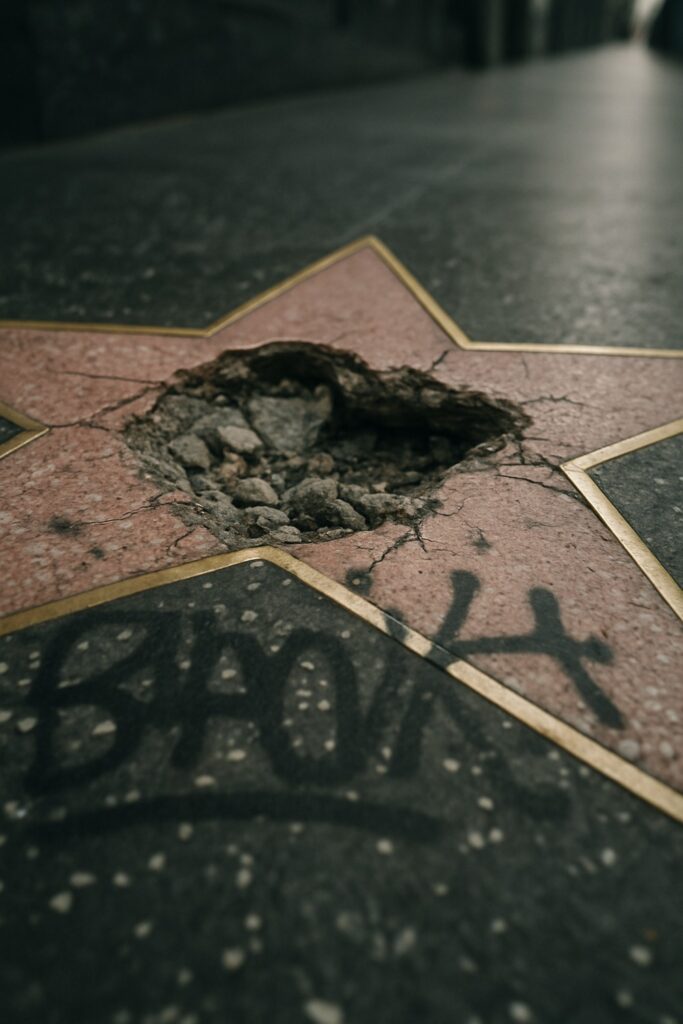
Here’s the thing about Trump Hollywood Walk of Fame star vandalism: the star keeps winning. Attacked with pickaxes, smashed with sledgehammers, surrounded by miniature mock walls — and every single time, within 48 hours, specialist craftsmen arrive and restore it to factory condition. The vandals get the headlines. The terrazzo gets the last word.
Nearly 2,700 stars line Hollywood Boulevard, honoring everyone from Marilyn Monroe to Muhammad Ali. Most sit undisturbed for decades. Donald Trump’s star, embedded in the pavement since 1994, has been attacked, guarded, surrounded by tiny toy walls, and rebuilt multiple times — making it arguably the most contested square foot of public space in the United States. So what turns a brass plaque into a battlefield?

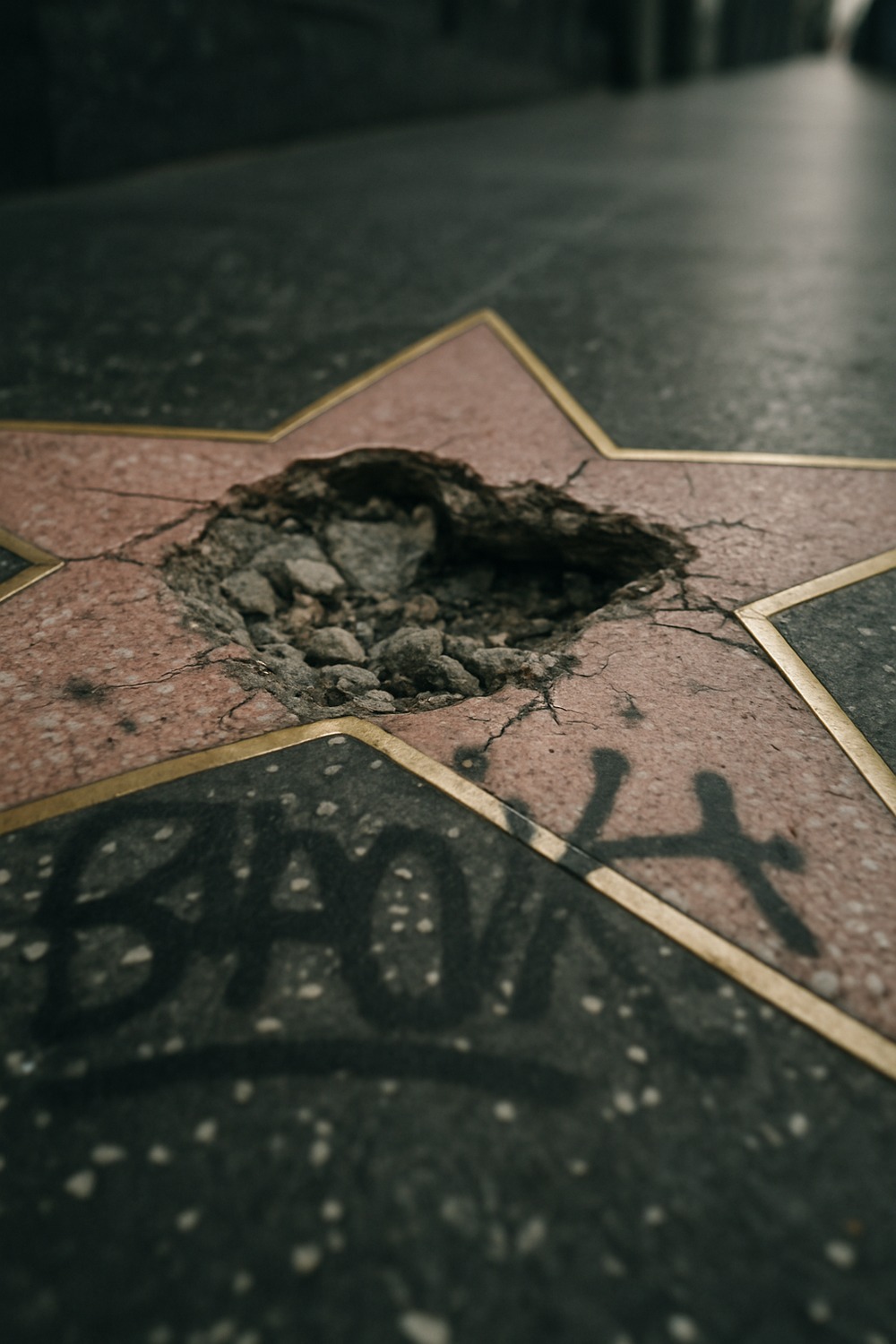
The Star That Keeps Getting Smashed Into History
Trump’s star was installed on Hollywood Boulevard on January 7, 1994, honoring his work as executive producer of the Miss Universe pageant — a television venture, not a political one. Back then, the Hollywood Walk of Fame, maintained by the Hollywood Chamber of Commerce and the Hollywood Historic Trust, was simply celebrating a brash New York developer who’d made it onto the small screen. The star cost approximately $25,000, as all stars do — nominees pay for their own installations. No one anticipated that three decades later, that same brass plaque would be targeted by pickaxes, sledgehammers, and eventually become the subject of active debates in Los Angeles City Council meetings.
The Chamber of Commerce has, on record since at least 2016, repaired the star multiple times, never once seriously entertaining calls for its removal.
The first major attack came in October 2016, just weeks before the presidential election. James Otis arrived on the boulevard dressed as a construction worker, armed with a sledgehammer and a pickaxe. He pried off the bronze letters spelling “TRUMP” and attempted to dig beneath the surface, later explaining he intended to auction the pieces to raise money for women who’d accused Trump of sexual misconduct. Otis was charged with felony vandalism. Bail was set at $20,000. He paid it, walked free, and what he did next became the hinge point of a much stranger story.
Hollywood Boulevard doesn’t stay broken for long — the Chamber of Commerce contracts specialist terrazzo craftsmen who can restore a damaged star in under 48 hours. By the time most tourists arrived the next morning, the star gleamed again. Pristine. Maddening, if you were Otis.
Austin Clay, James Otis, and a Bond Stranger Than Fiction
Why does this matter? Because the connection between the two attacks isn’t just thematic — it became financial. In July 2018, a 24-year-old man named Austin Clay arrived at the star just before 9 a.m., carrying a pickaxe. Within minutes, he’d shattered the terrazzo surface and gouged a hole roughly the size of a dinner plate where Trump’s name had been. Police arrived quickly — Hollywood Boulevard is one of the most surveilled stretches of pavement in Los Angeles — and Clay was arrested on felony vandalism charges. Bail was set at exactly $20,000. Then James Otis, the man who’d swung the sledgehammer in 2016, stepped forward and paid it.
Two attacks. Two men. The same charge, the same bail amount, and now a direct financial connection between them.
It reads like the kind of coincidence that, in a different context, might make you wonder about something genuinely coordinated. Whether that’s true remains murky. As detailed in a piece exploring a determined thief who struck the same target twice, there’s something distinctly human about returning to the scene — about the compulsion to finish what you started, or to see your predecessor succeed where you felt you’d fallen short. Clay’s stated motivation was political — he opposed Trump’s immigration policies. Otis had cited the sexual misconduct allegations. Neither man successfully removed the star permanently.
Both faced legal consequences: Clay was ultimately convicted of felony vandalism in 2019 and sentenced to three years of probation plus 20 days of community service. Otis had earlier received a similar probationary sentence. The Hollywood Chamber of Commerce, which owns and maintains all Walk of Fame stars and holds legal title to the plaques, filed for — and received — victim restitution in both cases.
Under California law, both men technically qualified for reduced charges given their lack of prior felony records (researchers actually call this a “threshold vandalism” prosecution, meaning the felony designation hung entirely on repair costs). Each incident cost the Hollywood Historic Trust an estimated $3,000 to $6,000 in specialist restoration — well above the $400 legal threshold. The star’s very durability made the attacks legally serious.
Why This Star and Not the Others?
Nearly every president, celebrity, and controversial public figure has some monument to their name. Yet Trump Hollywood Walk of Fame star vandalism has generated a volume of incidents — and a level of international media coverage — genuinely without parallel on the boulevard. Smithsonian Magazine noted in 2016 that the Walk of Fame’s stars function as uniquely accessible monuments: no fence, no raised plinth, no velvet rope. Most statues require a ladder. Trump’s star requires only a willingness to crouch on a public sidewalk, which is the Walk of Fame’s signature design choice and its greatest vulnerability.
There’s also a symbolic dimension that goes beyond politics. Trump received his star for television production, not for the presidency. That disconnect — between the entertainer-category designation and his later political identity — has made the star function as a kind of double effigy. People who vandalize it aren’t just attacking a politician; they’re attacking the entertainment-industrial complex that helped create his public persona. Bill Cosby’s star was debated for removal following his conviction, but the debate stayed largely institutional. Trump’s has been the target of direct, repeated physical intervention.
Letting anyone with a grievance treat a sidewalk star as a protest podium is either a design flaw or an accidental democratic feature — the Walk of Fame has never quite decided which, and that ambiguity is precisely why the attacks keep coming.
Between 2016 and 2022, the star was surrounded no fewer than three times by miniature replica walls — a direct mockery of Trump’s campaign promise — built by performance artist Plastic Jesus and others. Each installation drew hundreds of photographs and international wire coverage within hours. The star had become a stage set that anyone could use.
Trump Hollywood Walk of Fame Star: The Removal Debate That Went Nowhere
August 2018: following Austin Clay’s attack, the West Hollywood City Council voted unanimously to request that the Hollywood Chamber of Commerce remove Trump’s star from the Walk of Fame. It was a striking moment — an official municipal body formally asking a private organization to erase a public monument. The West Hollywood resolution cited the sexual misconduct allegations against Trump and argued the star sent a harmful message. The Hollywood Chamber of Commerce declined the same month. Their position was unequivocal: stars are permanent. Leron Gubler, then president of the Chamber, confirmed that removal was not on the table regardless of political pressure — the permanence principle, he argued, protected the Walk of Fame from becoming a tool of whoever happened to hold political power at any given moment.
And that argument has genuine historical weight. In 2004, Bill Cosby received a star. When he was convicted of sexual assault in 2018, the same removal debate erupted — and the Chamber held the same line. Charlie Sheen’s star has been the subject of similar calls. The Walk of Fame’s no-removal policy isn’t merely stubbornness; it’s a deliberate philosophical stance about the difference between honoring a specific achievement and endorsing a complete person. The star records what you did in a particular category at a particular moment. It doesn’t promise to track your moral arc forever.
The Los Angeles City Council itself has no jurisdiction over the Walk of Fame, which sits on private land managed by the Chamber. West Hollywood is a separate municipality entirely — its council’s vote was symbolic, carrying no legal force whatsoever. The resolution made headlines worldwide. It changed nothing.

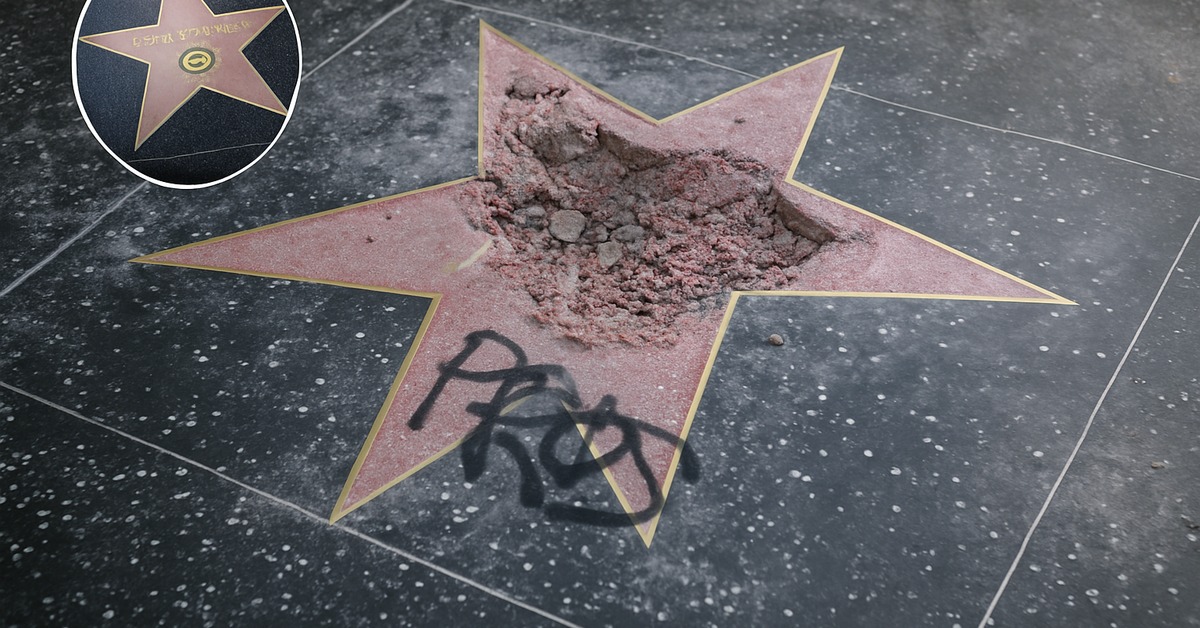
How It Unfolded
- 1994 — Donald Trump’s star is installed on Hollywood Boulevard on January 7, honoring his work as a television producer for the Miss Universe pageant.
- 2016 — James Otis attacks the star with a sledgehammer weeks before the presidential election, prying off the bronze letters; he’s charged with felony vandalism and receives probation.
- 2018 — Austin Clay strikes the star with a pickaxe in July; James Otis pays his $20,000 bail, directly connecting both attacks; West Hollywood City Council votes to request removal — the Chamber declines.
- 2019 — Clay is convicted of felony vandalism and sentenced to three years’ probation and 20 days of community service; the star is repaired and remains in place.
By the Numbers
- 2,700+ stars currently embedded in Hollywood Boulevard and Vine Street (Hollywood Chamber of Commerce, 2024)
- $25,000 — the fee each honoree pays to have a star installed, covering construction and a small ceremony
- $3,000–$6,000 — estimated repair cost per vandalism incident, pushing charges above California’s $400 felony threshold
- $20,000 — bail set in both the 2016 Otis case and the 2018 Clay case, an exact match that investigators noted at the time
- 0 — the number of stars ever permanently removed from the Walk of Fame, despite dozens of formal requests over the last three decades
Field Notes
- Terrazzo — the composite of marble chips set in cement used throughout the Walk of Fame — was chosen specifically in the 1950s for durability. It can be color-matched and repolished to near-invisible repair standards within 48 hours, which is why repeated vandalism leaves no long-term trace visible to the casual tourist.
- Performance artist Plastic Jesus erected a six-inch-tall replica wall around the star in 2016 — complete with tiny “Make America Great Again” signs — generating more than 50 million social media impressions before removal.
- Trump’s star sits in the 6800 block of Hollywood Boulevard, directly in front of what was once a well-known guitar shop — a detail that’s made it an especially photogenic target, with music-industry passersby adding an unintentional layer of cultural irony to every protest image.
- Researchers at the University of Southern California’s Annenberg School have studied Walk of Fame stars as sites of collective memory, but the specific mechanics of why some stars attract sustained protest while equally controversial figures’ stars do not remains an open question without a definitive published answer.
Frequently Asked Questions
Q: Has Trump Hollywood Walk of Fame star vandalism ever resulted in the star’s permanent removal?
No. The Hollywood Chamber of Commerce has never permanently removed any star from the Walk of Fame, and it has explicitly refused requests to remove Trump’s star on multiple occasions. Despite a formal 2018 West Hollywood City Council vote requesting removal, the Chamber held its position. The star has been repaired after each incident and remains in place today.
Q: Why were the vandalism charges felonies rather than misdemeanors?
Under California Penal Code Section 594, vandalism becomes a felony when damage exceeds $400. Each attack on Trump’s star required specialist terrazzo restoration costing between $3,000 and $6,000, well above that threshold. The Hollywood Historic Trust, as the legal owner of the star’s physical infrastructure, filed for victim restitution in both the 2016 and 2018 cases. Both James Otis and Austin Clay were convicted and received probationary sentences rather than prison time, partly due to their lack of prior felony records.
Q: What most people get wrong is that the city of Los Angeles could simply order the star’s removal — is that true?
It’s a common misconception. The Walk of Fame sits on land managed by the Hollywood Chamber of Commerce, a private nonprofit organization, not the City of Los Angeles. West Hollywood — a separate municipality — voted symbolically in 2018 to request removal, but that vote carried zero legal weight. Only the Hollywood Chamber of Commerce has the authority to remove a star, and its published policy has never permitted removal for reasons of public controversy or shifting opinion.
Editor’s Take — Sarah Blake
What strikes me about this story isn’t the vandalism — it’s the repair. Every time, within 48 hours, specialist craftsmen arrive and restore the star to factory condition. That quiet, methodical act of institutional maintenance is doing something the dramatic pickaxe swings never can: it’s declaring, without a press conference, that permanence wins. You can argue about who deserves to be remembered. The terrazzo doesn’t care. That indifference is either the Walk of Fame’s greatest strength or its most uncomfortable truth, and I’m genuinely not sure which.
Public monuments are never just pavement. They’re decisions made at a specific moment in time, hardened into stone or brass or terrazzo, and then handed to a future that didn’t get to vote. The struggle over Trump’s star — repaired, attacked, repaired again — plays out on a six-inch square of Hollywood Boulevard, but it’s really asking a question every society eventually has to face: who controls what gets remembered, and who gets to decide when the record changes? The pickaxe keeps swinging. The craftsmen keep coming. And the star keeps gleaming in the California sun, indifferent to all of it.


