


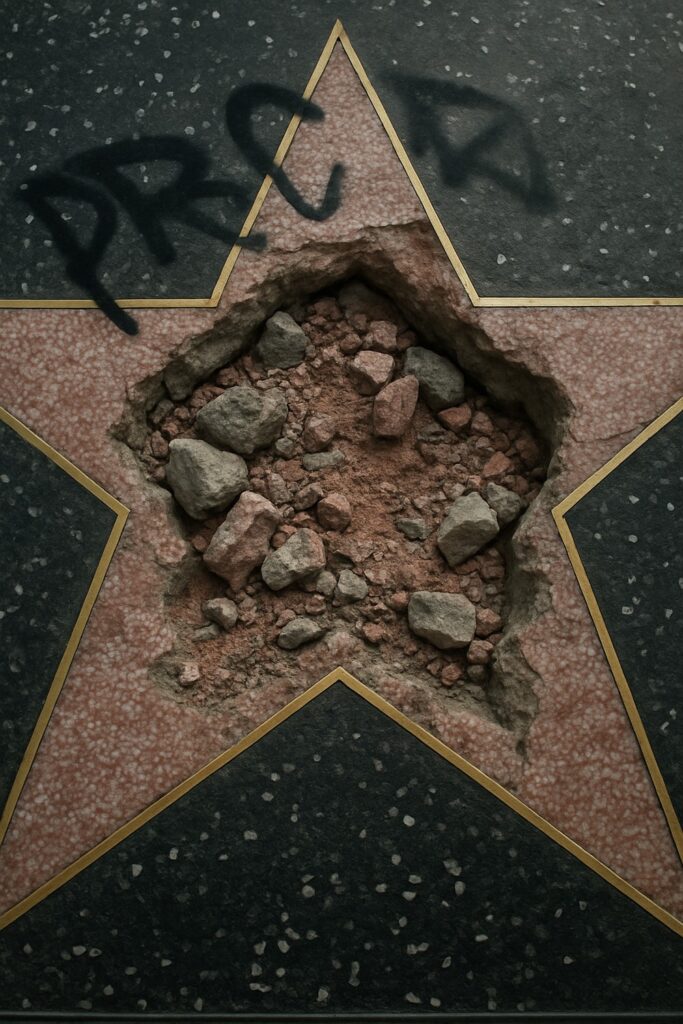
Here’s the thing about Trump’s star on Hollywood Boulevard: it keeps getting destroyed, and nobody — not the institution that owns it, not the people who attack it, not the cameras that keep showing up — seems to know how to stop the loop. Hollywood Walk of Fame star vandalism has its own strange gravity. The star gets smashed. It gets repaired. Someone arrives with a heavier tool next time.
Since 2016, Donald Trump’s star has been physically attacked at least twice with heavy tools, urinated on, surrounded by tiny protest walls, and repaired at the expense of an organization that never wanted to be in this fight. No other star in the Walk’s 65-year history has attracted anything close to this level of sustained, targeted destruction. The question isn’t just why people keep doing it. It’s what they think they’re accomplishing — and whether the sidewalk itself has anything to answer for.

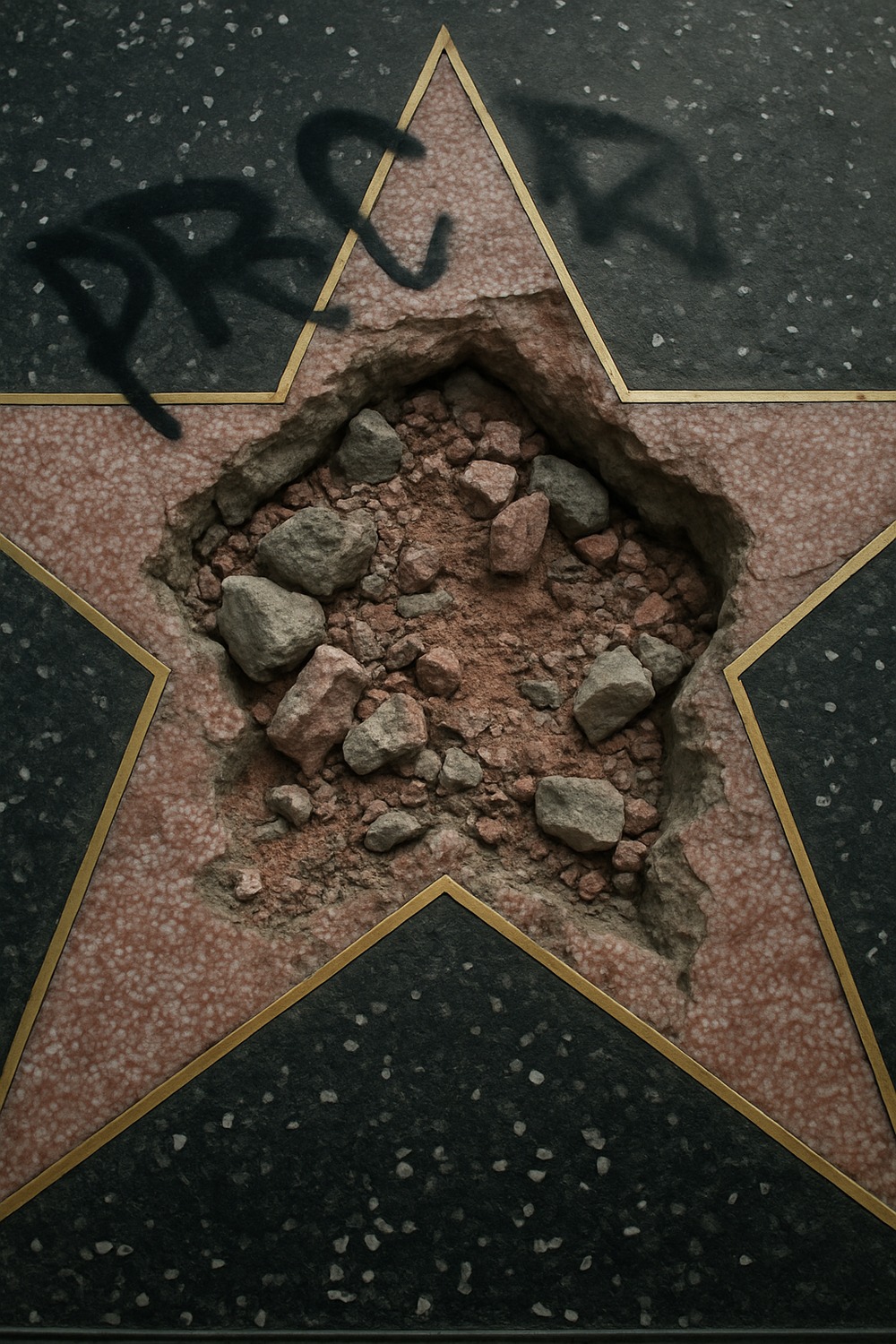


The Walk of Fame’s Strange Architecture of Glory
The Hollywood Walk of Fame, established in 1960 by the Hollywood Chamber of Commerce, was never exactly a neutral public space. It was designed as promotional infrastructure — a way to anchor tourism to a district already slipping from its golden-era glamour. Each star costs the honoree’s sponsors roughly $50,000 today to install and maintain, which means the sidewalk has always been, at its core, a pay-to-play monument.
The Hollywood Historic Trust, a nonprofit arm of the Chamber, maintains all 2,700-plus stars. That includes repairs. That includes the Trump star. The Trust has replaced it at least twice since 2016, absorbing costs and controversy with the resigned competence of a body that did not ask for any of this.
Trump received his star in 1994 for his work as executive producer of the Miss Universe pageant. That’s the official reason. By 2015, when he descended an escalator and announced a presidential run, the brass plaque on the ground had become something else entirely: a point of contact between entertainment culture and electoral reality, between myth and consequence. Stars here aren’t awarded for virtue. They’re awarded for fame — specifically, the kind of commercial, cross-platform, industry-ratified fame that Hollywood decided mattered.
The star sits at 6801 Hollywood Boulevard. Unremarkable in size — five points, pink terrazzo, brass inlay, same as Marilyn Monroe’s, same as Muhammad Ali’s. But it doesn’t behave like theirs. Tourists photograph Monroe’s star with something approaching reverence. Trump’s star draws people who arrive with tools.
Two Strangers, One Pickaxe, One Bail Payment
July 25, 2018. Austin Clay, a 24-year-old from Glendale, California, walked up to Trump’s star at roughly 3:30 a.m. and swung a pickaxe into it. He wasn’t subtle. He wasn’t masked. He destroyed it methodically, in a way that suggested he’d thought about this for a while. Los Angeles police arrested him on a charge of felony vandalism. Bail was set at $20,000. Then James Otis — a man Clay had never met — paid it.
Otis was the same individual who, in October 2016, had arrived at the same star with a sledgehammer and chisel, pried out the bronze letters spelling TRUMP, and caused roughly $3,400 in damage. Two separate incidents. Same star. Same bail amount. Same stranger covering the cost. It has the internal logic of a folk tale — except it’s just two people who felt strongly about the same five-pointed brass plaque. There’s something almost poignant about that. And something genuinely alarming about it too — the same way it’s alarming when you realize a heist has been attempted twice in the same place by people who couldn’t resist returning.
Their stated motivations were different. Clay said he acted out of anger over Trump’s immigration policies; Otis, a Republican-turned-activist, claimed he intended to donate the salvaged letters to the Smithsonian Institution, which declined. Their target was identical. And neither destruction stopped anything. The Hollywood Historic Trust repaired the star both times — each repair taking roughly two to four weeks, costing several thousand dollars, and paid for without federal subsidy.
That repetition is the thing. In most vandalism cases, destruction is a one-time eruption. Here it’s a pattern — almost ritualistic. Which raises an uncomfortable question about what the repairs themselves are saying. Every time the Trust reinstalls that star, it’s making a choice. So is every person who swings a pickaxe at it.
What Monuments Actually Do to a City’s Memory
Why does this matter? Because monuments aren’t passive — and ignoring that fact has consequences.
Urban historians and public space scholars have been making this argument with increasing urgency since the wave of Confederate statue removals that followed the 2015 Charleston church shooting and accelerated after 2020. The Smithsonian’s National Museum of American History has studied how contested public commemorations function — not as historical records, but as ongoing assertions of whose story the city endorses. When a monument stays up despite controversy, that’s a decision. When it comes down, that’s also a decision. Hollywood Walk of Fame star vandalism sits in a third, stranger category: the monument keeps being destroyed and kept being restored, producing a loop that satisfies nobody and ends nothing.
No other Walk of Fame honoree has generated this dynamic — not Roman Polanski, who was convicted of statutory rape in 1977 and still has a star, not Bill Cosby, whose star remained in place for years after his assault convictions. The difference seems to be active, physical, repeated confrontation — not just public outrage. History has a way of treating the institutions that dismissed this distinction as merely procedural very unkindly.
The paradox of Hollywood Walk of Fame star vandalism as political protest is that it’s almost perfectly self-defeating. Destruction generates news cycles. News cycles generate attention. Attention gets directed, inevitably, at the target — the star, the name, the man. Every act of vandalism that makes national headlines is, on some level, a reminder that the star exists. James Otis understood this, sort of. He said in 2016 that he hoped the episode would prompt the Hollywood Chamber of Commerce to remove the star permanently. It didn’t. Outrage, it turns out, is not a removal procedure.
What protest vandalism does accomplish — and this is the part that rarely gets discussed — is documentation. Clay’s act in 2018 was photographed, filmed, and archived. It became part of the historical record of how Americans responded to a particular political moment. Whether that’s worth a felony charge is a question only Clay can answer.
Hollywood Walk of Fame Star Vandalism and the Myth the Sidewalk Built
Trump’s relationship with Hollywood long predates his political career, and understanding that history is essential to understanding why the Hollywood Walk of Fame star vandalism keeps happening. His star was awarded in 1994, when he was primarily known as a real estate developer and tabloid fixture — not yet the reality television juggernaut he’d become with The Apprentice from 2004 onward. When Trump ran for president in 2015 and won in 2016, that certification didn’t disappear. It became a provocation. The sidewalk had endorsed him — or at least, that’s how it read to people who felt the entertainment industry bore some responsibility for elevating him.
The Chamber of Commerce has rejected that reading consistently. Stars reflect achievement in entertainment, not personal endorsement — that’s the official line. But public symbols don’t obey the intentions of the institutions that install them. They obey the people who walk over them.
There’s a mechanism here worth naming (researchers actually call this “moral outrage expression”). Psychologists who study political behavior — including researchers at the University of California, Berkeley’s Greater Good Science Center, which has published extensively on moral emotions since the early 2000s — have documented how certain acts feel meaningful not because they change outcomes, but because they externalize internal states. Destroying a symbol feels like doing something when doing something feels impossible. It’s emotionally coherent even when it’s tactically useless. That doesn’t make it right. It makes it human.
And here’s the part that genuinely complicates everything: removing Trump’s star would almost certainly generate more attention, more controversy, and more news coverage than leaving it in place. The Chamber knows this. Keeping the star and repairing it when it’s damaged is, in a perverse way, the least inflammatory option available to them. The vandals may be trying to erase a symbol. The institution is trying to outlast a fight it didn’t start.
The Question of Removal Nobody Will Actually Answer
August 2018 — three weeks after Austin Clay’s pickaxe attack — the West Hollywood City Council voted unanimously to ask the Hollywood Chamber of Commerce to remove Trump’s star. The resolution was non-binding, since West Hollywood has no jurisdiction over Hollywood Boulevard, which falls within the city of Los Angeles. The Chamber responded the way it always does: no mechanism exists for removal, the Walk of Fame is a cultural institution, stars are permanent.
What’s striking is that this position has held even as the conversation around other contested monuments has shifted dramatically. Confederate generals have come down from courthouse squares across the American South. Colonial-era statues have been toppled from Bristol to Bogotá. But a brass star on a pink terrazzo sidewalk, awarded for producing a beauty pageant, remains stubbornly in place — partly because the institution that owns it believes in permanence as policy, and partly because removal would almost certainly cause the exact kind of cultural explosion everyone involved is trying to avoid.
Nobody has found the off-ramp.
Genuinely unresolved is whether any of this matters in the long run. Monuments outlast the controversies that surround them — sometimes. Roman Polanski’s star has been walked over by millions of tourists who have no idea who he is. The controversy fades. The terrazzo stays. A 2019 analysis of Confederate monument protests by the Southern Poverty Law Center found that most sustained attention to specific monuments fades within 18 to 24 months of peak controversy, absent a triggering event. The more plausible scenario for Trump’s star isn’t removal or permanent destruction — it’s eventual irrelevance, the slow erosion of public attention that time applies to everything, including outrage.
But there hasn’t been irrelevance yet. Every election cycle, every legal development, every political flashpoint sends someone back to 6801 Hollywood Boulevard with a grievance and sometimes a tool. The star keeps getting repaired. The cycle keeps running. And the sidewalk absorbs all of it, passive and pink, saying nothing.

How It Unfolded
- 1960: The Hollywood Walk of Fame is officially dedicated by the Hollywood Chamber of Commerce, with the first stars installed along Hollywood and Vine as a tourism anchor for a declining district.
- 1994: Donald Trump receives his star for his role as executive producer of the Miss Universe pageant — a standard entertainment-industry honoree at the time, largely uncontroversial.
- October 2016: James Otis uses a sledgehammer and chisel to pry the bronze letters from Trump’s star during the presidential campaign, causing approximately $3,400 in damage and triggering national coverage.
- July 2018: Austin Clay attacks the star with a pickaxe; James Otis pays his $20,000 bail, creating the strange symmetry that defines the whole episode.
- August 2018: The West Hollywood City Council votes unanimously to request the star’s removal — a non-binding resolution the Hollywood Chamber declines to act on.
By the Numbers
- 2,700+: Stars currently on the Hollywood Walk of Fame, maintained by the Hollywood Historic Trust (Hollywood Chamber of Commerce, 2024)
- $50,000: Approximate cost for a sponsor to install a new star today, covering installation and an endowment for future maintenance
- $3,400: Estimated damage from James Otis’s October 2016 attack — the first confirmed physical destruction of Trump’s star
- $20,000: Bail amount set for Austin Clay after his July 2018 pickaxe attack — the same amount Otis paid on Clay’s behalf
- 65 years: The Walk of Fame’s operational history, during which no other star has been physically attacked with heavy tools on more than one occasion
Field Notes
- The Hollywood Historic Trust has never publicly disclosed the exact cost of repairing Trump’s star after either attack, citing standard policy of not itemizing individual star maintenance — which means the true financial toll of the vandalism cycle remains unknown.
- Trump’s star is one of only a handful on the Walk awarded for television production work rather than acting, music, or live performance — a category distinction most tourists don’t register when they photograph it.
- West Hollywood’s 2018 removal resolution was the first time any municipal government had formally asked the Chamber to pull a star — a precedent that, so far, has produced no results.
- Scholars of public monument psychology still can’t fully explain why repeated physical destruction of a symbol increases rather than decreases its cultural salience — the more a monument is attacked, the more attention it accrues, yet the mechanism driving that counterintuitive outcome isn’t well modeled.
Frequently Asked Questions
Q: Has the Hollywood Walk of Fame star vandalism involving Trump’s star ever led to the star being permanently removed?
No. Despite multiple attacks, a municipal resolution from West Hollywood, and sustained public pressure, the Hollywood Chamber of Commerce has declined to remove Trump’s star. The Chamber maintains that it has no formal mechanism for removal and that stars on the Walk of Fame are permanent honors. The Hollywood Historic Trust has repaired the star at least twice following physical attacks in 2016 and 2018.
Q: Who actually pays for repairs when a Walk of Fame star is vandalized?
The Hollywood Historic Trust, the nonprofit arm of the Hollywood Chamber of Commerce, covers the cost of repairs to all Walk of Fame stars, including vandalism damage. There’s no federal or city government funding for this. When sponsors pay the roughly $50,000 installation fee, a portion goes into a maintenance endowment — but the Trust absorbs unplanned repair costs from incidents like the Trump star attacks without public subsidy. The Chamber has never publicly itemized repair costs for individual incidents.
Q: Why do people think destroying Trump’s star will get it removed — isn’t that a misconception?
Yes, largely. James Otis stated in 2016 that he hoped his attack would prompt the Chamber to remove the star. It didn’t, and the Chamber has been consistent on this point for years. The common misconception is that sustained physical pressure or public outrage can trigger removal — but the Chamber treats permanence as an institutional policy, not a judgment call. If anything, the attacks have made removal politically harder, since acting under duress would set a precedent the Chamber clearly doesn’t want to establish.
Editor’s Take — Sarah Blake
What strikes me most about the Trump star cycle isn’t the vandalism itself — it’s the repairs. Every time the Hollywood Historic Trust puts that star back, it’s making a quiet, stubborn argument about what institutions are for. Not politics. Not endorsement. Permanence. There’s something almost noble in that position, and something deeply frustrating about it simultaneously. The sidewalk was never designed to carry this much meaning. The fact that it does anyway — that a piece of terrazzo can become a proxy war — tells you more about the state of American symbolic life than any act of vandalism ever could.
Monuments don’t mean what their creators intend. They mean what the culture needs them to mean — and that meaning shifts, accumulates, sometimes explodes. Hollywood Boulevard was built to celebrate fame and draw tourists with disposable income. Instead it’s hosting an ongoing argument about accountability, celebrity, political power, and the strange alchemy by which entertainment becomes something that feels like history. The pickaxe keeps coming back. The terrazzo keeps getting poured. And somewhere in that loop — between destruction and repair, between outrage and institutional silence — something real about America is being said, by everyone involved, whether they mean to say it or not.


