


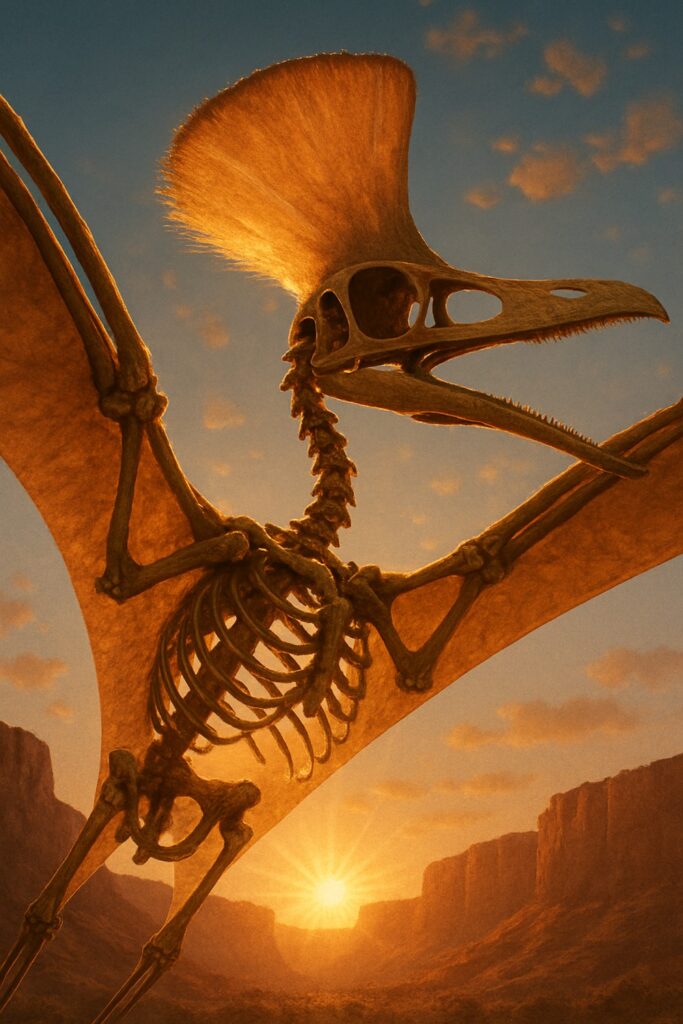
Tupuxuara leonardii had a wingspan approaching fifteen feet and a skull crest so structurally excessive it may have extended further in soft tissue than the bone beneath it — which raises an immediate question: what, exactly, was evolution optimizing for? The animal flew over what is now northeastern Brazil 110 million years ago, and paleontologists extracting it from the Santana Formation have been asking that question ever since.

Anatomy of a Sky Giant
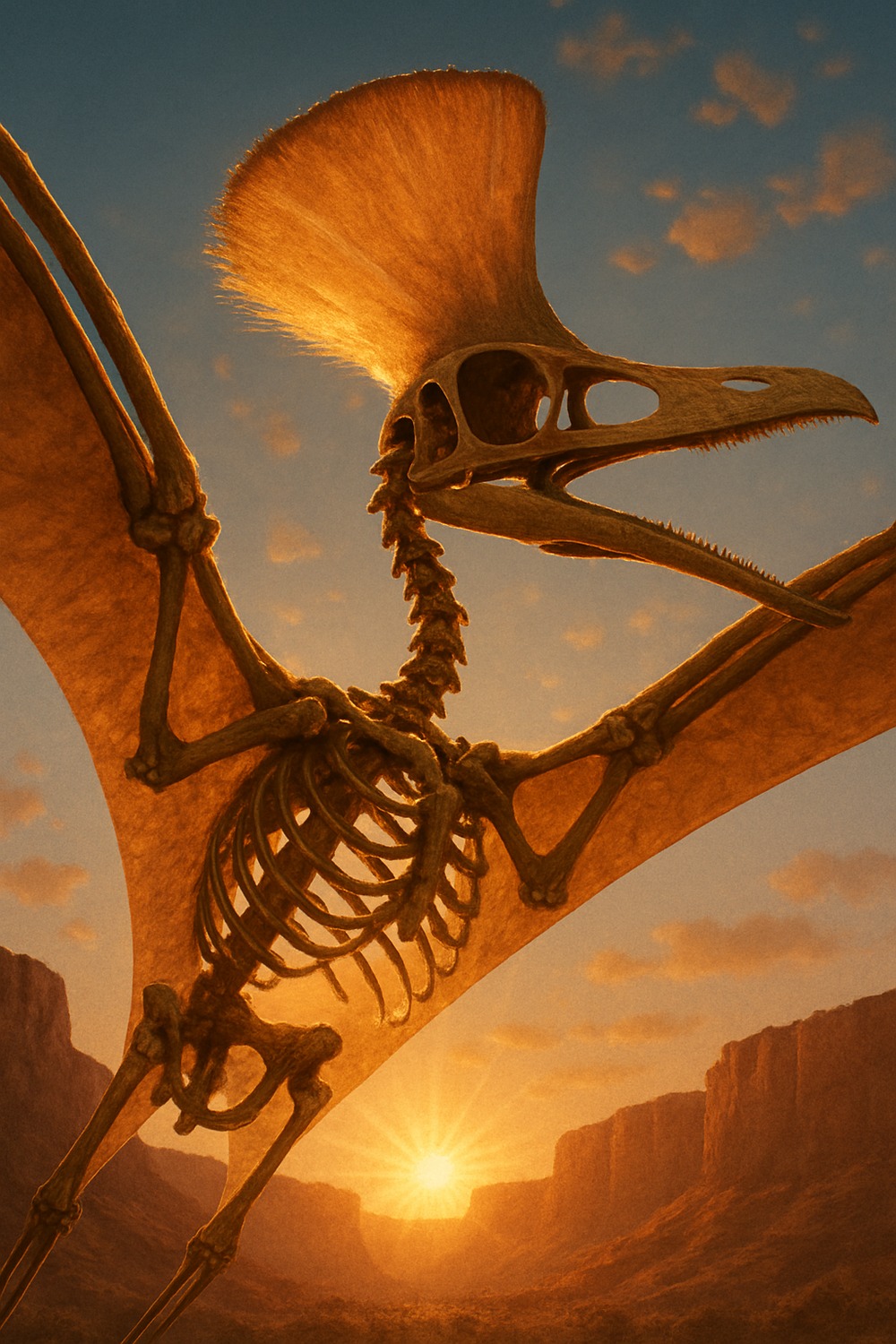
Tupuxuara leonardii belonged to the tapejarids, a pterosaur family defined by elaborate head ornamentation and largely toothless jaws. Adults reached a wingspan of around 4.5 meters — hollow bones keeping the whole apparatus airborne, the same weight-saving architecture evolution would later hand to birds. The fourth finger was dramatically elongated to anchor the primary flight membrane, the patagium, which likely swept back toward the hind legs to create a broad, efficient wing surface. Unlike their long-tailed pterosaur predecessors, tapejarids like Tupuxuara flew short-tailed, relying on muscular control and — possibly — those spectacular crests to stay on course.
That skull is something else entirely. Lightly built and elongated, it launched a massive crest upward and backward from the snout; fossil evidence suggests the structure extended even further in life through soft tissue beyond the bony core. The visible crest preserved in museum specimens is almost certainly the conservative estimate. The jaws curved gently downward at the tip — a detail that has driven real debate about diet. Soft fruits, fish plucked from shallow water, some opportunistic combination. The Cretaceous waterways and coastal lagoons of South America weren’t short on options for something this large and this agile.
The Enigma of the Crest
Why does this matter? Because the crest is where the biology stops being straightforward and starts requiring explanation. One leading hypothesis casts it as an aerodynamic tool — a sail or rudder trimming the animal’s heading during long soaring flights. Biomechanical models lend this some credibility; even modest cranial structures can redirect airflow, and a crest this size could have offered real steering advantages in open sky. Plausible. But here’s the thing: evolution is parsimonious. A functional steering fin doesn’t need to be gorgeous.
That’s where social signaling enters the argument, and it’s a compelling case. Turkeys have wattles. Cassowaries carry bony helmets. Peacocks are, well, peacocks. Elaborate structures in living animals frequently exist to communicate rather than to perform mechanics. Tupuxuara’s crest may have served as a species badge — readable at distance across open sky — or as a sexual advertisement, broadcasting fitness to prospective mates the way an impossible tail does for a peacock. Some fossil impressions preserve traces of varied surface textures across the crest (researchers actually call this differential keratinization), hinting that these structures wore color in life. Vivid reds, yellows, iridescent patterns — all speculative, none biologically unreasonable.
The grey stone gives nothing away. That’s precisely what makes it maddening.
And yet the sheer exuberance of this structure keeps pulling researchers back toward the signaling hypothesis. A steering mechanism scaled to this degree is almost architecturally excessive. At some point, the size of the thing becomes its own data point.
Masters of the Cretaceous Sky
Northeastern Brazil in the Early Cretaceous: lush river deltas, shallow inland seas, dense tropical vegetation, warm water thick with giant fish. Early flowering plants were beginning their slow conquest of terrestrial habitats. Crocodile relatives worked the muddy banks. Overhead, multiple pterosaur species divided up the airspace through differences in body size, jaw shape, and almost certainly crest morphology — an ecological partition that required real sophistication. Picture that kind of complexity, and then consider that scientists working in that heat, sifting sediment for bone fragments, would tell you the fossil record still outpaces the models built to explain it.
The data left no room for interpreting Tupuxuara as a marginal or transitional form — it was fully committed to aerial life, embedded in a layered community of flying reptiles that had been refining flight for tens of millions of years before birds attempted their first experiments with feathers and lift. The diversity visible in the fossil record suggests pterosaur ecology was far richer than early estimates credited, with each species occupying its own narrow niche in airspace that, from the ground below, must have looked genuinely crowded.

How It Unfolded
- 1985 — First Tupuxuara specimens formally described from Santana Formation concretions in northeastern Brazil, establishing the genus within tapejarid pterosaurs.
- 1994 — Tupuxuara leonardii named as a distinct species; crest morphology and jaw curvature identified as diagnostic features separating it from closely related taxa.
- Early 2000s — Biomechanical studies begin modeling the aerodynamic implications of large tapejarid crests; competing hypotheses — steering function versus social signaling — enter serious debate.
- 2010s–present — Micro-CT scanning and chemical analysis applied to Santana Formation concretions, recovering soft tissue traces and surface texture data that reopen questions about crest coloration and extent.
A Window Into Deep Time
Every Tupuxuara specimen recovered from the Santana Formation survived through a chain of geological luck — fossilization was rare in these environments; most animals simply disappeared. Limestone concretions sealed remains inside before decay could finish the job. These nodules have produced some of the finest pterosaur material on the planet: not just bones, but occasional wing membranes, soft tissue traces, even hints of skin texture. Researchers now run micro-CT scanners and chemical analyses across these specimens, extracting biological detail from rock that has held its secrets for over a hundred million years.
It’s painstaking work, and the payoff arrives in increments. Each new scan narrows the range of what remains unknown — which, with Tupuxuara, is still a considerable range.
By the Numbers
- ~4.5 m — adult wingspan
- 110 million years — approximate age of Santana Formation specimens
- 1 — number of species formally attributed to Tupuxuara leonardii
- Skull crest — bony core potentially exceeded in total length by soft tissue extension
- Multiple competing hypotheses — aerodynamic, social signaling, thermoregulation; no consensus reached
Field Notes
- Tapejarids are among the most crest-elaborate pterosaurs in the fossil record; Tupuxuara sits near the upper end of that range.
- The Santana Formation concretions represent one of the few Cretaceous deposits where soft tissue preservation occurs with enough regularity to support systematic study.
- Crest coloration remains entirely inferential — surface texture variation in fossil material is suggestive but not diagnostic for pigmentation.
- Jaw morphology in Tupuxuara is consistent with both frugivory and piscivory; isotopic studies on diet have not yet produced definitive results for this taxon.
Frequently Asked Questions
What did Tupuxuara leonardii eat?
Jaw curvature and toothless construction are consistent with soft fruit or fish. Neither option has been confirmed by isotopic analysis. Most researchers treat the diet as an open question, with frugivory favored for inland specimens and fish-feeding plausible near coastal or lacustrine environments.
How large was the crest relative to the skull?
In preserved bone, the crest matches or exceeds skull length. Soft tissue traces in some specimens suggest the full structure in life was larger still — though precise reconstruction remains difficult.
Was Tupuxuara closely related to other crested pterosaurs?
Yes. It belongs to Tapejaridae, a family that includes Tapejara and Caiuajara, all characterized by prominent cranial crests and reduced dentition. For broader context on pterosaur diversity, see our overview of Cretaceous flying reptiles.
How are Santana Formation fossils preserved?
Calcium carbonate concretions enclosed remains rapidly enough to prevent complete decay, occasionally preserving soft tissue alongside bone. Micro-CT scanning has become the primary tool for non-destructive analysis of these specimens.
Could Tupuxuara control its crest?
There is no direct skeletal evidence of crest musculature that would allow active movement. Most interpretations treat it as a fixed structure — static display or passive aerodynamic surface, not an actively controlled appendage.
Editor’s Take — Dr. James Carter
What the Tupuxuara crest actually demonstrates — and this is underappreciated in popular coverage — is that sexual selection and ecological pressure were operating simultaneously on pterosaur anatomy at a level of refinement we typically reserve for discussions of birds or mammals. A structure that large, in an animal that depends on weight economy for flight, carries a measurable metabolic cost. Evolution kept it anyway, and probably made it larger. That cost-benefit calculation tells you more about Cretaceous pterosaur society than any single fossil ever could.
Tupuxuara leonardii soared above ancient floodplains long before our own lineage had managed its first tentative mammalian steps. Its crest — steering fin, social banner, mating spectacle, or all three at once — stands as a record of evolution’s willingness to build the spectacular when the merely functional would have sufficed. Not just that this animal existed, but that it was apparently not content to exist quietly. As paleontologists continue working the Santana Formation, the Cretaceous sky fills in — more species, more color, more complexity. In the wings and crests of animals like Tupuxuara, something fundamental becomes clear: the drive to be seen, to signal, to soar, predates us by an almost incomprehensible margin.


