


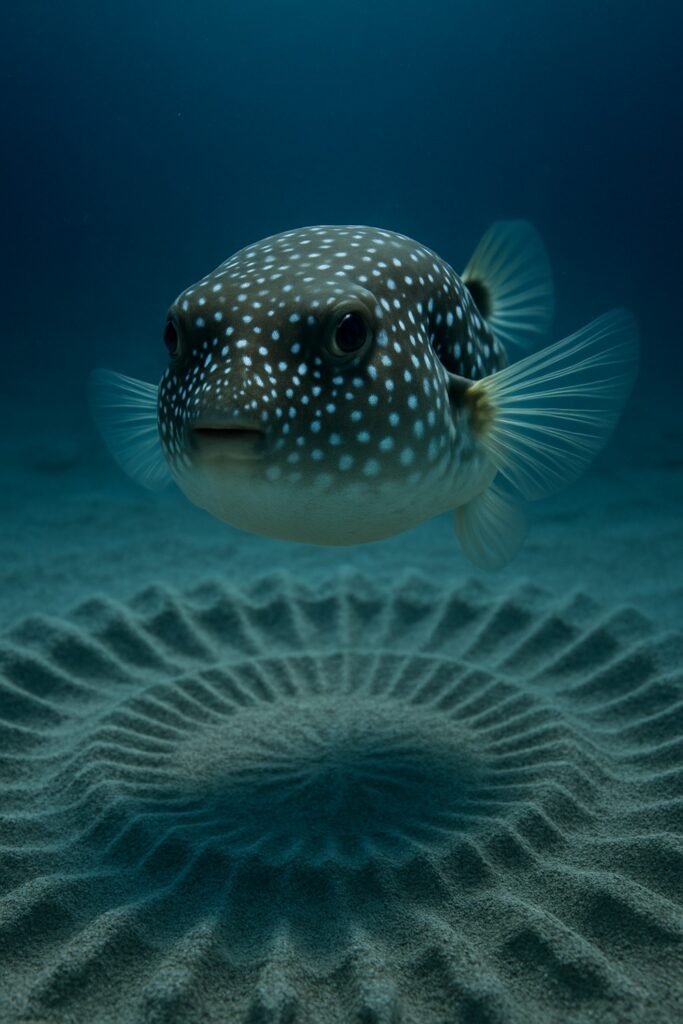
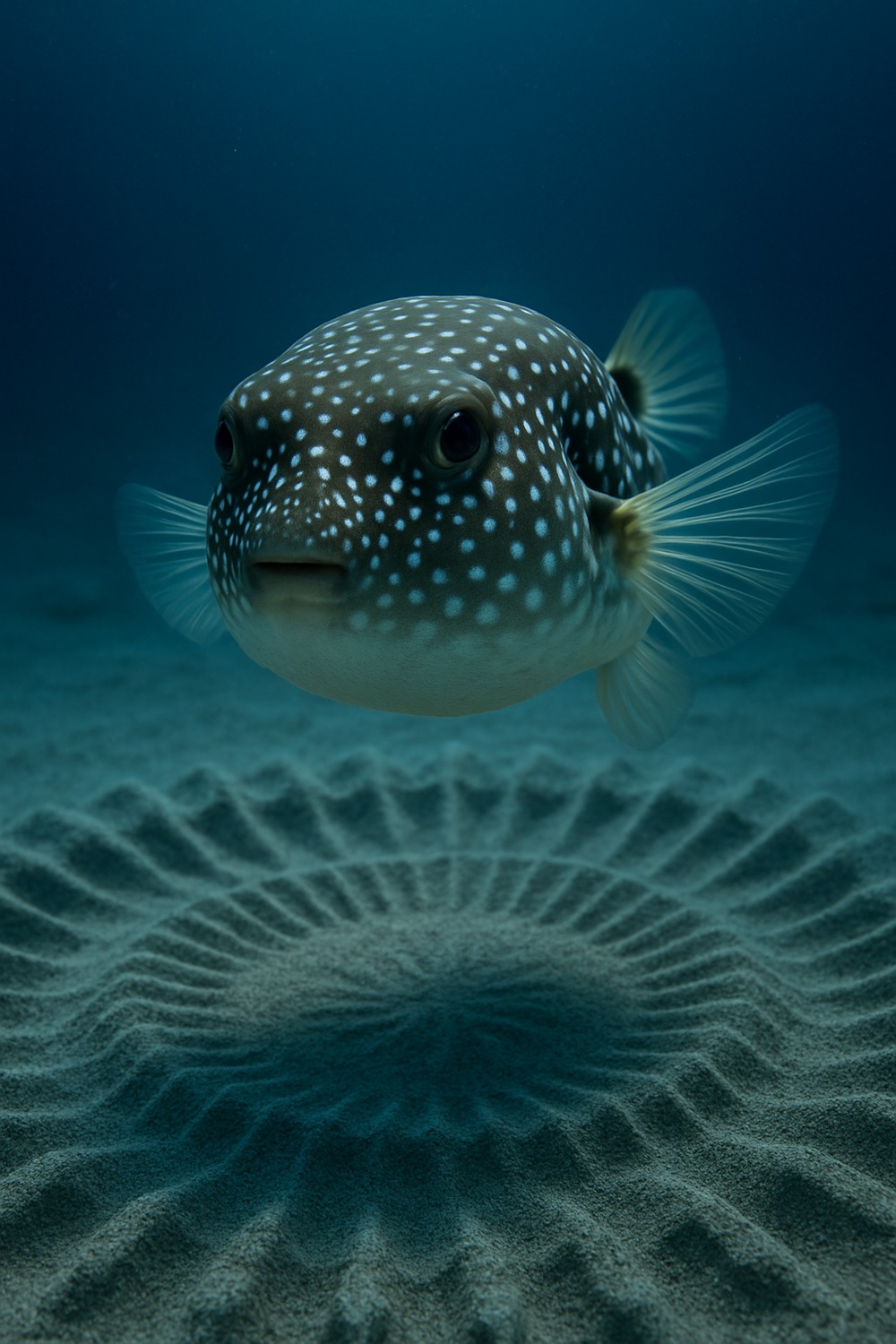
Here’s the thing about the white-spotted pufferfish sand circle: the animal that builds it fits in your palm. The structure it produces does not. Nearly two meters across, radially precise, hydrodynamically functional — and completed entirely by a fish using only its fins, working alone, against a seven-day deadline it didn’t choose.
The species is Torquigener albomaculosus, no longer than 12 centimeters. For years, nobody knew what made these circles. Now we do. And the answer raises a question that’s harder to shake than the geometry itself: what does it mean when an animal builds something beautiful?

The Mystery Circle That Stumped Marine Scientists
In 1995, underwater photographer Yoji Ookata was diving near Amami-Oshima Island in southern Japan when he spotted something strange on the seafloor: a perfect geometric circle, roughly two meters in diameter, etched into fine white sand. Radial ridges fanned outward from a central depression like the spokes of a wheel. The symmetry was almost unsettling. Ookata documented it and brought a television crew back to investigate — but the creator eluded them for years.
It wasn’t until 2011 that a team from the University of the Ryukyus, led by biologist Hiroshi Kawase, finally identified the architect. Their findings, published in 2013, confirmed it was a newly described species of pufferfish — Torquigener albomaculosus — and that each circle was built entirely by a single male, from scratch, with no tools beyond his own body.
The discovery landed like a small earthquake in marine biology. Not because large animals building elaborate structures was unheard of — bowerbirds do it, humans certainly do it — but because no fish had ever been documented doing anything like this. Fish weren’t supposed to be architects. The circles weren’t foraging pits or accidental disturbances. They were intentional, repeatable, and structurally consistent across individuals. Every circle had the same ratio of ridge to valley. Every center was the same relative depth. The precision wasn’t individual variation. It was a species-wide standard.
Kawase’s team watched males construct the circles over periods of five to nine days, swimming continuously, fins beating against the sediment in deliberate strokes. A single male, working without rest, producing geometry that required spatial awareness we’d never credited to a fish. The ocean had been hiding this for as long as the species had existed.
How a Fish Builds an Architectural Marvel
Construction begins at the outer edge. The male swims in concentric arcs, using his pectoral and dorsal fins to push coarse sand outward and upward into ridges. He returns again and again to the same furrows, deepening and refining them. As the structure takes shape, he shifts his attention inward — toward the central nest — where he smoothes the sediment until it reaches a different, finer texture than the surrounding ridges. It’s not random sweeping. It’s sequential, staged construction. Watching it is oddly reminiscent of watching a craftsman at work. Nature produces some extraordinary architects — the coral reef’s smallest residents reveal just how elaborate underwater adaptation can get — but even by those standards, the pufferfish’s geometric precision stands apart.
What the male also does, and this part still amazes researchers, is decorate. During the final stages of construction, he collects fragments of shell and small pieces of coral rubble and places them along the ridges and in the central nest. Kawase’s 2013 study noted that the shell fragments aren’t scattered randomly — they appear to be positioned deliberately, concentrated at specific intervals. Whether this reflects aesthetic preference or serves a functional purpose in terms of sediment stability isn’t fully resolved. But the behavior is consistent. Every male does it.
Shell collection appears to be a fixed part of the construction sequence, not an afterthought. A fish less than 13 centimeters long, maintaining near-constant movement for up to seven days, producing a structure roughly 15 times its own body length in diameter. Scale that up to human proportions and you’re talking about a person building a structure nearly 27 meters across using only their hands. The commitment is staggering. And it’s entirely possible she won’t show up at all.
The Female’s Standards Are Ruthlessly High
Why does any of this matter so much? Because the female’s evaluation turns out to be the real engine driving the entire architecture.
When a female arrives, she circles the structure, descends toward the center, and appears to examine the texture of the nest sediment with her body before deciding whether to stay. Kawase’s research team, observing at Amami-Oshima in the years following the initial discovery, noted that females appeared to favor males whose central nests contained the finest, most uniform sediment — and whose outer ridges were the most consistently proportioned. A 2013 study published in Scientific Reports found that the ridged structure serves a direct functional purpose beyond aesthetics: it acts as a current-breaker, reducing water flow velocity over the central nest. The finer sediment in the center, which the male actively cultivates, appears to provide a more stable environment for egg development. The female isn’t just choosing beauty. She’s choosing engineering.
That reframe matters. It would be tempting — and romantically satisfying — to describe the white-spotted pufferfish sand circle purely as an act of courtship art, a fish equivalent of a Valentine’s card writ large in sand. But the ridged geometry solves a real hydrodynamic problem. Faster-moving water near the seafloor can disturb developing eggs, and the ridges interrupt that flow. A poorly constructed circle, with uneven ridges or coarse center sediment, isn’t just aesthetically inferior — it’s functionally inferior. The female’s inspection isn’t arbitrary pickiness. It’s quality control on a nest that will determine her offspring’s survival. History has a way of treating the scientists who dismissed this kind of behavioral complexity in fish unkindly.
If she rejects the circle, the male doesn’t simply wait. He begins again. Researchers have observed males demolishing and reconstructing structures entirely, presumably refining their technique with each attempt. There’s no guarantee of success after seven days of labor. The selection pressure here is brutal, and the geometry is the résumé.
What the White-Spotted Pufferfish Sand Circle Tells Us About Intelligence
Prior to Kawase’s work, elaborate construction behavior in vertebrates was largely associated with birds and mammals — animals with the neural architecture to support spatial planning and iterative building. Fish, as a group, weren’t expected to demonstrate what behavioral ecologists call “extended goal-directed behavior” (and this matters more than it sounds) — action sequences that serve a future purpose rather than an immediate one. The white-spotted pufferfish sand circle forced a significant revision in how scientists categorize cognitive complexity in fish. A 2021 review by researchers at Kyoto University examined cross-species examples of non-avian, non-mammalian architectural behavior and flagged the pufferfish case as among the most compelling evidence that construction-based mate selection has evolved multiple times across the vertebrate family tree, independently of brain size thresholds previously assumed necessary.
But here is the detail that keeps surfacing in these discussions: the male builds toward an outcome he can’t see yet. The female hasn’t arrived. Her preferences — finer sediment, consistent ridge height, shell placement — are encoded in his behavior through generations of selection, not through conscious anticipation. He refines the center before she appears. He places shells before she evaluates them. The structure is completed to a standard before it’s judged. Whether that constitutes “intelligence” depends entirely on how you define the word — and the pufferfish case is increasingly useful in that philosophical argument.
And neurologically, pufferfish have relatively small brains compared to the birds and mammals that dominate construction-behavior literature. Yet the behavioral output is structurally comparable. That gap between neural complexity and behavioral complexity is one of the most productive tensions in contemporary animal cognition research. The fish didn’t read the neuroscience. It just kept building.
Where to See This
- Amami-Oshima Island, Kagoshima Prefecture, Japan — the original discovery site and still the most reliably documented location for observing active circles, particularly between spring and summer when males are most actively constructing. Visibility and depth (approximately 15–30 meters) require open-water dive certification.
- The Biological Institute on Kuroshio (formally affiliated with Kyoto University’s research network) has ongoing marine behavior monitoring in the region — Hiroshi Kawase’s published work through Scientific Reports remains the primary academic reference for researchers and naturalists seeking context before visiting.
- For non-divers, NHK’s original documentary footage of the circle-building behavior — filmed at Amami-Oshima and broadcast widely after 2012 — remains the most detailed visual record of the full construction sequence available to general audiences.
How It Unfolded
- 1995 — Underwater photographer Yoji Ookata first documents a geometric sand circle near Amami-Oshima Island, Japan, sparking years of speculation about its origin.
- 2011 — A team from the University of the Ryukyus, led by Hiroshi Kawase, identifies a pufferfish as the builder and begins systematic behavioral observation.
- 2013 — Kawase’s team formally describes Torquigener albomaculosus as a new species in PLOS ONE, simultaneously publishing construction behavior findings in Scientific Reports; the story reaches global media audiences.
- 2021 — Kyoto University researchers cite the pufferfish construction case in a broader review of non-avian architectural behavior, repositioning it as a benchmark in vertebrate cognition studies.
By the Numbers
- ~1.8–2 meters — the average diameter of a completed white-spotted pufferfish sand circle, approximately 15 times the builder’s body length (Kawase et al., 2013, Scientific Reports)
- 5–9 days — the documented construction window for a single circle, based on direct observation at Amami-Oshima
- 12–13 centimeters — the average total body length of an adult male Torquigener albomaculosus
- Roughly 2× reduction in near-bottom current velocity measured within the central nest compared to surrounding seafloor, according to Kawase’s hydrodynamic analysis
- ~25 meters — the typical depth at which active circles are most frequently observed, requiring full scuba equipment to witness directly
Field Notes
- During the 2011–2013 observation period at Amami-Oshima, researchers noted that males sometimes incorporated specific shell species into the central nest at higher concentrations than others nearby — suggesting selective, not random, material collection, though the precise selection criterion hasn’t been fully characterized.
- Circles are ephemeral. Ocean currents and storm activity can erase a completed structure within days of construction. Males have been observed beginning reconstruction almost immediately after a circle is damaged, with no apparent pause between destruction and restart.
- Torquigener albomaculosus wasn’t formally named as a distinct species until 2014 — meaning the behavior was documented before the animal building it had an official scientific name.
- Researchers still don’t fully understand how males calibrate ridge symmetry without any obvious external reference point. How a fish produces consistent radial geometry from a central position, with no line of sight to the outer edges, remains an open and genuinely puzzling question in spatial cognition research.
Frequently Asked Questions
Q: What exactly is a white-spotted pufferfish sand circle, and how big does it get?
A white-spotted pufferfish sand circle is a geometric structure built on the seafloor by a male Torquigener albomaculosus as part of its mating display. It consists of radial ridges extending outward from a finely textured central nest. Circles typically reach 1.8 to 2 meters in diameter — remarkable given the builder is around 12 centimeters long. These structures are found at depths of roughly 15 to 30 meters off southern Japan, primarily around Amami-Oshima Island.
Q: Why does the pufferfish build the circle — is it purely for attracting a mate?
The circle serves a dual purpose. It functions as both a courtship display and a working nest structure. The ridged geometry reduces water flow velocity over the central nest, creating calmer conditions for egg development. Females inspect the circle closely and appear to favor nests with the finest, most uniform central sediment and the most consistent ridges — so while the circle signals the male’s fitness, it also directly improves survival conditions for any eggs she lays there. Form and function are inseparable in this case.
Q: Do people often mistake these circles for human-made structures or natural formations?
Yes — and that’s precisely what happened when Yoji Ookata first photographed them in 1995. The symmetry is so precise that natural current activity seemed an unlikely explanation, and no human presence could account for structures at that depth. For over a decade, the circles circulated as a genuine seafloor mystery. Even after Kawase’s team identified the builder in 2011, some initial media coverage framed the story as a possible natural geological feature. The idea that a small fish could produce such consistent geometry simply didn’t fit existing assumptions about fish behavior — which is exactly what made the confirmation so significant.
Editor’s Take — Alex Morgan
What stays with me isn’t the geometry. It’s the sequence: he places the shells before she arrives. He smooths the center before anyone is watching. That’s not reflex. That’s preparation for an audience that doesn’t exist yet — and that distinction, however you want to frame it neurologically, is the part that quietly destabilizes a lot of assumptions we carry about what fish are capable of noticing, anticipating, and caring about. The pufferfish didn’t get the memo that only big-brained animals get to build things that matter.
A fish the length of your hand. Seven days of uninterrupted labor. A structure precise enough to alter the physics of water flow across its surface. The white-spotted pufferfish sand circle doesn’t just raise questions about animal intelligence — it raises questions about what we mean when we call something intentional, something beautiful, something built with purpose. Every time the ocean gives up a secret like this one, the honest response isn’t wonder. It’s the unsettling suspicion that we’ve been underestimating almost everything down there.


