



Fresh snow sound absorption exposes a contradiction at the heart of acoustic engineering: the most effective noise-reduction material on Earth isn’t manufactured. It falls. Cities spend billions on noise barriers and low-resonance asphalt, and then a weather system arrives overnight and outperforms all of it — quietly, without blueprints, and only for about ninety minutes.
Most of us have felt it. Few of us have stopped to ask why. The answer lives at a scale too small to see — inside the geometry of a single snowflake, in the physics of air pockets and ice lattices that together build something acousticians have spent careers trying to replicate in steel and foam. What snow does overnight, effortlessly, in the dark, engineers have never quite managed to copy. And the window to experience it is shorter than you’d think.


How Snow’s Crystal Structure Traps Sound Waves
The mechanism behind fresh snow sound absorption starts at the molecular level. Each snowflake is a lattice of ice crystals — hexagonal structures grown as water vapour freezes around a microscopic dust particle high in the atmosphere. When billions of these flakes settle on the ground, they don’t pack tightly. They pile loosely, interlocking at their edges, trapping enormous volumes of air in the spaces between them. Fresh powder snowpack is typically 90 to 95 percent air by volume. That’s not a metaphor. That’s a measurement.
Researchers at Norway’s Institute for Snow and Avalanche Research (NGI), publishing field measurements in the early 2000s, established that this porous structure creates a medium that behaves acoustically like open-cell foam — sound waves enter, scatter, and lose energy in the labyrinth of chambers rather than bouncing back. Sound is pressure. It moves through air as waves of compression and rarefaction, and it needs a reflective surface to travel efficiently. Compact surfaces — asphalt, concrete, frozen ground — bounce those waves back with minimal loss. Fresh snow is the opposite of compact.
When a sound wave enters the snowpack, it’s forced into thousands of tiny dead-end corridors. Each one scatters it. Each scatter costs energy. The wave loses momentum not in one collision but in thousands of tiny ones, distributed across a surface area that is, by any structural measure, enormous. A single cubic centimetre of new powder can contain hundreds of distinct air chambers.
Stand in a pine forest after a forty-centimetre snowfall and the usual audio landscape — wind noise, distant road hum, bird calls bouncing between trunks — compresses to almost nothing. You hear the creak of your own boot leather. Your own breath. It’s disorienting in a way that takes a moment to name.
The Physics Behind What Your Ears Already Know
There’s a parallel experience worth considering. In a different kind of quiet — a library where a golden retriever flops down between the shelves and the children drop their voices instinctively — we respond to acoustic softness with something like calm. That effect has been studied. It’s real. Both involve a change in ambient noise levels that the nervous system registers before the conscious mind catches up, and here’s the thing: the nervous system doesn’t distinguish between the source of quiet. It simply responds. If you’re curious about how sound shapes the body’s stress response, the quiet is a single boot sinking through six inches of new snow — and what that silence does to the listener — is a thread worth following in our archive.
Quantifying that quiet took decades of careful measurement. In 2007, researchers at the University of British Columbia’s acoustics laboratory ran field measurements comparing sound attenuation across ground surfaces in winter. At 20 centimetres, that figure climbed to 7 or 8 decibels. A 10-centimetre layer of loose fresh snow produced an attenuation of roughly 3 to 4 decibels across the 500 Hz to 4,000 Hz range — the frequencies that dominate urban noise. Every 10 decibels represents a perceived halving of loudness, which means a deep fresh snowfall cuts perceived ambient volume by as much as 60 percent in the frequencies humans find most intrusive.
Symphony hall architects have spent generations chasing numbers like that. They line walls with materials calibrated to absorb specific frequencies, adjust angles, test reverberation times across dozens of configurations. Snow gets there in hours. No blueprints. No budget. Just falling water and cold air.
Why the Silence Disappears So Quickly
Why does the effect vanish so fast? Because the structure producing it is almost unfairly fragile.
Snow science has a term for what happens next: metamorphism (researchers actually call this the principal driver of snowpack aging). It describes the way ice crystals change shape over time under pressure, temperature fluctuation, and the slow movement of water vapour through the snowpack. The tragedy of fresh snow sound absorption — if a physics phenomenon can have a tragedy — is its brevity. A few hours of sunlight, a few degrees of warming, a single person walking across the surface, and the structure begins to collapse. According to research published in the journal Nature Communications examining snowpack microstructure in alpine environments, the porosity of a snowpack can decline by more than 30 percent within the first 24 hours of deposition — depending on temperature, humidity, and solar radiation loading. The labyrinth doesn’t just shrink. It collapses inward, the walls between chambers merging as crystals grow into each other and air pockets seal shut.
What remains after a few warm hours is denser, more homogenous, and far less effective at scattering sound. Fresh snow sound absorption depends on that open, crystalline geometry. Wet, compacted, or refrozen snow loses its acoustic properties almost entirely. Researchers at Aalto University in Finland demonstrated this in 2015 by measuring sound absorption coefficients at different stages of snowpack aging. New powder registered absorption coefficients above 0.6 across mid-range frequencies — comparable to acoustic ceiling tiles. The same snow, compacted by foot traffic, dropped below 0.15.
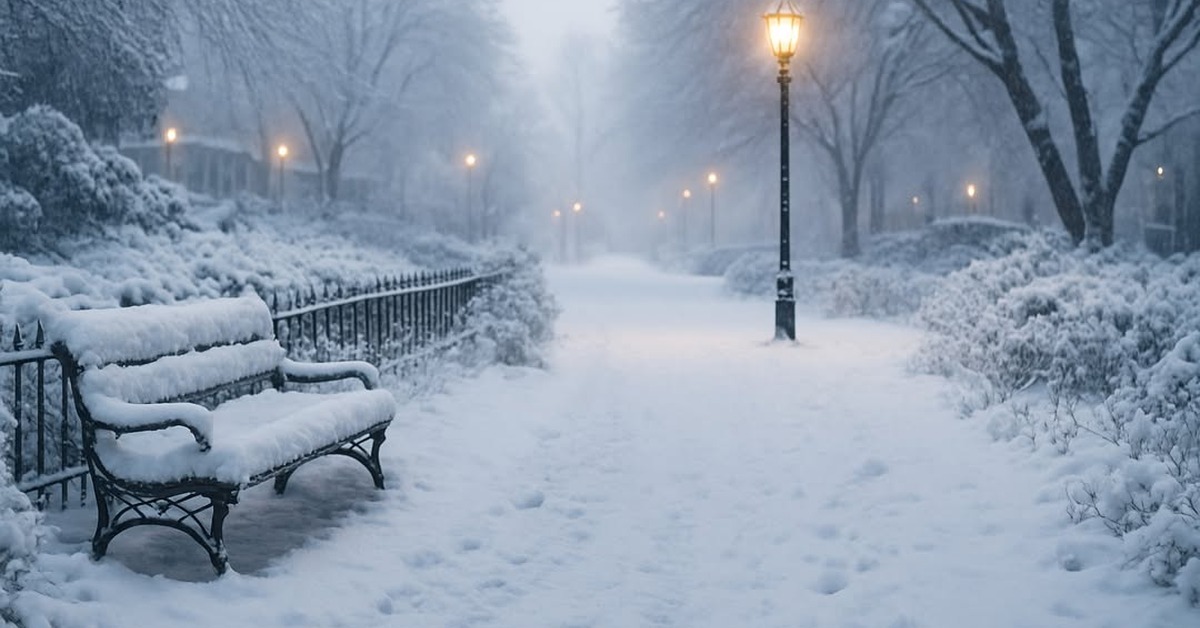
This is why the quietest moment of a winter storm isn’t during the snowfall itself, when falling crystals and wind create their own noise. It’s the hour after the snow stops. Before anyone walks outside. Before the temperature climbs. That window — sometimes as short as ninety minutes — is the peak of a natural acoustic event that most people sleep straight through.

Fresh Snow Sound Absorption and the Science of Urban Quiet
Urban noise is a public health problem of considerable scale. The World Health Organization estimated in 2018 that at least one million healthy life years are lost annually in Western Europe alone due to traffic-related noise exposure — through cardiovascular strain, sleep disruption, and cognitive impairment in children. Cities have invested heavily in noise barriers, low-noise road surfaces, and building insulation. What’s rarely discussed is the seasonal reprieve that winter snowfall provides — and what its loss means as global temperatures rise.
The Swedish Environmental Protection Agency tracked noise complaint data in Stockholm across winter months between 2010 and 2020, and found a statistically significant correlation between low-snow winters and increased reported noise disturbance. The relationship isn’t subtle. It’s measurable on a city scale. Fresh snow sound absorption at the urban level works through accumulation across every horizontal surface simultaneously — roads, pavements, parks, rooftops, vehicle roofs. Each surface, normally reflective, becomes absorbent. Sound that would normally bounce between buildings and amplify through urban canyon geometry instead hits soft snow and dies.
The data left no room for alternative interpretation — and the city planners who reviewed it knew it, yet noise mitigation budgets for the following decade made no mention of snowfall patterns at all.
Residents in Helsinki and Oslo who have lived through both heavy-snow and low-snow winters describe the difference in quality-of-life terms, not just acoustic ones. The quiet feels generous. Restorative. One sound engineer described it as the city briefly remembering what it was before it was built. And then there’s the structural irony: we build noise barriers, design acoustic glass, engineer highways with textured asphalt to reduce tyre noise — and a weather system rolls in overnight and does more in eight hours than any of it.
How It Unfolded
- 1877 — Lord Rayleigh’s foundational work on sound propagation through porous media, published in The Theory of Sound, laid the mathematical groundwork for understanding why materials with high air content absorb acoustic energy.
- 1950s — Postwar road traffic growth drove the first systematic studies of urban noise, with researchers beginning to note the pronounced seasonal variation in ambient sound levels in northern cities.
- 2003 — Norway’s Institute for Snow and Avalanche Research (NGI) published field measurements formally quantifying fresh snowpack’s acoustic absorption coefficients, establishing the scientific baseline for the effect.
- 2015 — Aalto University’s acoustics group demonstrated the rapid decline in snow absorption as snowpack ages, showing that the window of peak acoustic effect is narrower than previously assumed.
By the Numbers
- Up to 60% reduction in perceived ambient noise volume from a deep layer of fresh powder snowfall (NGI field measurements, 2003)
- 90–95% air by volume — the typical composition of freshly fallen powder snowpack, the structural basis of its acoustic properties
- 0.6+ absorption coefficient for fresh snow at mid-range frequencies — comparable to commercial acoustic ceiling tile (Aalto University, 2015)
- 30% decline in snowpack porosity within the first 24 hours under typical mid-latitude winter conditions (Nature Communications, 2020)
- 1 million healthy life years lost annually in Western Europe to traffic noise, a deficit that winter snowfall temporarily and measurably reduces (WHO, 2018)
Field Notes
- In 2003, researchers conducting acoustic measurements in the Norwegian backcountry found that snowpack on a steep slope absorbed sound differently depending on orientation to the wind — leeward accumulations, fluffier and less compacted, outperformed windward snowpack by a factor of nearly two. Deposition geometry matters as much as depth.
- Falling snow itself produces a faint but measurable broadband hiss — not from the flakes hitting surfaces, but from the flakes disturbing air as they fall. The silence after snowfall is partly a contrast effect: your auditory system recalibrates after that sustained soft input.
- Conifer forests experience more dramatic post-snowfall quiet than open ground, because snow caught in the canopy doubles the absorptive surface area above head height, catching sound that would otherwise travel laterally between trunks.
- Turns out researchers still can’t precisely predict how much noise reduction a given snowfall will produce in a real urban environment, because too many variables — wind direction, building geometry, traffic patterns — interact in ways that field models haven’t fully resolved. The gap between lab measurements and street-level reality remains frustratingly wide.
Frequently Asked Questions
Q: How does fresh snow sound absorption compare to man-made acoustic materials?
Fresh powder snow registers absorption coefficients above 0.6 at mid-range frequencies — the range that dominates urban noise. Commercial acoustic foam and ceiling tiles operate in roughly the same range. Engineered materials maintain their properties indefinitely, while fresh snow’s absorption collapses within 24 to 48 hours as crystal metamorphism closes off the air pockets responsible for scattering sound waves. Snow is better at the start and useless by Tuesday.
Q: Why does snow stop absorbing sound once it’s been walked on or partially melted?
The absorption effect depends entirely on the open, porous architecture of freshly fallen ice crystals. When snow is compressed underfoot, those air chambers collapse and the material becomes denser and more acoustically reflective — closer in behaviour to compacted soil than to acoustic foam. Partial melting causes surface water to wick between crystals, filling voids and cementing the structure closed. Refreezing then locks that denser configuration in place. What started as a labyrinth becomes a slab, and sound bounces off it rather than entering it.
Q: Does the depth of snow make a significant difference to how much sound it absorbs?
Yes, but with diminishing returns beyond a certain point. Most of the absorption happens in the top 10 to 15 centimetres of the snowpack, because that’s where sound waves entering from above are most effectively scattered before they can reflect back. Below that depth, the compacting weight of the snow above begins to reduce porosity. Field data from the University of British Columbia suggests that 20 centimetres of fresh powder delivers roughly twice the attenuation of 10 centimetres — but doubling that again to 40 centimetres yields only marginal further benefit. The relationship isn’t perfectly linear.
Editor’s Take — Dr. James Carter
What strikes me most about this story isn’t the physics — impressive as it is. It’s the window. Ninety minutes, sometimes less, between the snow stopping and the world reclaiming its noise. We’ve engineered cities for decades trying to solve urban noise pollution, at enormous expense and with modest results. And then winter hands us a working solution roughly once a month in northern latitudes, and we sleep through it. The question acoustic researchers probably should be asking isn’t just how snow absorbs sound. It’s what a synthetic material with the same properties would be worth.
Snow is a temporary architecture — built molecule by molecule in a cloud, assembled overnight across an entire landscape, and dismantled by a few hours of ordinary sunlight. The silence it creates isn’t a side effect. It’s a physical consequence of geometry so precise that engineers still can’t match it reliably. Somewhere right now, in Stockholm or Sapporo or a pine forest in Quebec, that window is open. The snow has stopped falling. The world has gone quiet. And almost everyone inside it is asleep.


