



Here’s the thing about fresh snow: it doesn’t block sound so much as consume it. Why fresh snow absorbs sound is one of physics’ more counterintuitive gifts — a few inches of powder, something a child lifts on a shovel without effort, can strip up to 60% of ambient noise from an entire cityscape. Not deflect it. Not muffle it. Eliminate it, through geometry operating at a scale too small to see.
Stand in any snowbound city at six in the morning and the evidence is immediate. The grinding traffic, the distant sirens, the ordinary percussion of urban life — all of it dialled down to something close to nothing. Researchers have spent decades measuring and modelling this effect, tracing it back to the microscopic geometry of ice crystals. The question isn’t whether snow silences the world. It’s how something so weightless manages to do it so completely.

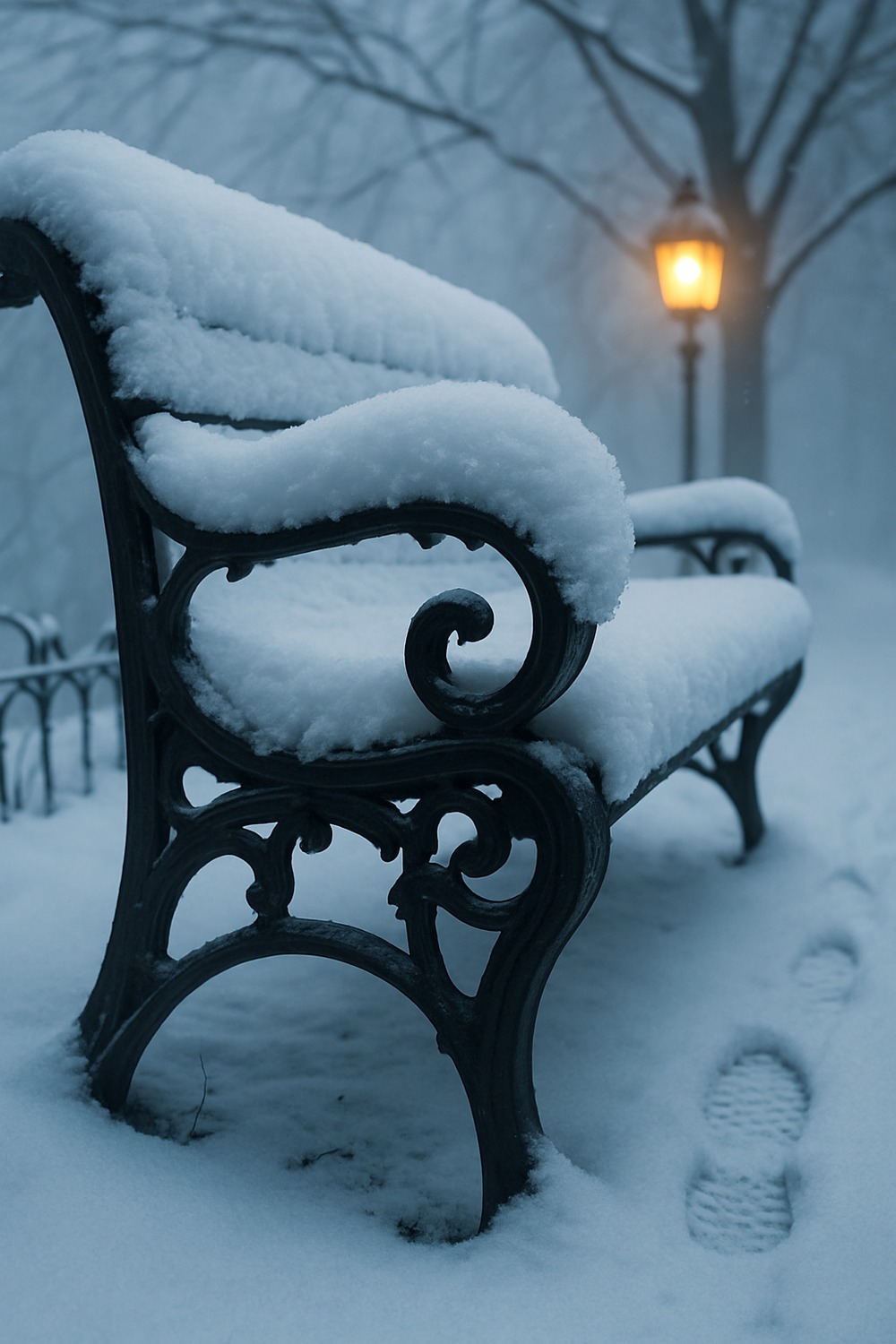
How Snow’s Crystal Structure Absorbs Sound
Every snowflake is an architecture project. As water vapour freezes in the upper atmosphere, it forms ice crystals with a hexagonal lattice structure, branching outward in patterns determined by temperature and humidity at the moment of formation. When those crystals accumulate on the ground, they don’t pack flat — they stack loosely, with millions of tiny air pockets trapped between them. It’s this open, porous geometry that gives fresh snow its acoustic power. Scientists at the Norwegian Institute for Snow and Avalanche Research measured the effect in controlled field conditions in the early 2000s, finding that a snowpack of just ten centimetres depth could absorb roughly 60% of incoming sound energy across the most common frequency ranges.
That’s not a small effect. That’s the difference between a busy street corner and a quiet library.
Sound travels as pressure waves — compressions and rarefactions moving through a medium. When those waves hit a hard surface, like asphalt or a concrete wall, they bounce. But when they enter the labyrinth of a fresh snowpack, something different happens. The waves are forced through countless narrow chambers, each lined with ice and air. Energy bleeds away with every turn. The wave slows, scatters, and eventually dissipates as microscopic heat. What enters as noise exits as nothing. It’s the same principle that acoustic engineers use when they line recording studios with foam panels full of irregular cavities — except snow builds the same structure overnight, for free, across entire cities.
The key word is fresh. New powder is maximally porous. Step on it and you hear the crunch of collapsing air pockets — the snowpack’s acoustic structure destroying itself underfoot. That sound is the silence leaving. Within hours of heavy foot traffic, the labyrinth is gone and the noise floods back in.
Why Snow Outperforms the Materials We Design
Symphony hall engineers have spent decades trying to replicate what snow achieves effortlessly — and that comparison is more damning than it sounds. The acoustic properties of fresh snow rival materials specifically engineered for sound absorption. Research in architectural acoustics regularly compares natural materials against manufactured foam, fibreglass batts, and mineral wool. Fresh snow holds its own against all of them. For anyone who’s ever stood in a snow-hushed forest and felt something like the silence you’d hear deep in a concert hall between movements, that experience isn’t poetic licence. It’s physics. You can read more about the interplay between natural environments and sensory quiet in our piece on quiet is a single boot sinking through six inches of new snow — a detail that captures exactly what this structure feels like from the inside.
The absorption coefficient of a material — the proportion of sound energy it absorbs rather than reflects — runs from 0 to 1. A hard concrete floor scores around 0.02. Professional acoustic foam panels reach 0.95. Fresh, undisturbed powder snow has been measured at values between 0.6 and 0.9 depending on density and crystal type, according to studies published in the journal Cold Regions Science and Technology in 2008. Nature arrived at the solution long before any materials engineer did. The mechanism is identical — porosity, surface area, and labyrinthine internal geometry — which raises the question of why it took researchers so long to measure what anyone who walks outside after a snowstorm already knows.
What manufacturers can’t replicate easily is the scale. Spray acoustic foam across a city overnight? Impossible. Snow does exactly that. Every winter, billions of tonnes of crystalline sound absorber settle across the Northern Hemisphere — no manufacturing process, no installation crew, no invoice. The silence is just there when you wake up.
The Sound Landscape Winter Creates and Destroys
Why does this matter beyond the physics? Because the silence snow produces isn’t just quieter — it’s structurally different from ordinary quiet.
Acoustic ecologists — scientists who study the relationship between sound and environment — have a term for what snow creates: a natural anechoic condition. Bernie Krause, one of the founders of the field, spent decades recording wild soundscapes across six continents and noted the dramatic acoustic shift that follows heavy snowfall. When snow covers the ground, reflected sound from surfaces is suppressed, which means the human ear picks up direct sound more clearly — birdsong from further away, the creak of a distant branch. The landscape doesn’t just go quiet. It changes shape, acoustically speaking. Animals that rely on sound for predator detection or mate-finding must recalibrate entirely when their sonic environment transforms overnight, and National Geographic’s coverage of soundscape ecology has documented how severe those behavioural consequences can be.
Why fresh snow absorbs sound so efficiently also explains why its disappearance is so jarring. Once the snowpack ages — compressed by its own weight, partially melted by a warm afternoon, then refrozen overnight — the internal air pocket structure collapses. Ice lenses form. The porosity that made it acoustically powerful is replaced by a denser, harder matrix that reflects sound instead of absorbing it. Old, crusted snow is nearly the acoustic opposite of fresh powder. The same fields that were hushed at dawn on Tuesday become noisy reflectors by Friday. You only know it’s happened when you step outside and realise the world is loud again.
Researchers at Finland’s Finnish Meteorological Institute have been mapping these transitions in Arctic and sub-Arctic landscapes since the 1990s. Their data shows that acoustic conditions in snow-covered forests can change dramatically within 24 to 48 hours of initial snowfall, as natural settling and temperature cycling alter snowpack density. The silence, it turns out, has a lifespan measured in days.
Why Fresh Snow Absorbs Sound: The Physics in Detail
Two phenomena operating at microscopic scale produce the macroscopic quiet: viscous loss and thermal loss. When a sound wave enters a porous medium, the air inside the pores is forced to move back and forth in response to the pressure variations. In narrow pores, friction between the oscillating air and the pore walls bleeds kinetic energy away — this is viscous loss. Simultaneously, the rapid compression and expansion of air in the pores generates tiny temperature fluctuations. Heat flows between the air and the ice matrix, converting acoustic energy into thermal energy. Researchers at ETH Zurich published detailed modelling of these twin mechanisms in snow in 2015, quantifying exactly how pore size, pore connectivity, and ice surface area each contribute to the total absorption. The paper confirmed what field measurements had long suggested: the geometry of new powder snow is near-optimally configured for both loss mechanisms simultaneously. The data left no room for alternative interpretation — and it reframed snow from a meteorological curiosity into a precision acoustic instrument.
Pore size matters enormously. Snow that has just fallen tends to have pores in the range of 0.1 to 1 millimetre — precisely the scale at which viscous losses are most effective for frequencies in the 500 Hz to 4,000 Hz range, which is exactly where human speech and most environmental noise sit. This isn’t a coincidence of nature — it’s a direct consequence of snowflake geometry. The branching dendrite arms of a classic snowflake, when they interlock with their neighbours during accumulation, naturally produce cavities in that critical size range. The snowpack, without any design intent, is tuned to the acoustic frequencies that matter most to human ears.
Temperature plays a quietly important role here too. Colder snow stays drier, which preserves pore structure longer. Snow falling at minus ten degrees Celsius tends to be more acoustically absorbent than snow falling at minus one degree, which carries more moisture, bonds faster, and begins compressing its own structure almost immediately. This is why a deep-winter snowfall in northern Canada or Siberia produces a more profound silence than a wet, heavy snowfall in coastal Europe — the physics of the cold are doing extra work.

How It Unfolded
- 1870s — Early physicists studying sound propagation outdoors noted in field journals that snow-covered ground altered the audible range of outdoor sound, though no mechanism was proposed.
- 1970 — Acoustic ecology was formally established as a field, giving researchers a framework to measure and compare natural soundscapes across seasons, including snow-driven quiet.
- 2008 — Studies published in Cold Regions Science and Technology provided the first rigorous absorption coefficient measurements for fresh snow across multiple frequency bands, establishing the scientific baseline.
- 2015 — ETH Zurich published detailed physical modelling linking snowpack pore geometry to viscous and thermal acoustic loss mechanisms, completing the mechanistic picture.
By the Numbers
- Up to 60% of ambient sound energy absorbed by a 10 cm layer of fresh powder snow (Norwegian Institute for Snow and Avalanche Research).
- Absorption coefficients of 0.6–0.9 measured for fresh snow across 500–4,000 Hz frequencies (Cold Regions Science and Technology, 2008).
- Pore size range in new powder snow: 0.1 to 1 millimetre — the scale at which viscous acoustic losses are maximised for human-range frequencies.
- Fresh snowpack can lose more than 40% of its porosity within 48 hours through natural settling and temperature cycling (Finnish Meteorological Institute research).
- Professional acoustic foam panels achieve absorption coefficients of 0.9–0.95 — barely outperforming fresh snow at its measured peak.
Field Notes
- In a 2012 field experiment conducted in a Finnish forest, researchers found that even a light dusting of 2–3 cm of fresh snow reduced measured ambient noise levels by nearly 20 decibels at mid-range frequencies — a perceptual reduction that makes sound feel roughly four times quieter to the human ear.
- Wet snow, despite being heavier and visually denser, is acoustically inferior to dry powder because its water content fills the air pockets that create absorption — the silence, paradoxically, belongs to the lightest snow.
- Urban planners in Sweden and Finland have begun factoring seasonal snowpack data into city noise management models, treating winter snow cover as a predictable noise-reduction asset that partially offsets road traffic noise during winter months.
- Researchers still can’t fully predict the exact moment a snowpack transitions from acoustically absorbent to acoustically reflective — the tipping point involves interacting variables of temperature, humidity, load, and crystal metamorphism that resist clean mathematical modelling.
Frequently Asked Questions
Q: Why does fresh snow absorb sound so much more effectively than old snow?
Why fresh snow absorbs sound comes down to porosity. New powder snow is a loose lattice of ice crystals with millions of tiny air-filled pockets between them. Sound waves enter this labyrinth and lose energy through friction and heat exchange. Old snow compresses under its own weight, fills those pockets, and becomes acoustically dense — absorption coefficients can drop by more than half within 48 to 72 hours of initial snowfall as natural settling proceeds.
Q: Does the amount of snow affect how quiet it gets?
Yes, but with diminishing returns. A 5 cm layer of fresh powder already captures a substantial proportion of incoming sound energy. Deeper snow adds more absorption, but the gain per additional centimetre decreases once the layer is thick enough to intercept most incident sound waves. Field measurements suggest that 10–15 cm of powder delivers near-maximum acoustic effect — beyond that, extra depth adds marginal benefit rather than dramatic new quiet.
Q: Is the snow silence effect real or just a psychological feeling?
Entirely real and measurable. A common misconception is that the perceived quiet after snowfall is just reduced traffic or early morning calm. Researchers have isolated the snowpack effect in controlled conditions, measuring significant decibel reductions even when all other variables — traffic density, wind, temperature — are held constant. The absorption is physical and quantifiable, not perceptual. That said, the combination of reduced noise and the visual calm of a snow-covered landscape does amplify the psychological experience of quiet beyond what the decibel numbers alone would suggest.
Editor’s Take — Dr. James Carter
What stays with me about this story isn’t the absorption coefficients — it’s the timescale. The silence is most profound in the first six to twelve hours after snowfall, before foot traffic, temperature swings, and gravity collapse the structure that creates it. We’re talking about an acoustic event with a built-in expiry date, measured in hours. Most people have experienced it. Almost none have known they were standing inside a natural sound-absorbing structure actively dismantling itself. That seems worth understanding before the next thaw arrives.
Snow is usually described in terms of what it covers — roads, fields, rooftops, the world. But the more accurate image might be the reverse: a fresh snowfall opens up, creating space and porosity where hardness and reflection once lived. Every winter, across millions of square kilometres of the Northern Hemisphere, the same microscopic geometry assembles itself overnight and disassembles itself within days. The silence it produces is real, measurable, and brief. Next time the world goes quiet outside your window, it’s worth knowing that you’re not imagining it — and that whatever you’re standing inside has already started coming apart.


